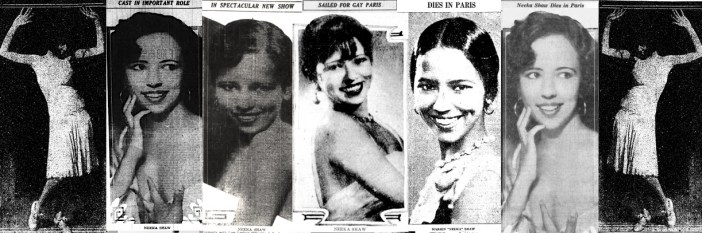
Neeka Shaw? Neeka Shaw? Why, she’s our own dimpled, laughing-eyed, curly-haired darling!
Over the past year and a half, research has found me scanning through online databases of the many African-American newspapers of the 1920’s and 30’s. There I became familiar with Neeka Shaw, a glamorous and ultimately tragic showgirl who garnered considerable press coverage at the time. This was due in part to her pleasing promotional photos, which publishers found to be a welcome addition to their newspaper layouts, but also because the talented young Broadway performer was profiled as a “home town girl” in news outlets from Richmond to the Windy City.

From the Pittsburgh Courier, 2/23/1929:
Yes, our little youngster has left “we Quakerites” to enter the theatrical firmament, and if she is accorded the same favoritism which was manifested toward her during her school career, stardom will be hers in the not too remote future! For she is chock-full of all the winsome personality ever possessed by aspirants who “make good.” Already she is a “principal.”
Outside of these 90 year-old news stories, there was virtually no mention of the “clever and charming soubrette” who dazzled audiences from New York to Paris in the 1930’s.
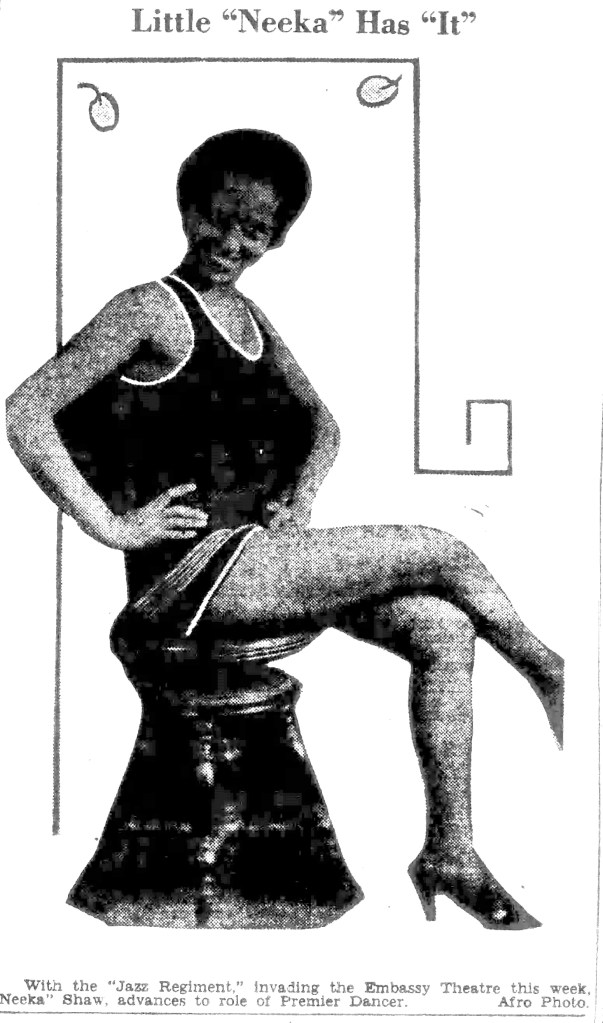
Born in Richmond, Virginia on May 19, 1911 – the day after Haley’s Comet, her publicist would later point out – Neeka was the middle child of Wilton and Frances Shaw, who initially raised their family just outside of Philadelphia. When Neeka was in her early teens, the family moved to Chicago, where she graduated from Wendell Phillips High School at age 15. Neeka attended one year of college before directing her attention towards her burgeoning performance career. She headed to New York with a friend and soon garnered a contract with renowned producer Henry Creamer.
At 18 years old, Neeka made her Broadway debut in a Creamer production titled Deep Harlem, an “all negro musical comedy” that both opened and closed in the second week of January, 1929. Although reviews were poor, Billboard did praise her excellent dancing.
The following month she was on the road with another Creamer production: The Jazz Regiment, a musical revue that enjoyed an extended run at Philadelphia’s Gibson (Standard) Theater on South Street. The show moved on to Washington D.C. and Baltimore, where The Afro-American review of the show highlighted Neeka’s “feminine pulchritude” and noted that she danced and sang “with that abandon that has been the mark in trade of race musicals.”
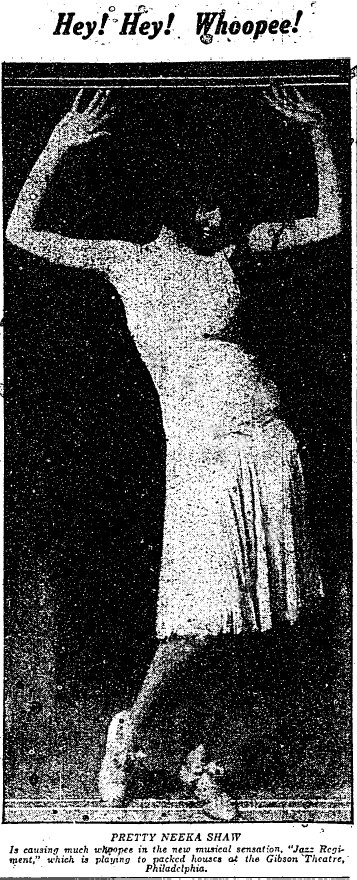


Neeka’s exotic looks were attributed to a mixed lineage of African/Mexican/Native American ancestry. The Afro-American ran a brief anecdote highlighting Neeka’s ability to “pass” for a Spanish dancer while working in New York. She was also said to have inspired one of the main characters in Vera Caspery’s popular 1929 novel The White Girl, about a dancer of color who passes for white.

In December, 1929 Neeka was working in the Jungle Drums review at The Plantation Club, a private night spot that competed with The Cotton Club for the attention of wealthy New Yorkers eager to venture up to Harlem. This engagement led her back to Broadway in June of 1930, where she played Josephine Peppers in the musical comedy Change Your Luck. Reviews of the show were scathing although the performers were complemented for their efforts to overcome the lackluster material. The show closed after two weeks.

A reboot of Lew Leslie’s 1928 Broadway hit Blackbirds was Neeka’s next stop. The 1930 edition of this “all-colored revue” starred Ethel Waters and the vaudeville team of Buck and Bubbles. Neeka had two new Eubie Blake songs to introduce to the world: “Lucky To Me” and “Cabin Door.” After successful stints at The Majestic Theater in Brooklyn and The Lyric in Boston, Blackbirds landed at Broadway’s Royale Theater on October 22, 1930. While Ethel Waters received rave notices, reviews for the show itself were tepid. The show closed in December, with a regional tour booked through March of 1931. However, Neeka left the production in Philadelphia a few weeks later, following other headliners (including Buck and Bubbles). Mr. Lesley reportedly was not forthcoming with several weeks of back pay.

Neeka’s next employment was in Singin’ the Blues, another musical revue that played in Atlantic City and Brooklyn but failed to make it to Broadway.
The autumn of 1931 brought Fast and Furious, which would prove to be Neeka’s last Broadway credit.
A fellow named Floyd G. Snelson was pulling double (or triple) duty at this time: working as a New York-based columnist/theater critic for the Pittsburgh Courier. Elsewhere in the same newspaper, one can find an advertisement for his publicity agency, with Neeka Shaw listed as one of his clients.
He writes of Neeka in his September 26, 1931 “Broadway Bound” column:
She is small in stature, weighs 110 pounds and has two lovely dimples in her cheeks. She is 21 years old and has as great a portion of the proverbial “IT” as any artist in the profession. She maintains an apartment at 80 St. Nicholas Avenue, where she resides with her mother.

On the same page of the newspaper is Snelson’s review of Fast And Furious, titled “Not As Hot As Its Name.” His review spares Neeka, writing “The diminutive pretty brownskin baby-faced soubrette… gets off nicely with the hit song of the piece ‘Walking On Air’…”
Although this appears to be a conflict of interest for Snelson, his review is in line with those in other outlets. Billboard‘s coverage began; “It is this corner’s unpleasant duty to report that Fast and Furious… was neither of those things.” However Neeka is described as “delightfully charming.”
Another standout performance noted amongst the poor reviews was a young comedienne named Jackie Mabley, long before she had adopted her “Moms” persona.
Fast and Furious closed by the end of the week.
In a Billboard wrap-up of the year 1931, columnist Eugene Burr offers “good will and thank yous… to various players who, by excellent acting and sterling performances, have made a bit easier the entirely thankless task of play reviewing.” He offers thanks “to Neeka Shaw, a charming little tan-skin sprite who did what she could in Fast and Furious, a revue that completely failed to live up to its title.”
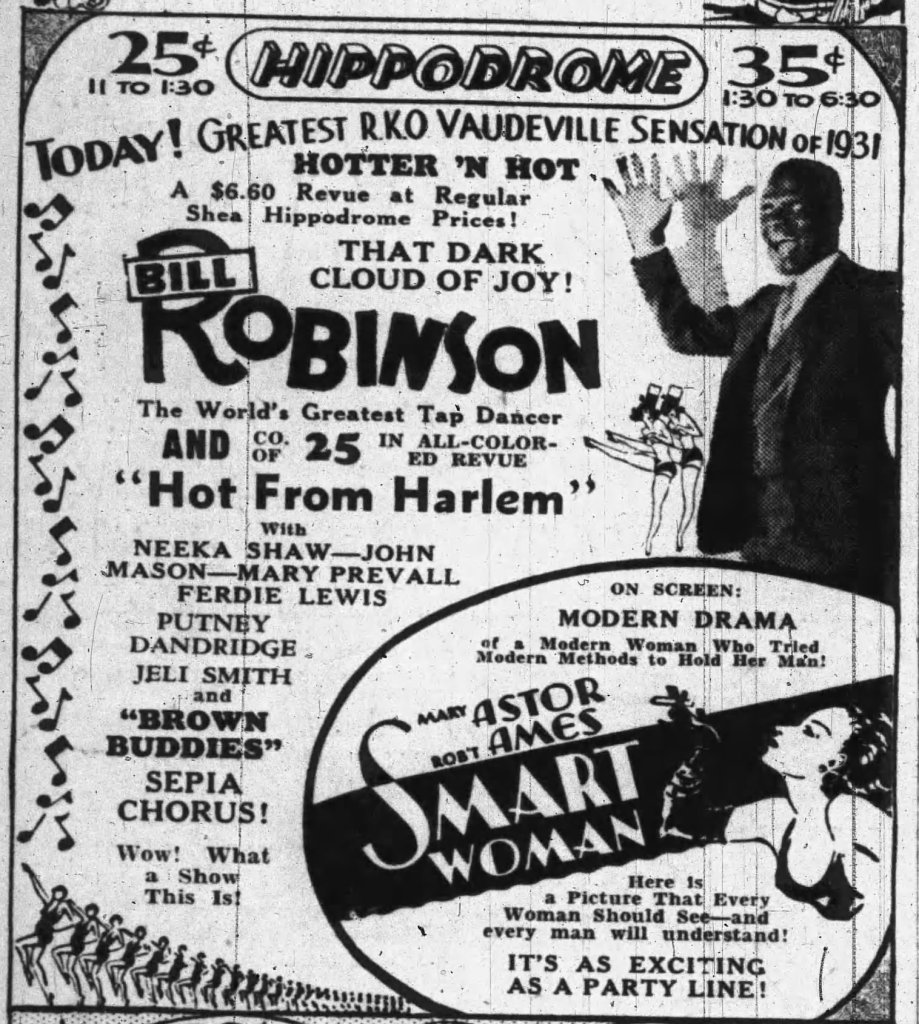
By that time, Neeka had been on the road for several months with Bill “Bojangles” Robinson’s Hot From Harlem revue. Neeka once again received special recognition, with a notice from Washington D.C.’s Howard Theater engagement stating “Neeka Shaw, demure tiny star of Harlem, was the big reason for the success of Bojangles’ show…”
1932 brought another middling revue, Harlem Scandals, which played the same Philadelphia/Atlantic City/Brooklyn circuit as her previous shows, but it did not transfer to Broadway. She was back with Bojangles’ Hot From Harlem review in the spring, but it had all been done before, and Neeka needed to make a change.

On June 3rd, 1932 Neeka sailed for Paris on the Ile de France, where she was engaged for 10 weeks at the legendary café society nightclub Chez Bricktop. This booking was followed by an extended stint at the fashionable Chez Florence, a nighclub named for American jazz singer/dancer Florence Embry Jones.
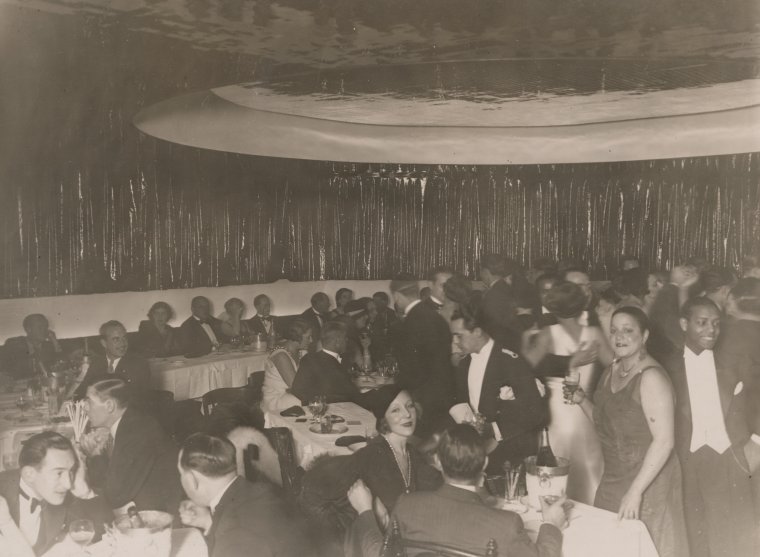
In a Chicago Defender feature that ran exactly one year after Neeka’s departure for Paris, reporter Edgar Wiggins took readers on a tour of “High Spots in Famous Montmartre”:
“We shall cross to the opposite side of Rue Fontaine, now from Boudon’s cafe. Immediately we are in front of the Melody’s Bar, which in reality is the most popular night club in Monmartre. Dainty little Neeka Shaw, who has been entertaining there for the past three months, is still enjoying a wonderful success.”
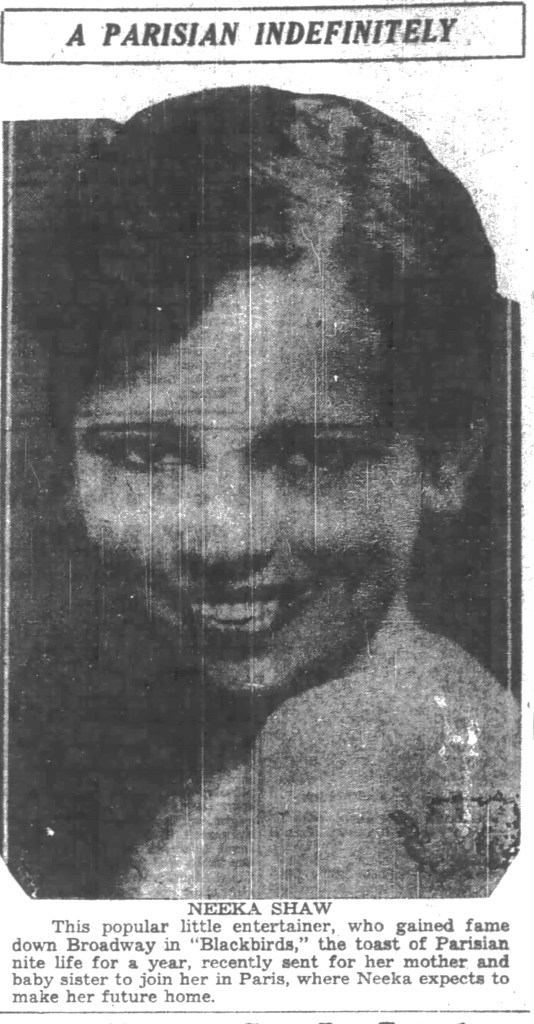
The following month, the Pittsburgh Courier reported that Neeka would be staying in Paris indefinitely and had sent for her mother Frances, older brother Wilton, and younger sister Theda to join her. In December she opened her own cabaret on Rue Pigalle called Hot Feet.
In his memoir Trumpet Story, Bill Coleman fondly recalls jamming at Hot Feet with resident pianist Freddie Johnson and trumpeter Arthur Briggs.
Hot Feet lasted just six months and the Shaw family then returned to the U.S. Neeka remained in Paris and would go on to charm audiences with an engagement at Le Grande Ecarte as well as return appearances at Melody’s Bar and Chez Florence.
In May of 1935, Neeka ventured to London to make her West End debut in the musical comedy Gay Deceivers with Charlotte Greenwood and Clair Luce. She garnered several favorable mentions, with The Stage noting that “Neeka Shaw makes Bedelia, a native girl, stand out prominently.”
Neeka closed out 1935 with a month-long engagement alongside Harry Watkins at Berlin’s Dschungel (Jungle) Bar. In a Chicago Defender column that does not age well, Edgar Wiggins writes “Despite all uncomplimentary rumors of the Nazi regime, both entertainers claim to have been treated wonderfully in the German capital and their entertainment highly appreciated.”
Unfortunately, little Neeka would not live to see how that story played out.
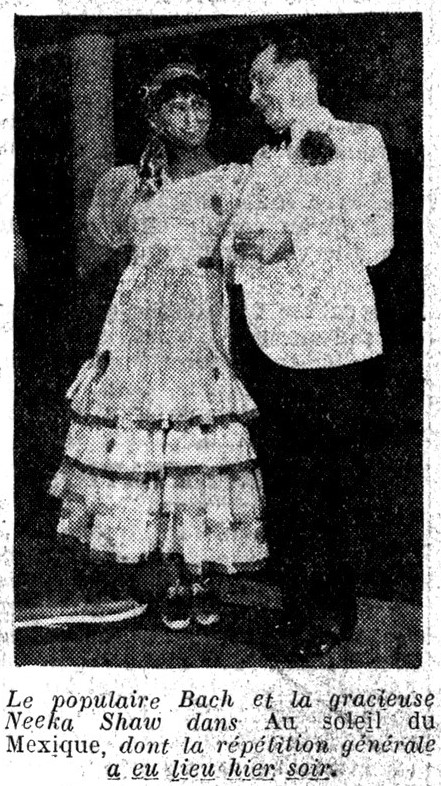
Back in Gay Paree, Neeka was cast as Kokolani in the premiere production of the operetta Au Soleil du Mexique (In The Mexican Sun). The show was a critical success and ran for 232 performances through September, 1936. She then returned to the U.S. for a three month trip to visit her family.
Upon her return to Paris, Neeka became “a great favorite at the (legendary cabaret) Boeuf-sur-le-Toit” as reported by Langston Hughes in The Afro-American.

On February 12, 1938, Billy Rowe’s Harlem Notebook reported “Neeka Shaw is in a serious condition in Europe. She’s suffering from T.B. and other ills which doctors report are too far gone to be cured.”
No other ailments were ever named – it is likely that the columnist was trying to be tactful, given the stigma that tuberculosis still carried at the time. The Chicago Defender would later report that “examining medical authorities adjudged her case as ‘helpless’, resulting from improper medical treatment for more than three years, and gave her ‘three weeks at the most’ to live. Her determination and will to live forestalled death for ten weeks.”
Frances Shaw rushed from New York to Paris and reached her daughter’s bedside several days before she died on April 30th – three weeks shy of her 27th birthday. The Chicago Defender painted a cinematic tableau:
“… she was conscious of everything, recognized her mother, conversed happily with her, laughed and spoke of her expected recovery. Neeka’s gay and uncompromising spirit – in view of her predicament – elicited profound admiration from all her many friends and acquaintances who visited her private ward, which was always filled with flowers, fruits, champagne and other gifts. Neeka was always cheerful and high-spirited and even when the end came, she met it with a smile.”
The California Eagle carried an obituary, noting “And so, Paris has added another name to the long list of its victims from the ranks of Negro performers. Two months ago, Raymond Thomas, one of the dancing ‘Cracker Jacks’ died at the American Hospital. Others who have succumbed in recent years are Joe Caulk, Strut Payne, and Johnny Dunn.”

Neeka was cremated, as per her wishes. Frances Shaw intended to bring her daughter’s remains back to New York for interment. She soon discovered that the steamship lines charge to transport an urn of ashes at the same cost as though Neeka was alive, or if the body was in a casket. Unable to pay another 5,000 francs to return home, Mrs. Shaw had no choice but to have her daughter interred in Paris.
In 1941, Neeka’s name once again appeared in newspapers when her beloved younger sister Theda died in New York City at the age of 18. In his Harlem Notebook column, Billy Rowe wrote:
“Notwithstanding that throughout the world death for all those who are innocent and young seems to be the order of the day and things to come, the seemingly untimely end of a girl who left the span of her life still unfinished is not without its deep sadness…“

See also:
The Mysterious Midge Williams
Madame Spivy’s Alley Cat
Madame Spivy’s Tarantella
The Christmas In Connecticut Delivery Woman
Etta James: Advertising Zombie
No More Chicken Pepperoni: RIP Yvonne Wilder
Artist’s Muse: José “Pete” Martinez
The Yale Posture Photos: Bill Hinnant
 Brian Ferrari's Blog
2 thoughts on “Neeka Shaw: The Forgotten Showgirl”