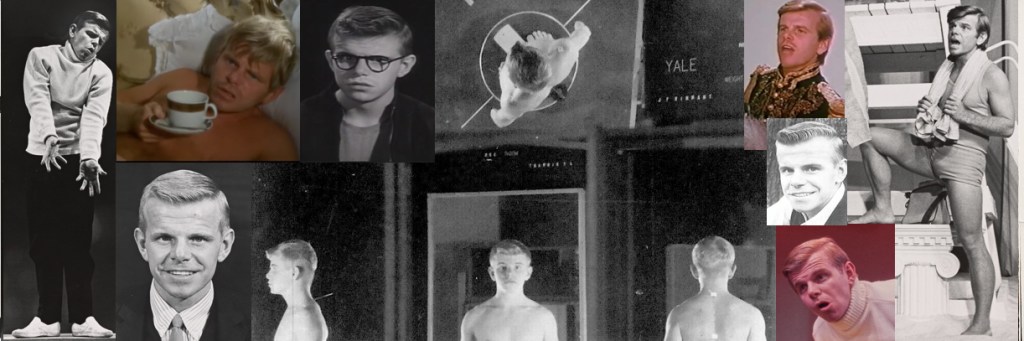
The Yale Posture Photos: Bill Hinnant

Up until recent years, the fabled Ivy League nude posture photos have been written about but seldom seen. Starting in the mid-1930’s and continuing on until the 1970’s, incoming Ivy League University students were photographed fully nude in order to gauge their posture, detect scoliosis, and address other correctable body issues while simultaneously inflicting emotional scarring on the participants. Talk show host Dick Cavett joked about it in his early stand-up routines:

“Some guys hated it… some seemed to enjoy it. One guy tried to go through twice… one guy fainted… one guy tried to buy his pictures… and one guy tried to get his retouched.”

50 years later, he penned a New York Times Op Ed piece with a much darker view of the experience.

In recent years, the posture photos from Yale have garnered the most press, with tongues wagging at the possibilities of seeing our country’s best and brightest in the buff. The pics were so rare that most articles on the subject did not actually feature any of the images, opting instead to use medical textbook illustrations or military posture photos.

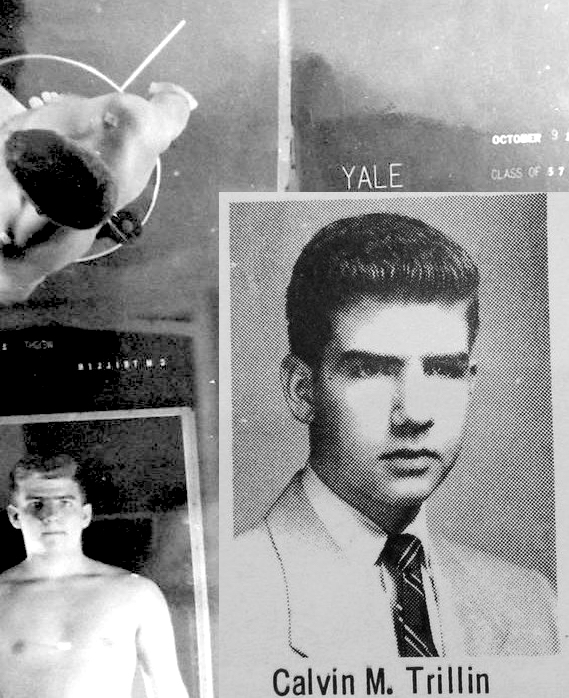
Since 2020, a steady stream of posture photos featuring male freshman Yalies from 1937-1960 have sold on eBay. It was really only a matter of time before some familiar faces began to pop up. I posted about writer Calvin Trillin‘s photo, which went for a little over $100, while the pic of late actor James Franciscus pulled in $1,225.

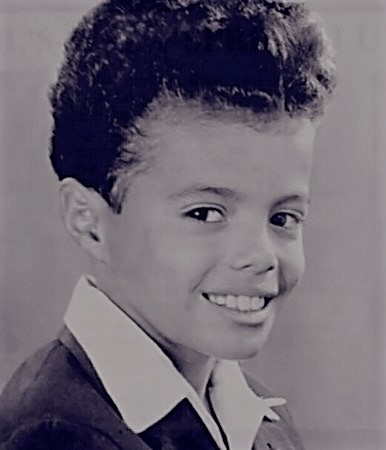
These pics now regularly sell for close to $1,000 each. Earlier this month, actor Bill Hinnant’s photo went for a whopping $1,600.

Chalk one up to eBay for their ever-changing goalposts of propriety. When James Franciscus’ Yale photo went up for auction in 2021, full nudity was prohibited in auction photos. What we were left with was a modesty strip applied by the seller to prevent us from viewing the full Franciscus. Now eBay requires that auctions selling nude photos actually show the goods – to insure that the subject isn’t too…erm… excited to be there. Dean Martin’s dong was covered with a post-it, but now it’s ok to see Bill’s Hinnant:

Hinnant was still known by his birth name of John F. Hinnant, Jr. when he arrived at Yale in the Fall of 1953. Originally from Chincoteague Island, Virginia, he had spent two summers as an apprentice at Ogunquit Playhouse in Maine. He made his professional debut there playing Barbara Cook’s son in Carousel. He also appeared in Life With Mother starring the legendary Billie (Glinda the Good Witch) Burke.

Following his sophomore year, Bill departed Yale when he won the role of Lt. Cover in the original cast of the comedy No Time For Sergeants starring Andy Griffith. After a year and a half on Broadway, Hinnant returned to Yale to complete his degree alongside his younger brother, Skip, who was also an actor.

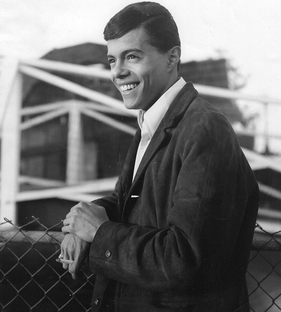
In 1957, Bill Hinnant co-starred with former Yale classmate James Franciscus in the noir film Four Boys And A Gun:

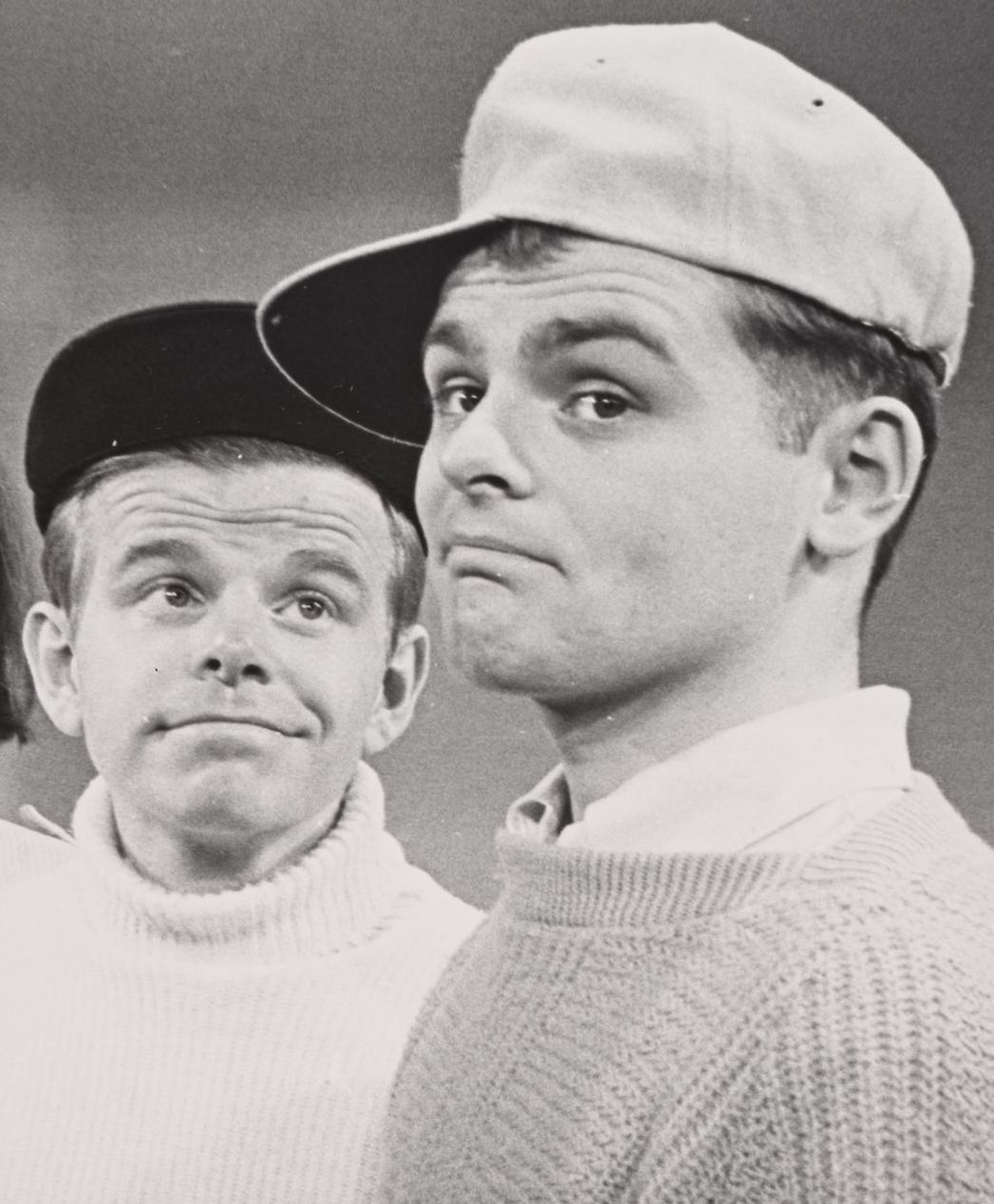
Standing just 5’2″, his stature was usually noted in press articles. “Pintsized blond Hinnant has a full-sized talent!” crowed a 1965 Variety review.

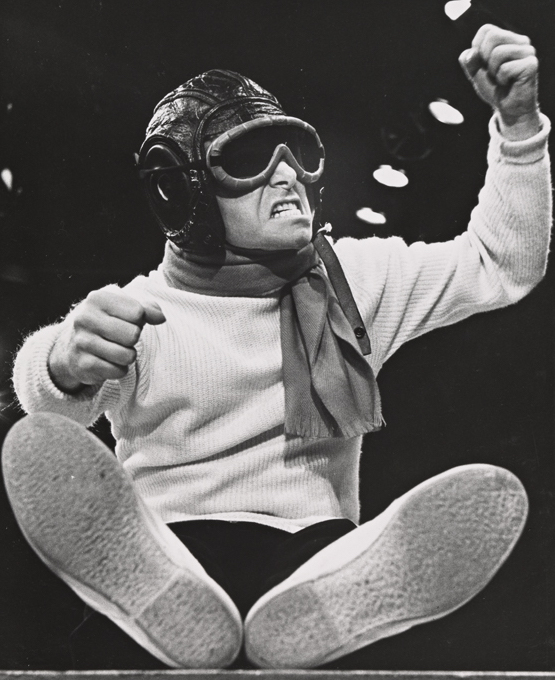
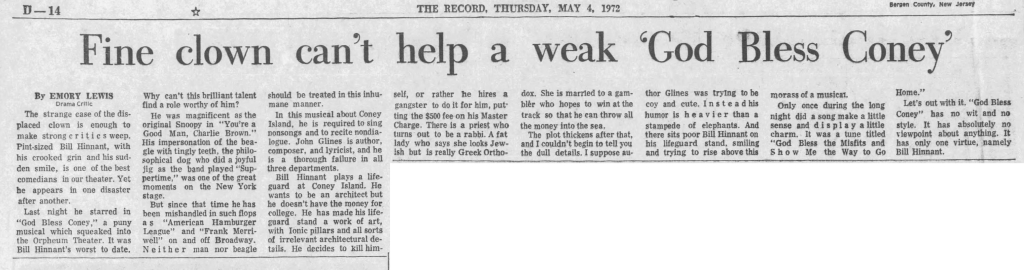
Most of his notices were similar to Variety’s take on the 1963 off-Broadway musical Put It In Writing: “Far from memorable but featuring good work by Bill Hinnant.” This was a theme throughout his career, as he received favorable reviews in forgotten musicals that would close on the road (Maltby & Shire’s Love Match), on opening night (The American Hamburger League, Frank Merriwell), or after a handful of performances (All Kinds Of Giants, God Bless Coney). He guested on television shows ranging from Route 66 and Naked City to sitcoms like Pete & Gladys and Karen Valentine’s self-titled show.

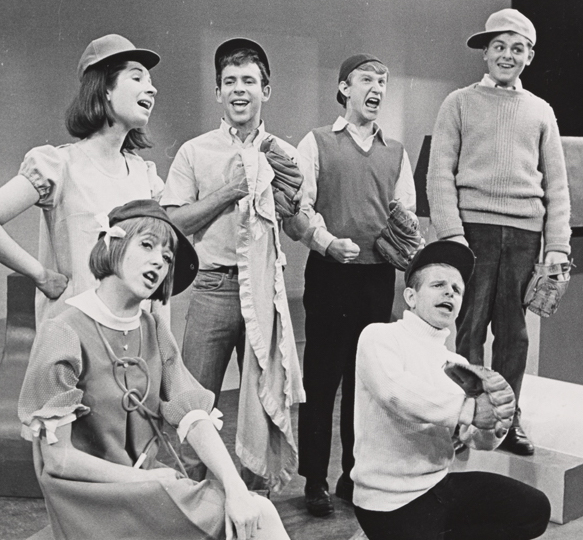
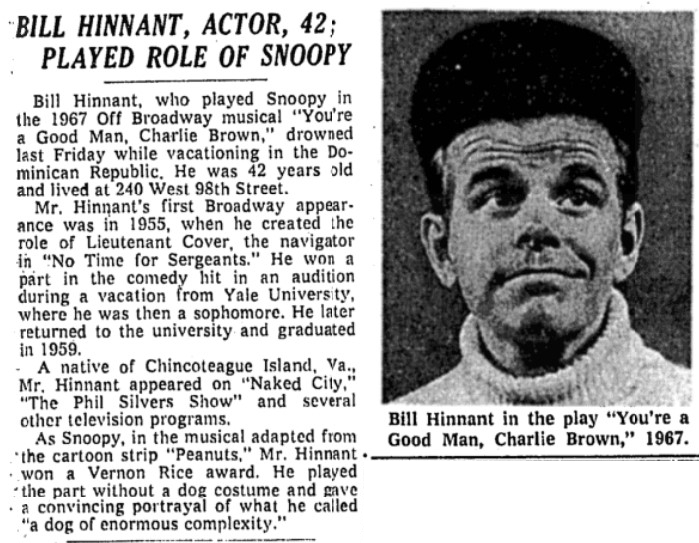
He found his defining role in 1967 when he was cast as Snoopy in the original production of You’re A Good Man, Charlie Brown. The cast included Gary “Radar” Burghoff in the title role, Bob Balaban as Linus and his younger brother Skip Hinnant playing Schroeder. Bill’s scene-stealing Snoopy is still considered to be the definitive interpretation of the role. His performance on the original cast recording is a blueprint for anyone tackling the part. He was awarded a Drama Desk Award for his performance later that year.

In 1969, Hinnant appeared in the film A Nice Girl Like Me with Barbara Ferris:

After a successful run with Charlie Brown, he was still plagued with subpar material- a fact that didn’t go unnoticed by critics:

Even when the material was up to snuff, there were other issues to contend with:

Hinnant reprised his role as Snoopy in a 1973 television adaption of You’re A Good Man, Charlie Brown. This cast featured Wendell Burton as Charlie Brown and My Three Sons actor Barry Livingston as Linus.

Unfortunately The Bill Hinnant Story does not have a happy ending. On February 17th, 1978, Hinnant drowned while vacationing in the Dominican Republic. He was just 42 years old. The Record noted that “the beige-haired, digest-sized and personable bachelor” was very active in charities for the underprivileged and had adopted several children worldwide through the Foster Parents Plan.

Bill Hinnant is interred (as John F. Bill Hinnant Jr.) at Dulaney Valley Memorial Gardens in Timonium, Maryland.

New York Times, (2/24/78)


See also:
The Yale Posture Photos: James Franciscus

Kenn Duncan After Dark
More Dean Martin & Jerry Lewis Shower Pics Surface
Men of St.Mary’s Pre-Flight School
Boys of Summer: St. Mary’s Pre-Flight School
Christmas At St. Mary’s Pre-Flight School, Pt. I
Christmas At St. Mary’s Pre-Flight School, Pt. II
80 Years Ago: The Men of St. Mary’s Pre-Flight School
More Men of St. Mary’s Pre-Flight School
1944: The Men of St. Mary’s Pre-Flight School

¿Dónde Está Santa Claus (& Augie Rios)?

When I was a child in the 1970’s, one of my favorite pastimes was playing my parents’ old discarded 45s on my Fisher Price record player. One single that received considerable airplay was a Christmas record by Augie Rios called “Ol’ Fatso,” which featured a sassy child giving Santa Claus a hard time with the repetitive chorus of “Don’t care who you are Ol’ Fatso / keep those reindeer off the roof.” What’s not to love?

The flip side of this blue Metro 45 with the lion on the label was another Christmas song: “¿Dónde Está Santa Claus?” I would later learn that this was actually the “a” side of the record. At that age, I had to rely upon my own underdeveloped musical tastes to figure out which side was the hit. For this reason, I am still partial to Dusty Springfield’s self-penned b-side “Something Special” over the faux-Spector bombast of “Stay Awhile.”

As you can imagine, the rather un-PC “Ol Fatso” does not get covered a whole lot. Or at all. “¿Dónde Está Santa Claus?” on the other hand, has some other versions that have become favorites of mine.

Toni Stante (aka Antoinette Binastante) released a version on the Parkway label in 1965. This single has been the highlight of my Girl Group Christmas playlist for many years.

Later in the 60’s, The Thomas Sisters recorded what is now my favorite version. It is harder to find, though: It’s not on Spotify and keeps getting removed from YouTube. We’ll see how long this link remains active:

Other notable covers of the song: Charo’s 12″ disco version and the band Guster’s 2004 take of the tune.

But back to the original version and our titular question: ¿Dónde Está Augie Rios?

Augustine Rios was born in 1946, the son of Puerto Rican immigrant factory workers living in New York City. He began performing at a young age and had made some local television appearances before being cast as Lena Horne’s little brother in the 1957 Broadway musical Jamaica, which also starred Ricardo Montalban and Ossie Davis. The role was originally only a few lines but Augie was such a standout in the out-of-town performances that it was expanded. By the time they hit Broadway, he was sixth on the cast list among his well-established co-stars.


New York Age, Sept. 21, 1957

Broadway cast recording of Jamaica with Augie Rios, Ricardo Montalban and Ossie Davis (1957)


Augie had been in Jamaica for over a year when he cut his first single for Metro records. “¿Dónde Está Santa Claus? was co-written by his manager, George Scheck and released just before Christmas, 1958.

Jamaica continued its run on Broadway for a year and a half, closing in April of 1959. Despite having a hit record and making television appearances during the run of the show, the press noted that Augie had never missed a performance.

Augie Rios with Carol Lawrence and Howard Keel in Saratoga (1959)

In December of 1959, Augie appeared as “Shorty” alongside Carol Lawrence and Howard Keel in the Broadway musical Saratoga, an adaption of the Edna Furber novel Saratoga Trunk with music & lyrics by Harold Arlen & Johnny Mercer. Although Cecil Beaton did win a Tony award for costume design, the show was not a success and closed in April of 1960.

Meanwhile, Augie had two follow-up singles released on Metro in 1959, followed by another bilingual Christmas single on MGM in 1960: “Felice Navidades (Merry Christmas To All)”:

Augie continued to work in theatrical productions on tour and in summer stock. He also made numerous television appearances. By 1963, he was performing with his own vocal group, Augie Rios and the Notations. They released a single on Shelley Records followed by two additional solo singles credited to Augie in 1964. Of course there have also been numerous reissues of his original Christmas classic single through the years.

Back in the early 2000’s, I came across an internet post about Augie Rios on a 1950’s music website. Augie himself had responded in the comments section, thanking everyone for their continued interest and also giving an update on what he had been up to in recent years – retired from his post-performance career and still living in the tri-state area. Unfortunately, the website is long gone, so I cannot locate details. His LinkedIn account lists him as “Retired and enjoying life.”

Here’s Augie singing his signature song with friends and family in recent years:

According to several sources, Augie Rios passed away in December 2019, age 73. There is also a memorial video on YouTube with a home audio recording and photo montage of his life.

¡Feliz Navidad Augie Ríos! Gracias por la música.

See also:
’60s Girl Group Survivors
The 60 Degrees Girl Group Christmas Show
Dusting Off The Holiday Favorites (2023)
Girl Group Heaven: Ronnie, Rosa & Wanda
The Christmas In Connecticut Delivery Woman
Sunshine & Tinsel: A Canine Christmas Tail
Tina Turner: 12+ Cover Songs You May Have Missed
Yes Virginia, There Is A Spotify Playlist
A Christmas Without Miracles: The 1987 Motown Xmas Special
Julius: The Bar That Never Changes Is Officially A Historic Landmark


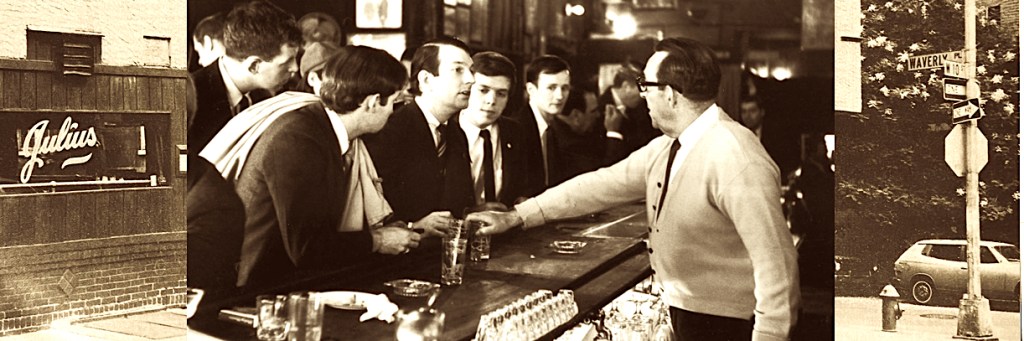
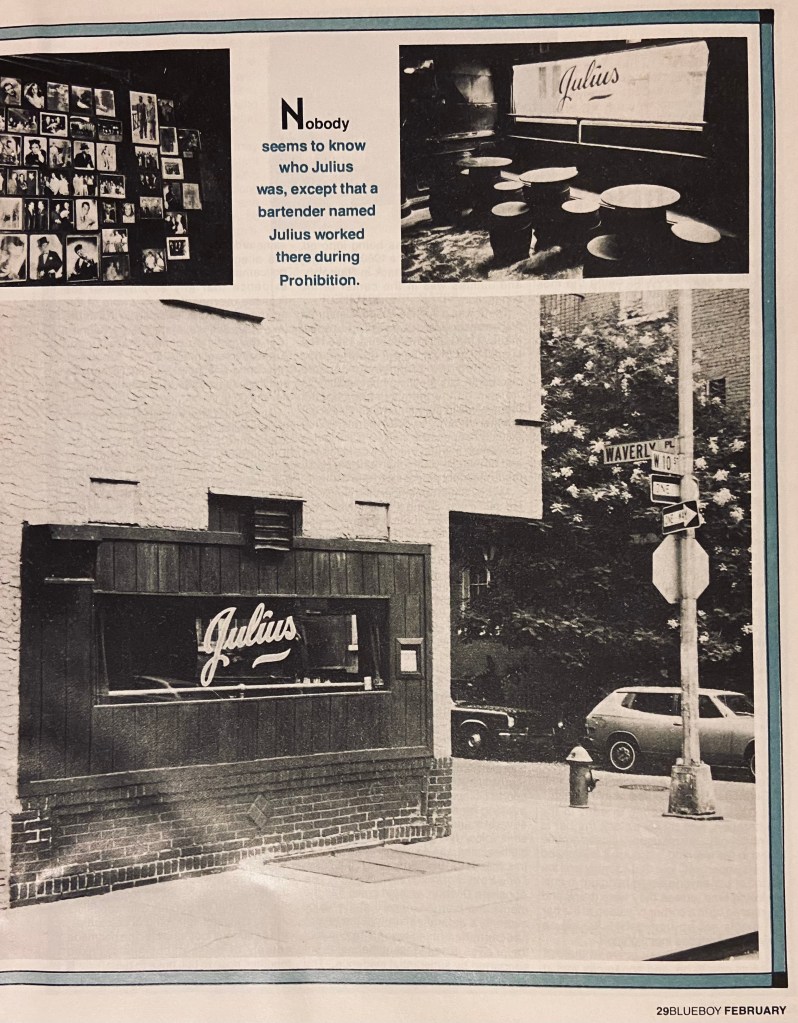
I recently posted a review of Bette Midler’s Thighs and Whispers LP from the February 1980 Blue Boy Magazine. We are revisiting the same issue of the magazine with a profile of Julius, the oldest continuously operating gay bar in New York City.

In April of 1966 – three years before the Stonewall Riots – a protest took place at Julius’s that became known as the “Sip-In.” This action established the rights of gay people to be served in licensed premises in New York and paved the way for gay establishments to obtain state liquor licenses.

The article below also recounts an earlier lesser-known challenge to the bar’s liquor license alleging that the owners “permitted the premise to become disorderly” by permitting homosexuals to “remain on the premises and conduct themselves in an offensive and indecent manner…” Apparently a patron had propositioned a plainclothed police officer. The courts ultimately decided that the charge was not supported by substantial evidence.

In 2016, Julius was listed on the National Register of Historic Places, and on December 6th, 2022 the bar was officially recognized by the New York City Landmarks Preservation Commission.

The article below states that the bar opened before 1860, although the wikipedia page notes different sources claiming 1864 or 1867. In any case, it’s ancient, but it did not gain its gay reputation until the 1950’s.

Some highlights from the piece below:

“The typical Julius’s person is almost always a doctor/lawyer type, though he may well be unemployed. He generally drinks too much – too early and too many.”

“The decor… is High Dirt.”

…and the hamburgers are still legendary.


See Also:
Revisiting Bette Midler’s Thighs & Whispers (1979)
Costello Presley & 80’s Gay Porn Guilty Pleasures
Kenn Duncan After Dark
Gay Times #69 (1978)
Blueboy 1980: Gays of NYC
John Waters in Blueboy Magazine (1977)
New York City: In Touch For Men (1979)
Remembering Bob Harrington
Revisiting Blueboy Magazine (1980)
Armistead Maupin in Blueboy Magazine (1980)
Keith Haring In Heat Magazine (1992)
A Stroll Through 1980’s NYC

Girl Group Heaven: Ronnie, Rosa & Wanda

Back in the summer of 2001, I was living up in Spanish Harlem when soul singer Aaliyah died in a plane crash. I was walking down the street and heard this guy on his cell phone saying “Aww man! All my divas are DYING!” Although I was not necessarily an Aaliyah fan, I felt his pain.

I thought about this recently with the passing of three key members of top 60’s girl groups: Wanda Young Rogers of The Marvelettes, Rosa Lee Hawkins of The Dixie Cups, and Ronnie Spector of The Ronettes. The latter two groups now have just one surviving original member.

It was Wanda who gave The Marvelettes their second act. Gladys Horton sang lead on Motown’s first #1 hit, “Please Mr. Postman,” as well as the classics “Beechwood 4-5789” and “Too Many Fish In The Sea.” As their chart success waned, Wanda transitioned into the lead vocalist position on more smooth and sophisticated material – usually written specifically for her by Smokey Robinson. At the time, she was married to Bobby Rogers of Smokey’s group The Miracles.

Robinson recalled, “In the groups I worked with, I always felt these ‘sleeping giants.’ I felt the same way about the Temptations with David Ruffin when I did ‘My Girl’ on him… I knew if I could get a song for her it would be a smash.” She sang lead on such Motown classics as “Don’t Mess With Bill” “The Hunter Gets Captured By The Game” and “Destination: Anywhere.”

Post-Marvelettes, her life was plagued by tragedy, addiction and mental illness. She recorded briefly for Ian Levine’s Motorcity label in the late 80’s. Wanda was 78 when she passed away on December 15, 2021.

The Dixie Cups did not have a distinct lead singer, but they had a sound: all three members usually sang in unison or tight harmony. Rosa Lee Hawkins was 1/3rd of the New Orleans trio, which also featured her petite older sister Barbara and their cousin Joan Johnson.

Phil Spector originally recorded “Chapel of Love” with Darlene Love and the Ronettes but was never satisfied with the results. The Dixie Cups version was chosen as the premiere single for Jerry Lieber and Mike Stoller’s Red Bird Records. Produced by the songwriters Jeff Barry and Ellie Greenwich, it was a smash – knocking the Beatles out of the #1 spot in June of 1964.

The combination of The Dixie Cups with the Barry/Greenwich producing/songwriting team resulted in girl group gold for Red Bird Records with classics like “People Say”, “Iko Iko”, “Girls Can Tell” and many others.

It was just last year when Rosa Lee Hawkins released her memoir Chapel Of Love, in which she wrote about her career in The Dixie Cups as well as the abuse she suffered at the hands of Joe Jones, their manager. She felt a great relief in finally telling her story. “I did not write my book to hurt anyone;” she said “I just wanted to get it all down on paper.” Rosa was 76 when she passed away of complications following surgery on January 11, 2022 in Tampa, Florida.

And then there’s Ronnie.

Meeting Ronnie at The Bottom Line, NYC, March 23, 1991

I waited to write about Ronnie Spector’s passing because I knew it would get ample press coverage, her career examined and appreciated with the florid language utilized by Professional Rock Critics. Why would I race to compete with that? Please don’t make me use the word “zeitgeist”.

Rolling Stone magazine posted a list of 15 Essential Ronnie Spector Recordings. Of course I disagree with some of the choices, which I envision being compiled on a post-it note-covered bulletin board with equally weighted choices from one old fanboy and four baby rock critics who had to Google her name when they got the assignment.

Here are five choices that I would have preferred to see on the list:

1) The Ronettes – “You Baby” (1964)
This Barry Mann / Cynthia Weil classic first appeared on the Presenting the Fabulous Ronettes LP. It was subsequently recorded by Linda Scott, Len Barry, Jackie Trent, Sonny & Cher and The Lovin’ Spoonful, just to name a few.

The Ronettes sing “You Baby” on Hullabaloo.

2) Ronnie Spector – “It’s A Heartache” (1977)
Ronnie’s recording of this song was released in the U.S. the first week of November, 1977 alongside competing versions by Bonnie Tyler and Juice Newton. Tyler ultimately won the battle with a #3 pop hit.

Ronnie Spector – “It’s A Heartache” (1977)

3) Ronnie Spector – “Any Way That You Want Me” (1980)
The Rolling Stone “15 Essential” list features no tracks from Ronnie’s first two solo LPs: the Genya Ravan-produced Siren and 1987’s Unfinished Business. This Chip Taylor composition from Siren was originally recorded in the 60’s by The Troggs and then Evie Sands, but Ronnie makes it her own.

Ronnie Spector – “Any Way That You Want Me” (1980)

4) Ronnie Spector – “Something’s Gonna Happen” (1989)
In 1989 Ronnie recorded a handful of Marshall Crenshaw songs with Crenshaw and his band backing her up. These Alan Betrock-produced tracks are among the best of her solo recordings – it’s hard to choose just one, as the artist and material worked so well together. Unfortunately, plans for an entire album were halted and the recordings stuck in financial limbo. In 2003, Ronnie was finally able to buy them back and released an EP with “Something’s Gonna Happen” as the title track. As blogger Denis Pilon recently wrote; “In a better world, the release of this EP would have marked Spector’s triumphant return to the spotlight.”

Ronnie Spector – “Something’s Gonna Happen” (1989)

5) Ronnie Spector – “Don’t Worry Baby” (1999)
Brian Wilson wrote the song for The Ronettes as a follow-up to “Be My Baby” but Phil Spector would not let them record it. 35 years later, Ronnie finally gave it her best on the Joey Ramone-produced EP She Talks To Rainbows. Entertainment Weekly wrote; “She sounds more fragile than belligerent now, and her bruised, cracked vocals work wonders on (the song).”

Ronnie Spector – “Don’t Worry Baby” (1999)

Brian Wilson hears Ronnie’s version of “Don’t Worry Baby”:

See also:
’60s Girl Group Survivors
Ronnie Spector – Siren (1980)
10 Forgotten Cher Moments
Dusty Springfield Sings Kate Bush
Tina Turner: 12+ Cover Songs You May Have Missed
Etta James: Advertising Zombie
Debbie At The World (1989)
The 60 Degrees Girl Group Christmas Show
The 60 Degrees Girl Group Halloween Show
A Christmas Without Miracles: The 1987 Motown Xmas Special

No More Chicken Pepperoni: RIP Yvonne Wilder (1937-2021)

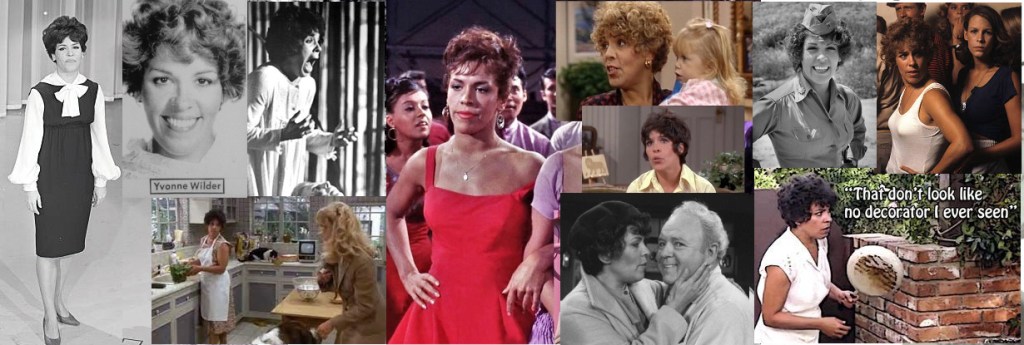
Rita Moreno is having a great season, with an acclaimed documentary and an appearance in Steven Spielberg’s remake of West Side Story, which she also executive produced. She celebrated her 90th birthday while making countless appearances on news and talk shows promoting these projects. In sharp contrast, though, the passing of fellow Shark Girl Yvonne Wilder on November 24th seems to have gone relatively unnoticed.

“I know you do!” Yvonne Wilder as Consuelo sings ‘America’ alongside Rita Moreno in the original ‘West Side Story’.

She was still known as Yvonne Othon when she played Consuelo in the 1961 film. Born in the Bronx in 1937 with Cuban/Puerto Rican ancestry, she attended New York’s High School of Performing Arts and the Royal Academy of Dramatic Arts in London before getting cast in the West End production of West Side Story alongside George Chikiris. According to her website, she would go on to play Anita for over 1,500 performances on Broadway and stages around the world.

Colvin & Wilder on ‘The Hollywood Palace’ (1964)

Throughout the 1960’s Wilder was partnered professionally with Jack Colvin (1934-2004). As Colvin & Wilder, they were one of the most successful comedy duos of the decade, with appearances across the U.S. on stage and television, including The Dean Martin Show, The Ed Sullivan Show and The Tonight Show, culminating in their farewell appearance at Carnegie Hall in New York City.

Colvin & Wilder on ‘The Hollywood Palace’ (1964)
Colvin & Wilder on ‘Playboy After Dark’ (1969)
Coleman & Wilder reunite for a 1986 episode of ‘Gimme A Break’.
Yvonne does a “comic rope routine” on the ‘Johnny Cash Presents The Everly Brothers Show’ (July, 1970)
In 1971, Wilder and third husband Bob Kelljan co-wrote and co-starred in the cult horror movie ‘The Return of Count Yorga’.

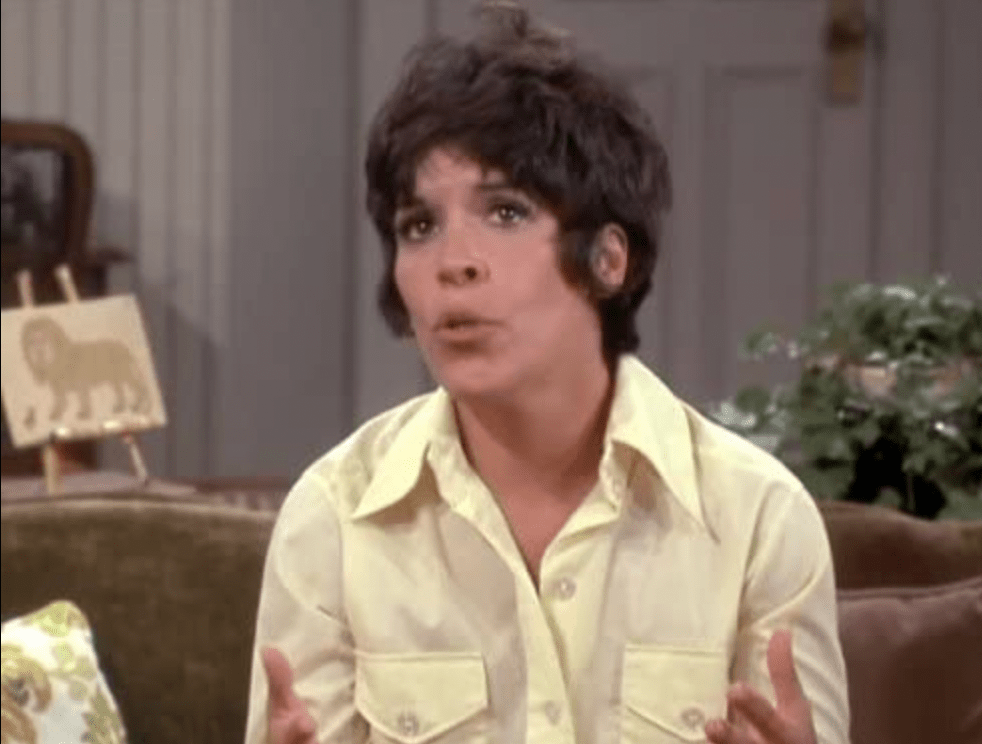
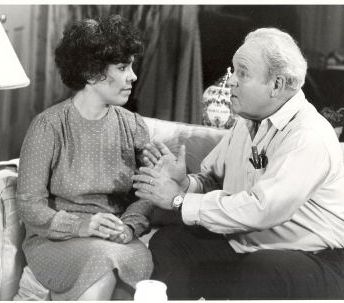
Over 30 years, Wilder racked up dozens of television appearances on shows including The Mary Tyler Moore Show, The Courtship of Eddie’s Father, Room 222, The Partridge Family, and 227. She was Archie’s girlfriend on Archie Bunker’s Place and co-starred in the sitcom Operation Petticoat with John Astin, Adam West and 19-year-old Jamie Lee Curtis.

Yvonne Wilder was reunited with Rita Moreno in the ABC series ‘The Rita Moreno Show’. Hamilton Camp co-starred. (1978)

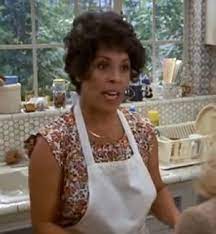
Wilder is perhaps best remembered for her role as Aurora De La Hoya, housekeeper for Glenda & Ira Parks (Goldie Hawn & Charles Grodin) in Neil Simon’s Seems Like Old Times (1980).

One of Wilder’s final roles before retiring was as the grandmother of the Olsen twins on Full House. She then focused on her work as a watercolor artist and sculptor. Her work was shown at the Santa Monica Art Institute and can be viewed on her website.

Adios, Ms. Wilder. Thank you for all your fine work. And for the chicken pepperoni.

See also:
Neeka Shaw: The Forgotten Showgirl
Ten Forgotten Cher Moments
Madame Spivy: Movies & Television
¿Dónde Está Santa Claus (& Augie Rios)?
Madame Spivy’s Tarantella
The Christmas In Connecticut Delivery Woman
Etta James: Advertising Zombie
The Mysterious Midge Williams
Artist’s Muse: José “Pete” Martinez

10 Forgotten Cher Moments

Comedian Frank DeCaro recently tweeted:  I’m convinced Cher gave us the Dancing Queen album so we could get through the Kavanaugh hearings.

I was intrigued with this album concept from the moment it was announced: Cher covering ABBA. Two great tastes that taste great together. I put it on my Christmas wish list. But after the album’s release last week, a wave of raves washed across my very gay Facebook newsfeed. So I purchased it and, I must say…. listening to this album makes me downright giddy. It’s the perfect antidote to 2018: Chicken soup for the ears, if you will.

10 Dancing queenDancing Queen scored an A- minus from Entertainment Weekly and is likely to debut atop the Billboard album charts later this week. Reminder: Cher is 72 years old. This is 20 years after the #1 success of Believe, which was considered to be an impossibly late career comeback at that time.

This seemed like a good time to have a look at some of the forgotten moments of Cher’s fifty-fucking-five year career.

Let’s face it – some things are not remembered because they are just not very good. But there will always be some uber-fan in the comments section that will argue that Cher has never had a bad moment, EVER and you can go to HELL if you disagree. Cher 70s

Also – some critical or commercial failures do fare better when viewed through the lens of time. So let’s not categorize the following examples as good or bad… just… worth a mention.

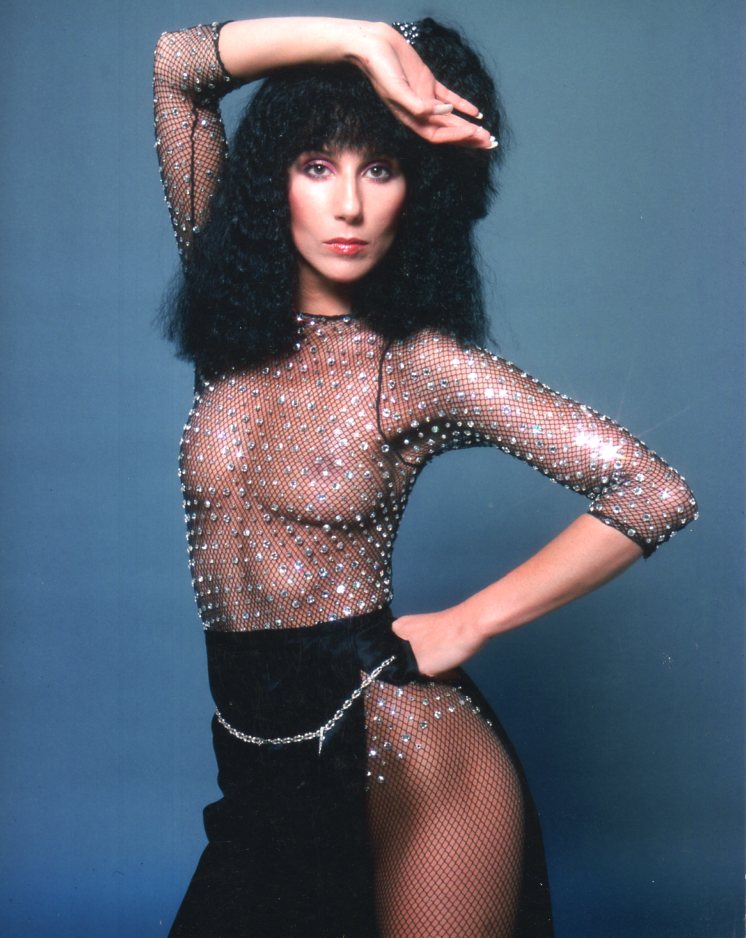
Like this outfit.

1 Bittersweet white light1) Bittersweet White Light (1973)– In certain circles, this LP is considered a camp classic. It’s up to you to decide if you belong in that camp. If you want to hear Cher tackle an Al Jolson medley and other American songbook standards while wading through a muddy, dated Sonny Bono production, look no further! Although her vocal rage had expanded since the 1960’s, she was still partially stuck in her honking Dylan-by-way-of-Sonny-style of singing. Compare her vocals here to anything she has recorded in the past two decades: Vocoder and pitch correction aside, her range now – vocally, stylistically, dramatically – is a world away from her own limitations 40+ years ago.

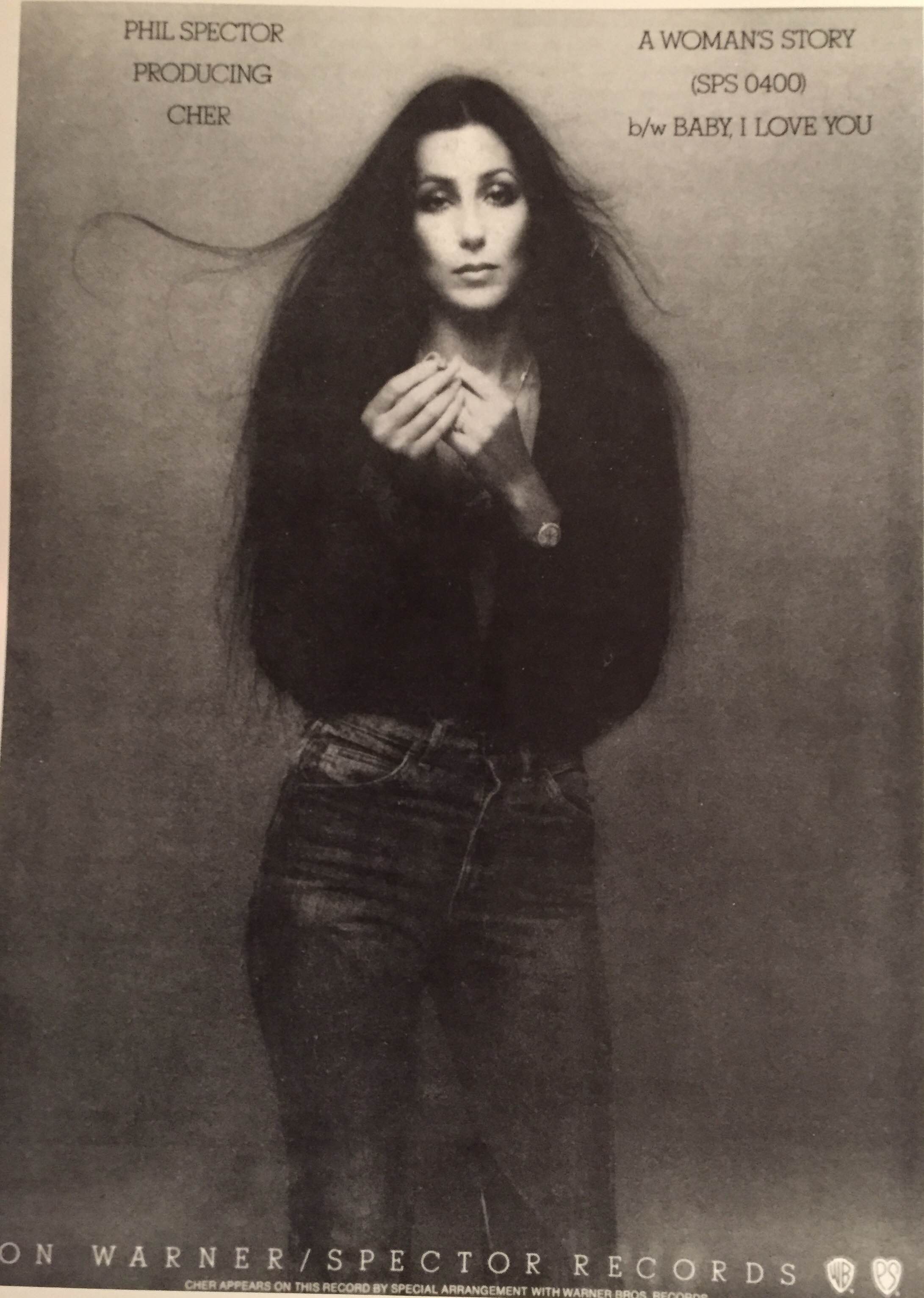
2) A Woman’s Story / Baby I Love You (1974) Cher reunited with producer Phil Spector for this single, which has never appeared on any Cher LP or compilation. The A-side was written by Spector with brother / sister duo Nino Tempo & April Stevens. Soft Cell’s Marc Almond covered this with a spot-on Cher imitation that few realized because the original was so obscure.

2 cherwomans

The B-side is a cover of the Ronettes classic – Cher sang backing vocals on the 1963 original. Here, the song is slowed down to a snail’s pace while ramping up the bombast that you would expect from a Spector production. I won’t argue the pros and cons of this venture – some think it’s brilliant, while Ronnie Spector reports that John Lennon referred to it as proof that Phil had gone ‘round the bend.

3) Cherished (1977) – Cher’s last Snuff Garrett-produced LP continued in the storytelling style of their earlier #1 hits Dark Lady and Half Breed. But by 1977, both Cher and the pop music world had moved on. Like her other mid-70’s solo LPs, this album never charted and has never been released on CD. Cher reportedly owns the rights and has no plans to re-release them.

4 black rose4) Black Rose (1980) People forget that Cher is a rock chick at heart. She seems to have made peace with dance music now, but in 1980 she was bristling under the disco material she was recording for Casablanca records. Cher formed and fronted Black Rose, a punkish indie rock band with then boyfriend/guitarist Les Dudek. Casablanca released one LP – it was neither a critical or commercial success and closed out her tenure at the record label.
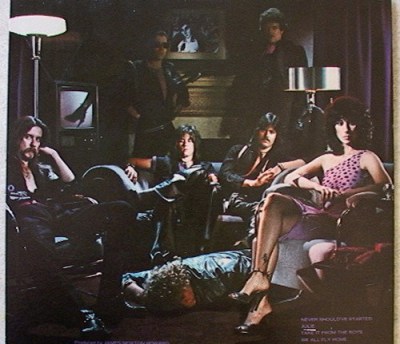
5) Cher & Meat Loaf: Dead Ringer For Love (1981): From Mr. Loaf’s follow up to the hugely successful Bat Out Of Hell LP. This duet was a moderate chart hit in other countries, but inexplicably not released as a single in the U.S. If you want to hear Cher take part in the trademark aural excesses of a Jim Steinman production, here it is.

7 I paralyze

6) I Paralyze (1982) Continuing her early 80’s musical slump, this sole LP for Columbia records was a flop. New Wave Cher didn’t translate well to the current pop market. She then focused on her acting career for the next 5 years before resurfacing with 1987’s self-titled comeback LP. At the time it seemed like she had been gone for much longer, since her early 80’s material had all gone largely unnoticed. Here she is on American Bandstand:

6 come-back-to-

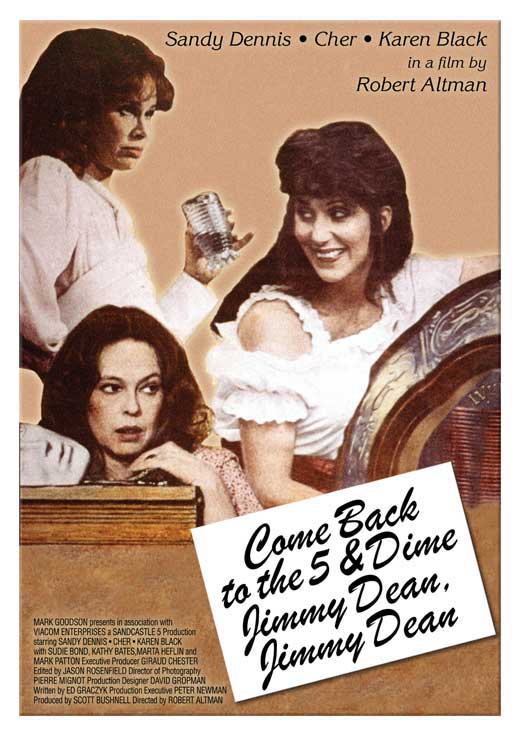
7) Come Back To The Five And Dime, Jimmy Dean Jimmy Dean (1982) – Robert Altman directed this low-budget movie version of the Broadway play, which he also directed with the same cast. Cher co-starred with Karen Black, Sandy Dennis and a young Kathy Bates. While not commercially successful, people did sit up and take notice of her acting chops. Surprisingly, the whole movie is on YouTube, but skip to 1.29 if you want to watch her character’s heartbreaking meltdown.

8 not.com.mercial.jpeg8) Not.com.mercial CD (1994/2000) – In 1994, Cher attended a songwriter’s workshop that garnered an album’s worth of songs that she had co-written. The resulting album was subsequently rejected by her record label as “Nice, but not commercial.” Cher held on to it for 6 years before releasing it with little fanfare via the internet during her post-Believe renaissance. At the time, she said “I think that the internet is a place that at least it doesn’t infringe on anyone else’s life and if you want to go there you can go there and check it out, and if you don’t want to be bothered by it you don’t even have to know it’s in the universe” Reviews were generally favorable.
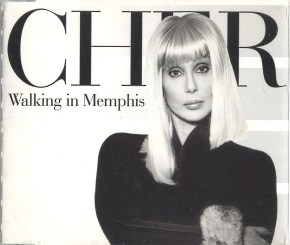
9 Walking in memphis9) Walking in Memphis (1995) – When the record company rejected Cher’s songwriter LP, she returned the following year with It’s A Man’s World, about which she told the Advocate “I don’t know. It’s kind of good. It doesn’t suck.” The standout track is her cover of Marc Cohn’s signature song. A modest success in Europe and the UK, it sank without a trace in the U.S. It should have been a hit, with a music video featuring Cher in Elvis drag. Cher liked the video so much, it was played in its entirety on the big screen during her live shows for years after. Take that, bitches.

10 Faithful10)  Faithful (1996) – Director Paul Mazursky’s final film – written by Chazz Palmienteri based on his stage play. This was the end of Cher’s A-list Hollywood film career – whether it was the cause or she purposely walked away is debatable. In any case, the film was a commercial failure – criticized for not translating well to the big screen. A charming LA Times review also said “she’s had so much cosmetic surgery, you can’t get through a single close-up without marveling at the cadaverous mask she has become.” Which… by the way… have you seen Palmienteri lately? But I digress: It’s a pretty good movie that is definitely worth revisiting.

BONUS: Don’t Come Crying To Me (1991/1999)

Originally recorded during the Heart Of Stone album sessions, the song was unreleased until 1999, when it was remixed and included in first pressings of If I Could Turn Back Time: Cher’s Greatest Hits. The song was later removed, at Cher’s request. In any case, it’s a favorite of mine.

You may also like:
Tina Turner: 12+ Cover Songs You May Have Missed
Gimme Gimme Gimme… Erasure Covering ABBA
Angela McCluskey: A Voice You Know
Dusty Springfield Sings Kate Bush
Revisiting Bette Midler’s Thighs And Whispers
Adam Schlesinger: Not Just The Guy On The Right
Debbie At The World (1989)
12 Forgotten Classics By New Wave Women
Kate Bush’s Queerest Songs
So Jill Sobule
You Know The B-52’s Song “Roam” Is About Butt Sex, Right?
The Lost Madonna 80’s Megamix Video