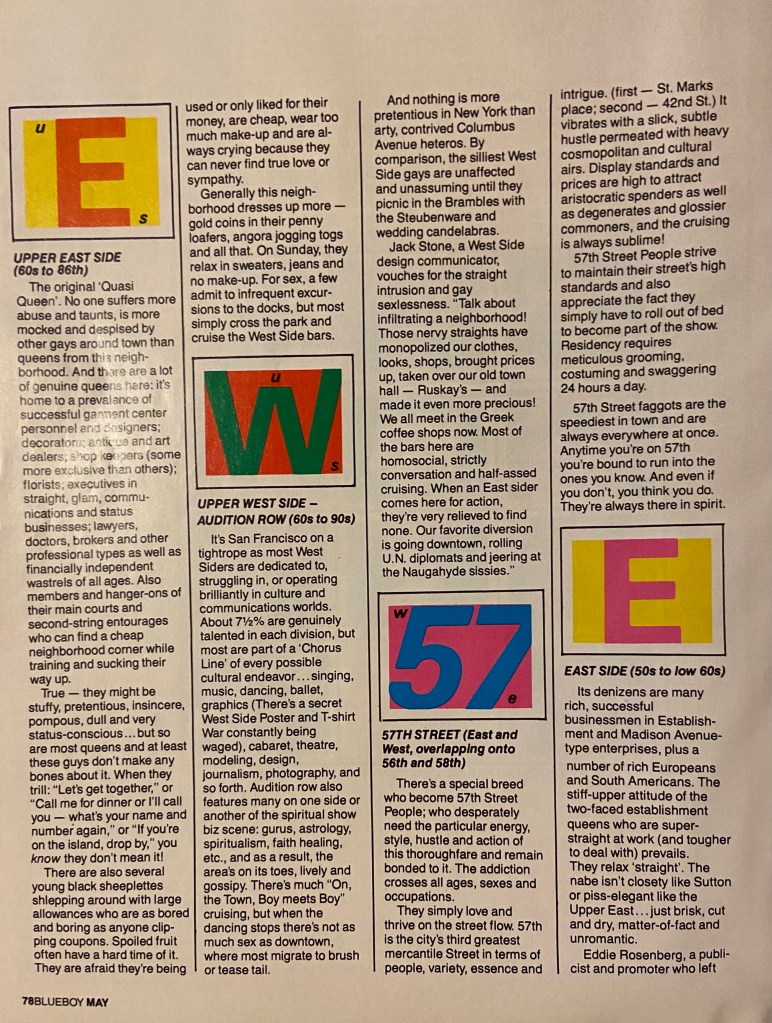
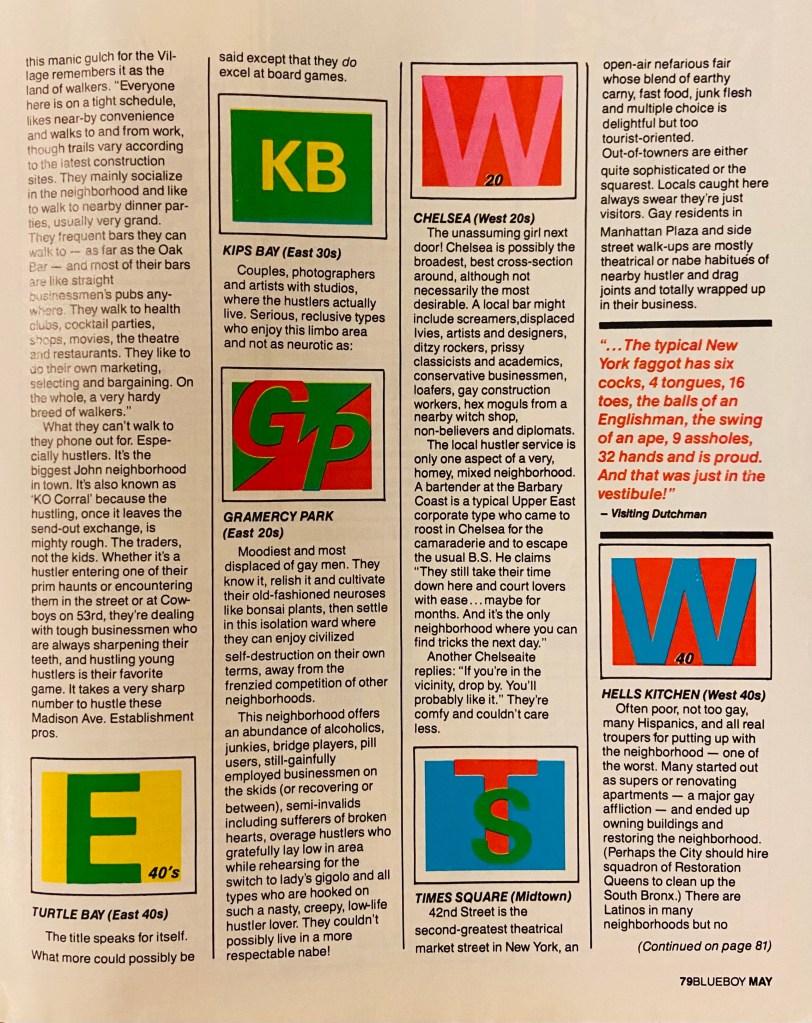
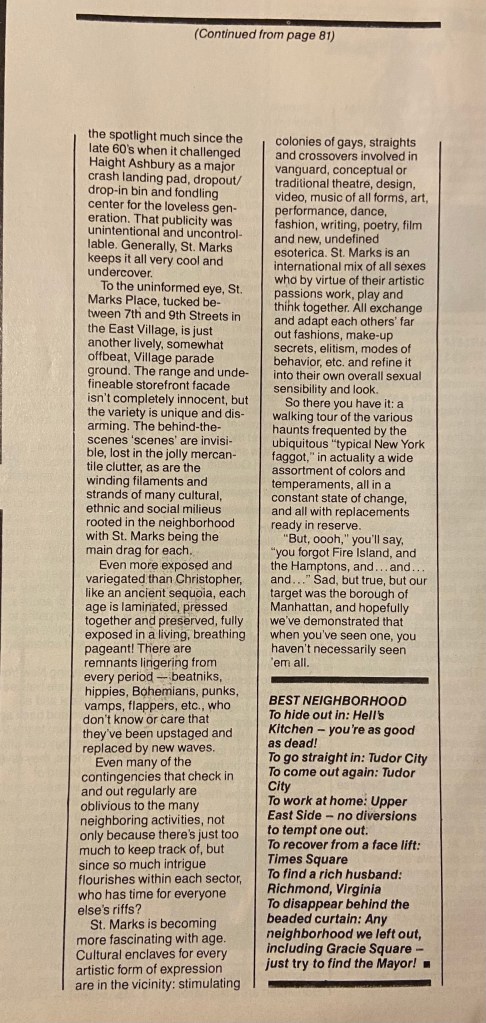
It’s not nice to stereotype. This may be especially true of homosexuals, who have borne the brunt of unkind pinpointing for so long that they believe it themselves.
…so begins an outrageously stereotypical article from the May, 1980 issue of Blueboy Magazine, titled “Is There A Typical New York Faggot?”
Now… before you lose your shit over the title, keep in mind that those were different times. The “F” word wasn’t taboo. Larry Kramer’s book by that name had been published just a year and a half earlier. So let’s put that sticking point aside. There’s plenty more to discuss.
Another caveat: This is from Blueboy. A gay porn magazine. It ain’t the Advocate or The Village Voice. Presumably author “J. Greller” was the pen name of a jaded queen with his tongue firmly planted in his own cheek and his head up his own ass. Who can say for sure? I wouldn’t want to, you know, stereotype… but Harold from Boys In The Band could deliver this piece as a monologue.
It’s mean and bitchy, but not in a fun way. It’s like the author had one martini too many and his New York City rant went to a dark place that was no longer funny or clever. The specificity of many of the “types” described gives the indication that he had an axe to grind with very particular unnamed individuals.
Have a read:
To be fair, the entire piece isn’t completely tone-deaf. There are glimpses that ring true, especially in the downtown neighborhoods. This is due in part to the quotes from others – Doley the Third’s observation on Harlem, for example.
I find the piece to be out of sync with the NYC neighborhoods as I have known them since the early 1990’s. But this is my perception over a 30 year period. I wasn’t there in 1980, but I have to wonder if the author has based his observations on, say, a 30 year period prior to that. Were there were really still old vamps & flappers on St. Marks in the CBGB era? Did 57th Street really have its own gay male type that needed dissection? Did nobody ever travel out of their own neighborhood to socialize? Were the streetcars not running?
Interesting to note that, for all this compartmentalizing of Midtown East neighborhoods: Kips Bay vs Turtle Bay vs. East Side… there is no mention of Murray Hill. At the time, according to older gay New Yorkers that I have known, it was referred to as “Mary Hill” due to the large number of gay bars and homosexual residents. J. Geller missed a golden opportunity.
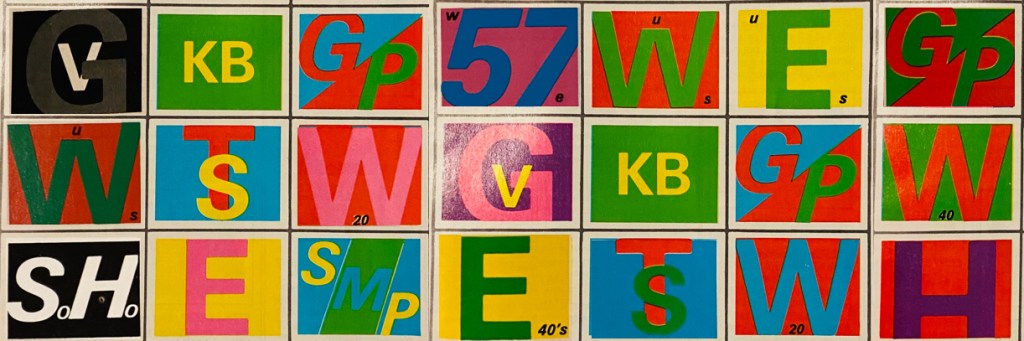
Kudos to the graphic artist Favio Castelli, though.
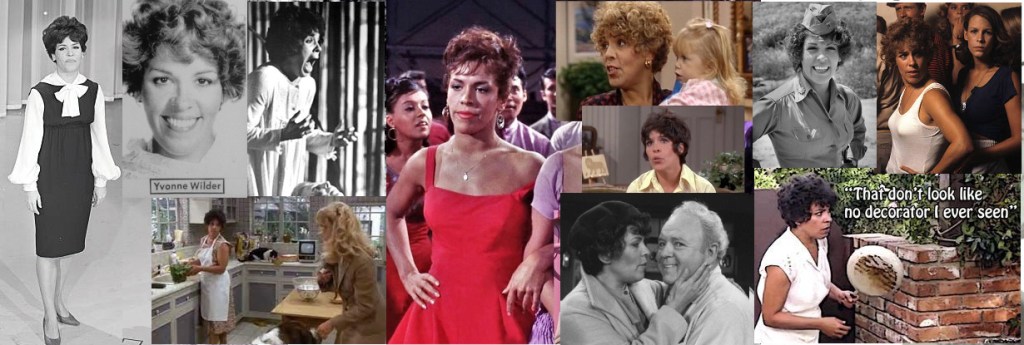
Rita Moreno is having a great season, with an acclaimed documentary and an appearance in Steven Spielberg’s remake of West Side Story, which she also executive produced. She celebrated her 90th birthday while making countless appearances on news and talk shows promoting these projects. In sharp contrast, though, the passing of fellow Shark Girl Yvonne Wilder on November 24th seems to have gone relatively unnoticed.
“I know you do!” Yvonne Wilder as Consuelo sings ‘America’ alongside Rita Moreno in the original ‘West Side Story’.
She was still known as Yvonne Othon when she played Consuelo in the 1961 film. Born in the Bronx in 1937 with Cuban/Puerto Rican ancestry, she attended New York’s High School of Performing Arts and the Royal Academy of Dramatic Arts in London before getting cast in the West End production of West Side Story alongside George Chikiris. According to her website, she would go on to play Anita for over 1,500 performances on Broadway and stages around the world.
Colvin & Wilder on ‘The Hollywood Palace’ (1964)
Throughout the 1960’s Wilder was partnered professionally with Jack Colvin (1934-2004). As Colvin & Wilder, they were one of the most successful comedy duos of the decade, with appearances across the U.S. on stage and television, including The Dean Martin Show, The Ed Sullivan Show and The Tonight Show, culminating in their farewell appearance at Carnegie Hall in New York City.
Colvin & Wilder on ‘The Hollywood Palace’ (1964)
Colvin & Wilder on ‘Playboy After Dark’ (1969)
Coleman & Wilder reunite for a 1986 episode of ‘Gimme A Break’.
Yvonne does a “comic rope routine” on the ‘Johnny Cash Presents The Everly Brothers Show’ (July, 1970)
In 1971, Wilder and third husband Bob Kelljan co-wrote and co-starred in the cult horror movie ‘The Return of Count Yorga’.
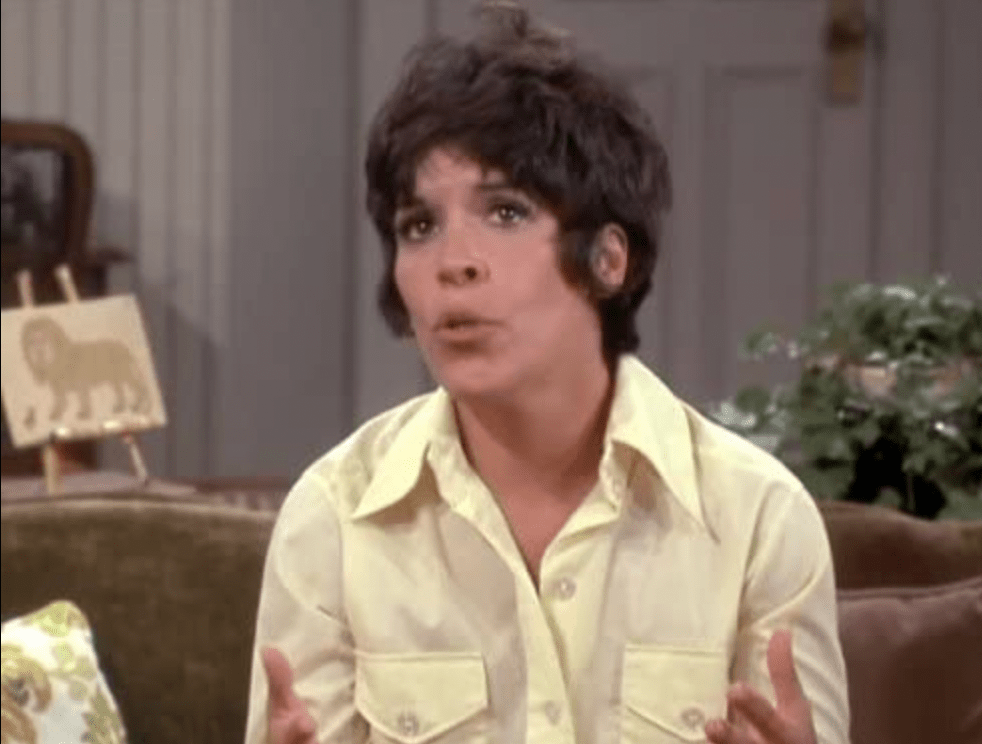
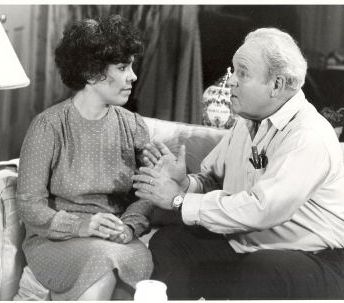
Over 30 years, Wilder racked up dozens of television appearances on shows including The Mary Tyler Moore Show, The Courtship of Eddie’s Father, Room 222, The Partridge Family, and 227. She was Archie’s girlfriend on Archie Bunker’s Place and co-starred in the sitcom Operation Petticoat with John Astin, Adam West and 19-year-old Jamie Lee Curtis.
Yvonne Wilder was reunited with Rita Moreno in the ABC series ‘The Rita Moreno Show’. Hamilton Camp co-starred. (1978)
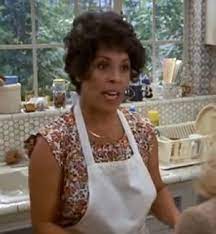
Wilder is perhaps best remembered for her role as Aurora De La Hoya, housekeeper for Glenda & Ira Parks (Goldie Hawn & Charles Grodin) in Neil Simon’s Seems Like Old Times (1980).
One of Wilder’s final roles before retiring was as the grandmother of the Olsen twins on Full House. She then focused on her work as a watercolor artist and sculptor. Her work was shown at the Santa Monica Art Institute and can be viewed on her website.
Adios, Ms. Wilder. Thank you for all your fine work. And for the chicken pepperoni.
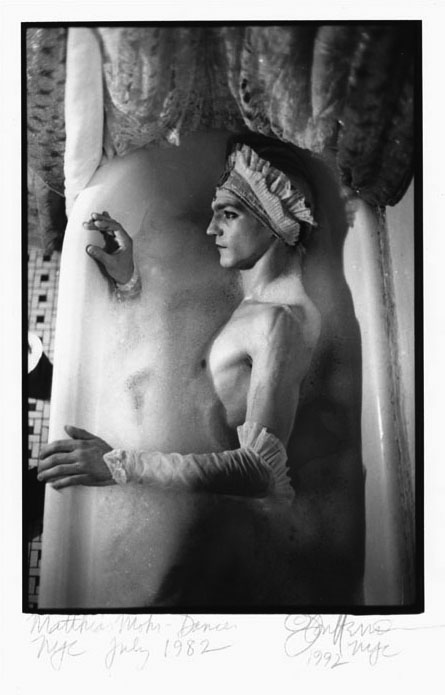
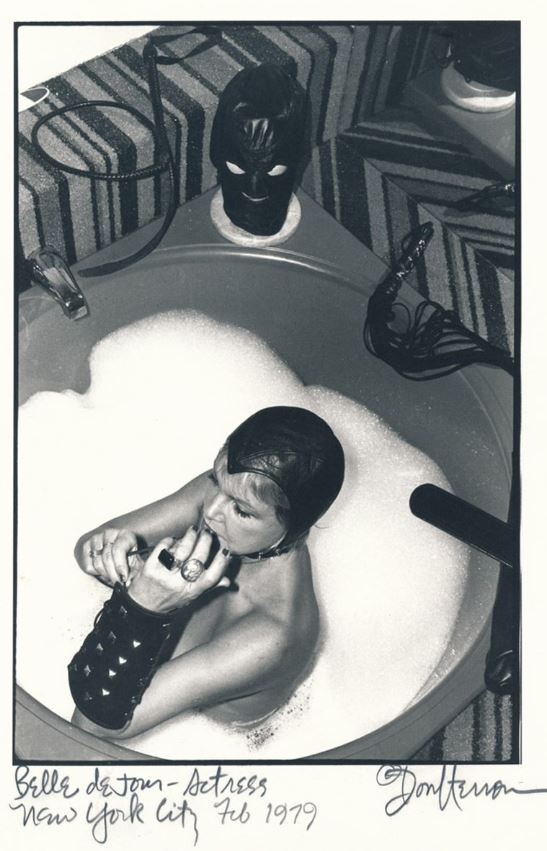
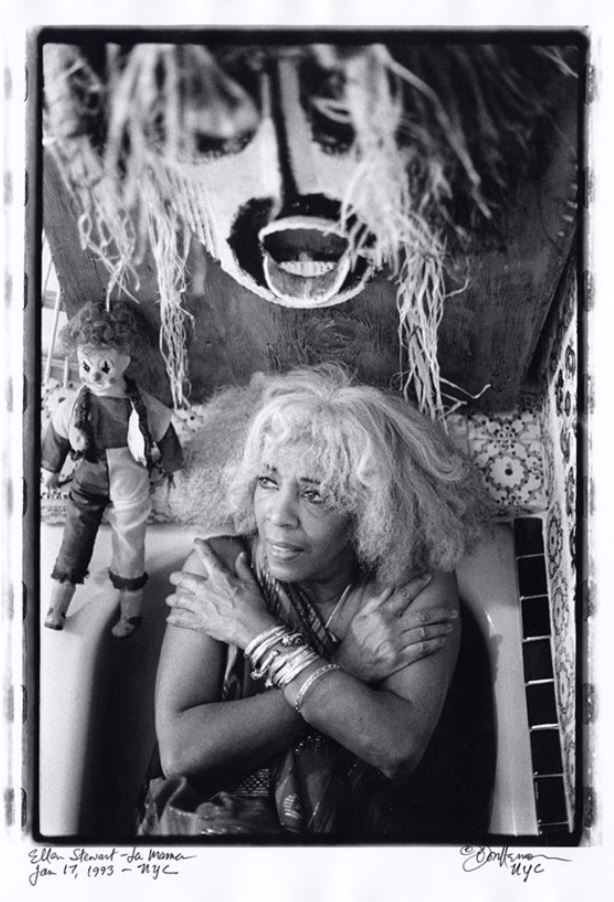
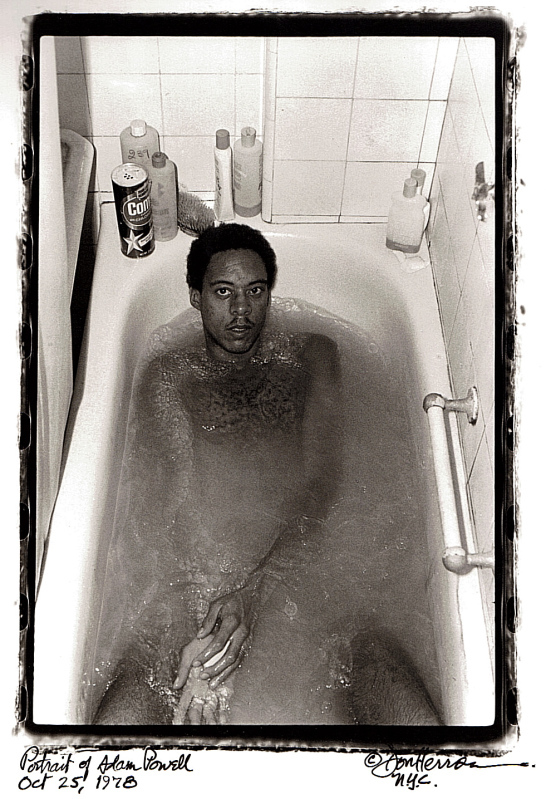
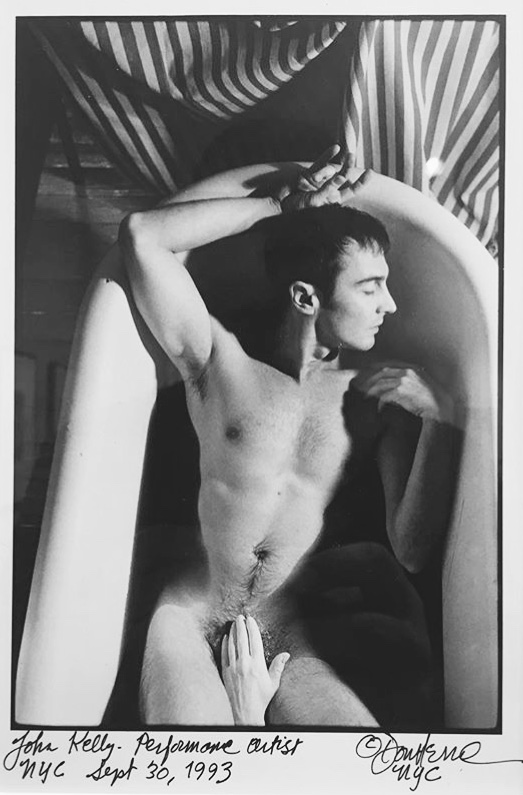
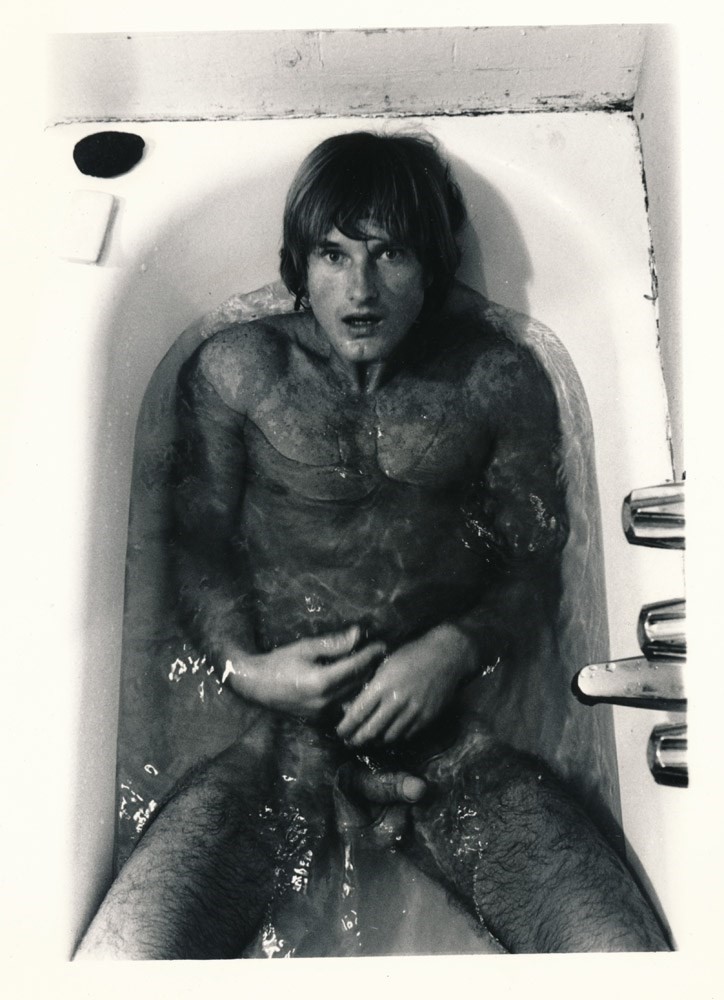
Three years ago, I posted two collections of artist / photographer Don Herron’s Tub Shots, a series of photographs featuring the famous and near famous posing in their bathtubs. This coincided with an exhibition of 65 of the images at the Daniel Cooney Gallery here in NYC. My blog posts (Pt. 1 and Pt. II) still garner a considerable amount of traffic, so I thought I would share more of these photos – ones that didn’t make it into those original posts and others that have resurfaced since that time.
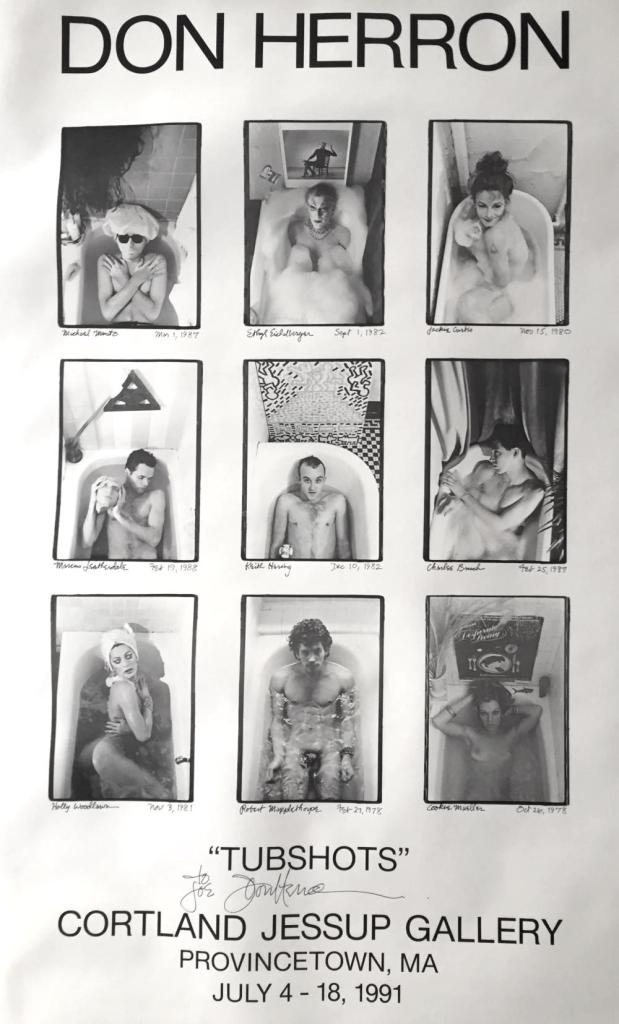
Signed poster for a 1991 exhibition in Provincetown.
Writer/Performer/Filmmaker John Heys as Diana Vreeland (1992). Looking back at the photo in 2018, Heys commented, “Simply put, as Diana Vreeland often said… ‘A bit of alright!’ Of course that is how I felt in my divine penthouse bath.”
Amos Poe, Filmmaker
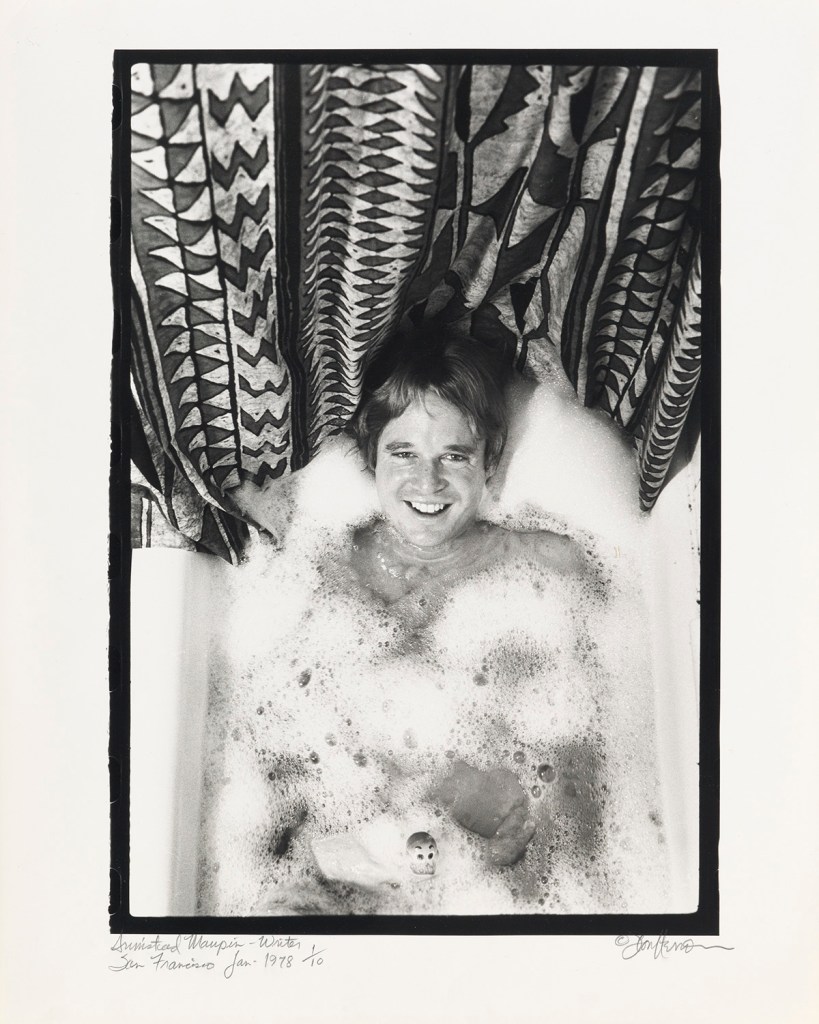
Tales of the City Author Armistead Maupin – San Francisco (1978)
Cassandra, Photographer – Houston, Texas (1979)
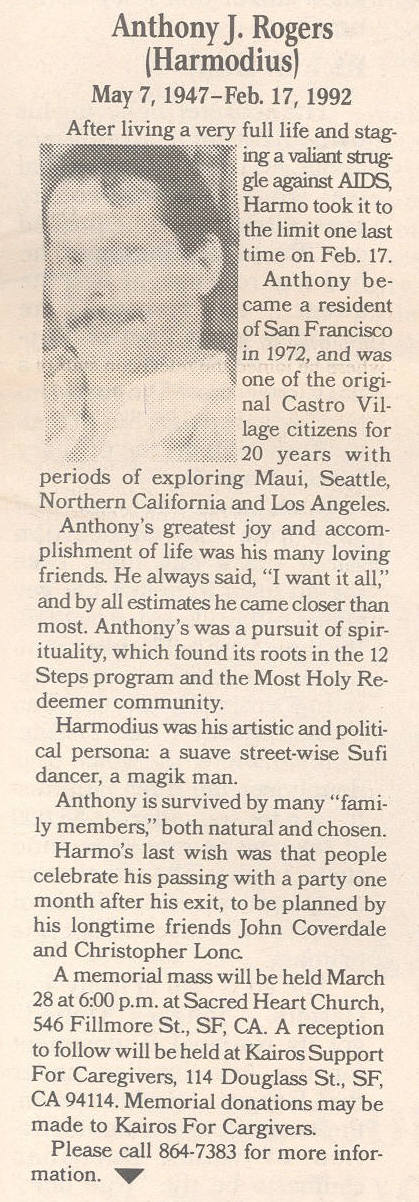
Queer San Francisco performerHarmodious, aka Anthony J. Rogers (1947-1992) was photographed in 1978 at Fey Way Gallery in the same tub used for the portraits of his sometime boyfriend Robert Opel, and gallery employee Christine McCabe.
Bill Dodd, Jeweler – Austin, Texas (1980)
Victor Bockris – author of many rock biographies who also wrote for Andy Warhol’s Interview magazine.
Warner Jepson (1930-2011), Composer – San Francisco (1980)
When McCabe’s photo was published in the 1980 Village Voice layout, she sued Herron and the newspaper. Although the signature on the model release was questionable, McCabe admitted that Herron did tell her that he wanted to publish a book of the photos. The suit was settled with McCabe receiving an undisclosed sum.
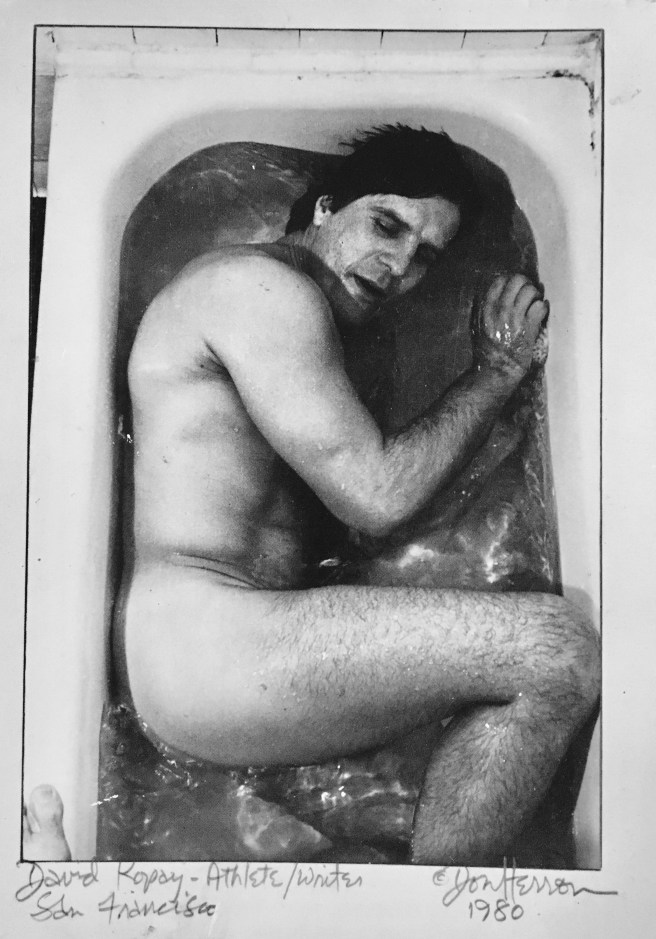
A selection of Tub Shots were featured in the April, 1980 issue of Christopher Street, with football player David Kopay‘s photo on the cover.
Actor/Playwright/Visual Artist/Puppeteer and Singer-songwriter Winston Tong – San Francisco, CA
When the Village Voice Online edition posted an article about the Daniel Cooney gallery exhibition in 2018, they chose to post just 3 of the 23 photos from the original layout: Robert Mapplethorpe and McCabe’s photos were 2 of them. Whether or not this was a random occurrence or a belated turn of the screw towards McCabe, the photos have since been removed.
David Middaugh – Painter
Jerry Burchard (1931-2011) Photographer, San Francisco (1978)
Liz Derringer – ex-wife of Rick Derringer, she is a rock journalist & publicist who also wrote for Interview, NYC (1979)
Ron Jehu (1937-2007) was a San Francisco gallery owner who also hosted avant-garde exhibitions and events featuring Sylvester, Divine and Robert Mapplethorpe.
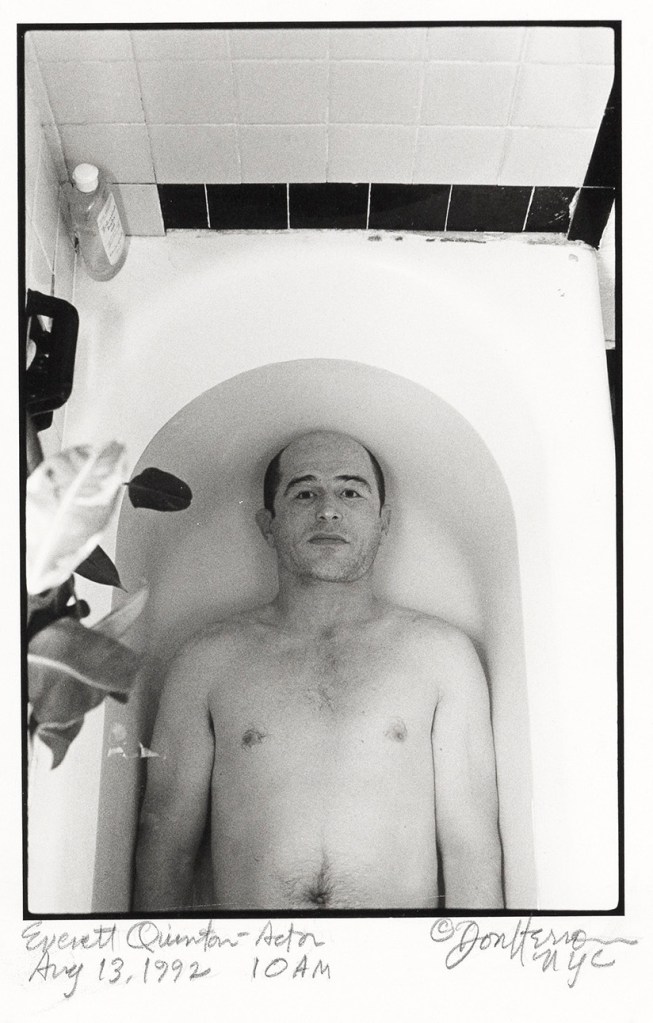
Everett Quinton (1952-2023) was an actor, director, & artistic director of the Ridiculous Theatre Company. “I’m not sure if Don was a friend of a friend or how he got my number. I only know that he asked me if I would like to be photographed in the bathtub and that seemed fun and I said yes. I remember the smell of the chlorine in my nose for days after the shoot as I laid still under the water for a while… waiting for the bubbles to go away so it would look creepy. I love the picture very much and I remember Don standing on the sides of the bathtub to get the shot. And I remember it was a fun experience.”
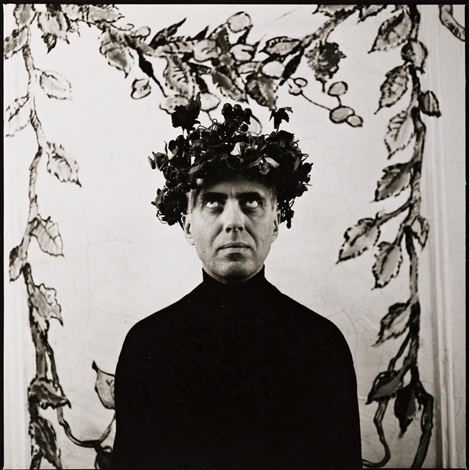
Charles Henri Ford (1908-2002) was a surrealist poet, magazine editor, filmmaker, photographer, collage artist and diarist. He was also the partner of artist Pavel Tchelitchew. NYC (1980)
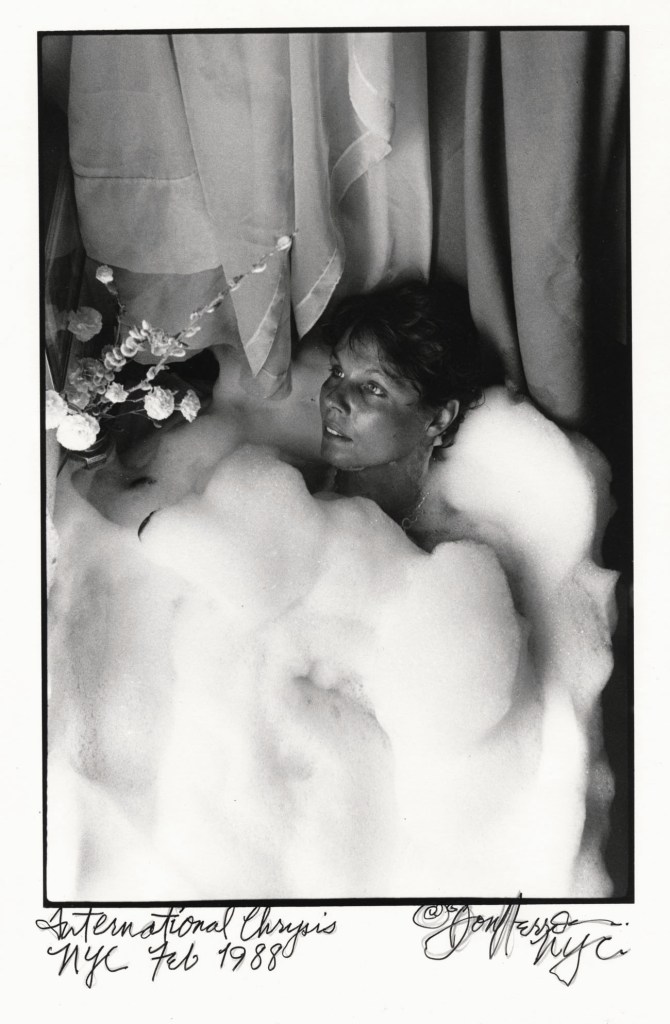
International Chrysis (1951-1990) was a transgender entertainer and protege to Salvador Dali. She is the subject of the 1993 documentary Split. NYC (1988)
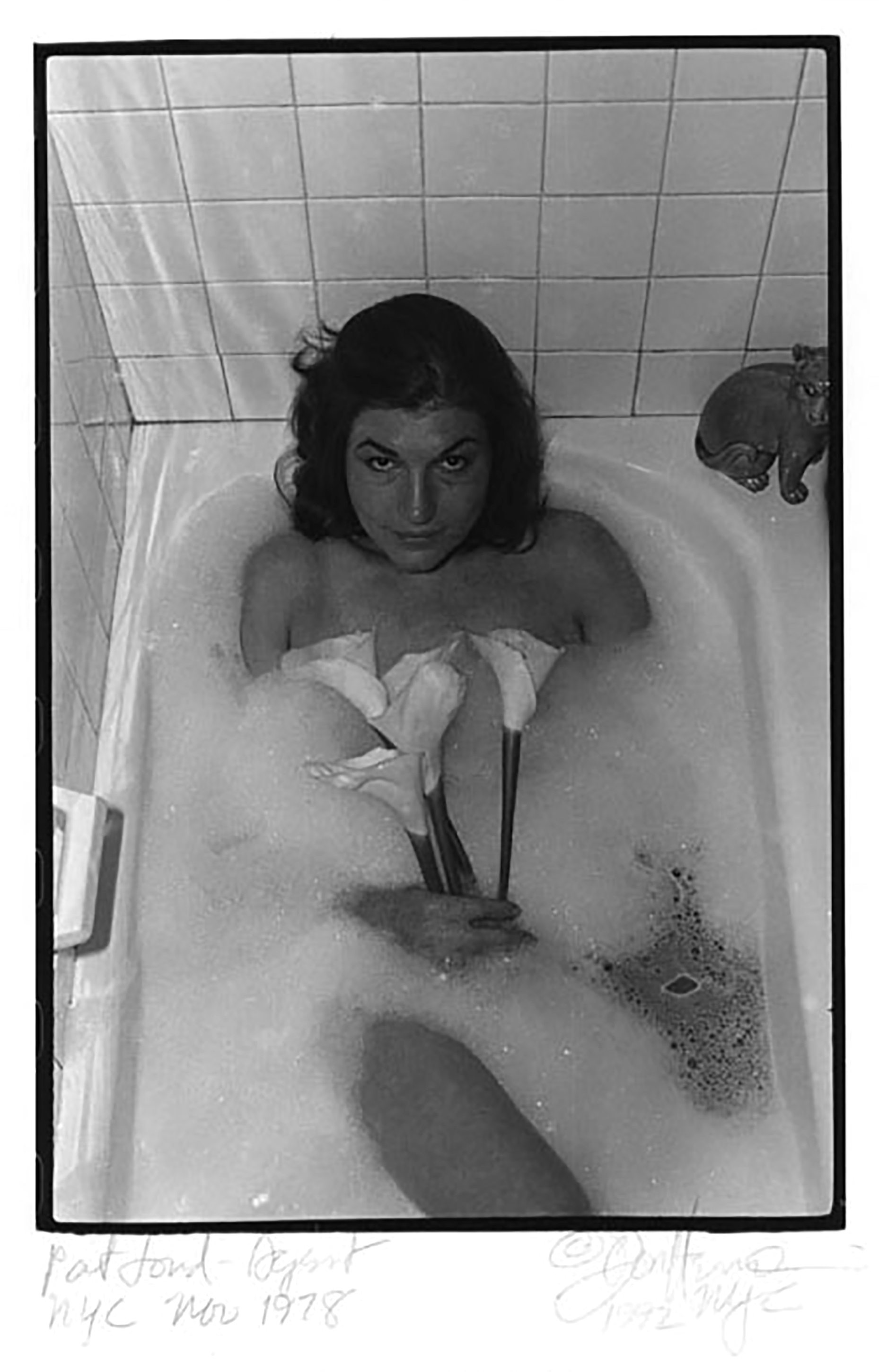
Pat Loud (1926-2021) was the matriarch of the Loud family, subject of the first reality series on American television. She later recalled that she only agreed to Don Herron’s request for a photo shoot if her friend and interior designer Richard Ridge (1928-2021) posed as well. NYC (1978)
Richard Erker (1945-2004) was an artist, sculptor and jewelry maker. He owned a shop in SoHo in the early 1980’s and later moved to Palm Springs, where he was the victim of an unsolved murder.
Richard Hartenstein (1945-1988) Makeup artist, NYC (1980)
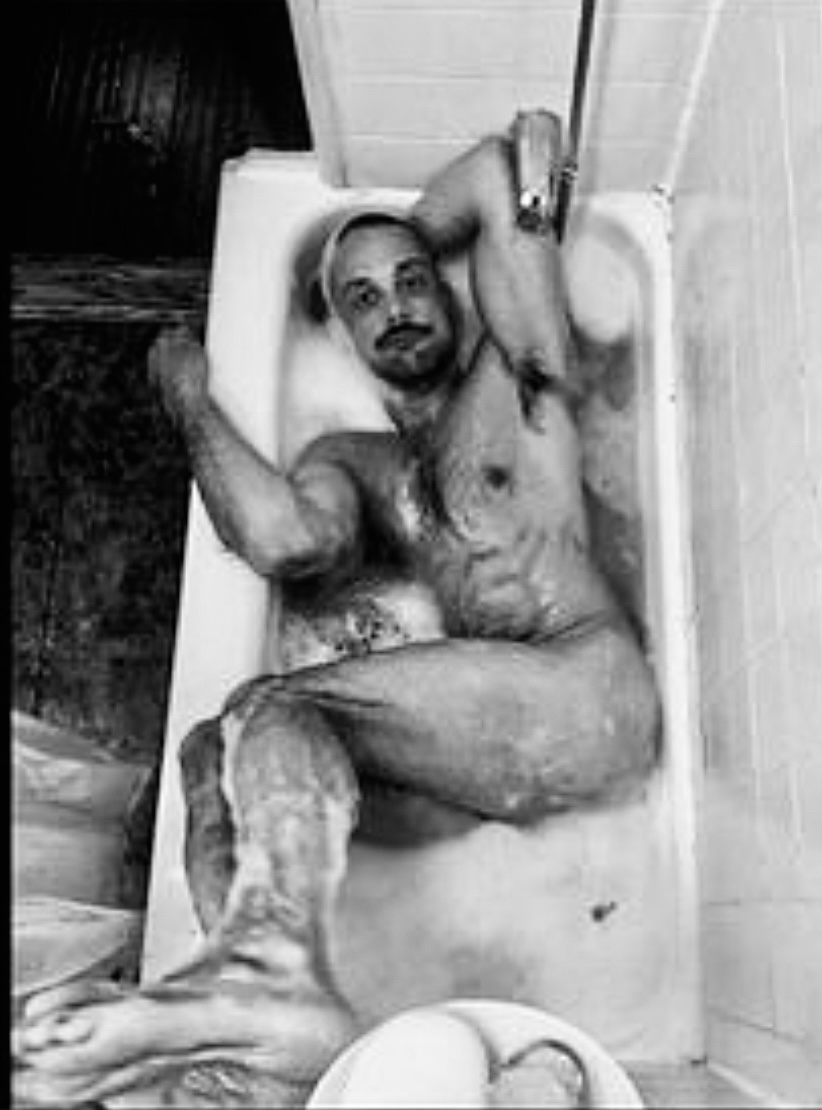
Cornelius Conboy was the owner of 8BC, an East Village nightclub, performance space and gallery. “Don was gloriously set in his own universe yet welcomed everyone to join. I see that the photo is dated 1987 yet am certain it was taken earlier than that. 1986 at the latest. I lived in Italy in 1987 and that bathtub is from my apartment above 8BC, when Donald’s famous mural “Civilization Teeters” hung above the bar.
“My memory is that while he was very meticulous about the lighting he was rather laissez-faire about posing. There was a vase of those bodega flowers that last forever after they dry out – baby’s breath and purple statice. I’ve always considered myself a romantic and here I seem to be channeling my best inner Ophelia.”
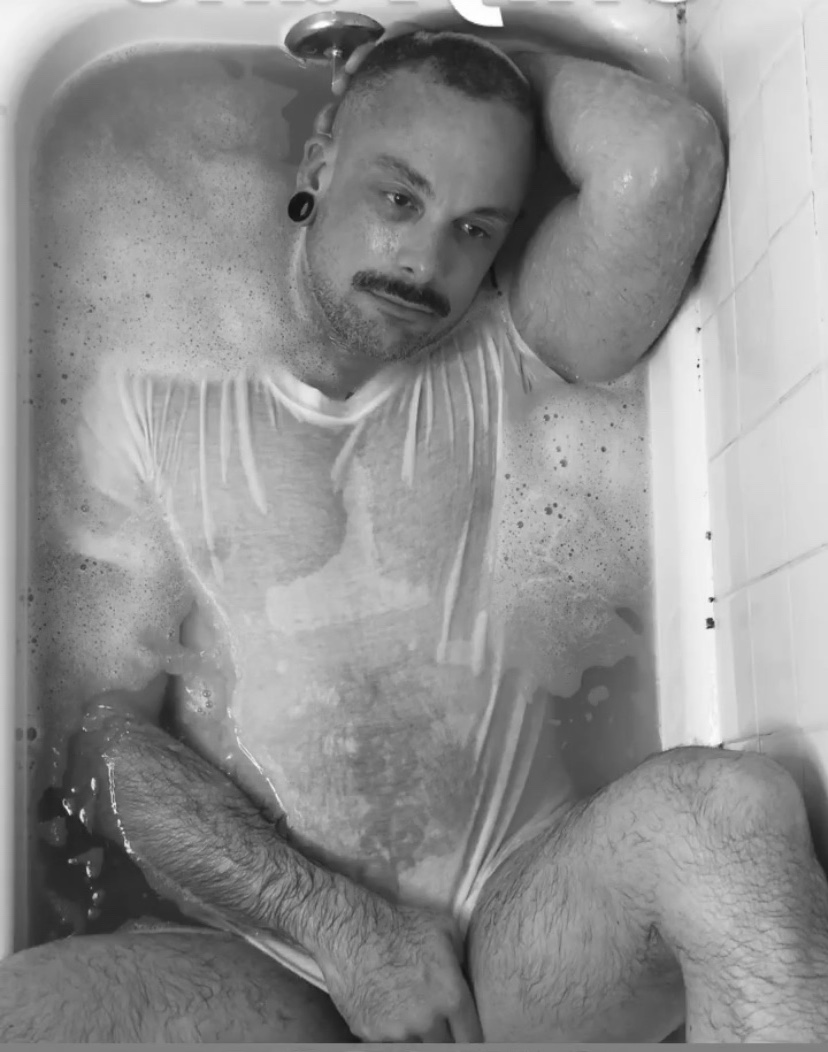
Fashion designer Geoffrey Mac‘s (unintentional?) homage to the “Tub Shots” series, as recently posted on Instagram.
I was a freshman theatre major at Syracuse University when I scribbled this in my journal one bright spring day in 1988:
I’m writing at Oakwood Cemetery, where we are sitting on the steps of the Brown Mausoleum. People might think it’s morbid to hang out in a cemetery, but I love it here – so beautiful and peaceful. If we were sitting in the Quad, with radios blaring and frisbees flying around, I couldn’t relax – it always feels like a fight is just waiting to break out. There’s no judgement here. Other kids walk by every so often but it’s very quiet. I’ve heard that drug deals go on here at night though.
So young. So innocent. So little insight. Then again, I was 19 years old and this was before that kid boiled John Crouse Jr.’s head.
Hanging out with friends at the mortuary chapel in Oakwood Cemetery (Spring 1988)
Oakwood is a 160 acre cemetery adjacent to the Syracuse University campus. Their website advertises “a grand array of monuments and mausoleums which form a virtual outdoor museum of funerary sculpture and architecture while mirroring the lives of Syracuse’s Victorian families.”
The cemetery was an alternative hangout for us – actors and artists clad in vintage chic attire, toting journals, sketchbooks and cameras. We didn’t come to SU for the sports or fraternity life. The typical campus hangout spots weren’t always the best places to relax, so we went to the cemetery. We were respectful, but not everyone else subscribed to the ‘Take only pictures, leave only footprints’ credo. This is why we can’t have nice things.
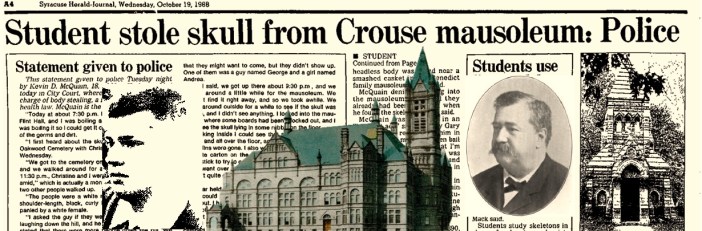
In October of that year, freshman art student Kevin McQuain thought it would be cool to steal a human head from a mausoleum “to use as a model for sculpture class,” he would later say. He brought it back to his dorm – the nearby Flint Hall – and proceeded to try and clean the cranium by boiling it with bleach in a trashcan placed on the stove of the 3rd floor common area. Residents were alarmed by the stench and even more so when they discovered the source. McQuain was arrested along with his friends, Seth Prince and Omar Kutty.
Flint and Day Halls – two Syracuse University dorms adjacent to Oakwood Cemetery
Two factors helped this gruesome crime to become a national news story:
a) It was Halloween season.
b) It wasn’t just any old skull in the trashcan.
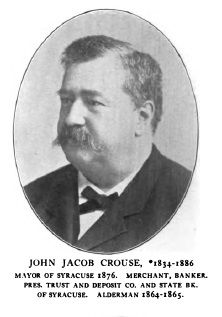
The vandalized mausoleum contained John and Catherine Crouse and their two sons. The Crouse family was a wealthy philanthropic clan that loomed large in the area for generations. A fair percentage of the city of Syracuse bears the Crouse name. John Sr. funded the University’s Crouse College to honor his wife. Their son, John Jacob Crouse, Jr. served as the mayor of Syracuse. All of the coffins in the tomb were vandalized, but the cranium in question belonged to John Jr.
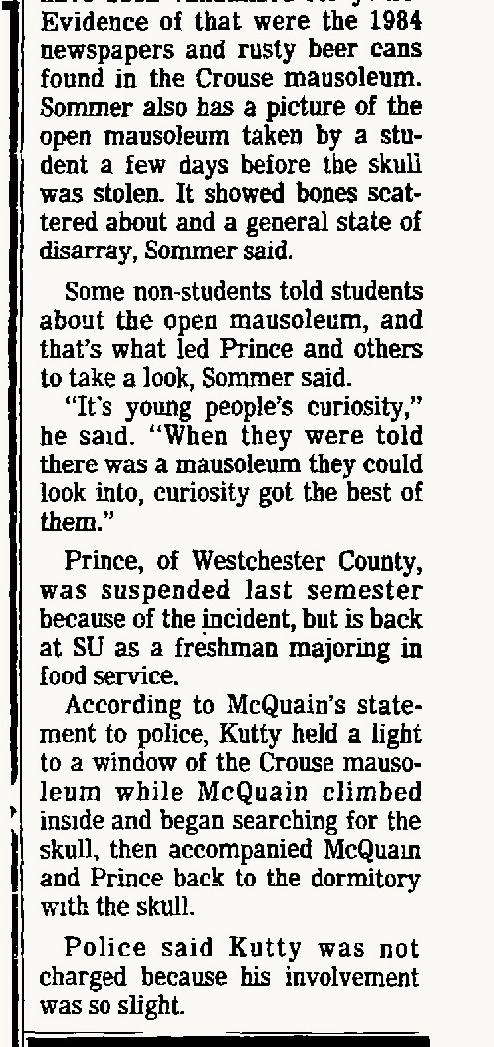
From The Syracuse Herald, 10/21/88 and a vintage postcard for Crouse College:
While this macabre news story placed the University in the national spotlight, it would soon be forgotten – replaced by an unfathomable tragedy. Two months after this incident, the Lockerbie bombing took place. Thirty-five Syracuse students perished on Flight 103 in a terrorist attack that divided campus life with a definitive line of before and after.
By the time Kevin McQuain and his friends went to court in early 1989, all but local news outlets had lost interest in the macabre little “Art Student Boils Founder’s Head” story. McQuain pled guilty and was properly contrite under advice of counsel. The charges against Seth Prince and Omar Kutty were dropped, yet all three received the same sentence: 200 hours of community service.
From The Syracuse Times, 1/26/89:
Kevin McQuain at sentencing. (Herald Journal photo by Carl J. Single)
Universities tend to frown upon students who cook the heads of their benefactors. Following McQuain’s sentencing, his scholarship was revoked. Later newspaper articles state that he left Syracuse due to a lack of funds, but he did complete his undergraduate degree at Alfred University, which is not exactly the Dollar Tree of higher education. Perhaps it was best for all concerned that he made a fresh start outside of Onondaga County.
There is a 2002 follow-up piece from the Syracuse Post Standard that keeps getting… ahem… dug up… every few years and reprinted around Halloween. It’s about how poor Kevin McQuain got stuck with a nickname that he could not shake. His friends dubbed him “Skully.” And he decided “to embrace it.” He went on to form a Goth/Rockabilly record label called Skully Records, which he apparently still runs himself as a side hustle to his every day technical services job.
In 2015, he self-published a vampire/punk novel under the name Kevin Skully McQuain. He also designs t-shirts.
Somehow, the unavoidable “Skully” handle does not force itself onto his professional resume: it just leaks into his side projects where the macabre notoriety might help bump things up a notch.
But oh, how the nickname plagues him! He CANNOT escape it.
Here’s the thing: I’ve been called several things throughout my life that I have hated. I assume that you, dear reader, have had one or two unwanted nicknames as well. But I don’t know yours… and you don’t know mine… because we did not hyphenate them into our names.
How contrite is a person if he is still trying to milk the last ounce of notoriety out of something he stupidly did over 30 years ago? If you made a mistake at 18 – and who hasn’t? – would you allow that thing to be the defining moment of your life? Would you still call yourself “Farty” because you once let one rip in gym class? Is that all ya got?
McQuain is married and a father now, and I can’t help but wonder: at what point in the dating process does one explain the origin of “Skully”? Third date? Over dinner? And what is the appropriate age to sit your child down to explain that you once desecrated a corpse? “Yes, Jayden, Skully-daddy did once boil the head of the mayor of Syracuse, but listen…. that was a bad idea, ok?”
Back in 2002, McQuain said “That was a mistake I made when I was young, and I’m fortunate that it didn’t stigmatize me for the rest of my life.” And yet, at 50 years old, he still holds on to the “Skully” nickname, with the backstory tucked into the pocket of his aging punk-rock jeans, ready to whip out and exploit whenever he has a new artistic endeavor that might need a little publicity boost.
In 1988, Kevin McQuain walked out of Oakwood Cemetery with the head of John Crouse in a paper bag, intent on using it as a prop for his art. Over 30 years later, he still finds it quite useful.
Last week, the New York Times posted a piece by Doug Brod titled 12 Forgotten Classics by Women-Led New Wave Bands. Brod writes: “……for every Kate Bush, Blondie, Bow Wow Wow or Go-Go, there were lesser-known female artists who exuded both sharp, shoulder-padded glamour and beehived, boho cool, often mixed with quick wit and sass.”
It’s an admirable dozen, evenly weighted with some of my favorites (The Waitresses, Josie Cotton, Rachel Sweet, Pearl Harbor & the Explosions, The Passions, Holly & The Italians) and tracks I had forgotten or never heard before (The Cosmopolitans, Nervus Rex, Spider, Robin Lane & The Chartbusters, Pulsallama, Suzanne Fellini).
Kenneth Walsh of KennethInThe212 blog posted a link to the article noting “I guess every writer finds himself saying, ‘How did I not write this’ at some point or another…..Seriously, how did I NOT write this?”
I thought I would take the bait and compile my own list. And here we are:
12 (More) Forgotten Classics by Women-Led New Wave Bands
Of course, “forgotten” is subjective. Is The Flirts’ Don’t Put Another Dime In The Jukebox forgotten just because nobody can remember the band name or mis-identifies them as the Bangles? If I say “I might like you better if we slept together” to the most casual fan of new wave music and they get the reference but can’t place the band, does that make Romeo Void forgotten? Can a song be considered forgotten when it is on the soundtrack of one of the most popular video games of all time? (I’m looking at you, Passions. With a side-eye towards Romeo Void as well).
Both of these lists assume that you are already familiar with prominent post-punk / new wave acts like The Raincoats, Marine Girls, Slits, Go-Go’s, Blondie, Berlin, Eurythmics, Motels, Altered Images, Bananarama, Divinyls, Missing Persons, Pretenders, Kim Wilde, Siouxsie, Yaz, Nena, Lena, Nina… the list goes on.
So – now that I have set the playing field, here are my picks – chosen by a middle-aged New Yorker who still loves the music of the 80’s but with little nostalgia for the decade. The music was great, but it was the pits to live through. Don’t kid yourself.
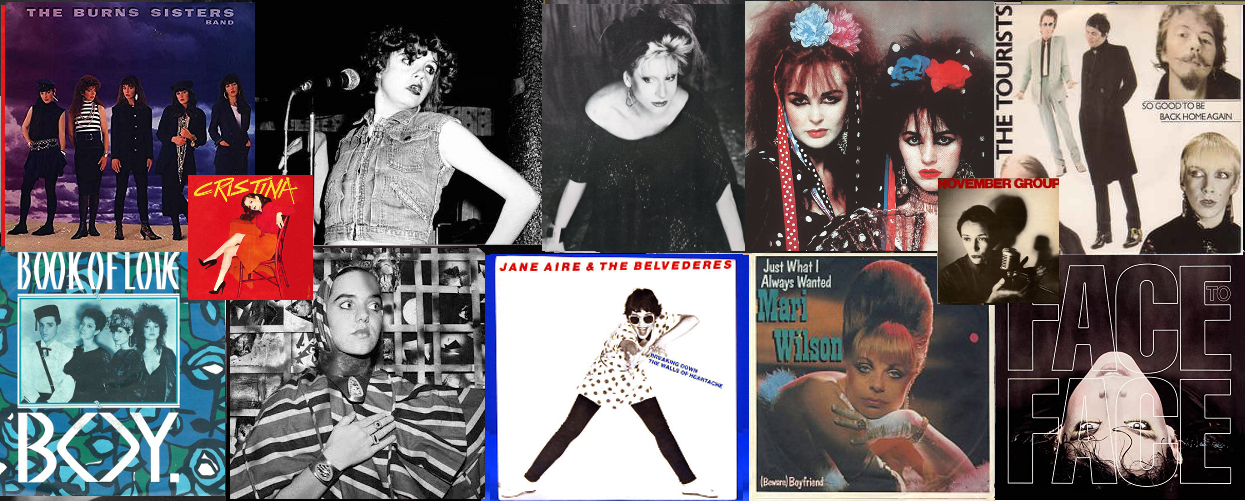
The Shirts – Laugh and Walk Away (1979)
The Shirts were the CBGB’s band that got away. Rubbing shoulders with the Ramones, Blondie and Talking Heads did not lead to worldwide success, although they garnered a few hits in Europe. Laugh and Walk Away was a single from their second LP Streetlight Shine.
Post-1981 breakup, lead singer Annie Golden’s Hang Up The Phone was a highlight of the Sixteen Candles soundtrack. Her eclectic career is now in its 5th decade, spanning film (Hair), Broadway (Leader of the Pack), and television (Cheers, Orange Is The New Black). By all accounts she’s also one of the nicest people you’d ever want to meet. And The Shirts do get back together from time to time.
Hilary – Drop Your Pants (1983)
Hilary Blake released one EP – the Stephen Hague-produced Kinetic. Both the title tune and Drop Your Pants were voted “Screamer of the Week” – the coveted top-voted song by listeners to New York’s influential WLIR alternative radio station. Drop Your Pants – with a repetitive pulsating chorus of “Drop you pants around your ankles / You make me shiver when you deliver” was Hilary’s commentary on how ridiculous the fear of sex in United States was at the time.
Hilary and Hague were married for many years but had divorced before she died of cancer in 2007.
Jane Aire and the Belvederes – Breaking Down The Walls Of Heartache (1979)
Jane Aire, aka Jane Ashley was one of several acts (The Waitresses and Rachel Sweet among them) featured on Liam Sternberg’s Akron compilation LP. Like Chrissie Hynde before her, Ashley left the wilds of Ohio to record in London, where her Belvederes were the UK band also known as The Edge: Lu Edmonds, Gavin Povey, Glyn Havard and Jon Moss (later of Culture Club).
Following a couple of Stiff singles, an LP was released on Virgin with background vocals provided by Ms. Sweet and Kirsty MacColl . The album features several choice covers: Pearl Harbour & The Explosions’ Driving, The Supremes’ Come See About Me, and this Northern Soul classic by Johnny Johnson & His Bandwagon which was also later recorded by Dexy’s Midnight Runners.
Mari Wilson – Just What I Always Wanted (1982)
Mari Wilson was the epitome of the “beehive boho cool” that Brod writes about in the New York Times piece. And the foot-high beehive was her real hair. Do other people consider this song forgotten? It’s a default earworm in my head, so my perception may be off. But I am happy to introduce it to anyone who doesn’t know it.
Just What I Always Wanted was Wilson’s biggest hit – reaching the UK top 10 accompanied by a video which gave glimpses of the dynamic stage show Mari and her Wilsations were famous for. As it turned out, being a pop star wasn’t just what she always wanted, and she moved on to successful forays in jazz and stage musicals. Wilson may not have garnered more pop hits, but her catalogue is considerable and definitely worth checking out.
Face To Face – 10-9-8 (1984)
Laurie Sargent fronted the Boston-based quintet Face To Face. In the 1984 movie Streets of Fire, the fictional band Ellen Aim and The Attackers were played onscreen by Diane Lane and the male members of Face to Face, with Lane lip-synching Laurie‘s lead vocals on several tracks. 10-9-8 was Face To Face’s debut single on Epic records and also their biggest hit – peaking at #38 on the US Billboard Top 100.
Book Of Love – Boy (1985)
Boy was the debut single by Book of Love, a New York by way of Philadelphia synthpop band fronted by Susan Ottaviano. Signed by Seymour Stein to his Sire records, the band gained exposure opening for Depeche Mode on their 1985 & 1986 tours.
Although Boy was popular enough in NY to become a WLIR “Screamer of the Week” in February 1985, the song did not chart nationally until 2001, when a Peter Rauhofer remix topped the U.S. Dance Charts. In a 2016 Village Voice interview, keyboardist/songwriter Ted Ottaviano revealed that the song was written about the gay East Village night spot Boy Bar.
Burns Sisters Band – I Wonder Who’s Out Tonight (1986)
Nowadays, Ithaca New York’s Burns Sisters are a well regarded folk duo with 10 albums under their belt. Back in the mid-80’s, The Burns Sisters Band launched as a quintet of siblings giving the Bangles a run for their money. Marie, Annie, Jeannie, Sheila and Terry had the WLIR “Screamer of the Week” with this single in July of 1986 – perfect listening while takin’ the time to do your hair / puttin’ on something HOT to wear.
The Tourists – So Good To Be Back Home Again (1980)
The Tourists’ output included three LPs and a handful of hit singles in their native UK. A peppy cover of Dusty Springfield’s I Only Wanna Be With Youscraped the US charts as well. Keyboardist Ann Lennox shared lead vocal duties with guitarist Pete Coombs. There was also a guy named David Stewart in the band. After The Tourists split in 1980, David and Ann went on to do some other stuff you may have heard of, but their Tourists output is seldom mentioned and definitely worth a revisit, starting with this track – a top 10 hit in the UK and Ireland.
Put Your Back To It – November Group (1983)
I actually ventured into the comments section of the NYT article (I know – the comments section can be a scary place. But for the most part, this time it wasn’t.) There were quite a few mentions of this alt band from the Boston new wave scene. November Group formed in the early 1980s with Ann Prim and Kearney Kirby, both previously of Wunderkind. Put Your Back To It was a single from their second LP- Persistent Memories.
Suburban Lawns – Janitor (1981)
“What do you do?”
Su Tissue was trying to have a conversation in a noisy room. She misheard the response “I’m a janitor” as “Oh, my genitals.” And a song chorus was born.
Suburban Lawns was formed in Long Beach, California in 1978 by CalArts students William “Vex Billingsgate” Ranson and Sue “Su Tissue” McLane. Their first single Gidget Goes To Hell may be more likely to turn up on new wave compilations, but Janitor – the lead single from their self-titled IRS LP – is an overlooked gem.
Cristina – Is That All There Is? (1980)
This slashing cover of the Peggy Lee classic was produced with broken glass and cuckoo clocks by August Darnell, a.k.a. Kid Creole. When the single was originally released in 1980, songwriters Lieber and Stoller successfully sued to have it withdrawn, objecting to the lyric changes embracing drugs, physical abuse and *gasp* the club scene. They later changed their mind.
Cristina, aka New York socialite Cristina Monet-Palaci Zilkha recorded two highly regarded but commercially unsuccessful albums for ZE records before turning her attention elsewhere. She succumbed to coronavirus at the age of 64 on March 31, 2020.
And as sure as I’m standing here talking at you, I was not ready for that kind of a come down.
Strawberry Switchblade – Let Her Go (1985)
Strawberry Switchblade – Jill Bryson and Rose McDowall – were a Glasgow duo formed in 1981. They released one album and had a top 5 UK hit with Since Yesterday. Follow-up single Let Her Go and a synth-pop cover of Dolly Parton’s Jolenealso charted – especially in Japan – before the duo split in 1986. Both continued to make music but were unable to recreate their Switchblade success.
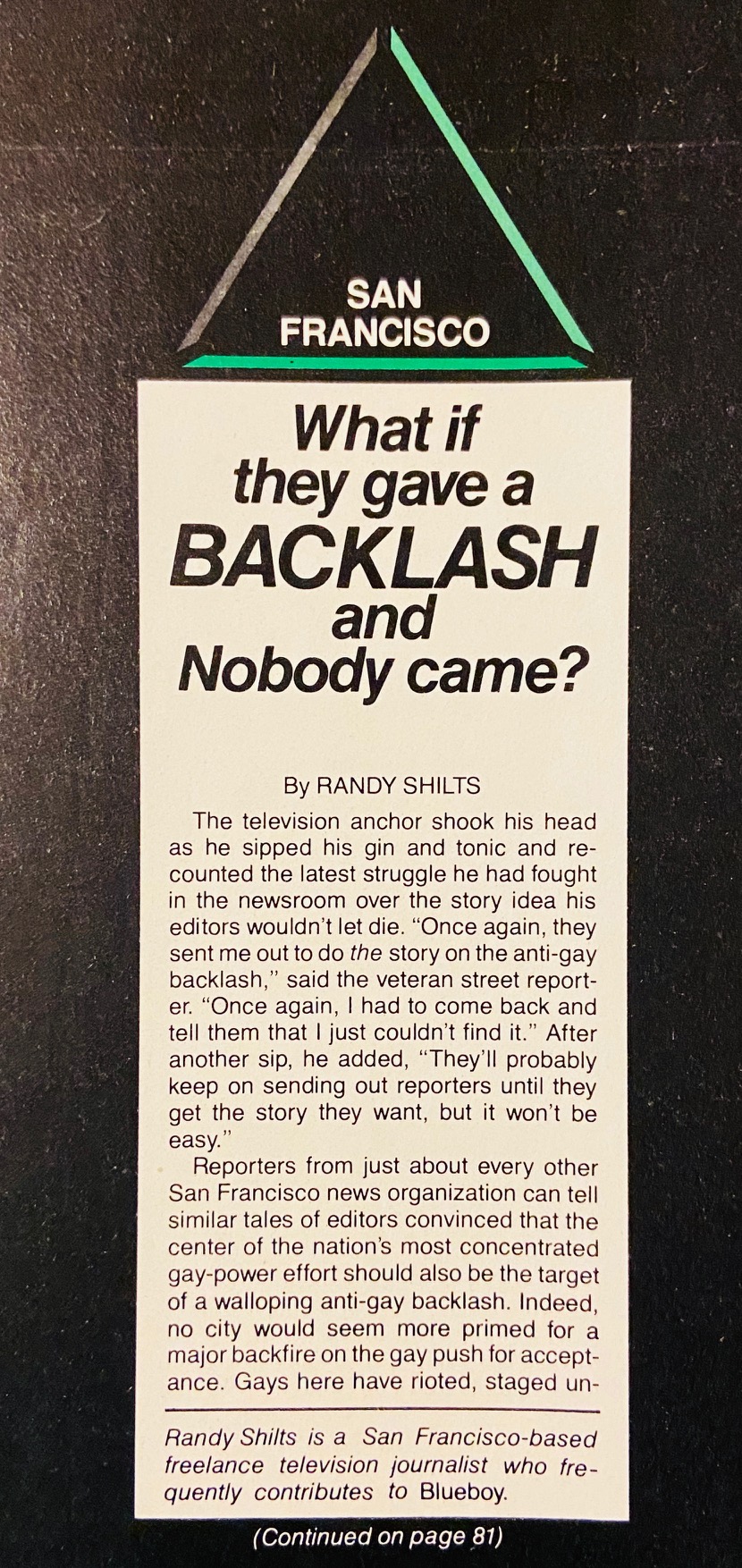
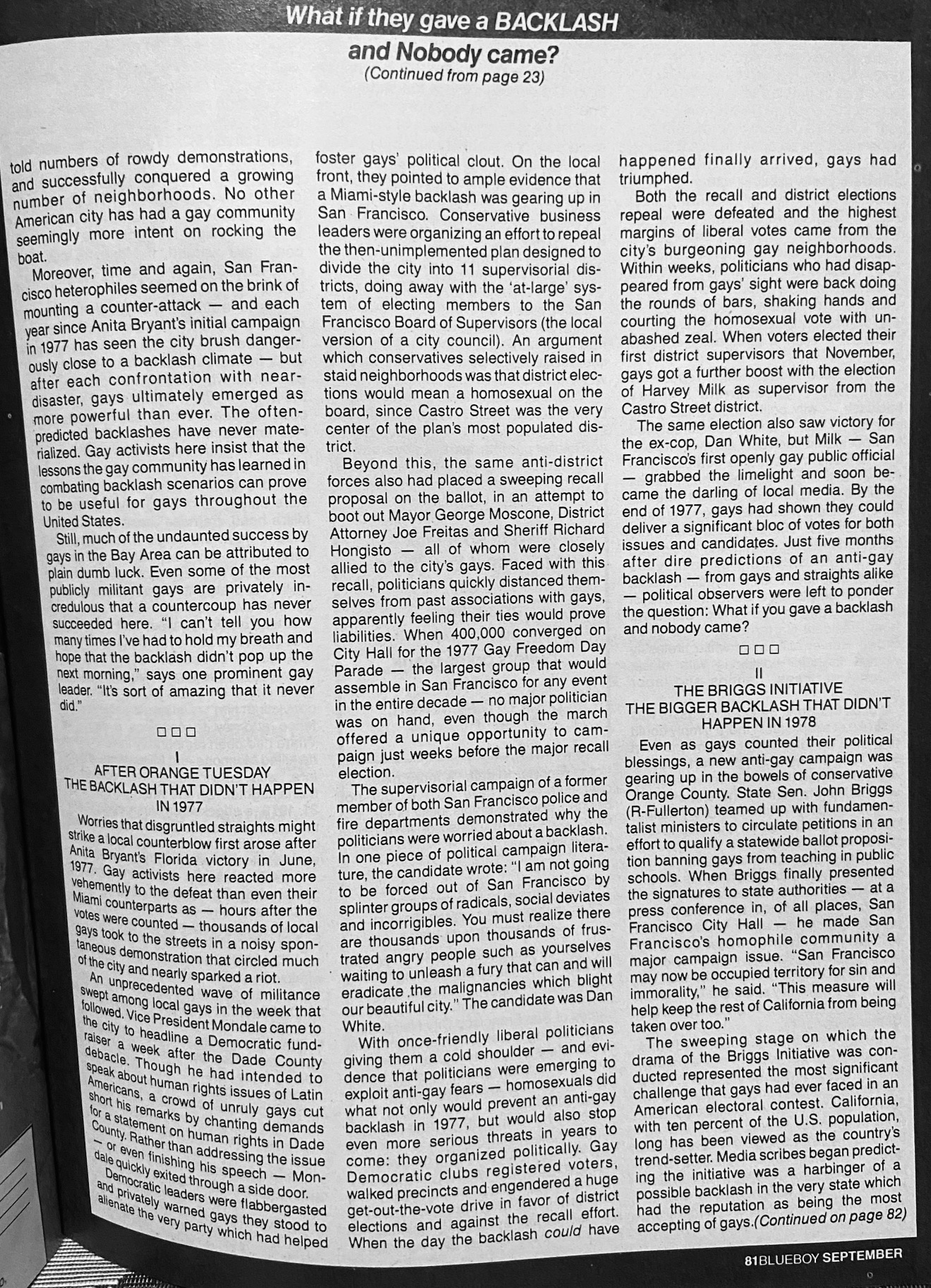
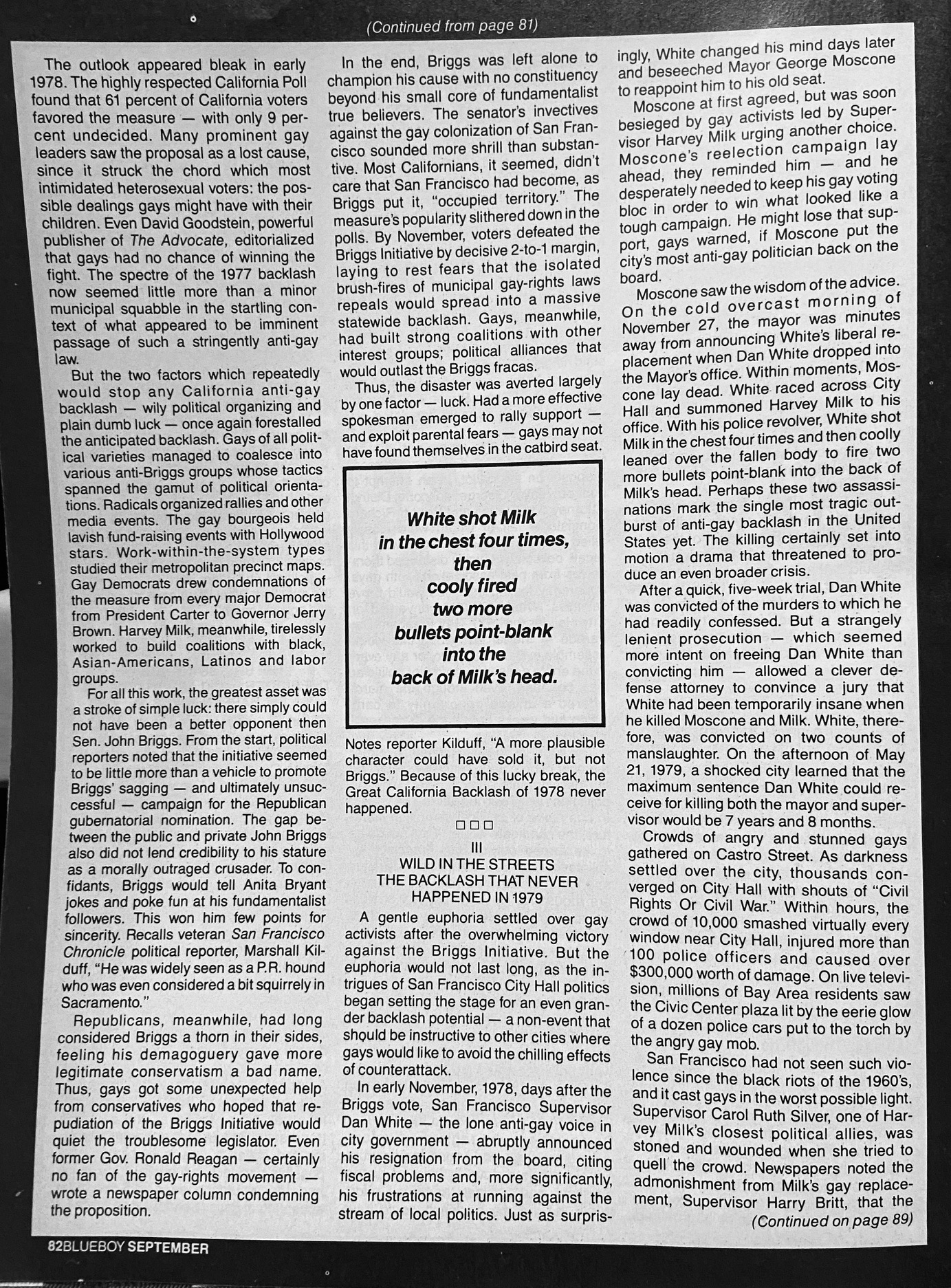
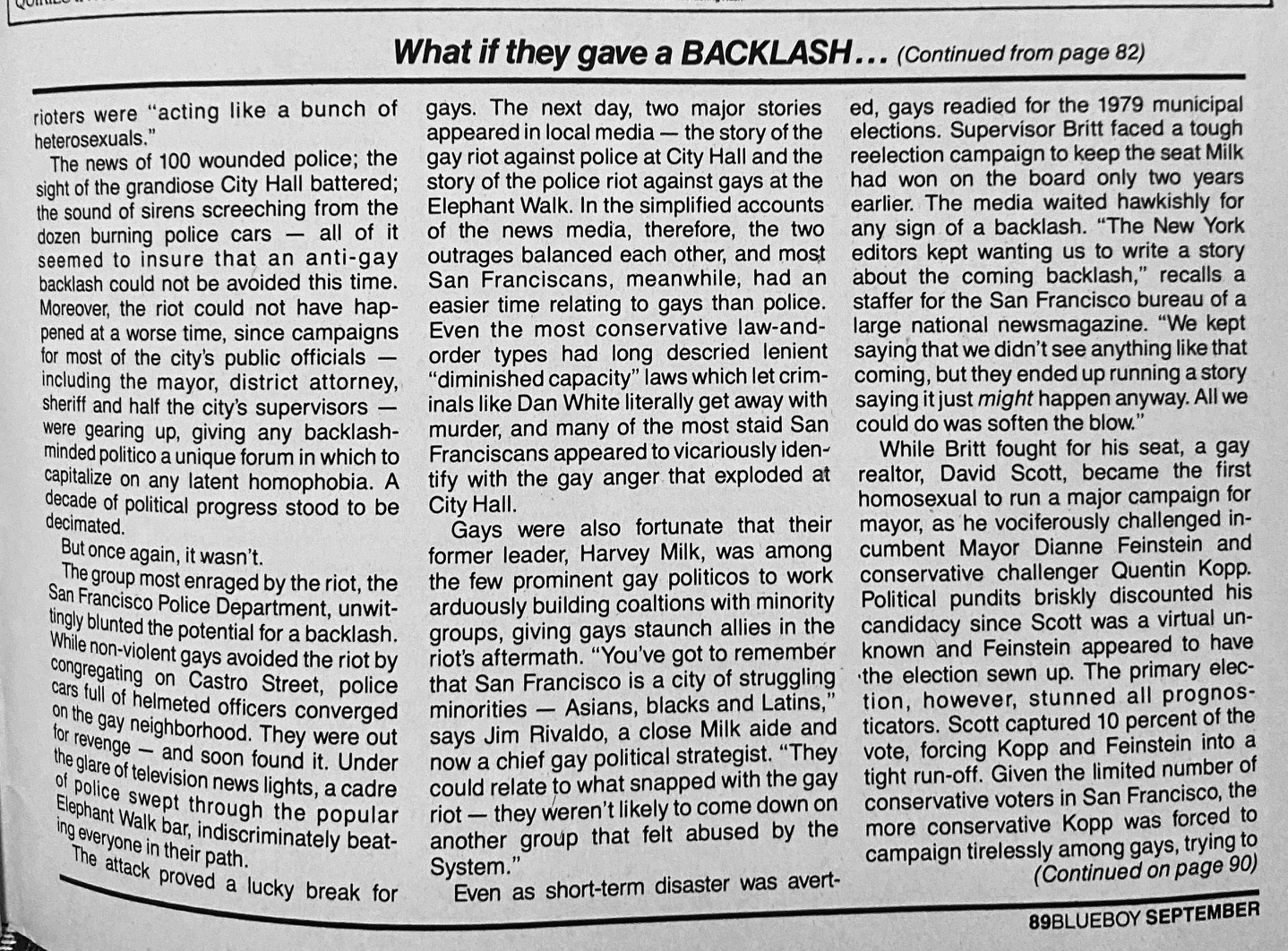
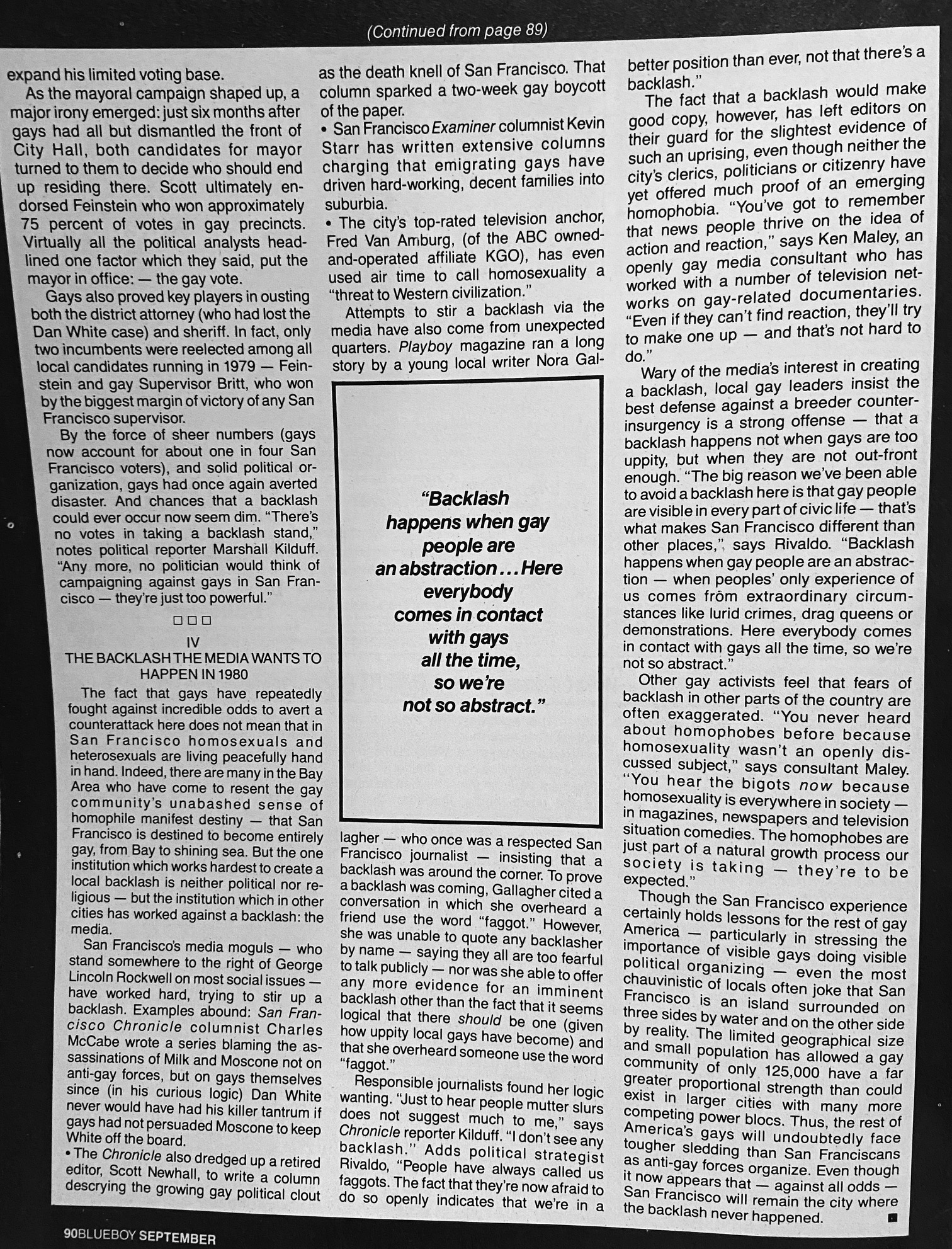
A recent post – the one featuring an essay written by Armistead Maupin for the September 1980 issue of Blueboy Magazine – was my most-viewed ever. This was thanks in part to links from Queerclick and KennethInThe212. I threatened to upload another article from the San Francisco-themed issue written by Randy Shilts: “What If They Gave A Backlash And Nobody Came?” Several people requested it, so here it is.
But first… a couple of other items of interest from this same issue:
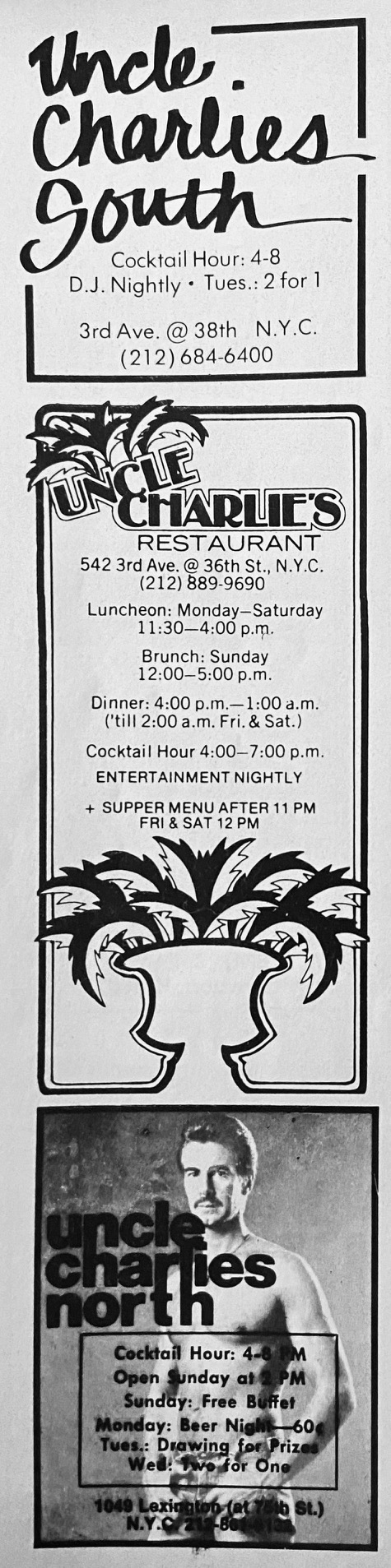
There used to be a whole lot of Uncle Charlies in New York City! None of those advertised above is the one that lasted longest: The Uncle Charlies bar on Greenwich Ave. in the West Village, which closed in 1997. And then there’s the one that has been on E. 45th st for 10 years now.
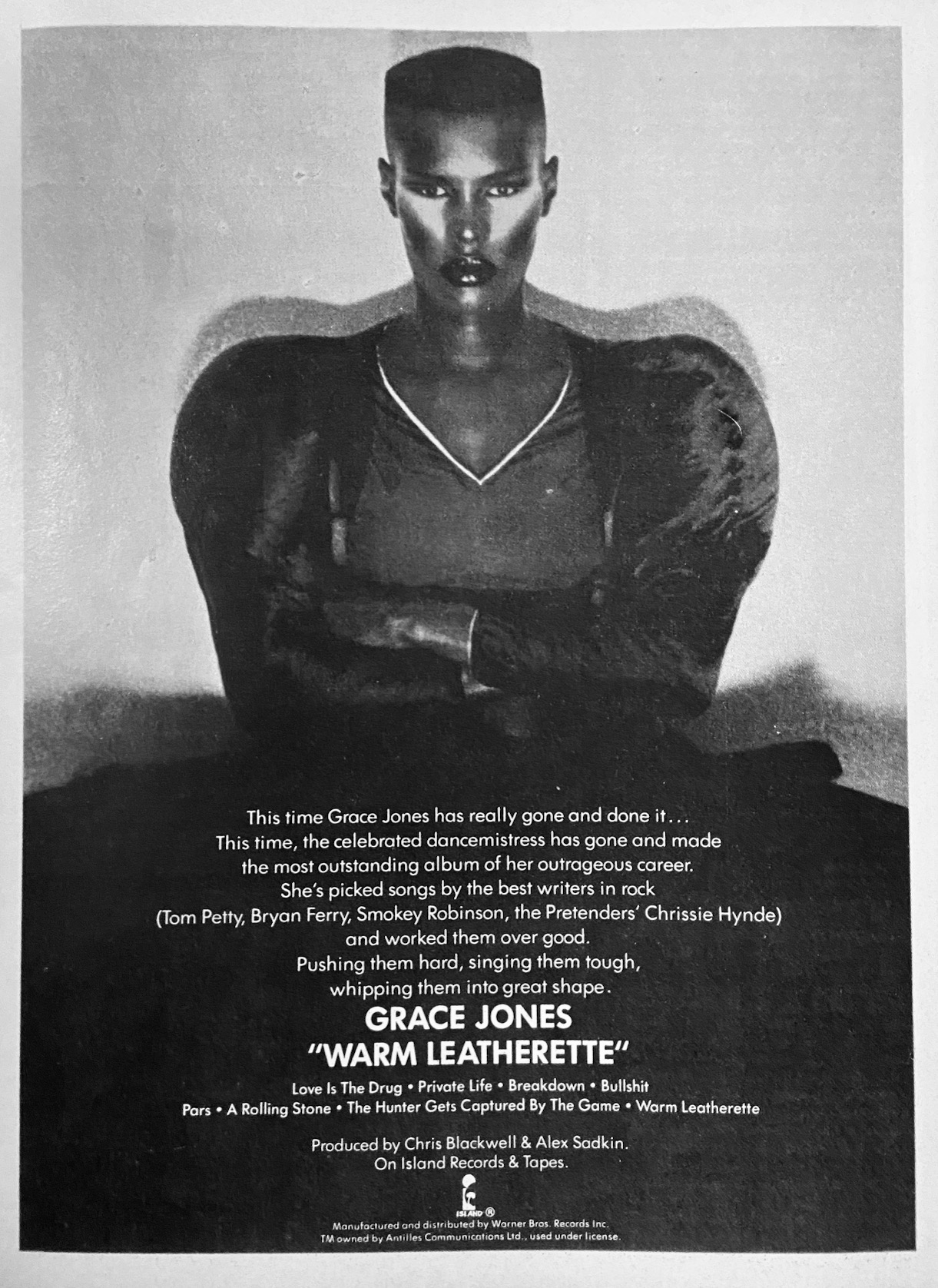
And Look! It’s an advertisement for Grace Jones’ fourth LP… her first good album!
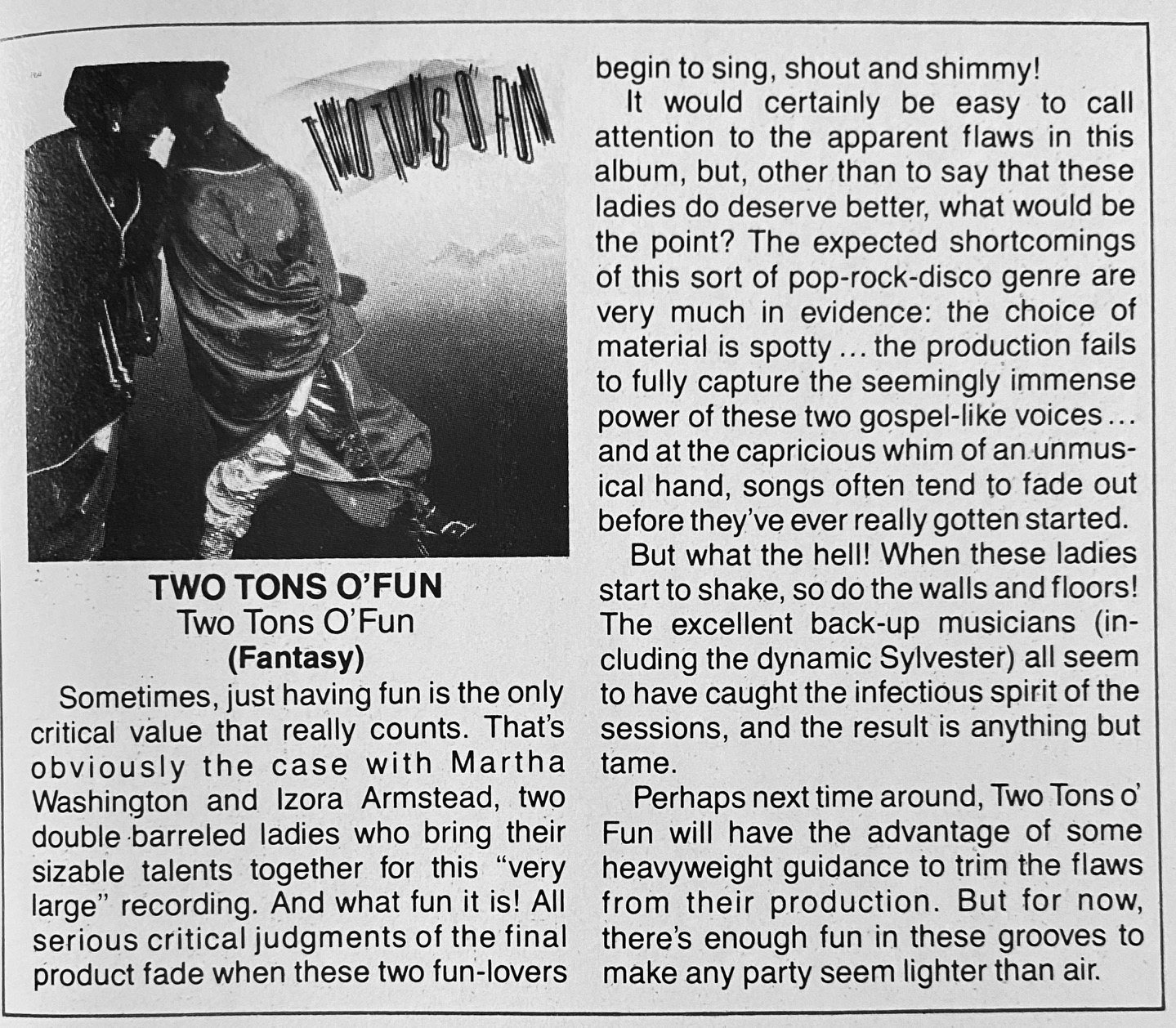
Record review: San Francisco’s very own Two Tons O’Fun. Izora Armstead and Martha Wash had been Sylvester’s backup singers. They soon changed their name to The Weather Girls when it started raining men… and the rest is history. Hallelujah!
10 time capsules from PM Productions. Check ’em out! They’re a hoot. And Christopher Street Blues has a zippy little theme song.
And now for our feature presentation. This article recounts several significant incidents where backlash against the San Francisco gay community was anticipated, but did not happen. It’s interesting to read Shilts’ account of what had been accomplished up to this point in time – with no idea that they were standing on the precipice of a health crisis that would decimate the community and undo so much of the work towards assimilation that he was highlighting.
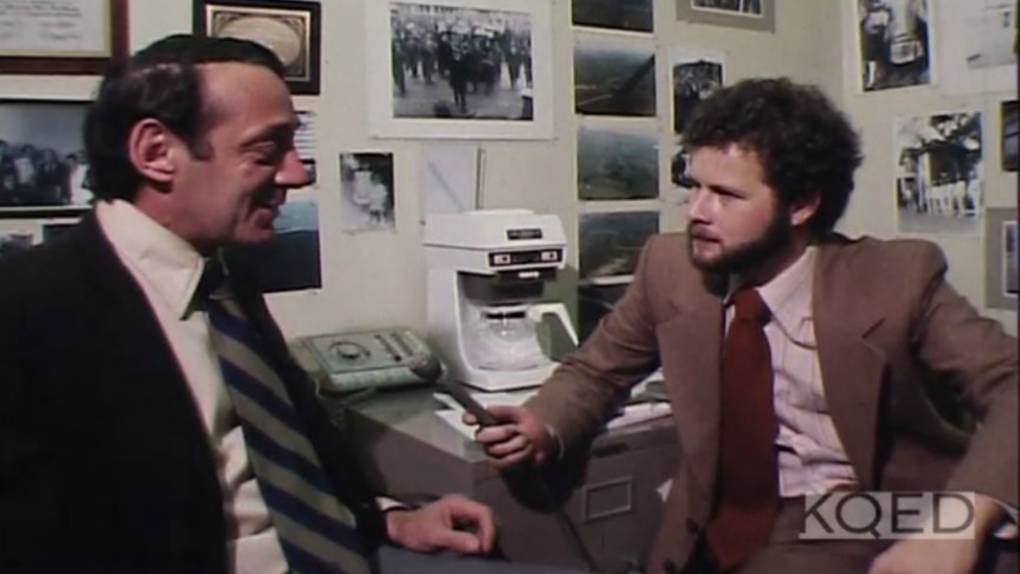
Randy Shilts Interviews Harvey Milk (1977/78)
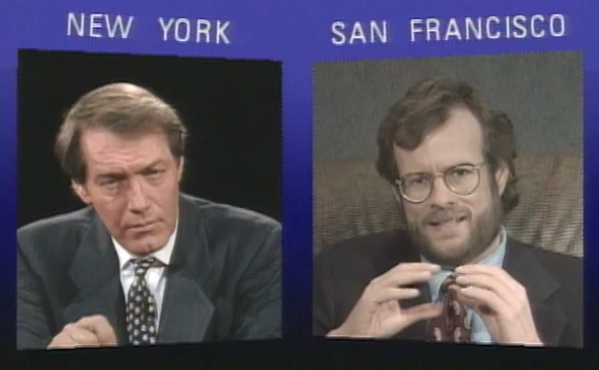
Randy Shilts on The Charlie Rose Show (1993)
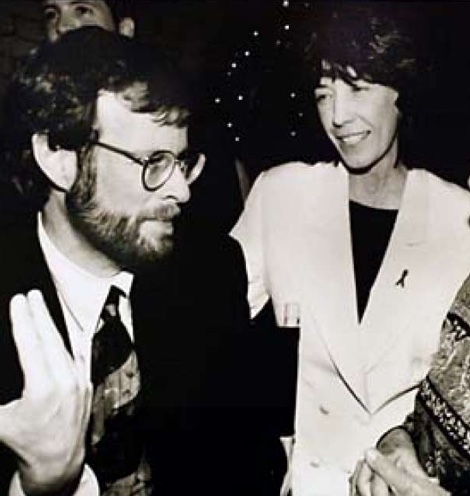
Randy Shilts with Lily Tomlin (1993)
Shilts would go on to write three books, all important documents of gay history: The Mayor of Castro Street – a Harvey Milk bio, And The Band Played On, which chronicled the early days of the AIDS epidemic and Conduct Unbecoming: Gays and Lesbians In The Military. He died of AIDS complications in 1994.
Just imagine what he would have to say about the current administration. Or Mayor Pete. Picture him as a frequent guest on Rachel Maddow. His voice is sorely missed.
What a difference a week makes! It has only been 10 days since my original article about Don Herron’s Tub Shots was posted to coincide with the opening of the Daniel Cooney Fine Art exhibit. The article was then re-posted on Queerclick, while Out magazine posted their own piece about the gallery exhibit, as did numerous art photography websites and blogs. Each time I do a Google search, I find more information about Don Herron and his series of photos, which had very little internet presence up to this point.
The digital skeleton of the Village Voice even resurrected their feature from April, 1980. This is curious, considering a) The paper had been declared officially dead two weeks ago, and b) One of the subjects in their 23 photo spread sued for invasion of privacy when it was published the first time, claiming that the model release form was forged.
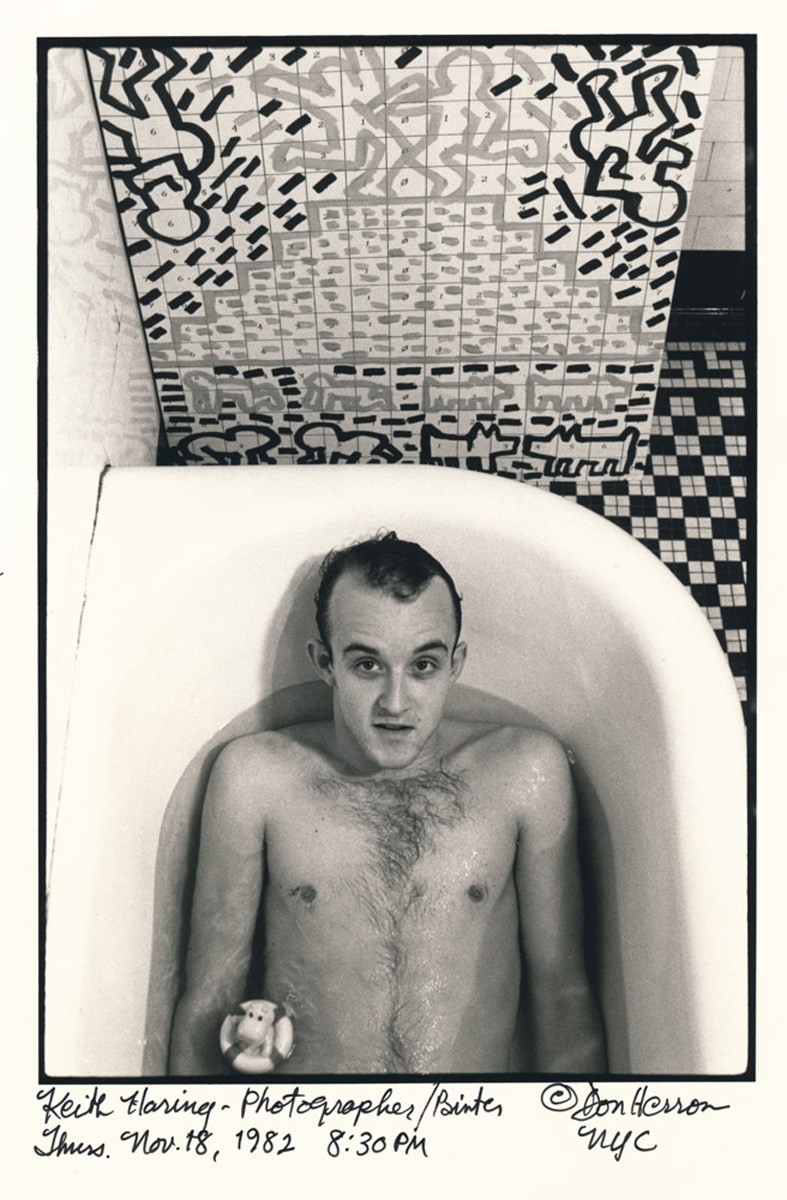
Some alternate pics have surfaced of the ubiquitous Tub Shots featuring Keith Haring and Robert Mapplethorpe:
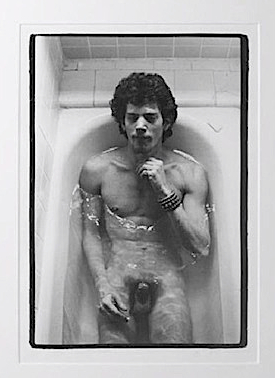
In a letter to a friend, Herron recalled; “I photographed Robert Mapplethorpe in San Francisco in February, 1978. He was having a show of photos at the Edward de Celle Gallery and we had met at his opening the night before.
“I was to photograph him at 3pm the next day in his hotel room, at at 3 Robert wasn’t in his room, so I waited in the lobby. At 3:15 he walked in and apologized: he had forgotten all about the shoot and was just getting in. As I photographed him in his bathtub he kept saying that he couldn’t remember much about his opening the night before or much about our conversation at the gallery, but if I was willing to photograph him in his current condition he was willing to pose.”
Daniel Cooney Fine Art posted several Instagram photos from the September 13th exhibit opening with original subjects standing next to their photos.
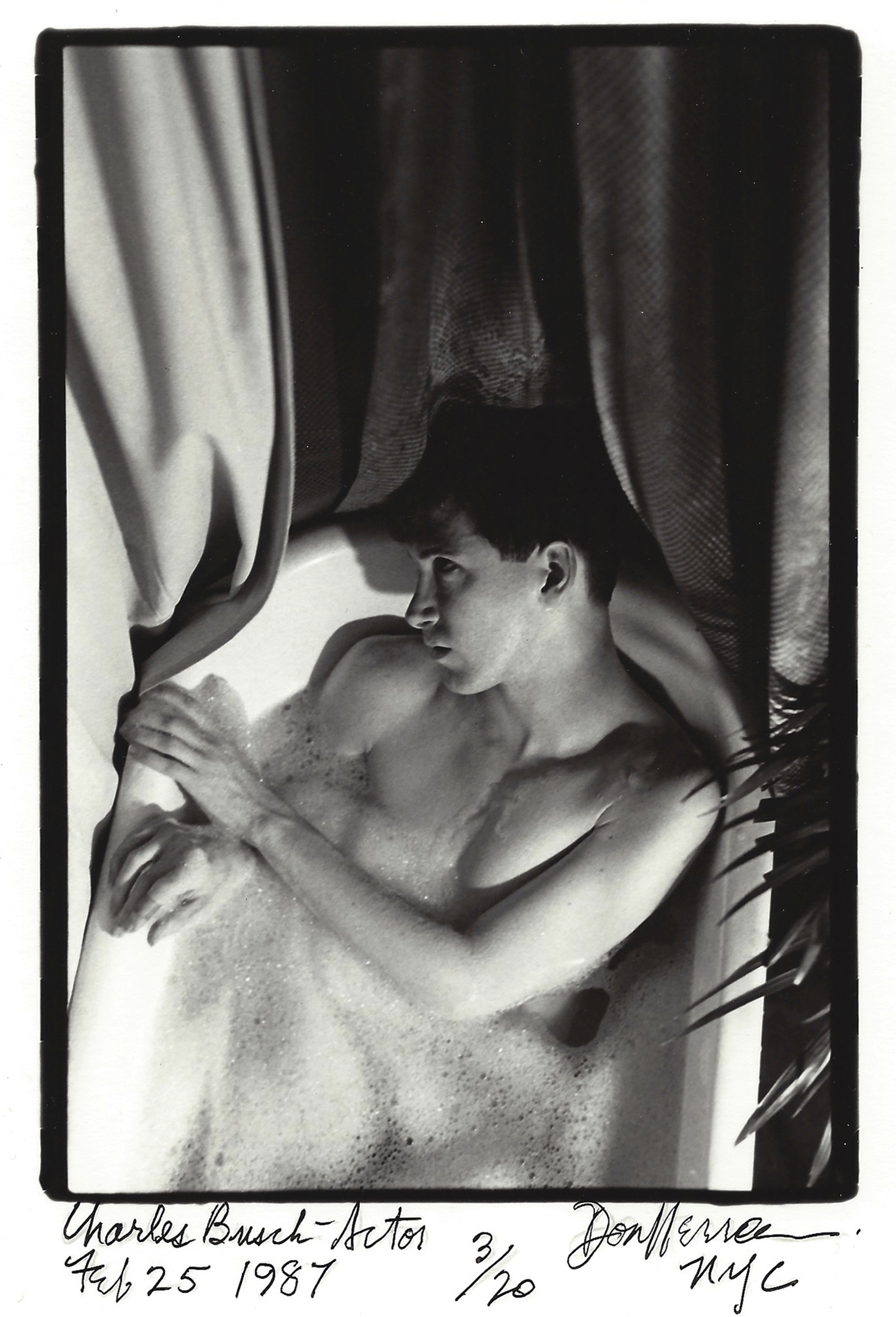
Left to right: Charles Busch, Agosto Machado and Michael Musto:
Here’s a little more info about some of the other luminaries featured in Tub Shots :
Robert Opel (1939-1979) was a conceptual artist, Advocate photographer and gay rights activist who achieved notoriety when he streaked through the 1974 Oscar Ceremony. He launched the first openly gay art gallery in San Francisco, where he was murdered in 1979. He is the subject of Uncle Bob, a 2011 documentary directed by his nephew Robert Oppel.
ActressMink Stoleis one of John Waters’ Dreamlanders and has appeared in all his films, most notably as Connie Marble in Polyester, Taffy in Female Trouble and Dottie Hinkle in Serial Mom. She also played Aunt Helen in all of the Eating Out films.
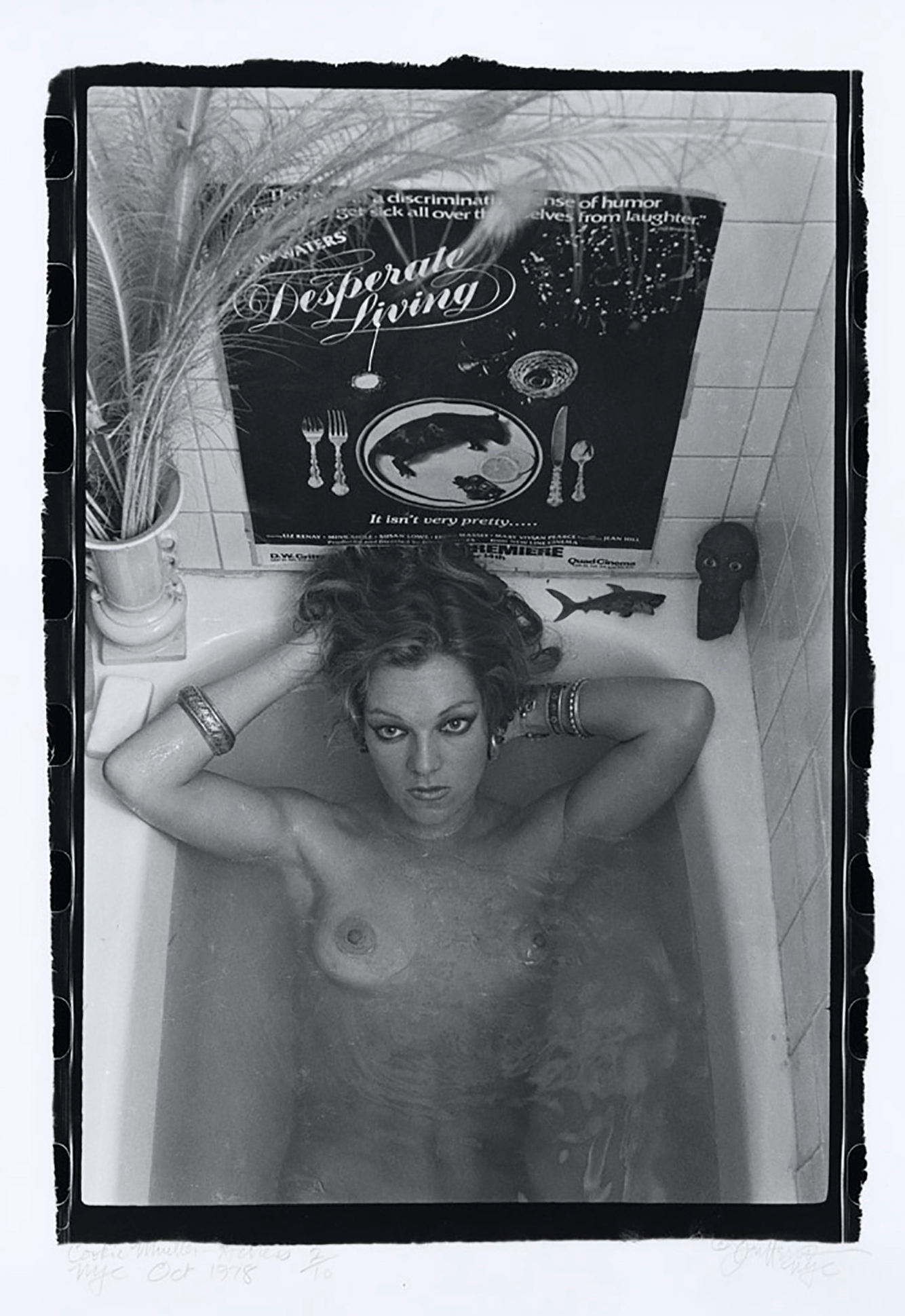
Cookie Mueller (1949-1989) was another John Waters Dreamlander who appeared many of his films, including Pink Flamingos and Desperate Living – her Tub Shot includes the poster for the latter. She also penned a column for The East Village Eye and half a dozen books.
Victor Hugo (1942-1993) was a Venezuelan artist, window dresser and nightlife personality. Hugo designed window displays for his partner Halston‘s Madison Avenue store. He later became one of Andy Warhol’s assistants at The Factory where he worked on the oxidation paintings. As a model, he also appeared in Warhol’s Torso and Sex Parts series.
As the different subjects recount how they got involved in the project, a thread emerges: Robert Mapplethorpe brought in Felice Picano, who in turn suggested Victor Hugo and George Stavrinos, who then connected Mel Odom. (Read part 1 of this post for more on them)
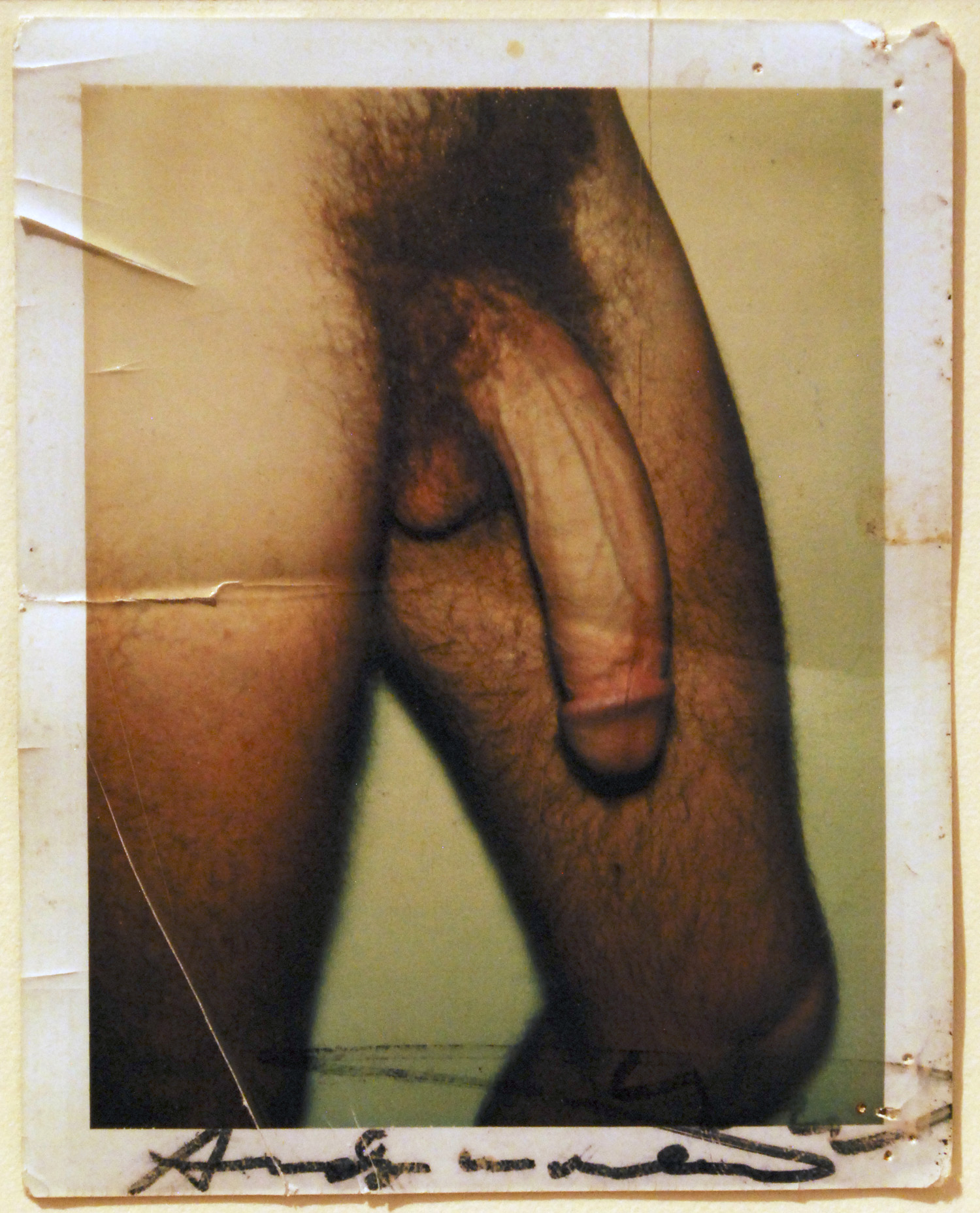
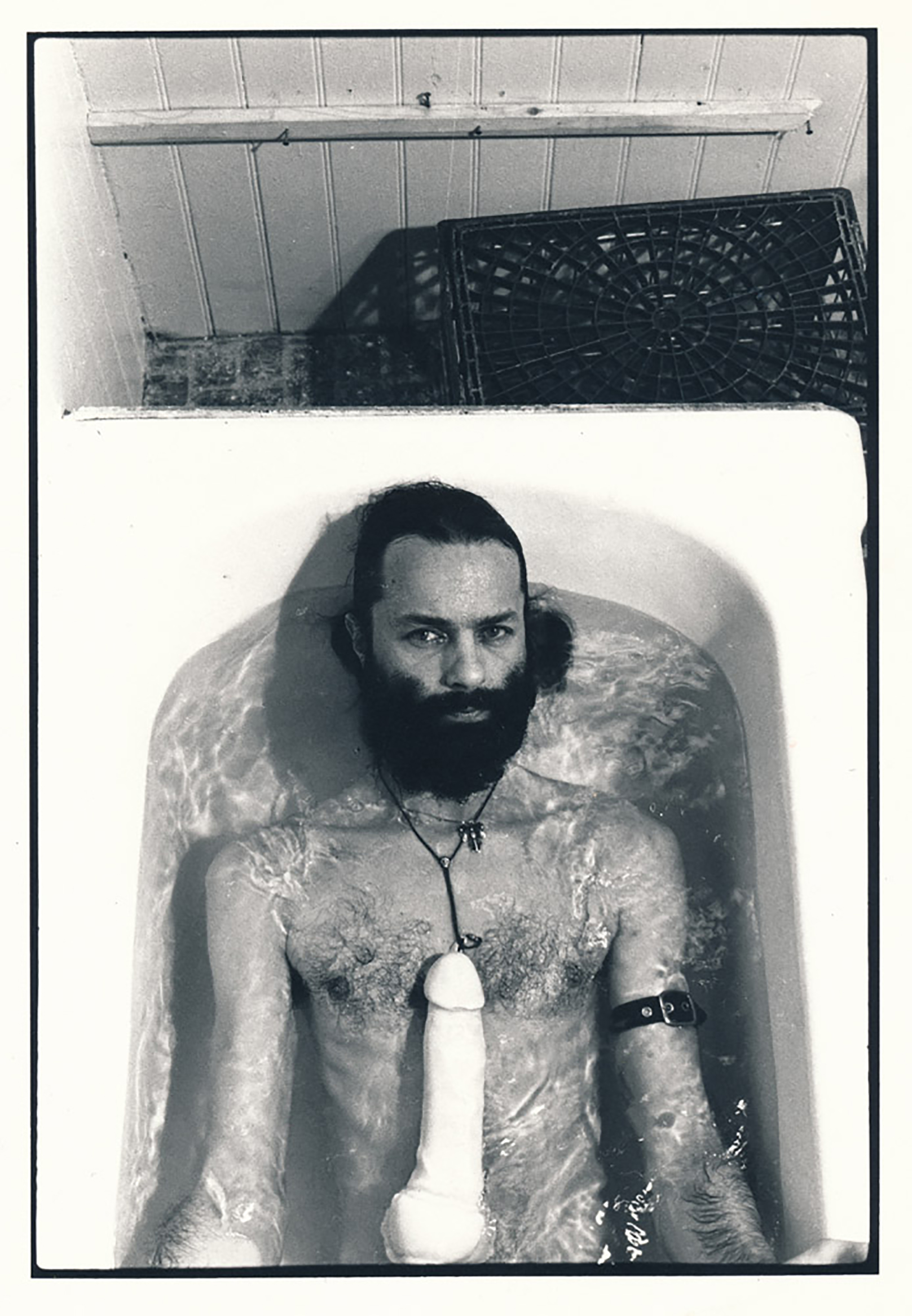
Peter Berlin‘s statement about Don Herron and his Tub Shots is exactly what you would expect from the legendary narcissist:
“He may have approached me for sex and then asked to take my photo. I have no recollection of him or the photo shoot.
At the time, I never cared for photos taken by other photographers, not even Mapplethorpe’s photos of me. I realized how critical I was looking at my image, so I probably would have seen this photo and not liked it. Looking at the photo now, I don’t mind it. It’s not a typical Peter Berlin photo that I would have taken of myself. I like everything but the dick and my expression in the face. But I have no recollection at all of him or this shoot.”
The Daniel Cooney Fine Art exhibit with 65 of these photos at their gallery in New York City runs from September 13 until November 3, 2018. Contact the gallery for reservations via phone at 212-255-8158, via email dan@danielcooneyfineart.com or give them a visit at 508-526 West 26th St., #9C, NY NY.
Congratulations to the late Mr. Herron on this recent rediscovery of his work. As artist Adam Donaldson Powell posted in the comments of Part 1: “…he deserves due credit now. His other paintings and silk screen art were even more impressive than Tub Shots. I would love to see that work praised online as well.” We shall see…
A recent Out Magazine article about Felice Picano featured a 1980 photograph of the author lounging in his bathtub with a cigarette and a glass of wine. I immediately recognized the photo as one of Don Herron’s Tub Shots, a series that the photographer snapped over a 20 year period, spanning from San Francisco to New York and covering a wide swath of his legendary friends, lovers and fellow artists.
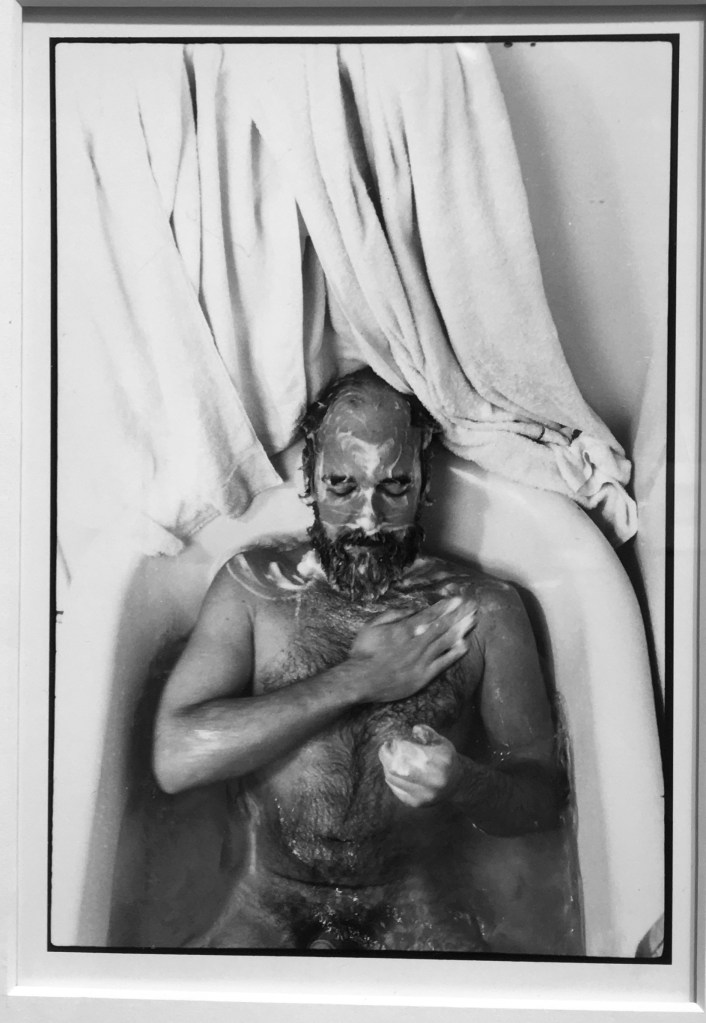
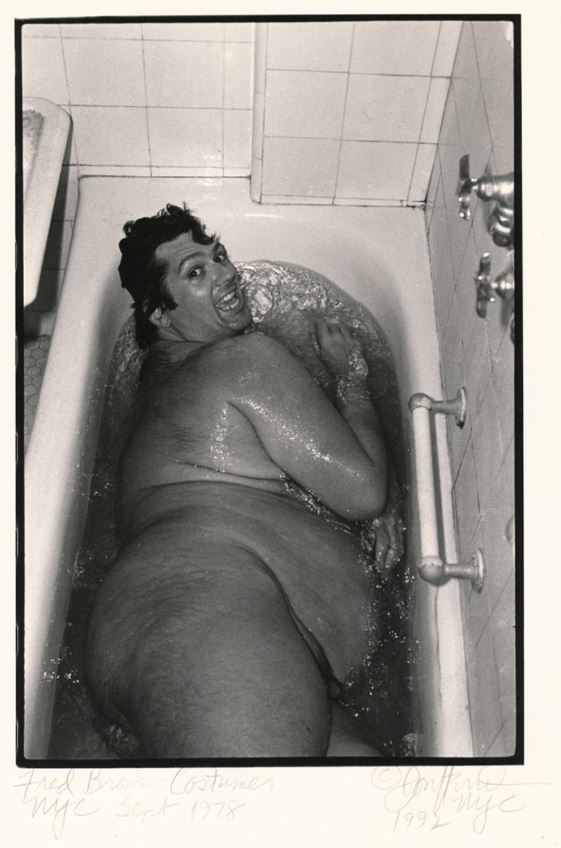
Don Herron (1941-2012) was living in San Francisco in the early 1970’s when he began shooting the bathtub photos, having been inspired by medieval sculptures set in niches. Herron told the Village Voice in 1980, “I decided to do a series of photographs of people in containers. The bathtub was the logical container to use. I started with my friends and it grew from there.”
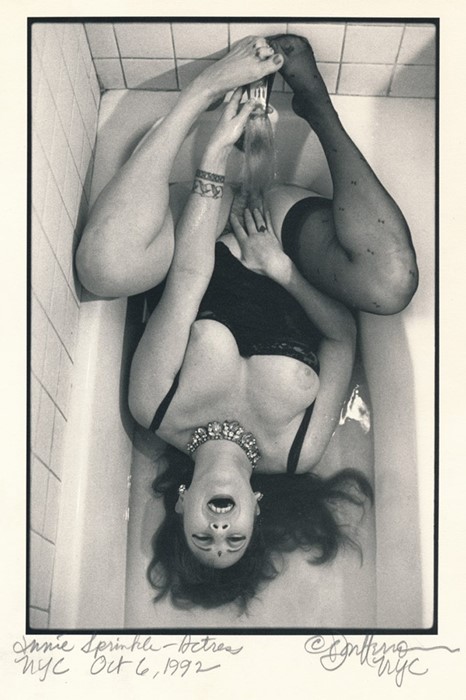
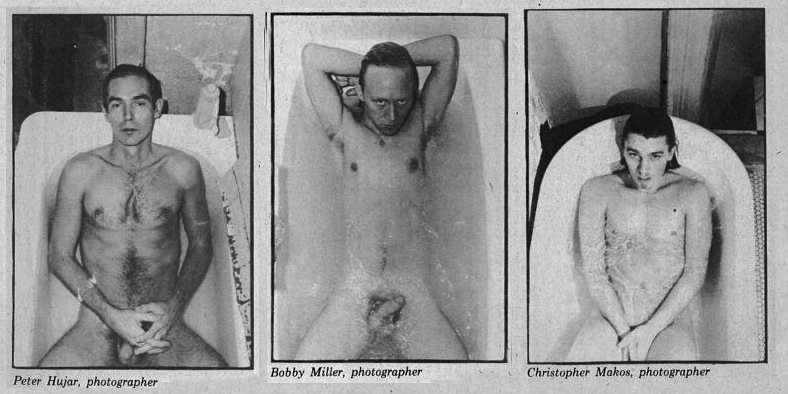
He continued the series after moving to New York City in 1978, where he was a part of the vibrant East Village art scene. Among the many who posed on the porcelain for Herron: Keith Haring, Peter Hujar, Robert Mapplethorpe, Annie Sprinkle, Peter Berlin, Ethyl Eichelberger, Michael Musto, Phoebe Legere, John Waters’ leading ladies Mink Stole and Cookie Mueller as well as Warhol factory superstars Jackie Curtis, Taylor Mead, and Holly Woodlawn. The Tub Shots were featured in the Village Voice, New York Magazine, Christopher Street and Art Forum.
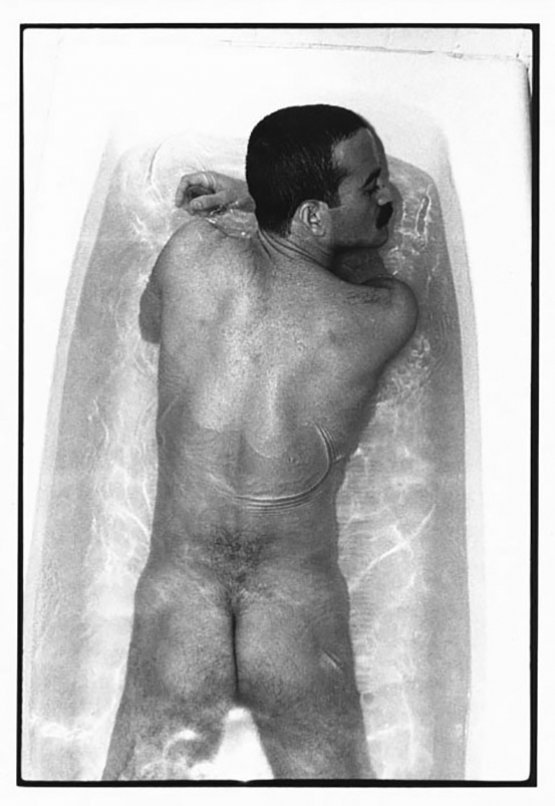
My first encounter with the photos were a couple of postcards I picked up in an East Village shop back in the late 1980’s. I had just finished reading David Kopay’s autobiography and was quite happy to see (almost) all of the gay footballer on display. Another card I purchased was of a director named Robert Schifflett, about whom I know nothing other than the charms on exhibit in the photo and his ability to hold his breath.
Recalling his bathtub session with Herron and the noir photo it produced, performer Charles Busch recently said “My crummy 12th Street tenement tub amazingly looks kinda glam. If memory serves, after we called it a wrap I believe the charming photographer ended up in the tub with me. I think so.”
Another subject was artist Mel Odom, whom I recently asked about the experience.
“George Stavrinos dared me to do it;” he said “But I’ve never seen one of him!”
“Don did two shoots with me – the first one was without the mask. He wasn’t satisfied with that and we did a second shoot. He was probably right.”
“My parents didn’t know that I had posed nude and it was published in the Village Voice just as I went home to visit them in Ahoskie, North Carolina… and there was the issue sitting on their friend’s coffee table!” Odom managed to pilfer the newspaper and, as far as he knows, his parents never found out about the photo.
Odom’s Tub Shot was also reprinted as a full page when the series was profiled in the April, 1980 issue of Christopher Street. When I mentioned the postcard series that was my introduction to the photos, he recalled “Mine wasn’t used for the postcards because I received weird phone calls after it was printed in the magazines. ‘Hey! Are you naked like you were in the Village Voice?’ I got letters from prisoners, too.”
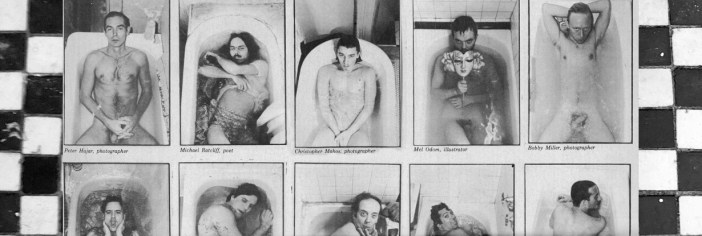
Here’s the Village Voice feature from April, 1980:
I still have the Kopay and Shifflett postcards I bought 30 years ago. Every once in a while, I Google around looking for other Tub Shots online. With the exception of the Mapplethorpe and Haring photos below, they are fairly obscure in the digital age.
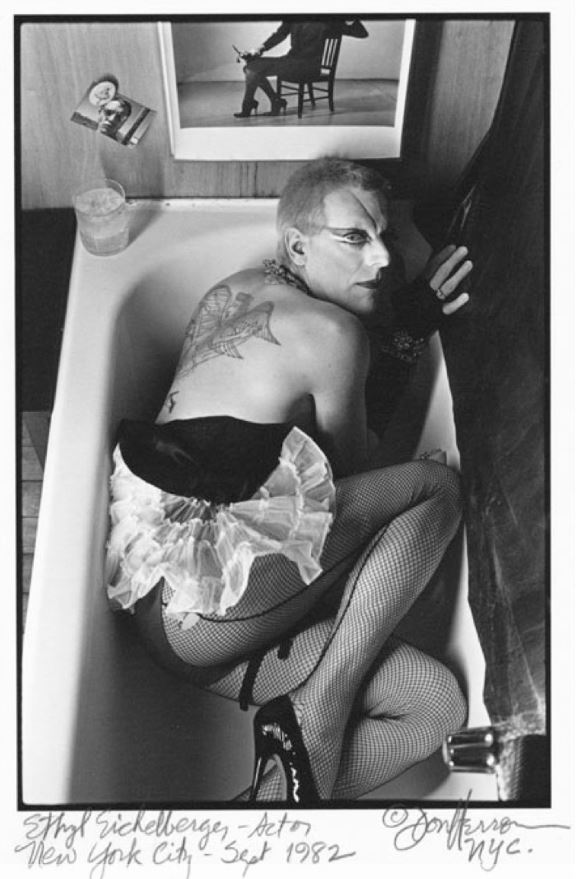
Random pics pop up on Pinterest – this one of Ethyl Eichelberger, for example – but I have not found any online collections.
When Herron passed away a few years ago, his ex-lover, artist Adam Donaldson Powell paid tribute to him here. Herron’s estate has created a Tub Shots website but there is currently no content.
That might be about to change. Daniel Cooney Fine Art will be exhibiting 65 of these photos at their gallery in New York City from September 13 until November 3, 2018. Interested viewers may contact the gallery for reservations via phone at 212-255-8158, via email dan@danielcooneyfineart.com or give them a visit at 508-526 West 26th St., #9C, NY NY.
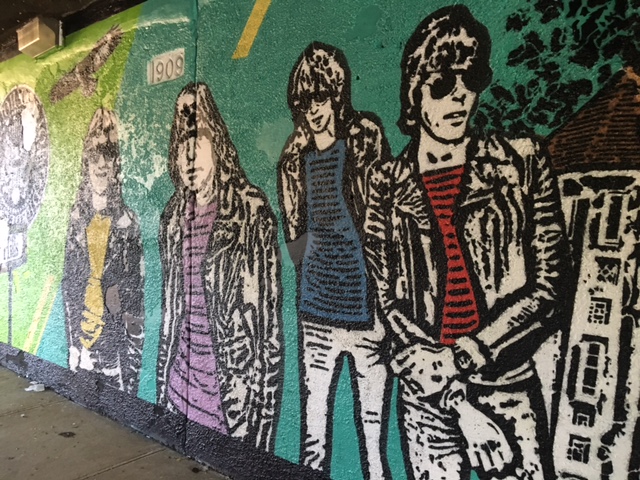
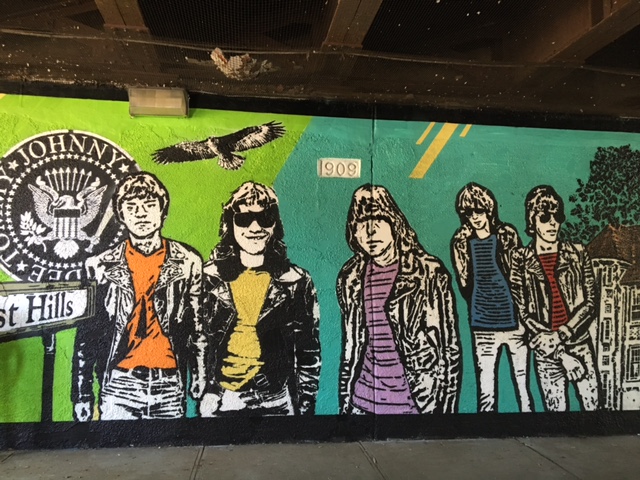
“DUDE! Dude. Duuuuuuuude. Remember that notice on the bulletin board at Parsons? About the Ramones mural in Forest Hills? DUDE! I got it! I totally fucking got it. Totally painting it. Yeah – I love the Ramones. Totally built my 80’s playlist around them on Spotify. I’m tellin’ ya, dude… every time My Sharona comes on, I totally have to stop what I’m doing and CRANK. IT. UP.
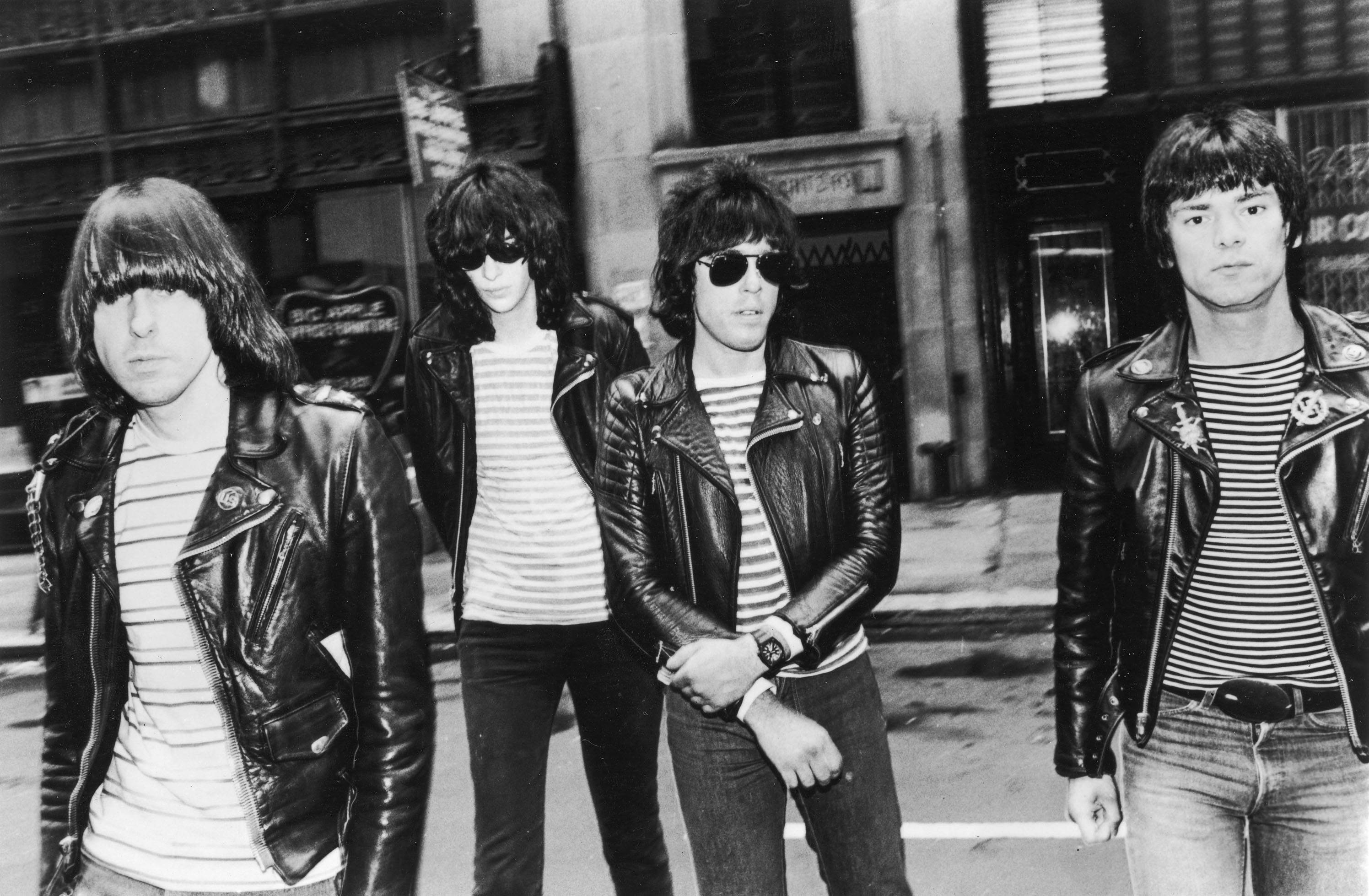
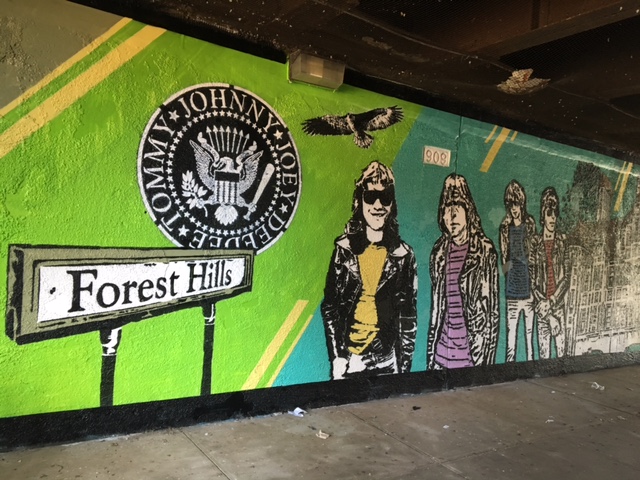
“So I went on Google Images and found this cool shot I wanna use… and they approved it but they said that the second drummer is in the pic. Marky – the replacement guy. So I gotta take him out and find a pic of the first drummer, cuz the original band is from Forest Hills, right? That’s why they’re paying for a mural in the train underpass. Dude, it’s gonna be AWESOME.
“So I projected the picture on the wall to trace it and I did my thing, man. Totally smoked and painted in the underpass all day, ridin’ the buzz and listenin’ to tunage. Awesome. Like every day should be, right? I was totally stoked just makin’ art and gettin’ PAID, man! And I added a hawk flying overhead in the mural cuz AMERICA, man!
“So… two days later I start gettin’ phone calls. Dude. They are going ballistic because I left out fuckin’ Dee Dee Ramone instead of Marky, the second drummer. There’s TWO drummers on the wall, man, and NO bass player. How shitty would that sound? And Marky’s from Brooklyn. Doubleyou Tee Eff, Man. The fans and Dee Dee’s family are calling them and pissed off and crying and shit…
“I mean how the fuck was I supposed to know? I’m like – they all dressed the same and Marky’s wearin’ shades so maybe lets just say it IS Dee Dee, right? Like, who really gives a shit? That’s what I said! But no good.
“So now I gotta go back and add fuckin’ DEE DEE to the mural. Not so much fun the second time around, man. I set up my projector and traced out the biggest fuckin’ Dee Dee you’ve ever seen. I was pissed! He’s blocking the logo, man! Covered up Joey’s name. Plus Joey’s kinda in the background like in the picture anyway but at least Dee Dee’s there, right? A big fuckin’ Dee Dee.
“Never again, dude. Whatever. As they say, ‘Hey Ho! Never mind the bollocks!'”



































 eter Berlin