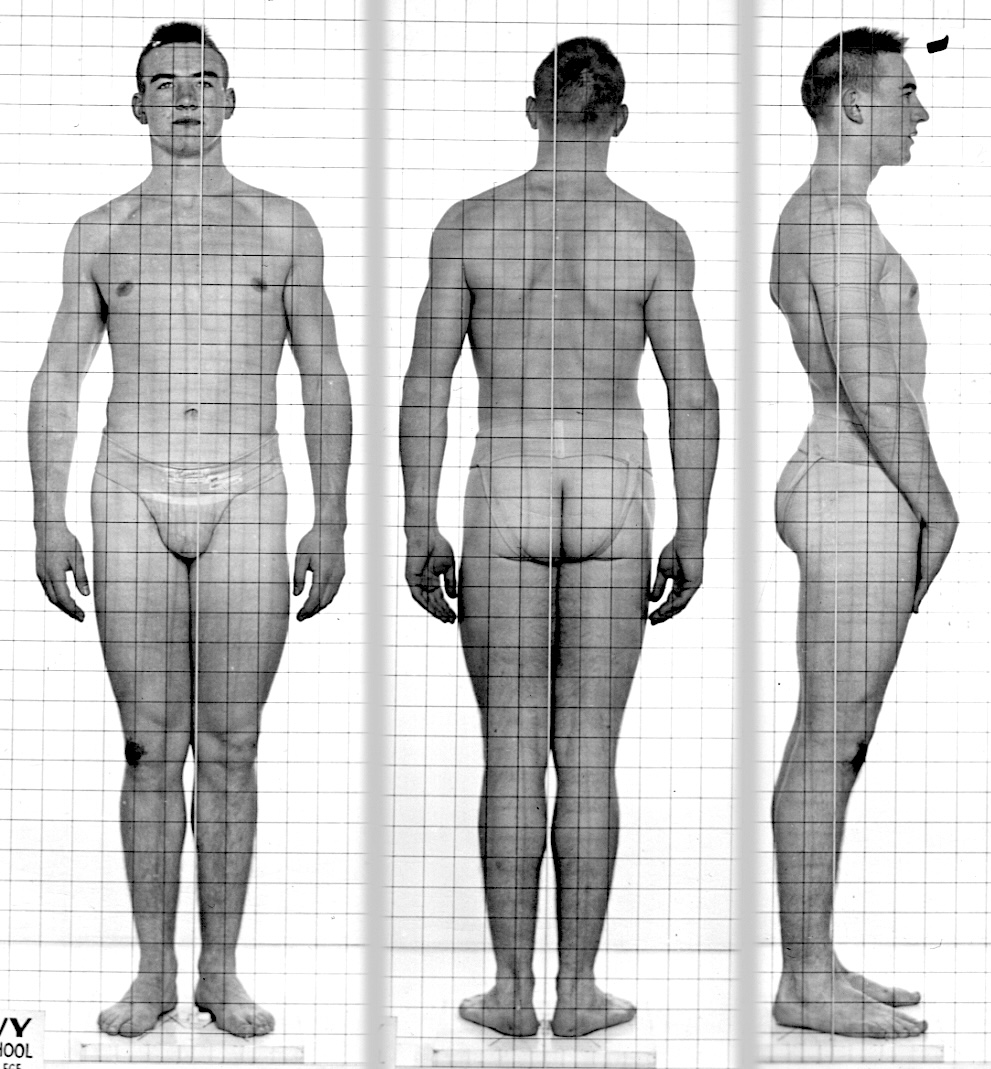
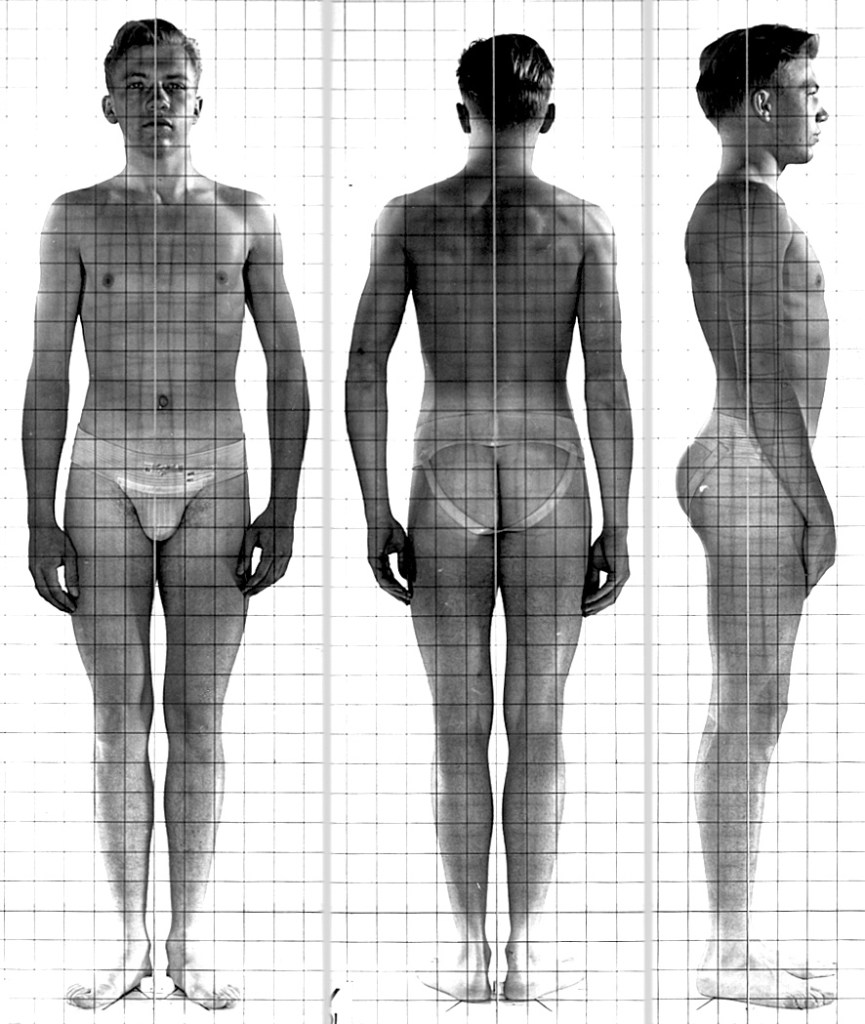
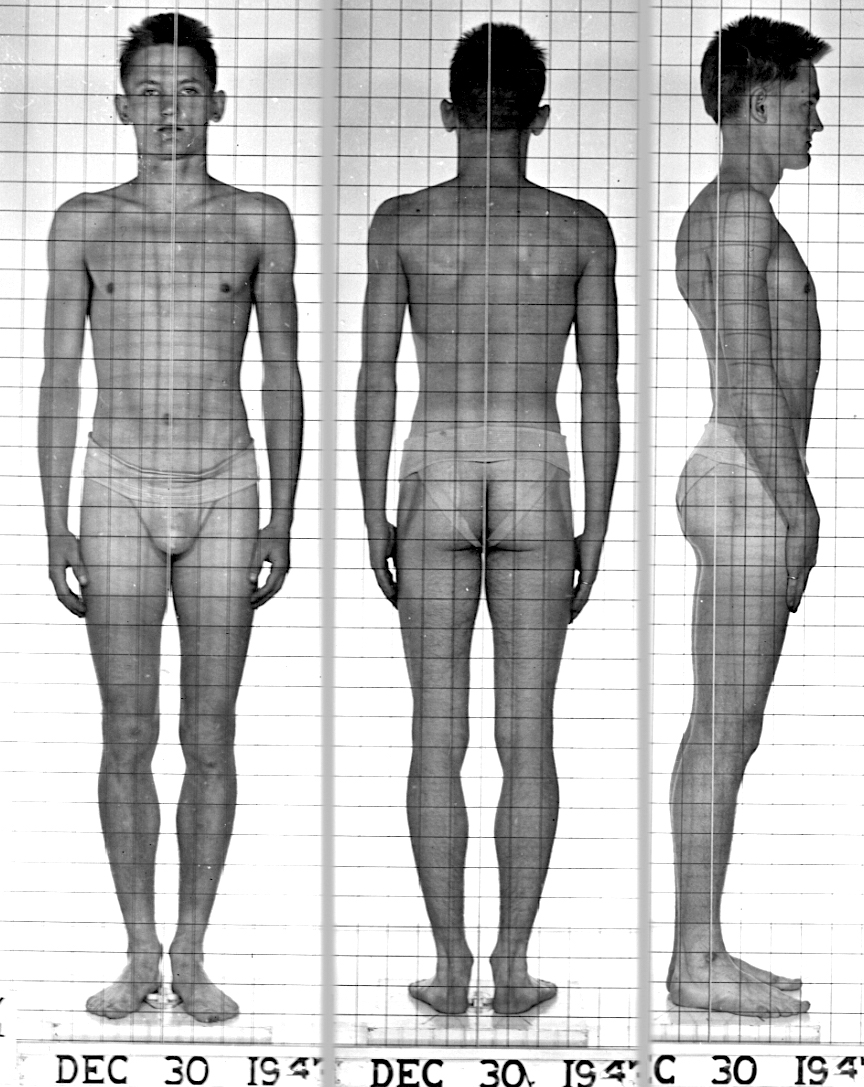
It’s that time again… due to popular demand, we have a 7th installment of WWII-era photos featuring the jockstrap-clad pre-flight training school cadets at St. Mary’s College in California. You can view the first one here, with links to all the rest at the bottom of the article. This is the third installment focusing on these strapping young men – many away from home for the first time – photographed as they trained to go to war during the holiday season.
I first became aware of these black and white 5″x7″ triptych photos several years ago. Listings turn up on auction sites frequently, where the photos are often accompanied by the index card used to record the physical training progress of the cadet.
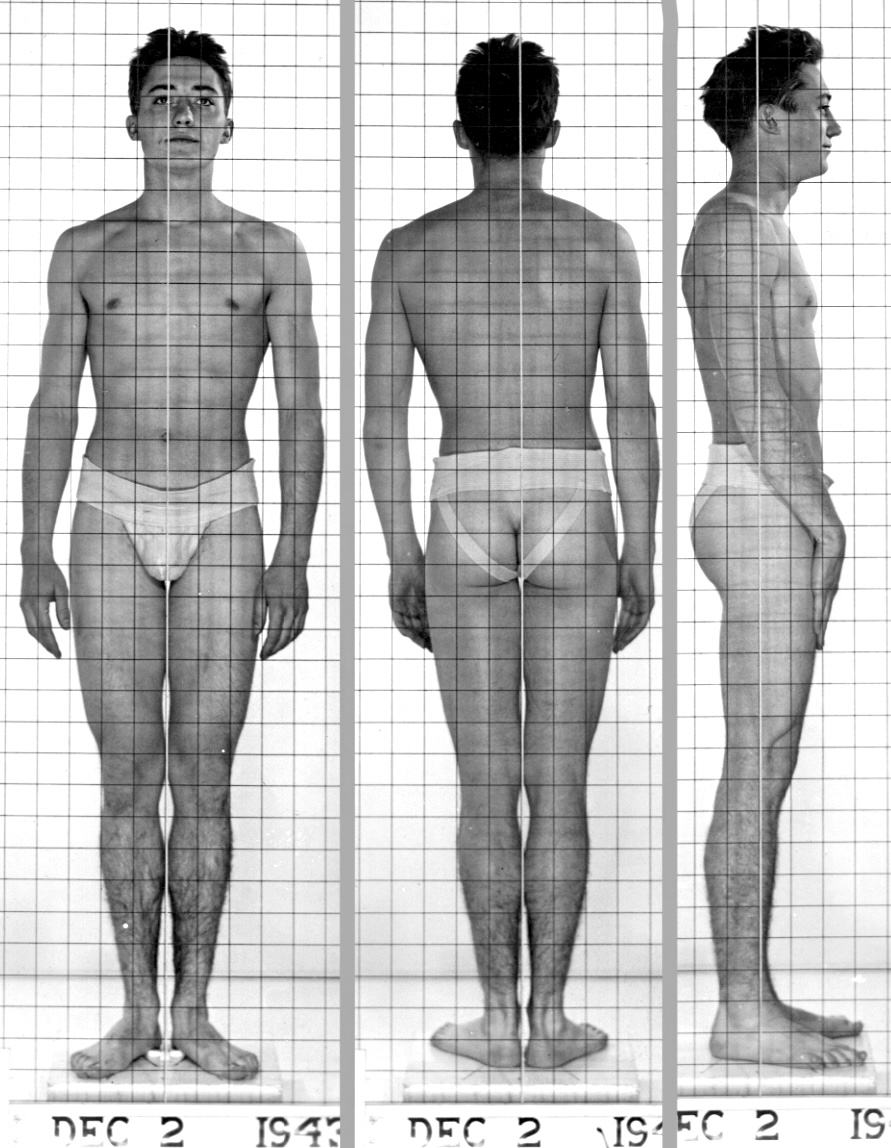
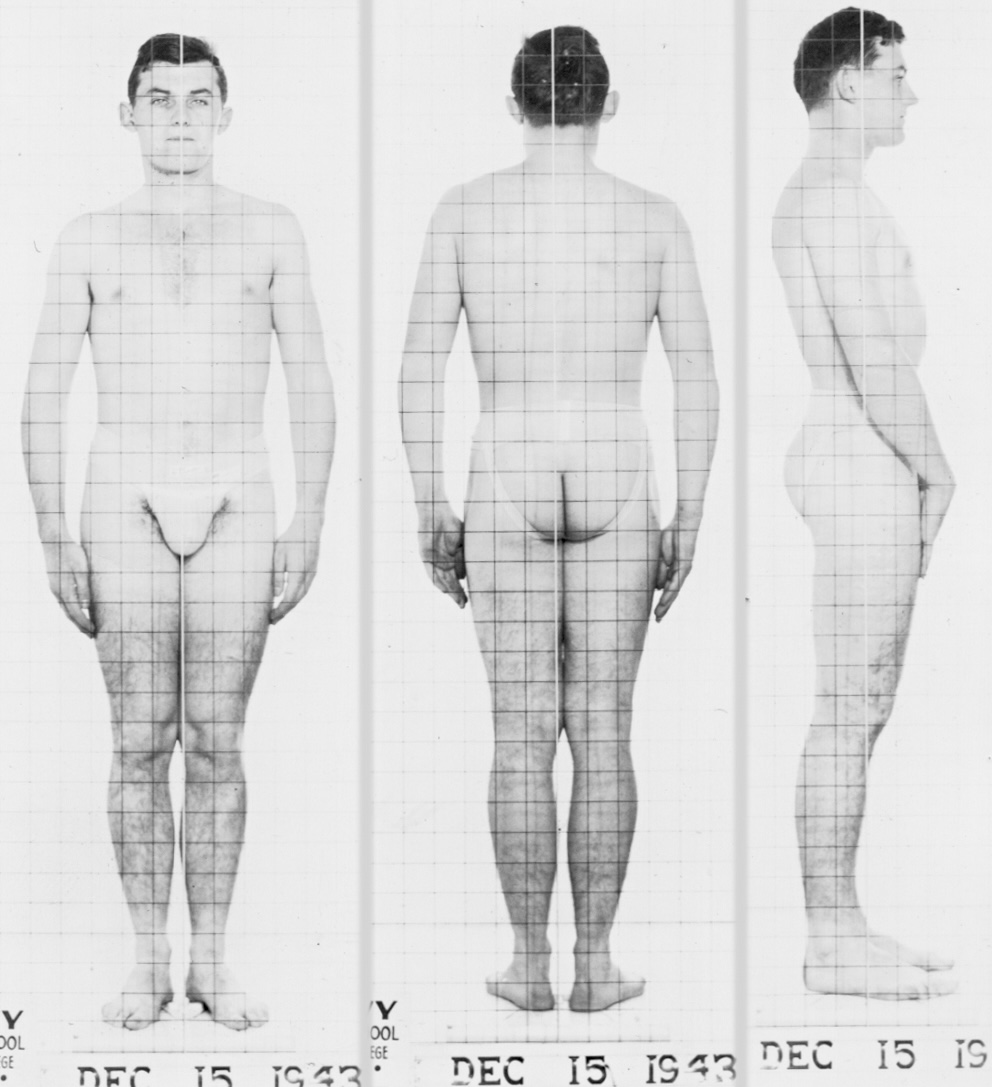
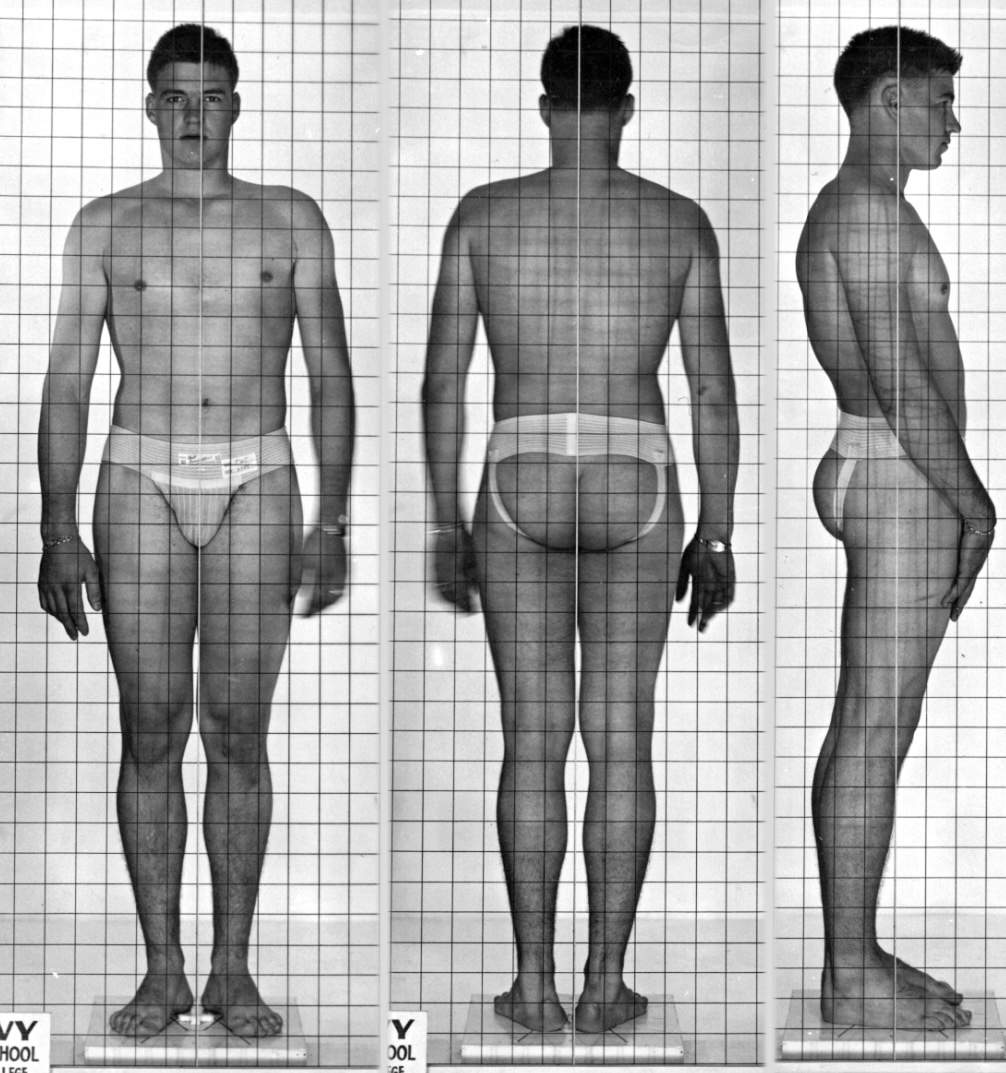
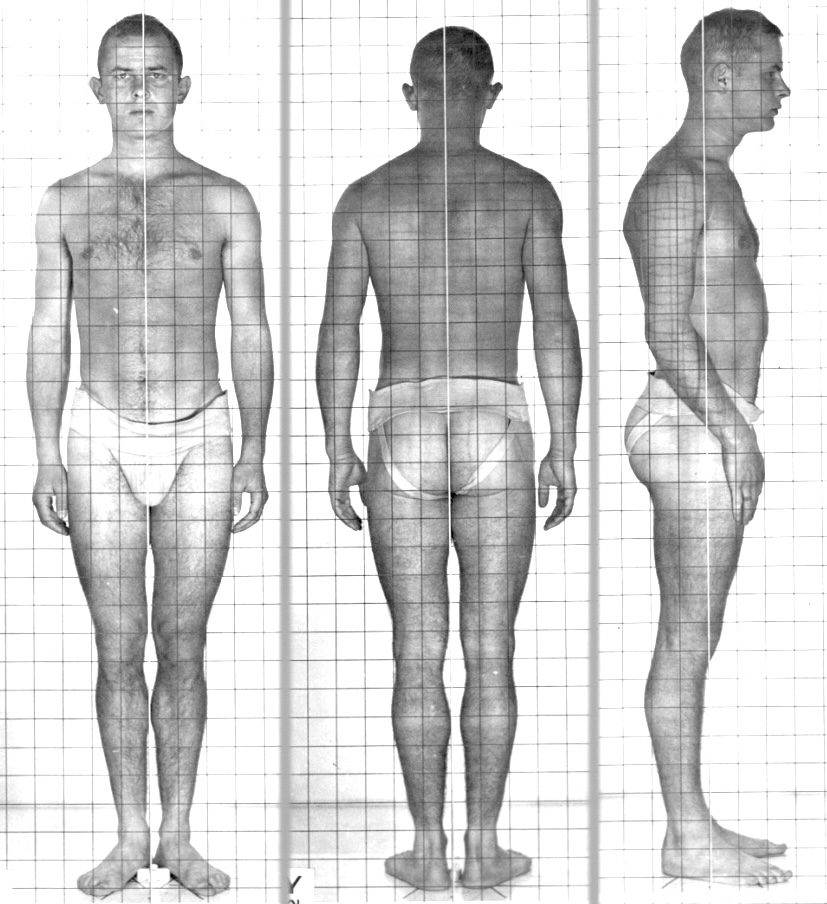
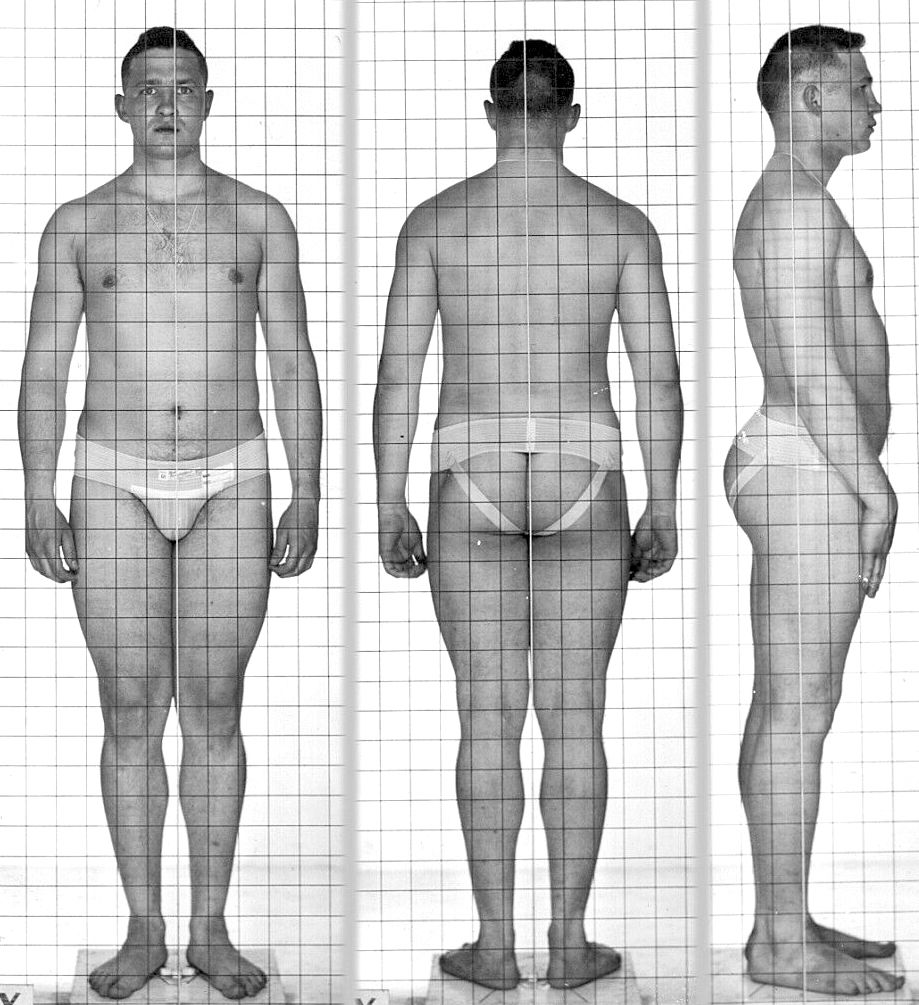
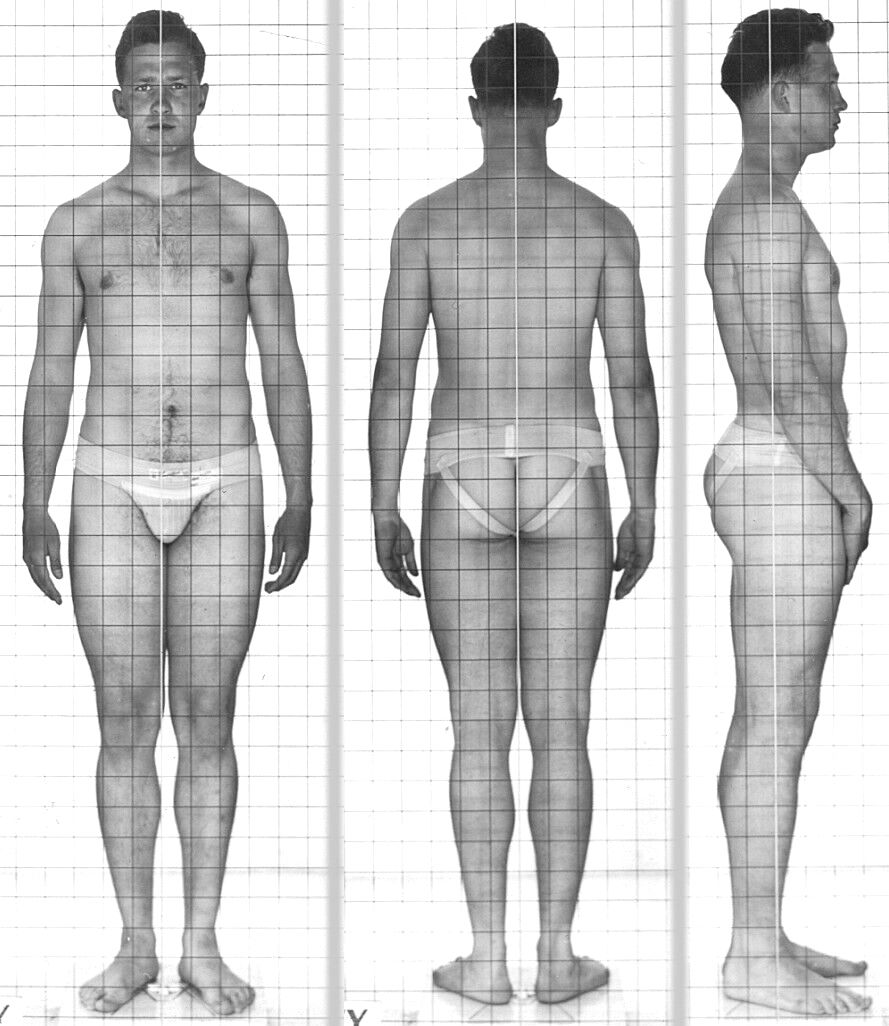
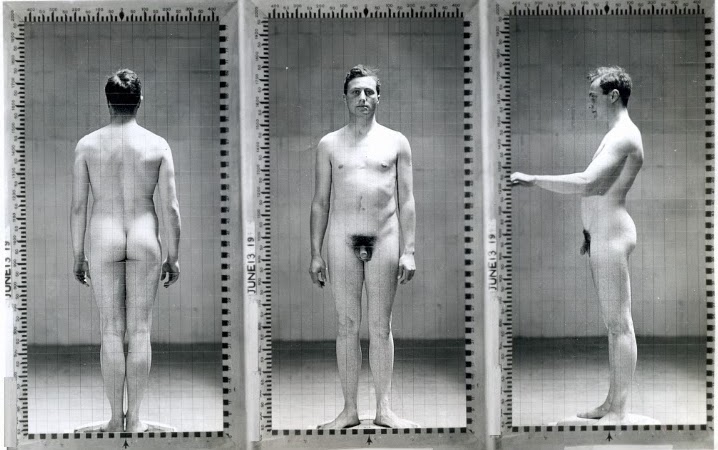
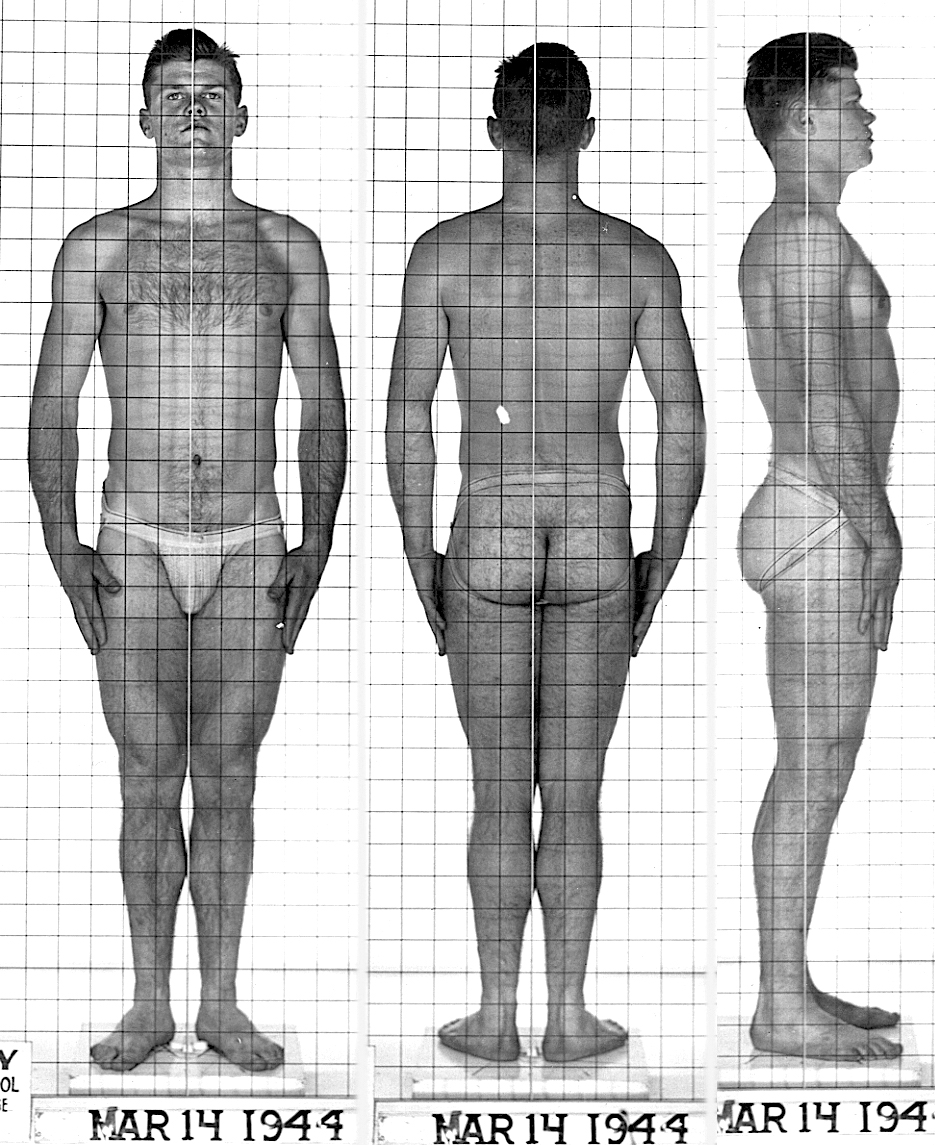
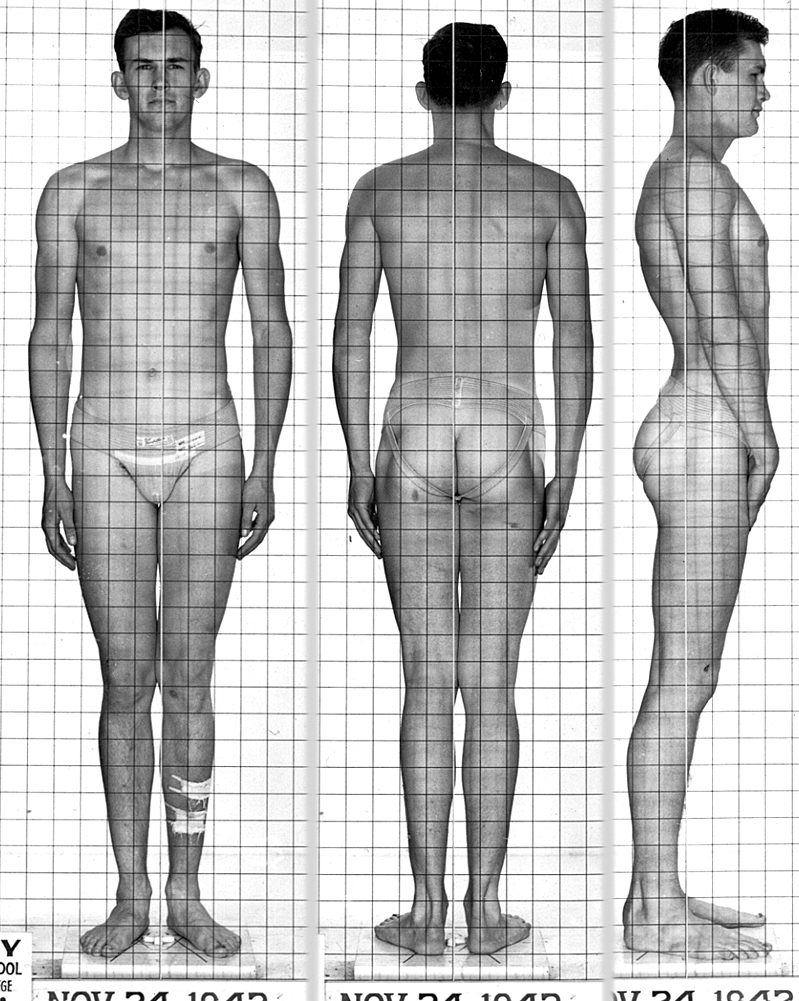
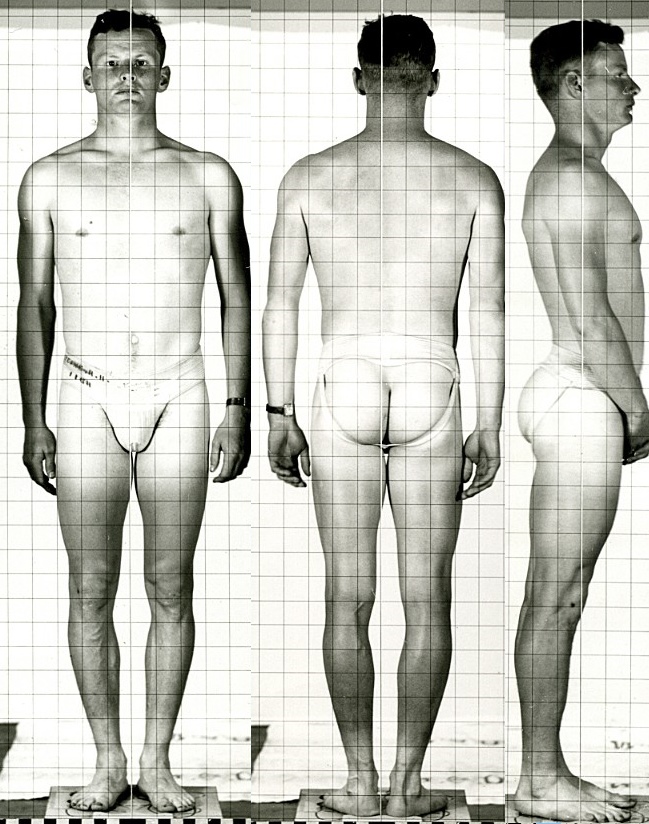
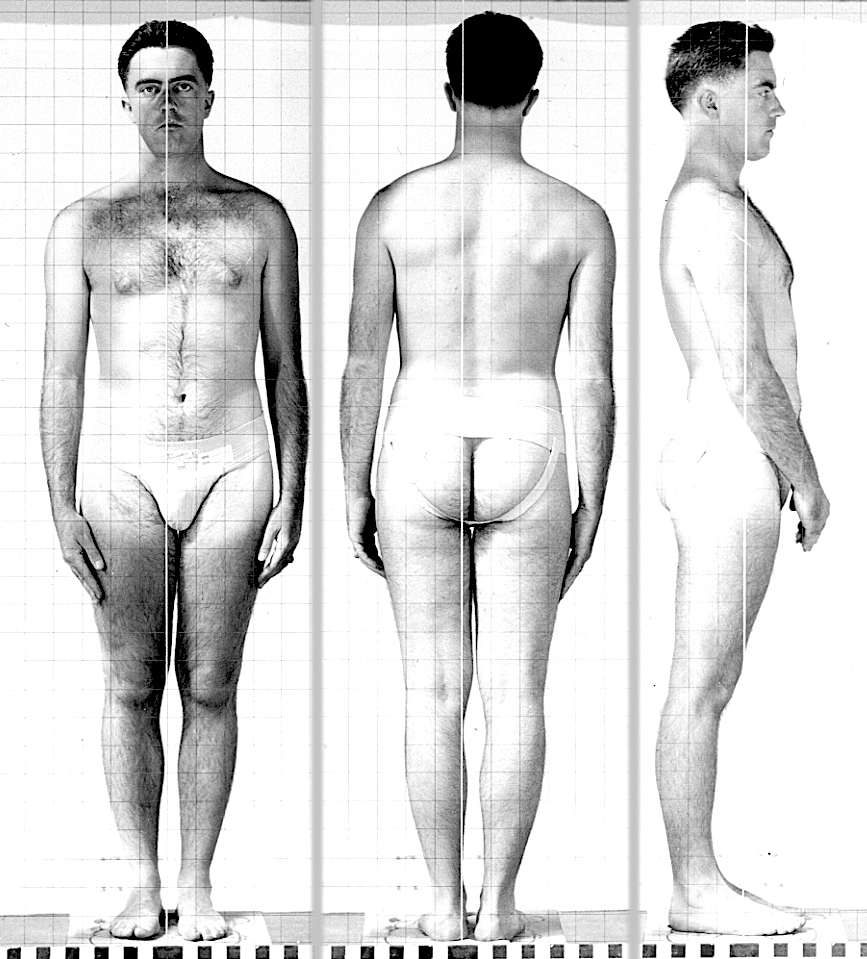
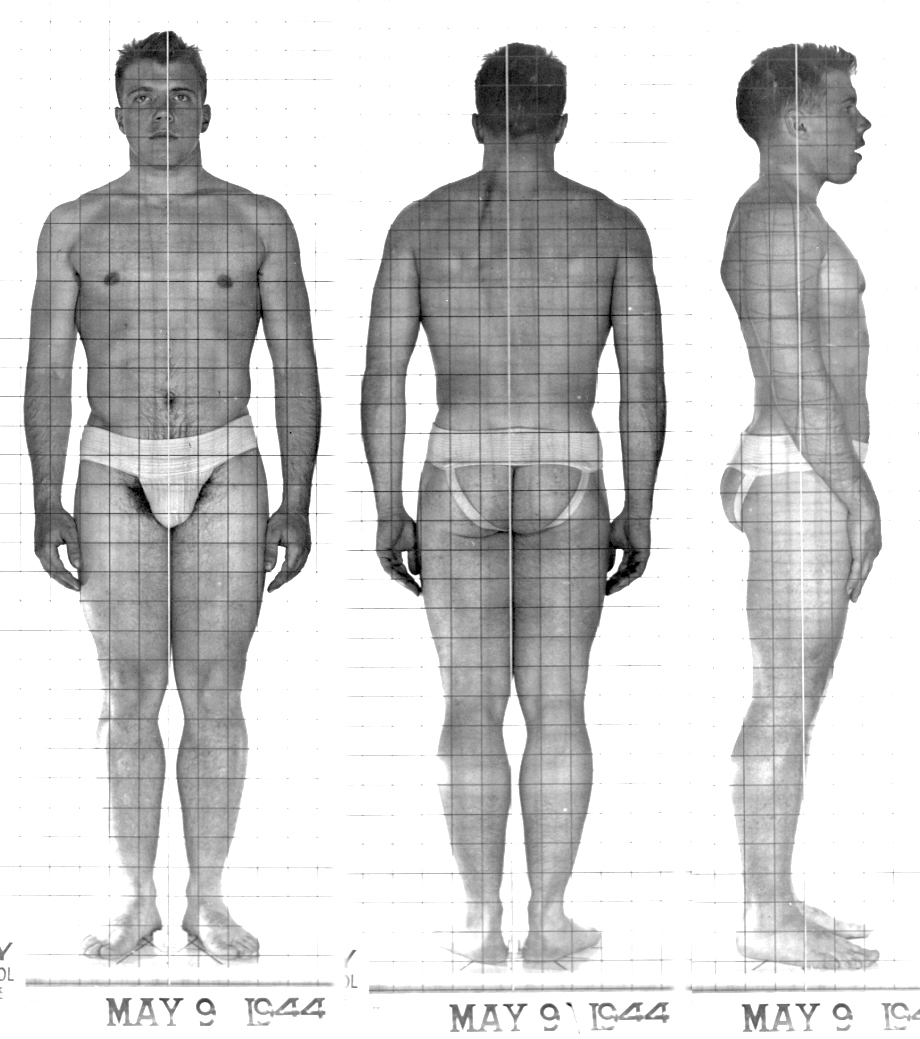
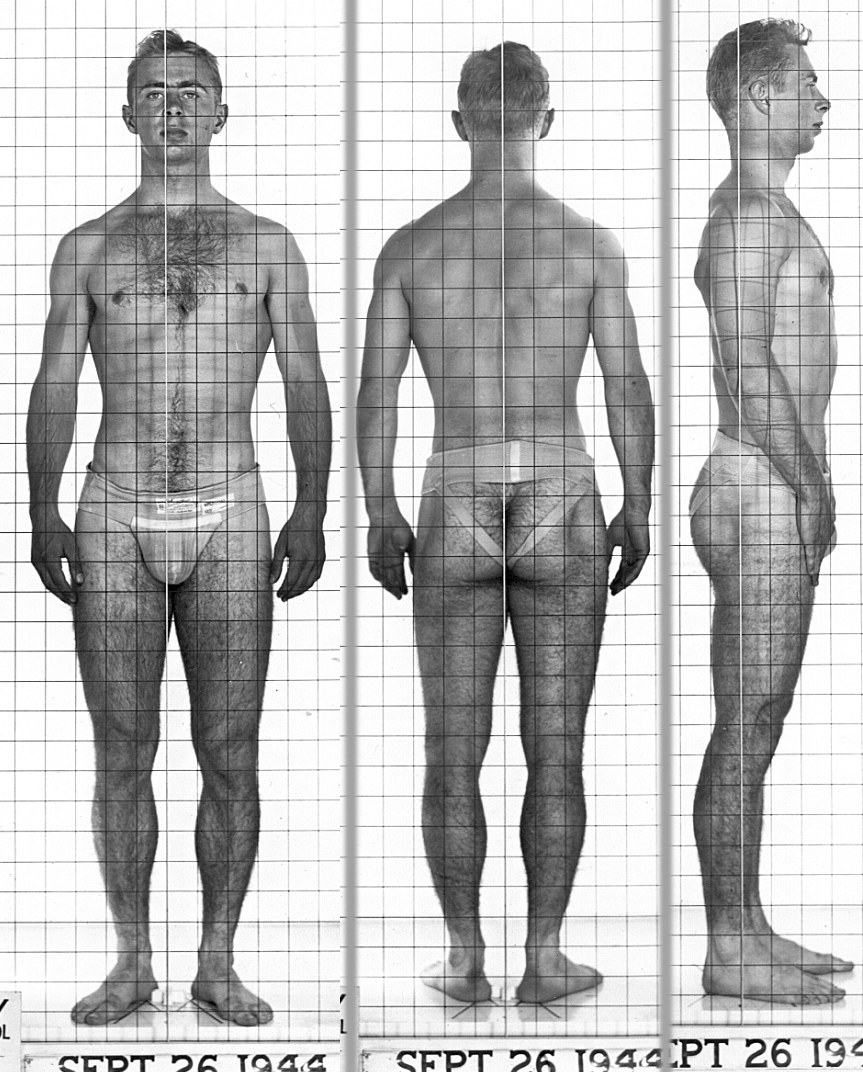
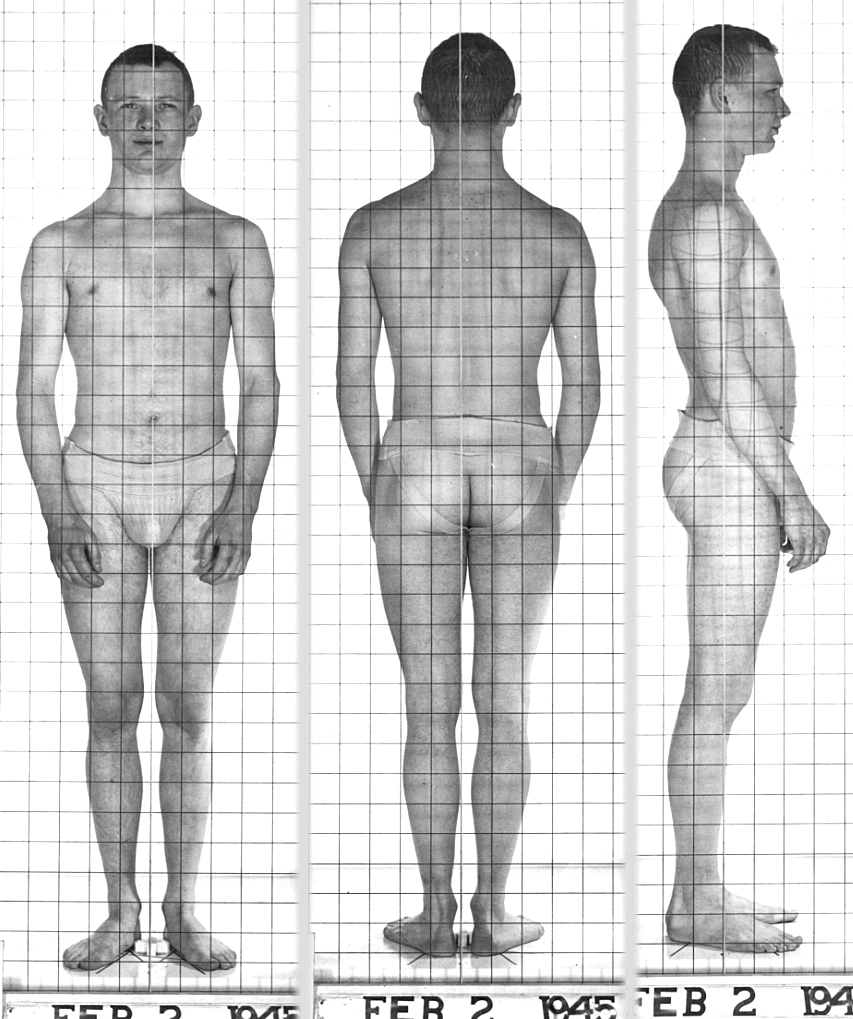
The earliest photos (from June 13, 1942) feature the men completely nude, but all subsequent photos feature the cadets in jockstraps, standing behind some sort of grid fencing to better detect posture misalignment and spinal curvature.
There is still some confusion between these photos and the Yale / Ivy League posture pics, since the Navy photos were sometimes used to illustrate stories about the Yale pics. Note that all of these images contain a visible U.S. Navy / St. Mary’s Pre-Flight School placard, even if they have been cropped out in some posts. Similarly the Yale University photos are identified as such within the frame of the photos:
Fortunately for us, multiple photos of some cadets have surfaced, allowing for comparisons of their training progress:
Comparison photos 11/2-12/1/42
And while there is a lack of ethnic diversity, there are a variety of body types.
Comparison photos: 10/24 – 12/22/44
My collection now includes over 800 jpegs of different cadets. While some of these men did perish during WWII, the largest majority that I have researched lived to ripe old ages.
Comparison photos: 12/8/43-2/2/44
Any surviving cadets would now be close to 100 years old. I recently discovered one who passed away last year at the age of 103.
Comparison photos: 11/2-12/22/42
One thing these young men have in common, as they were documented in timeless photos of their physical prime: they were far from home during the holidays, training to fight for their country.
At this time of year, 80 years later, we again salute The Greatest Generation for their fine forms and dedication.
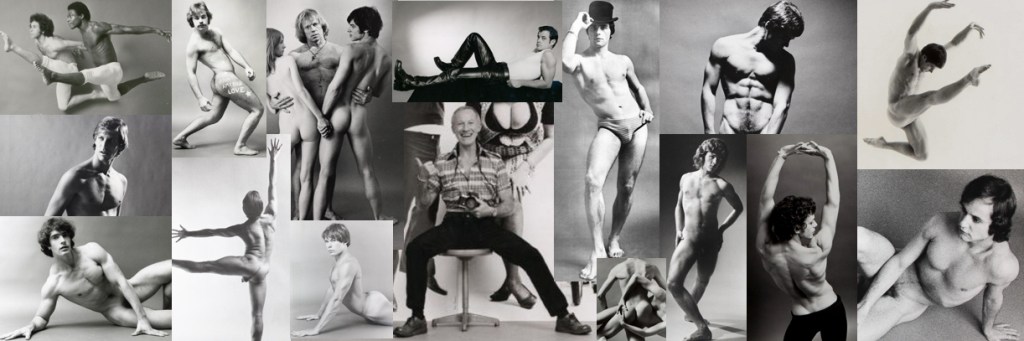
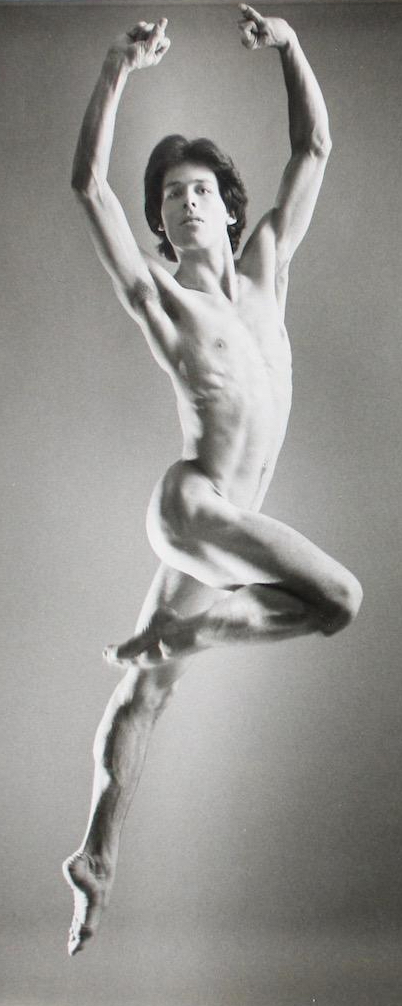
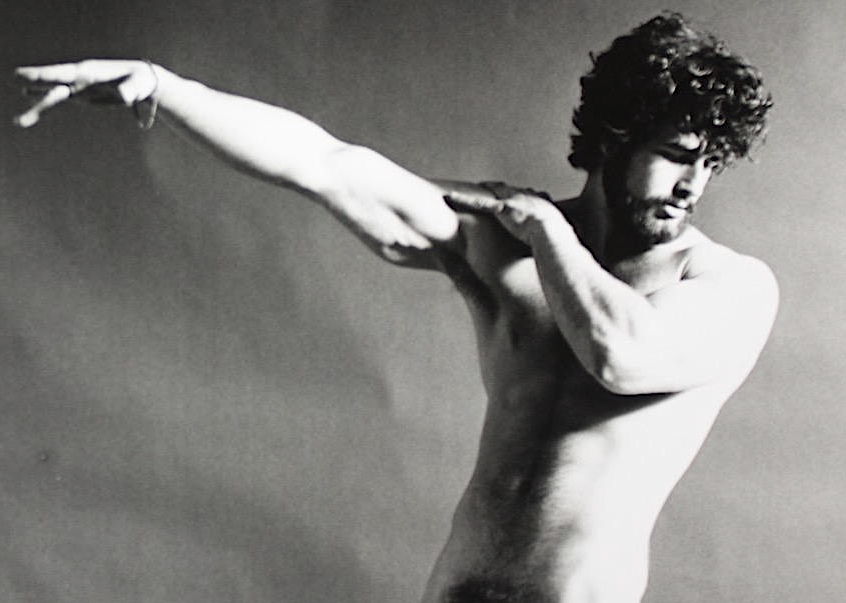
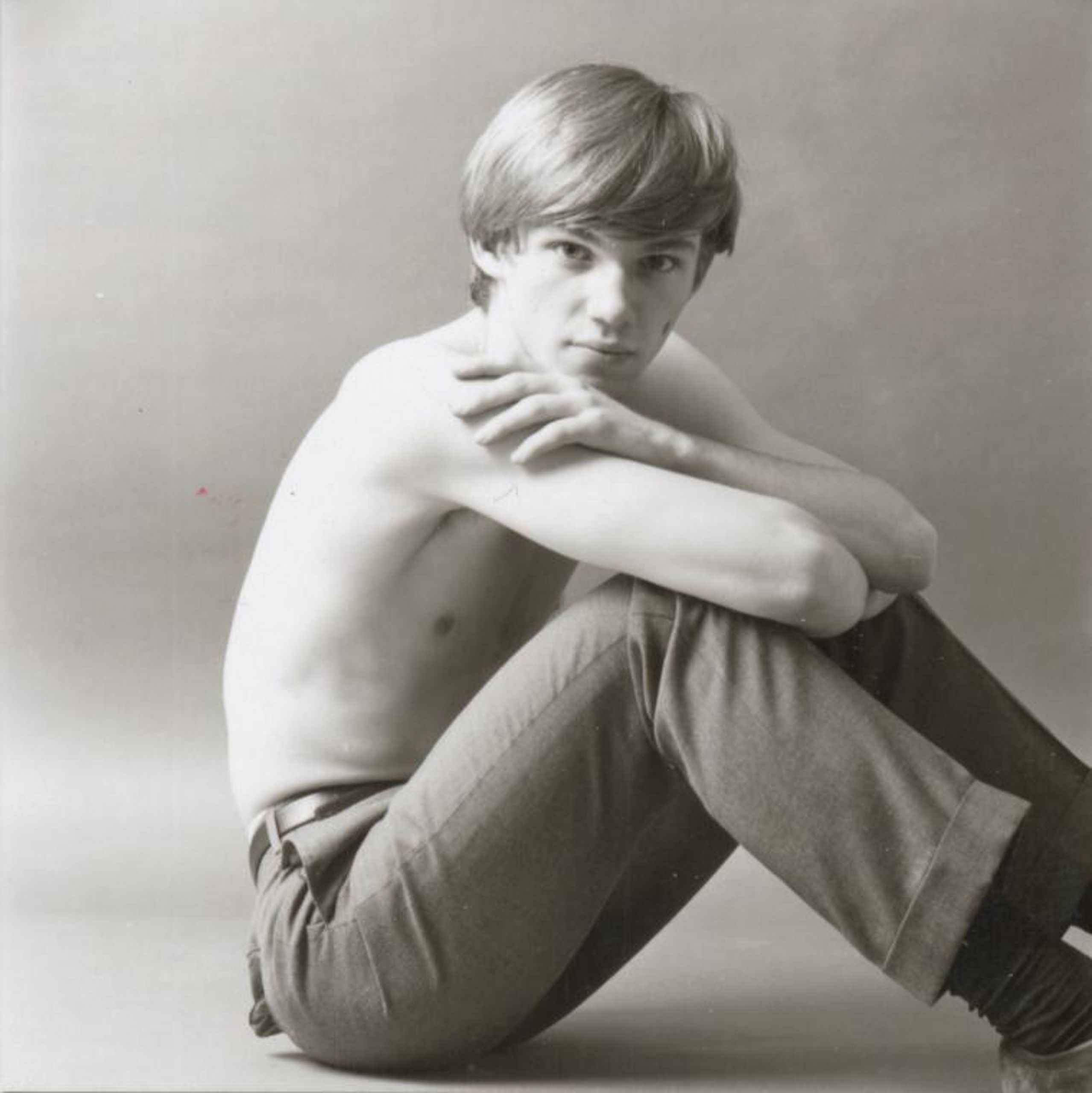
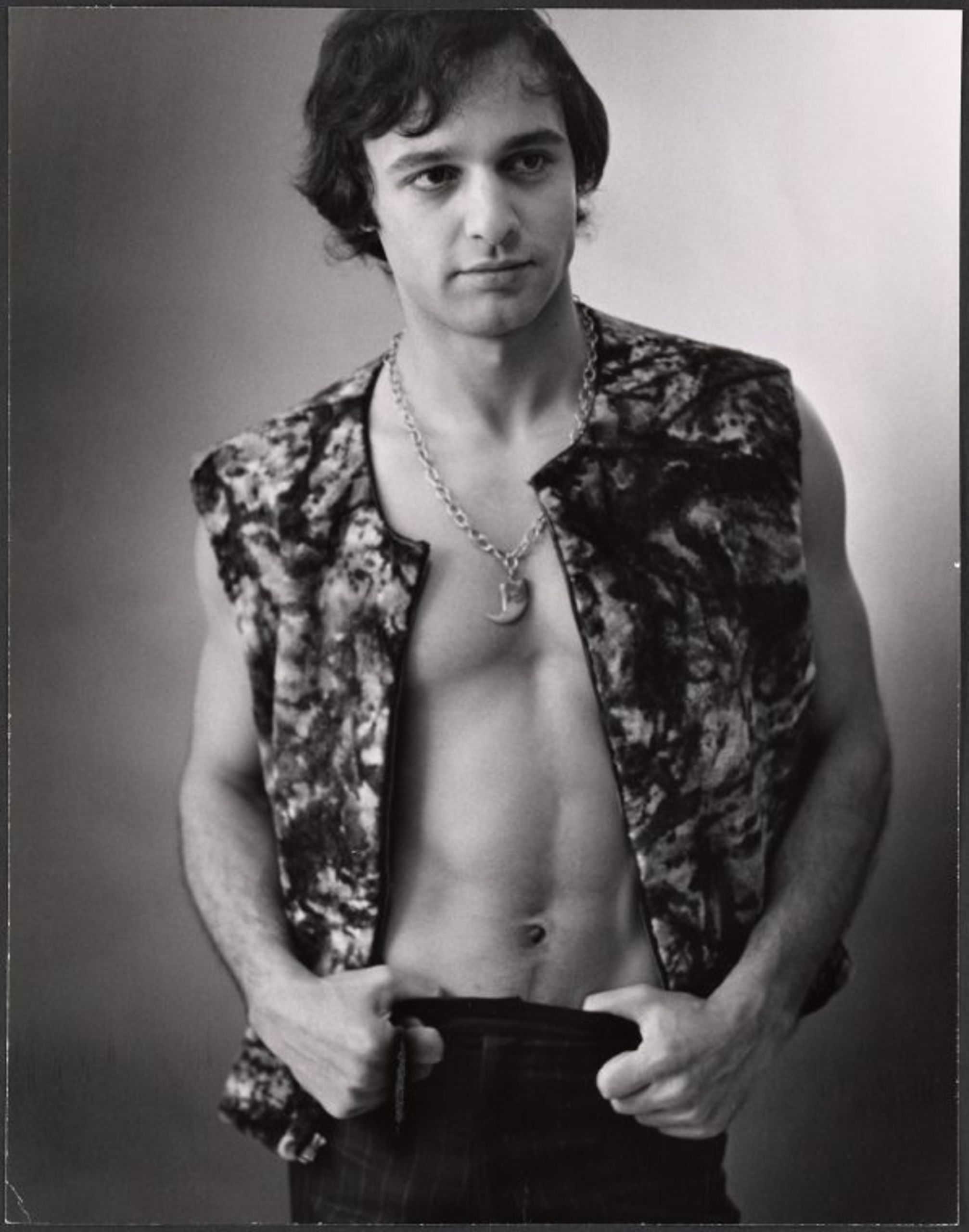
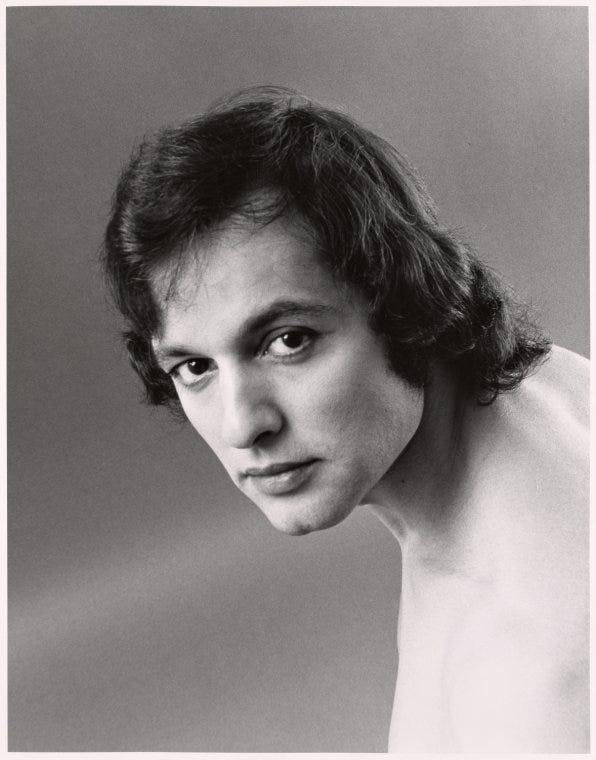
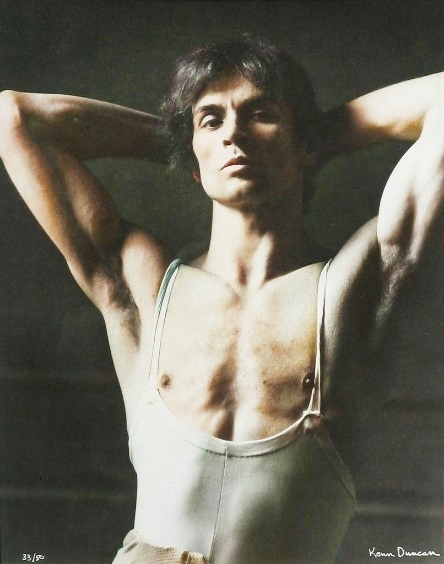
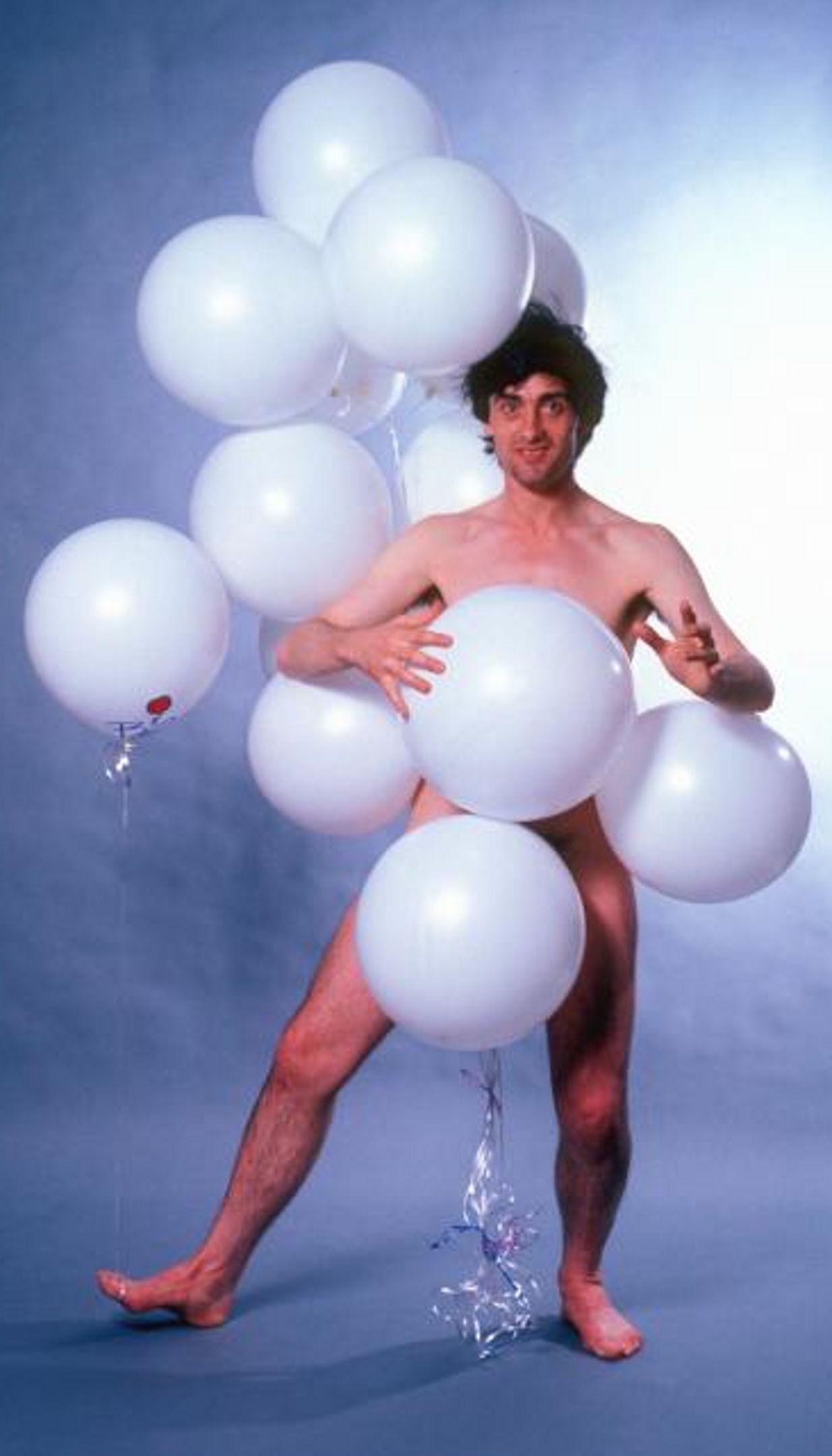
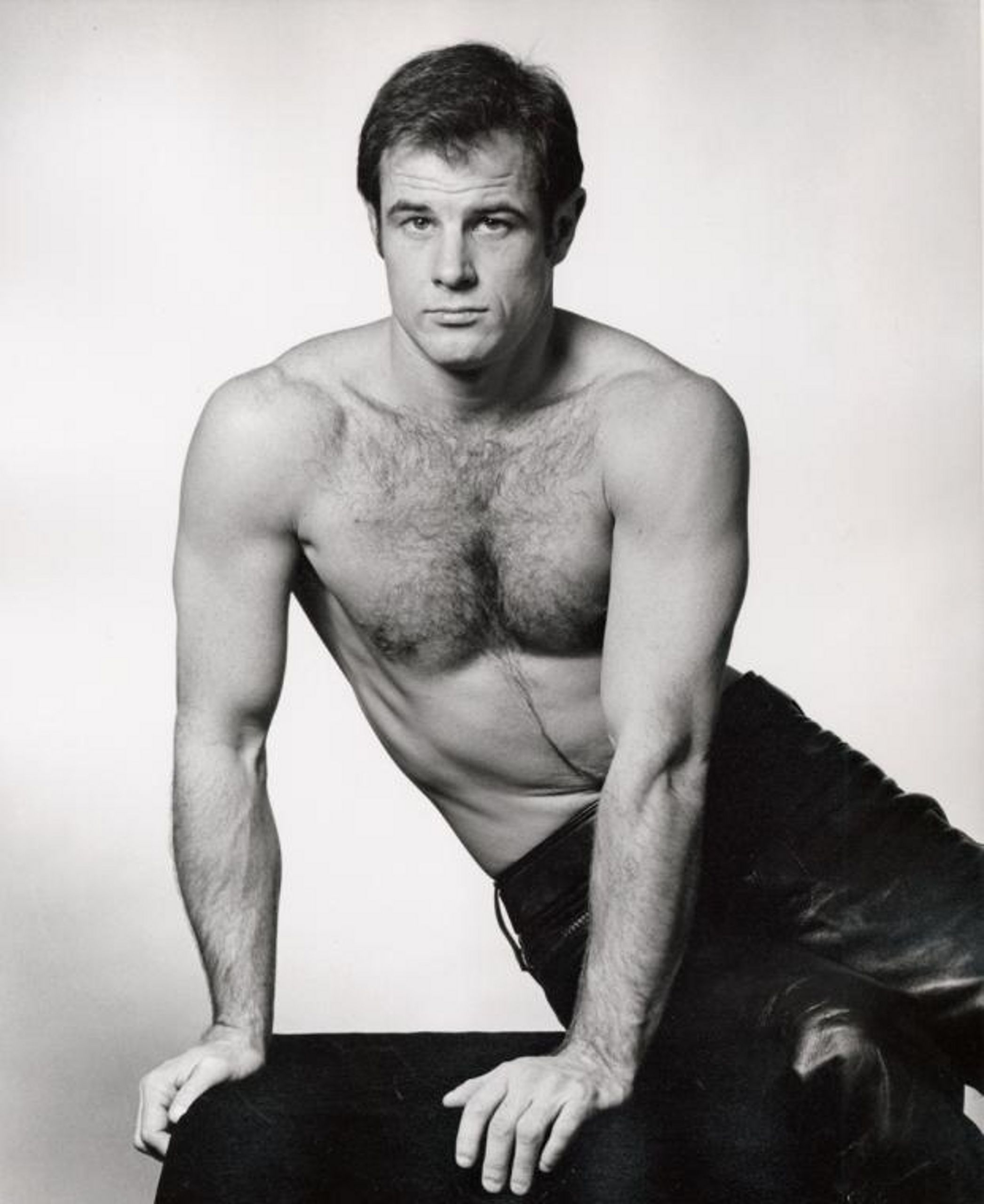
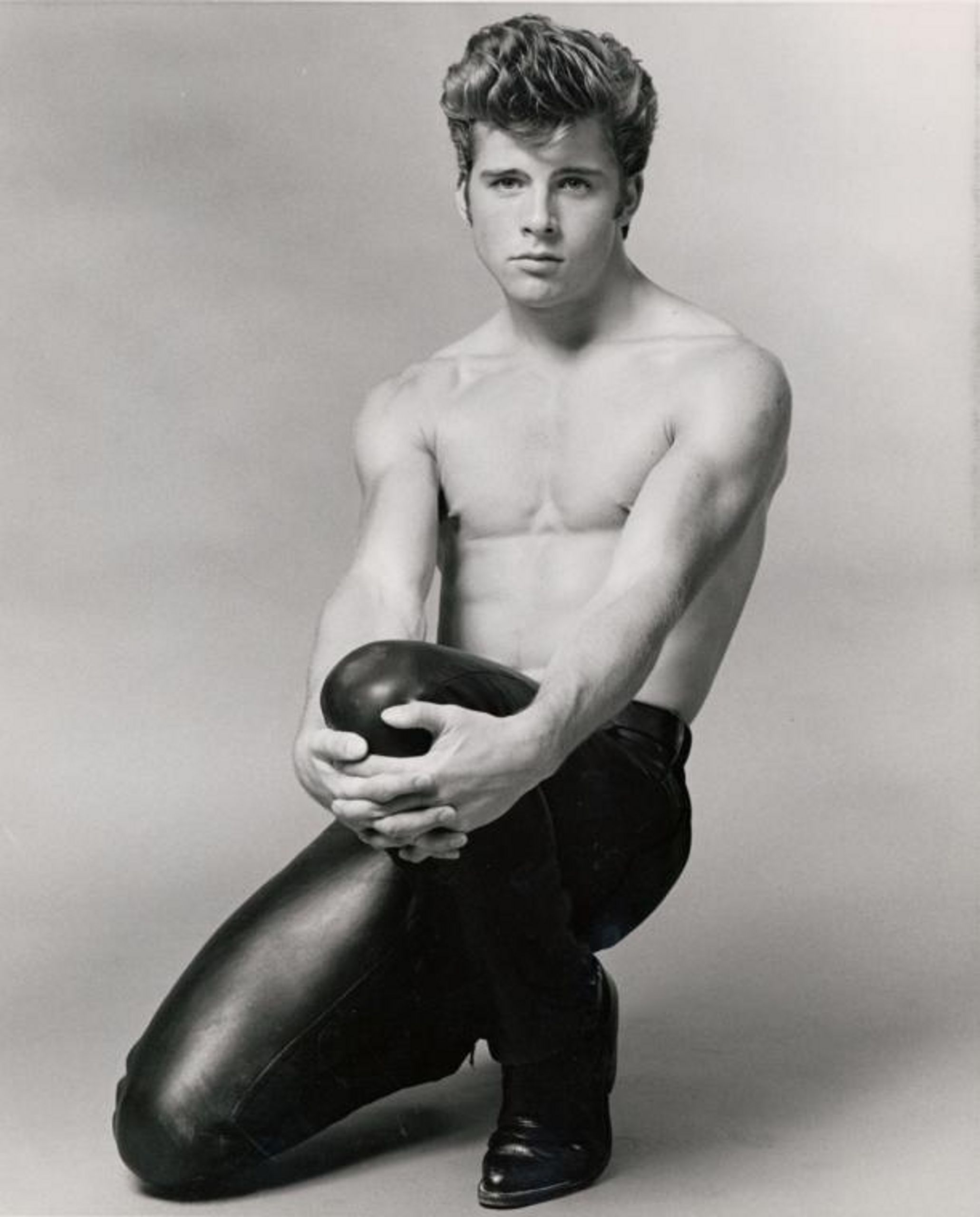
Kenn Duncan is widely considered to be one of the foremost dance photographers of the late 20th Century. In addition to his work as principal photographer for After Dark and Dance Magazine, his photos also appeared in Vogue, Time, Life, Newsweek and Harper’s Bazaar. From the mid-1960’s through the early 1980’s, he photographed nearly every major dance company in the world as well as many Broadway shows.
Born in New Jersey on September 22, 1928, Duncan began his career as a figure skater and then segued into dance. His career took another turn when he was sidelined with a broken foot and signed up for a six-week photography course at the local YMCA. Naturally he gravitated back to the dance world for photographic inspiration.
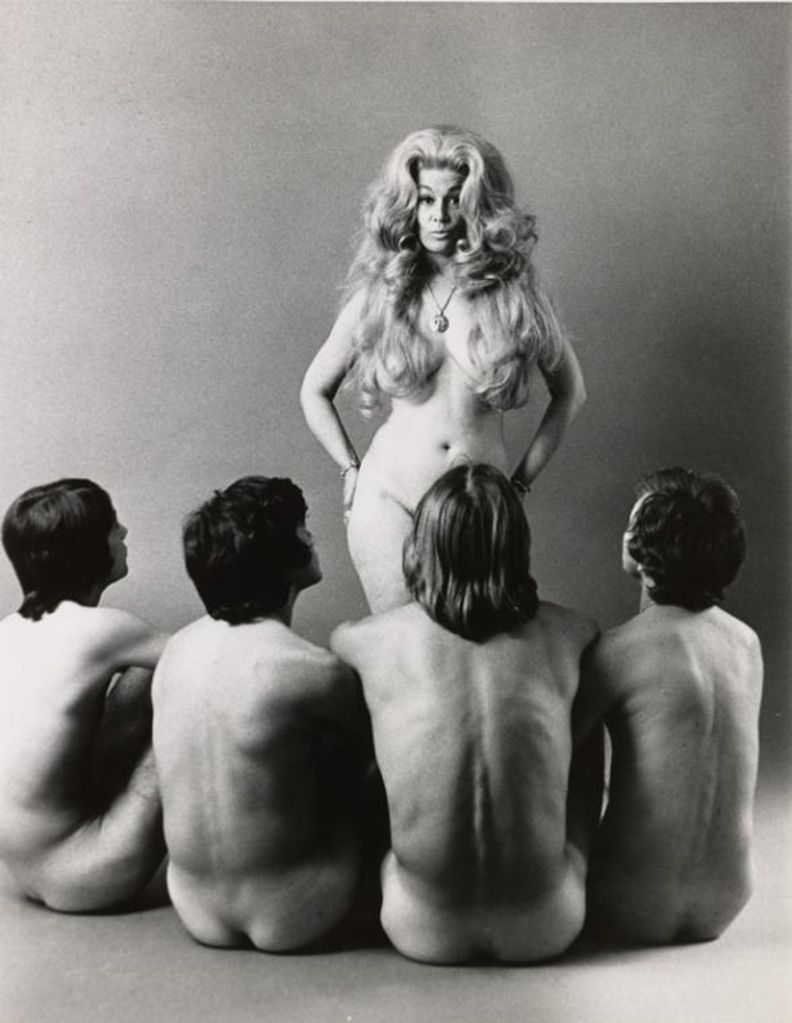
In addition to his dance photography, Duncan was well regarded for his nude photographs, with an emphasis on male subjects. His first two books, Nudes (1970) and More Nudes (1971) were favorably received for his “discreet and artistic arrangements of his subjects.”
Christopher Walken (1968)
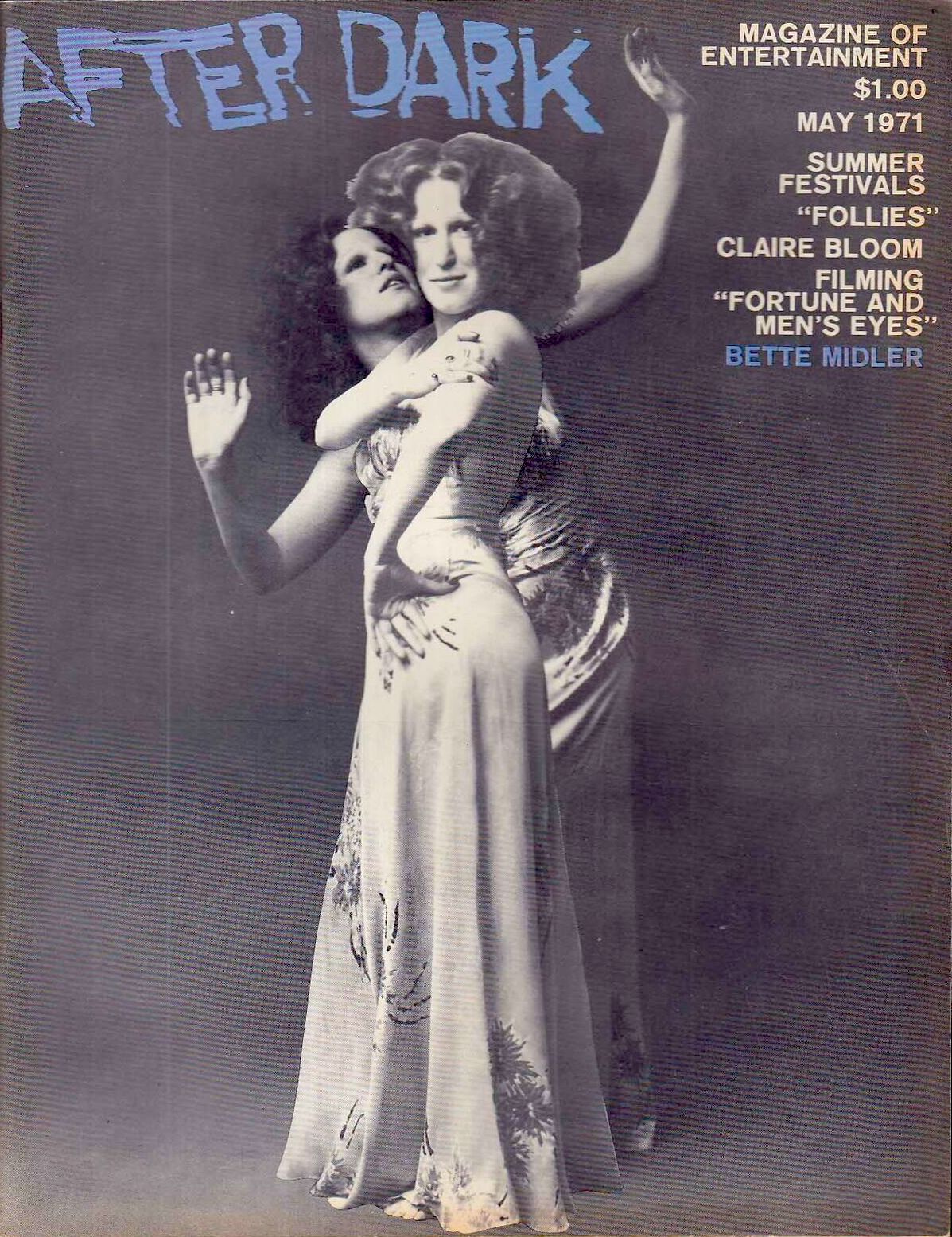
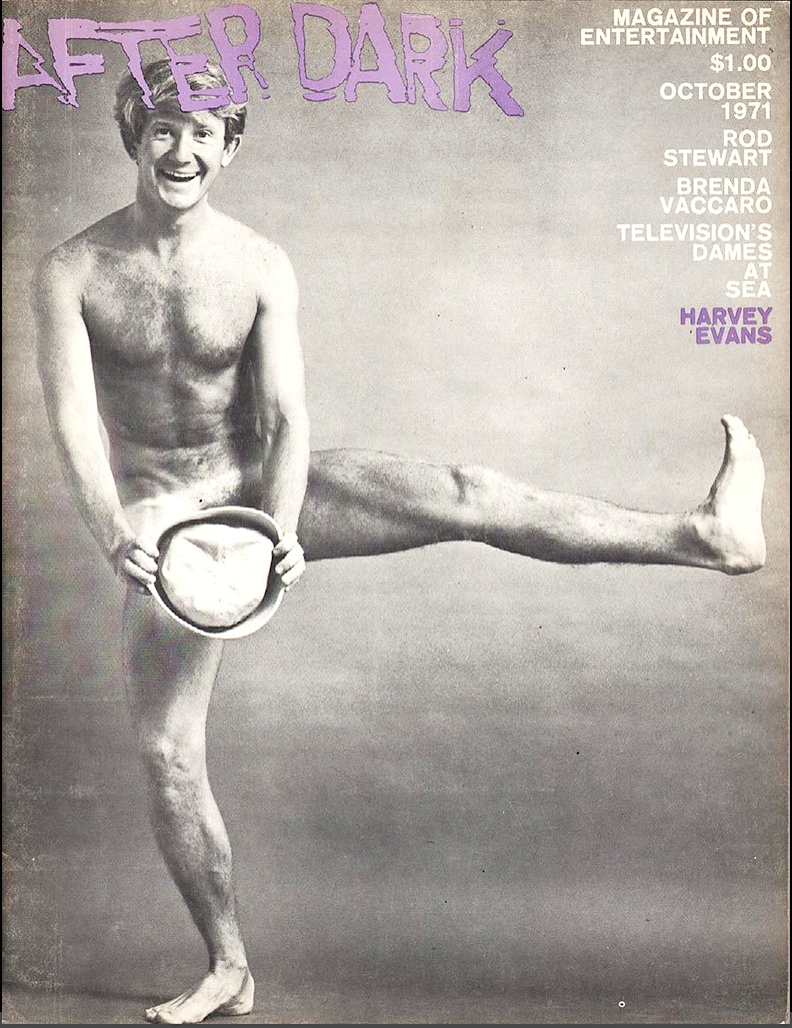
After Dark was an edgy entertainment and culture-based magazine that sprang from the waning Ballroom Dance Magazine in 1968. In The Rise And Fall Of Gay Culture, Daniel Harris writes; “One of the strangest reincarnations in journalistic history… it was out of the ashes of a periodical devoted to such topics as waltzes, rumbas, and turkey trots that After Dark, an audacious mass-market experiment in gay eroticism, arose like a phoenix in all of its subversive splendor.”
Although After Dark was not officially a gay magazine, the publishers were certainly willing to cater to that audience, pushing the envelope on male nudity to a degree that is still not seen in mainstream US publications 50 years later.
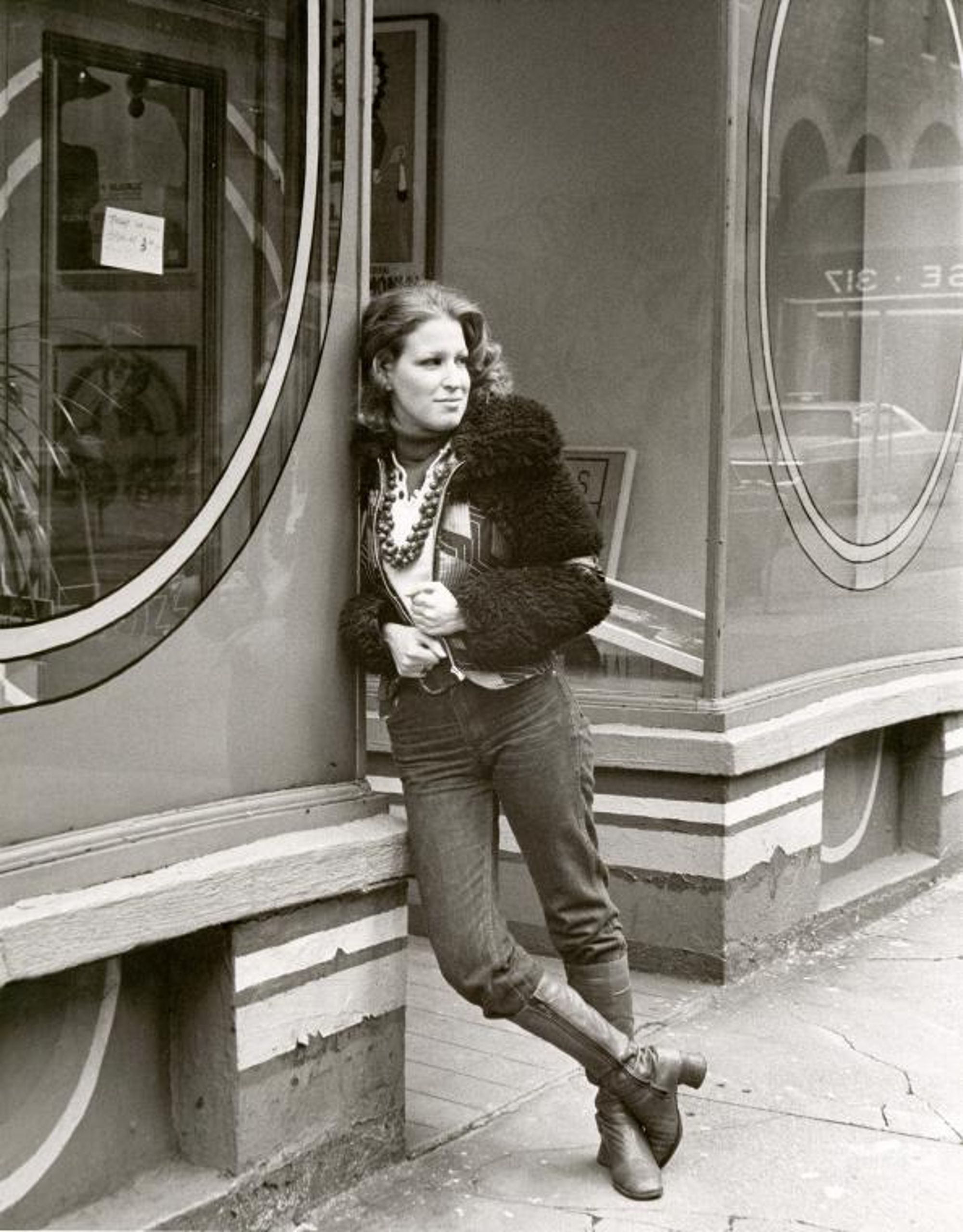
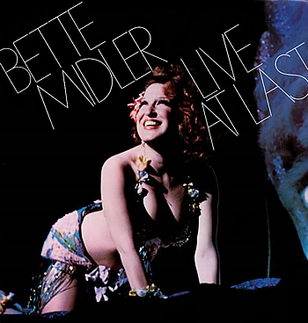
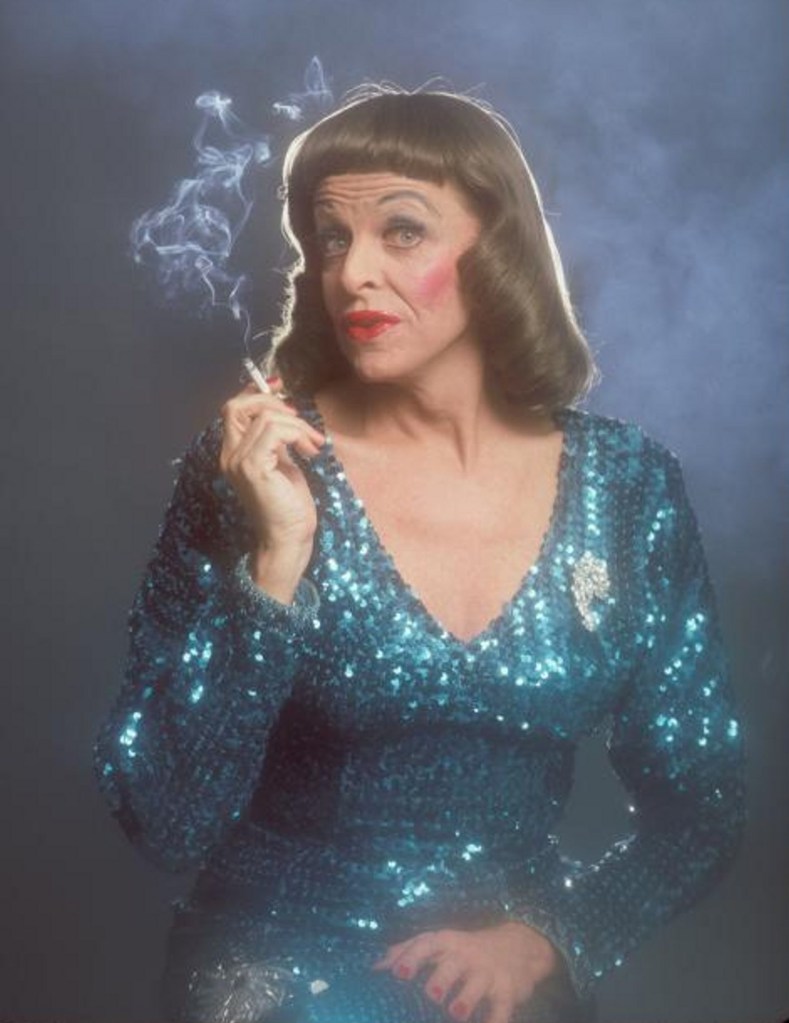
Duncan photographed Bette Midler numerous times through the years, including three After Dark cover photos and the cover shot for her 1976 Live At Last LP.
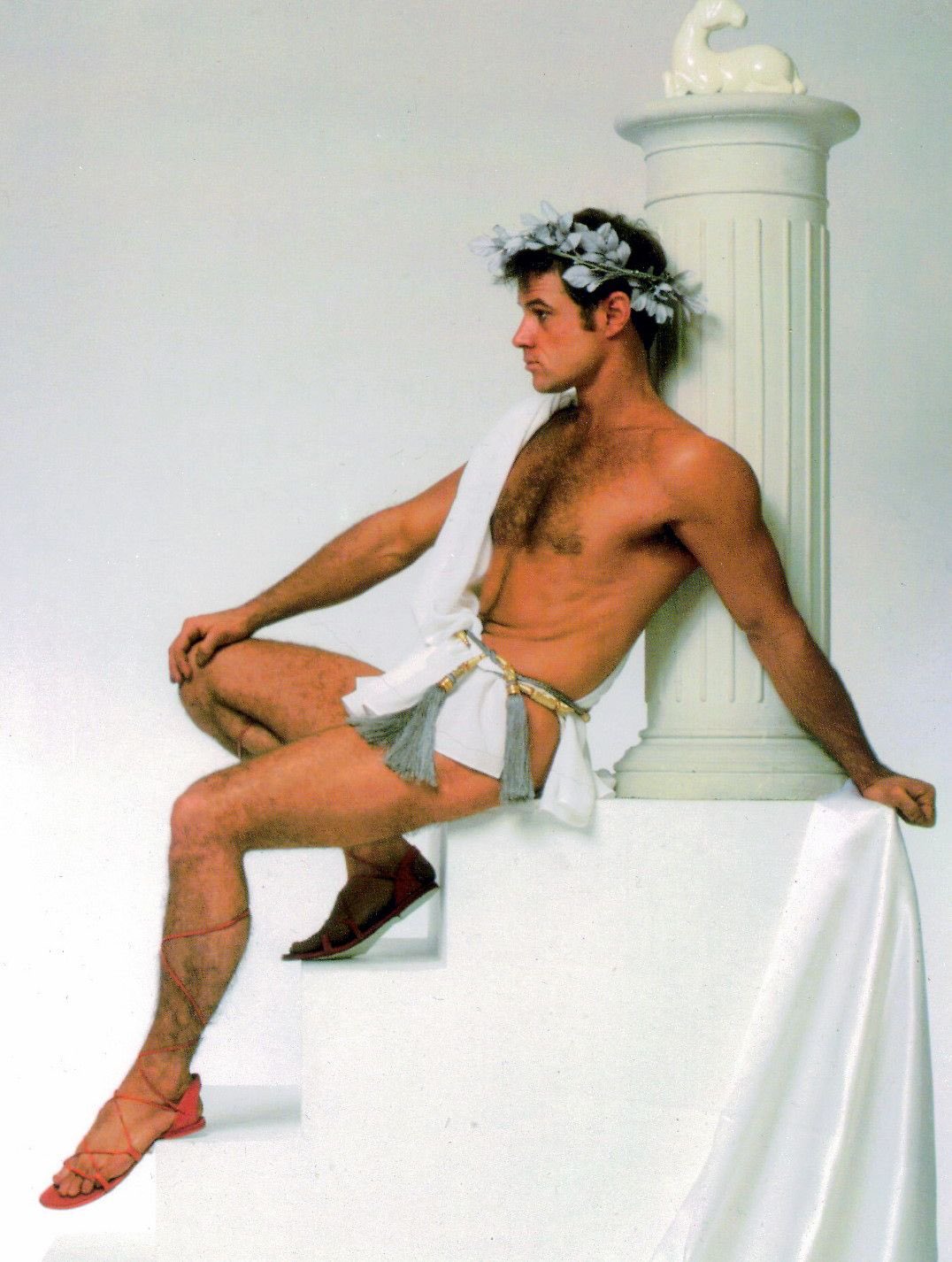
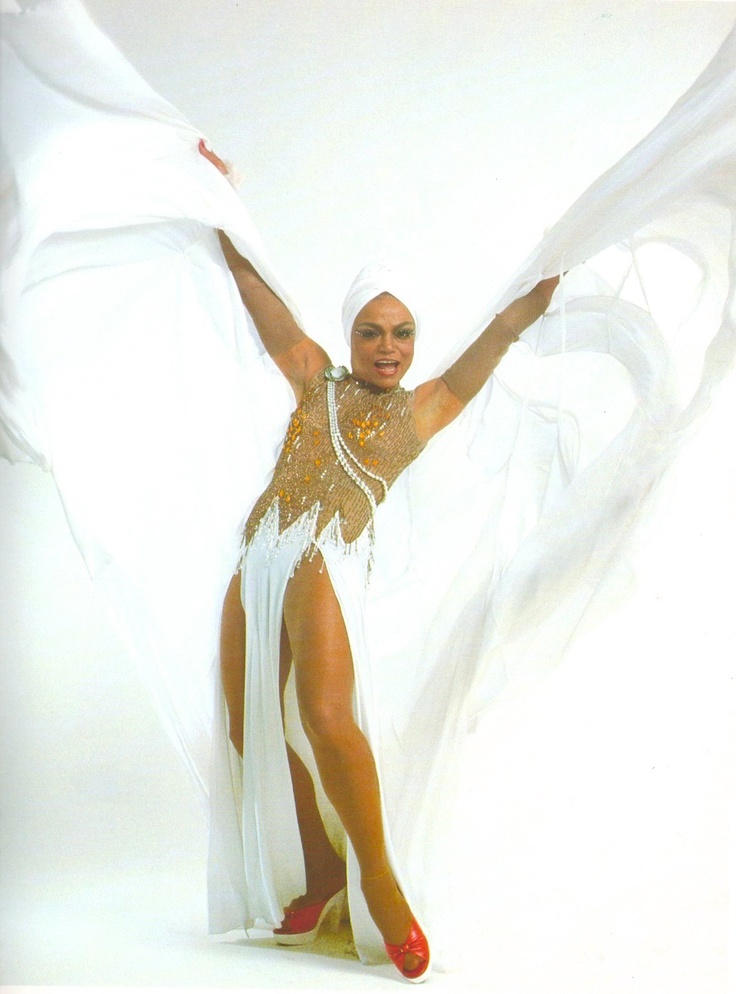
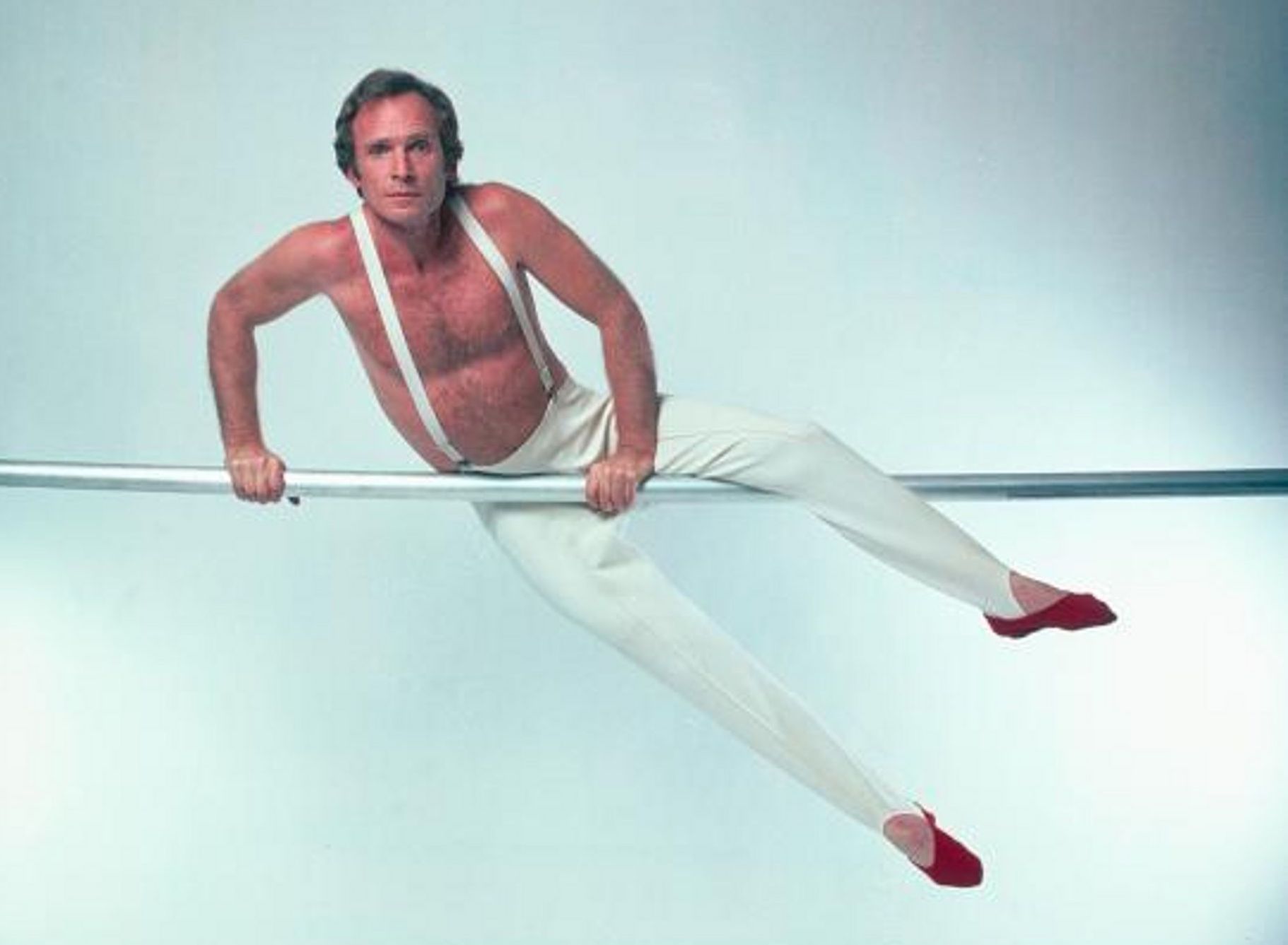
After Dark shuttered in early 1983. The following year, Duncan published The Red Shoes, a photo book featuring celebrities wearing red shoes in a nod to both the Hans Christian Anderson fairy tale as well as the ruby slippers of The Wizard of Oz. Among those featured were many familiar subjects of his earlier work, including (pictured below) Brad Davis, Bette Midler, Maxwell Caulfield, Eartha Kitt, Dick Cavett, Mikhail Baryshnikov, John Curry, Richard Thomas, Gregory Hines, and Treat Williams.
Duncan began work on a second Red Shoes book, but it remained unfinished, along with several other projects. He was just 57 years old when he died of AIDS complications at New York Hospital on July 27, 1986. In 2003, the New York Public Library for the Performing Arts acquired 600,000 photos from Kenn Duncan’s estate. Many of these photos have been digitized and are now available for viewing online for free.
September 11th and the onset of Fall always makes me think back on the New York City that I photographed as a teenager in the 1980’s.
The intrepid photographer (1985)
My photography class would take field trips into Manhattan each semester. Later I began hopping on the Long Island Rail Road to venture in by myself. I loved photographing the city. There was – and is – an infinite number of things to focus your camera on. I learned early on that as much as I loved taking pictures in the city, I did not enjoy photographing the people. I was afraid someone would freak out and demand money or break my camera. My photos with live subjects tended to be dark and blurry or out of focus because I just wanted to snap the photo and run.
Instead, I focused on other elements of the city – a cat in a window, a gargoyle on a building. The purple shoeprints that appeared all around the village in the mid 1980’s. I would go into the city on a Sunday and walk south from Penn Station to the World Trade Center and back, snapping pictures the whole time.
To this day, I will spot a familiar building detail or doorway and remember… oh yeah! I took a picture of that in 1986. After 9/11, I would scan through the footage from that day, searching for familiar places on the plaza and in the vicinity, looking for details so familiar to me in the photos I had taken years ago.
The Statue of Liberty gets a facelift (1984)
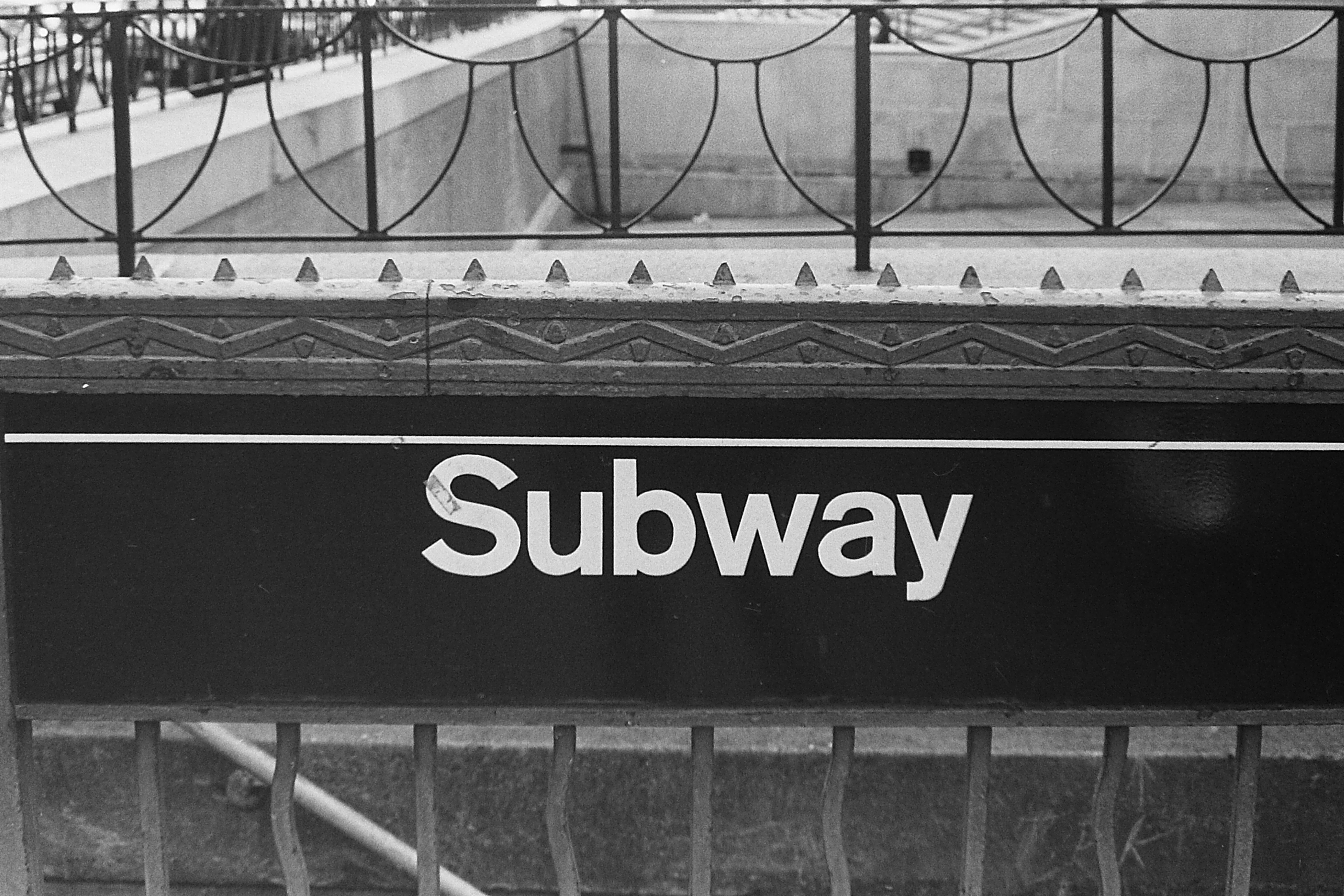
Canal Street Station (1986)
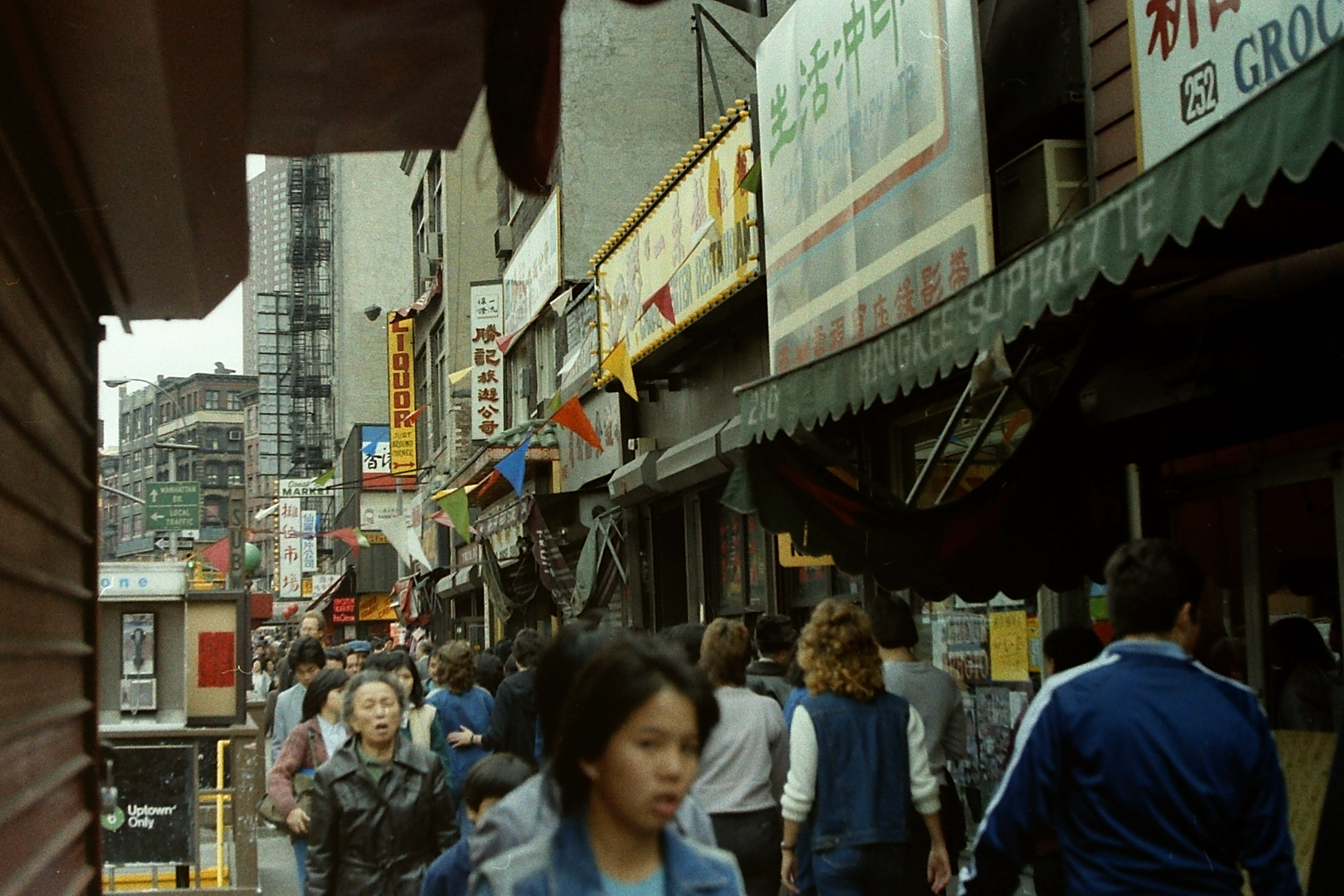
Chinatown (1984):
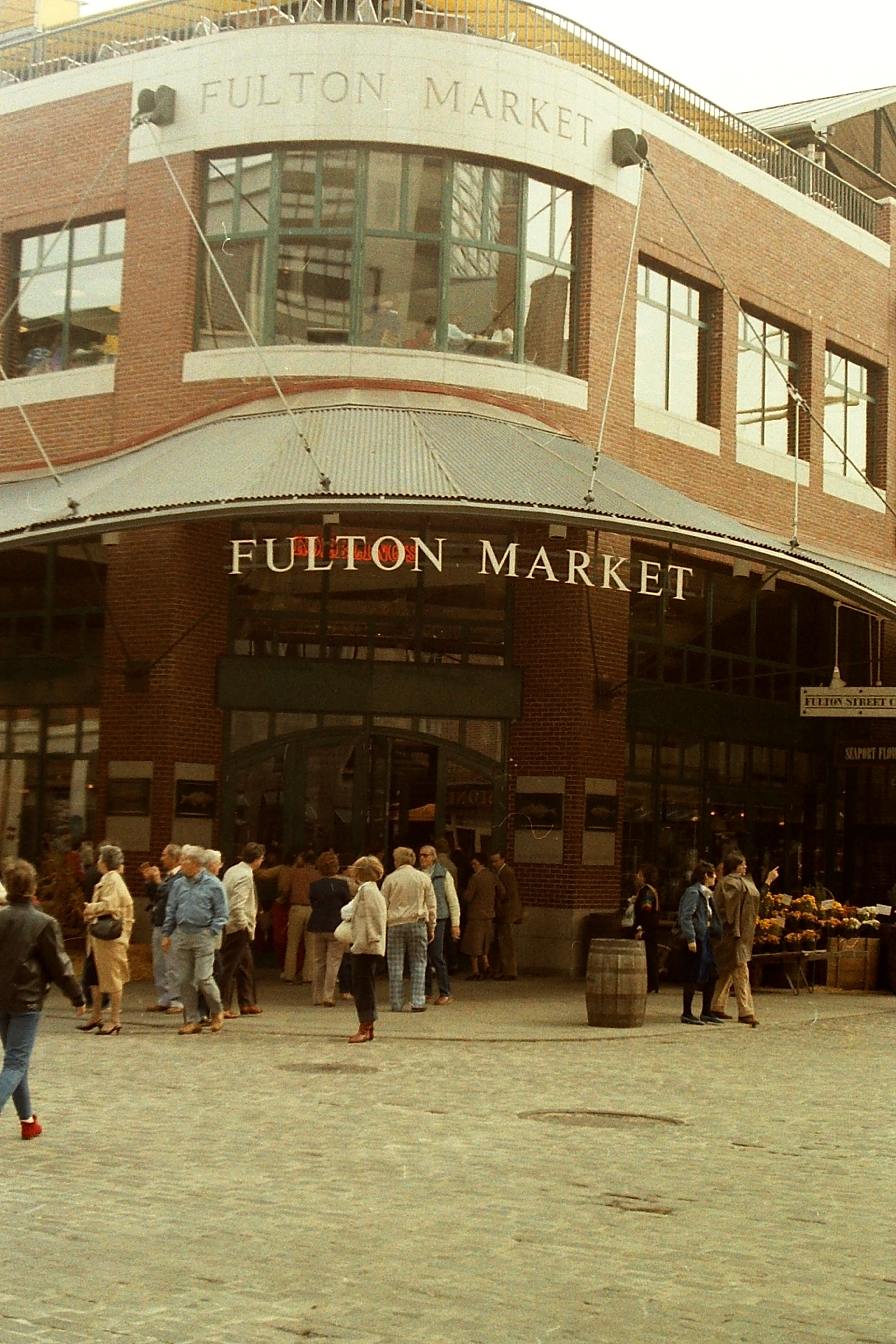
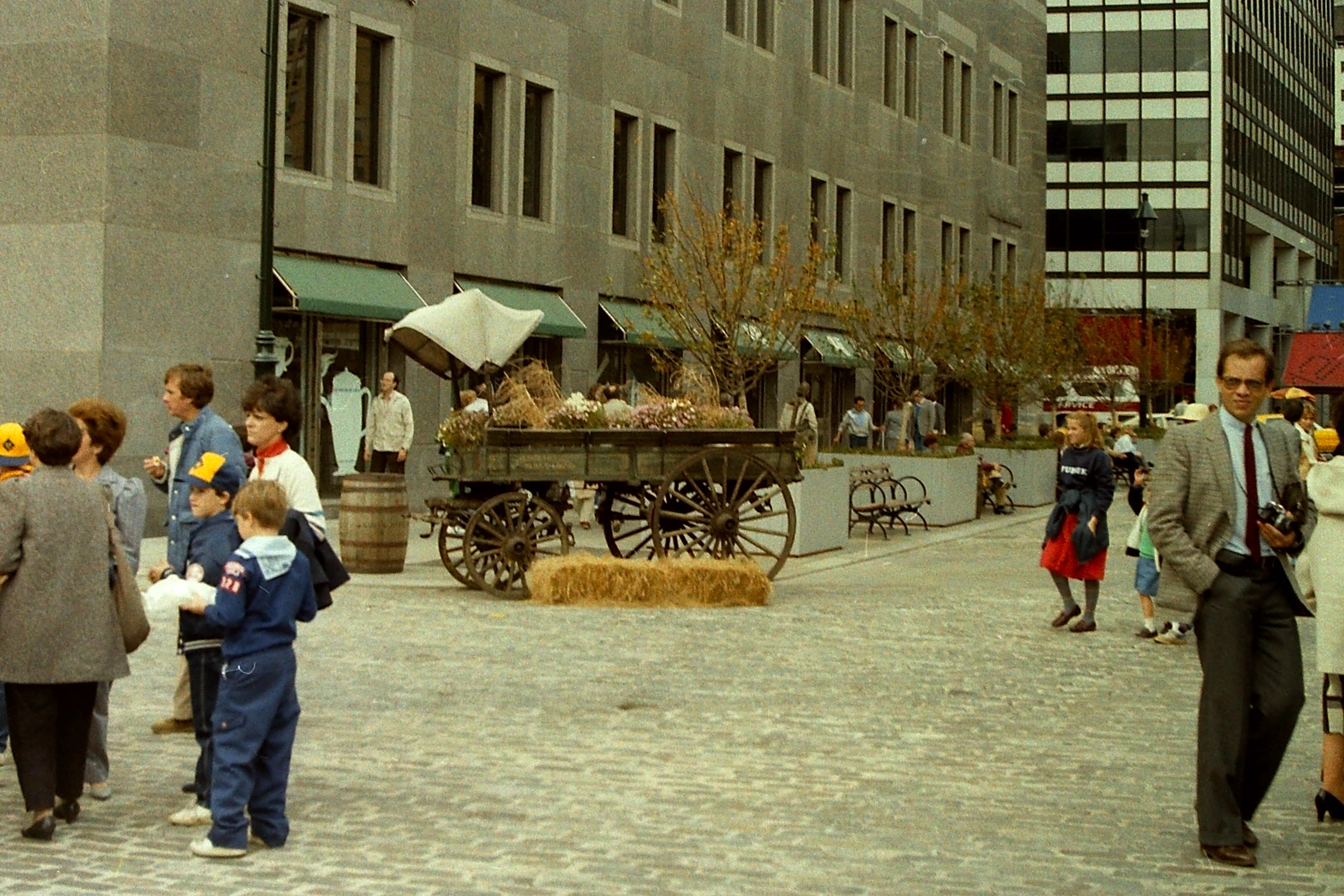
South Street Seaport (1984):
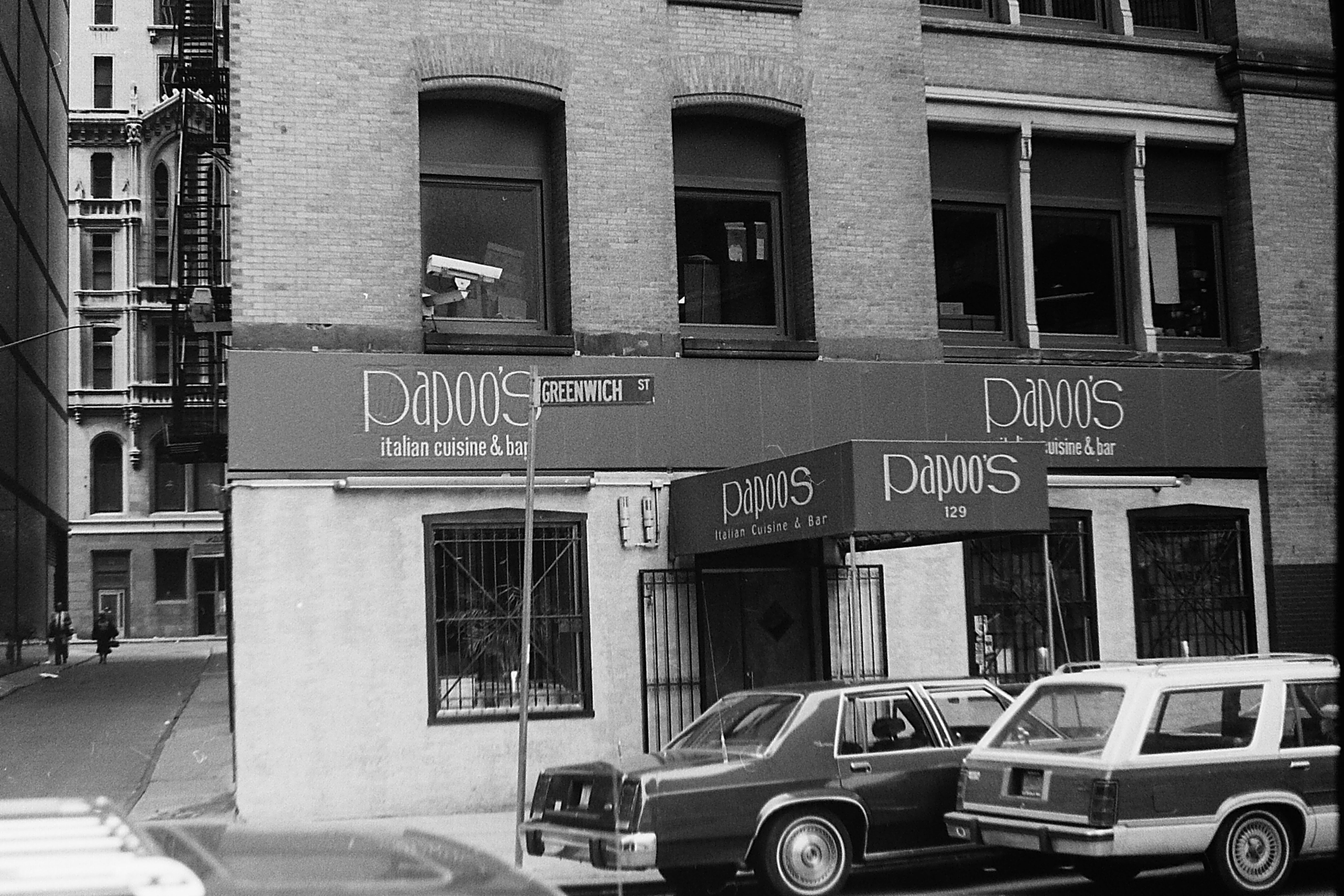
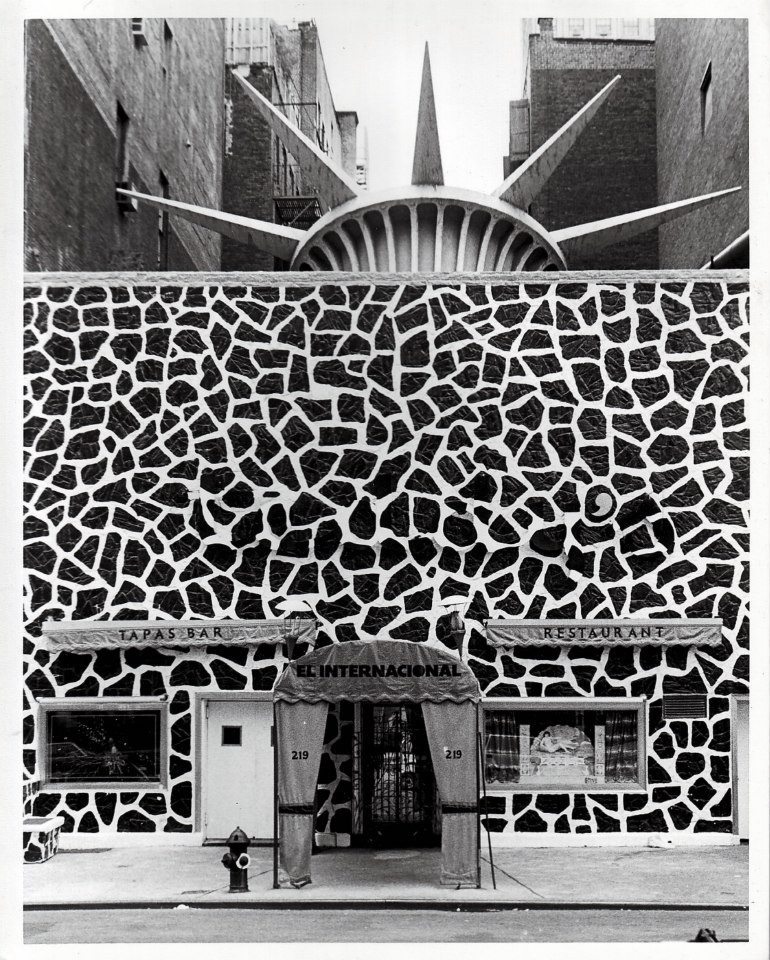
TriBeCa (1986): Donovan’s Publik House was at 108 Greenwich Street. It is now Suspenders restaurant. 67 Greenwich Street housed The Whitehall Hardware Store when this photo was taken. In 2021, the New York Times profiled this structure in an article titled The Indestructible Townhouse. El Internacional, formerly El Teddy’s was a popular hangout at 219 West Broadway. The Guest Of A Guest website described it as “The epitome of downtown cool.”
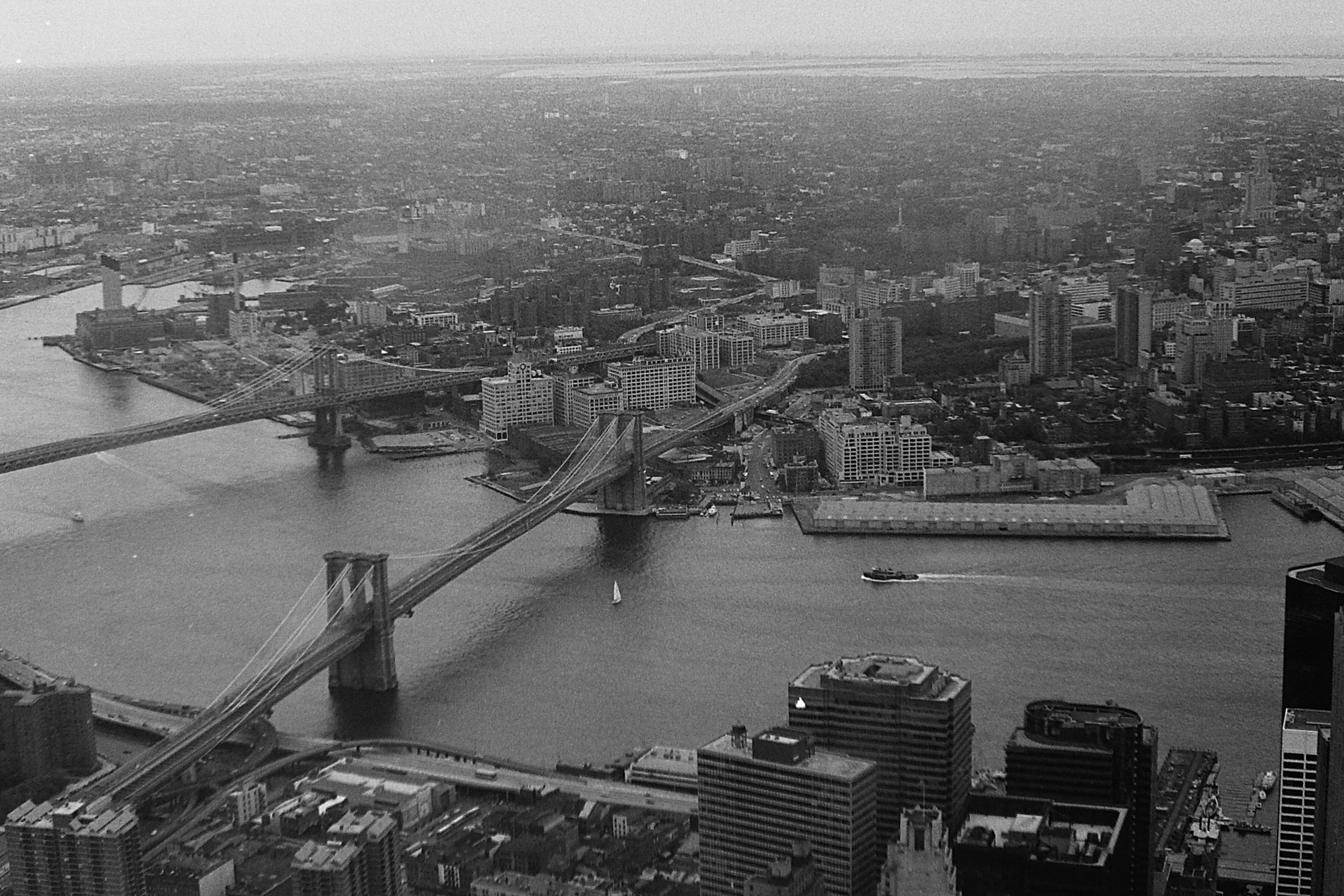
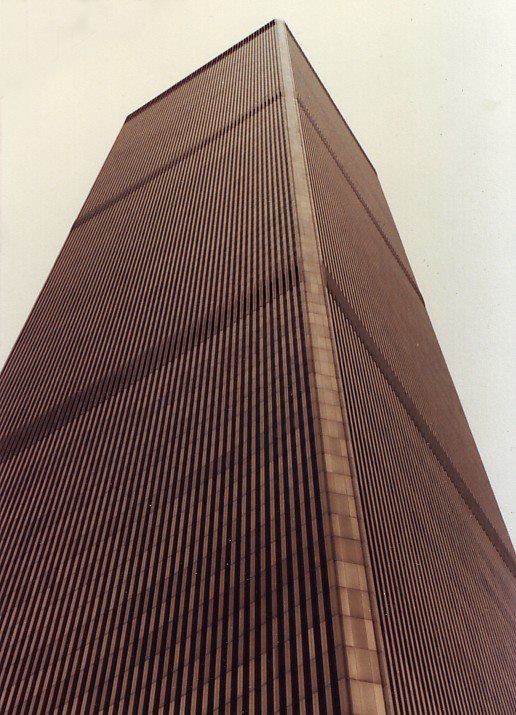
World Trade Center from above and below (1985-86):
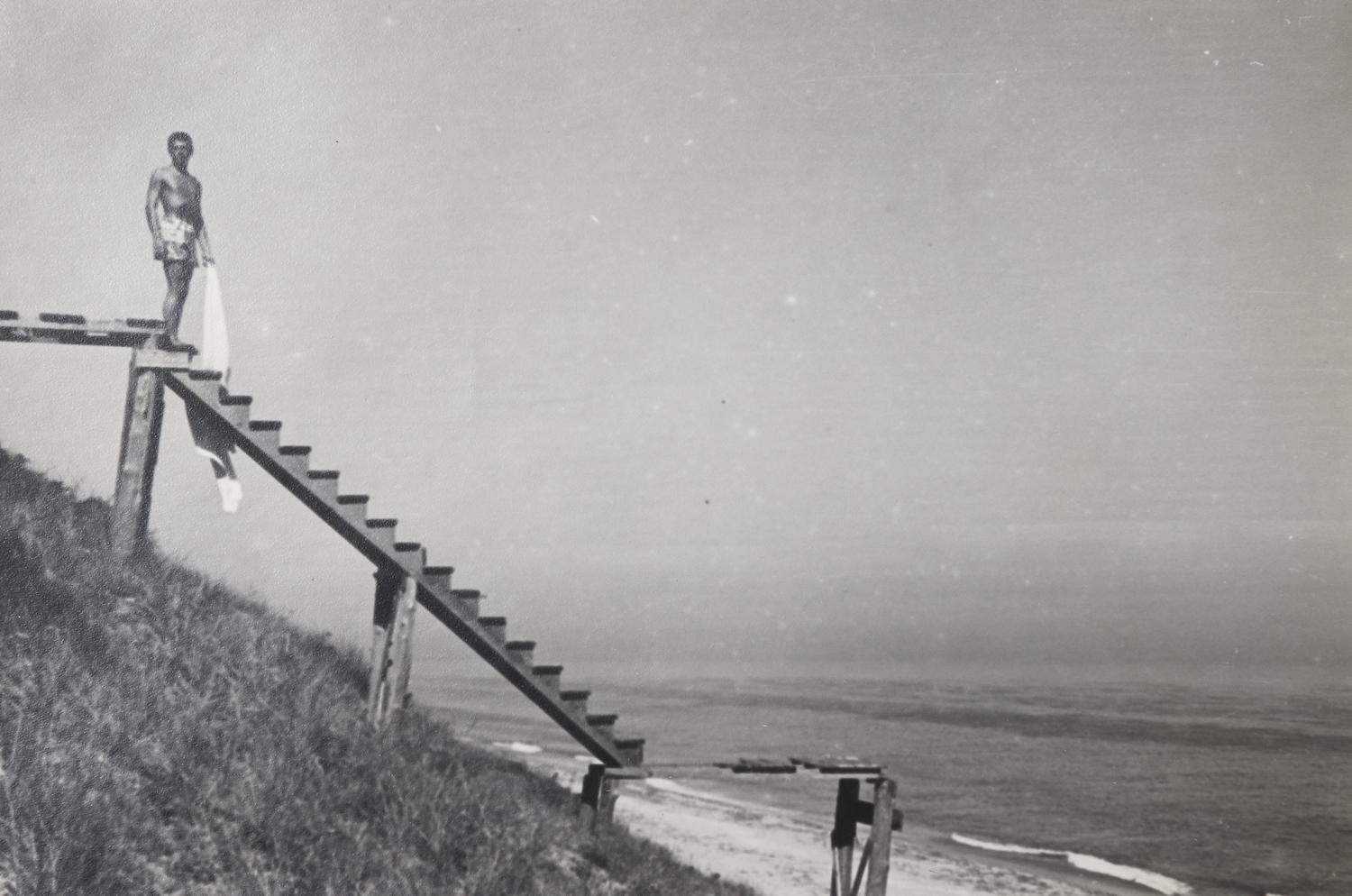
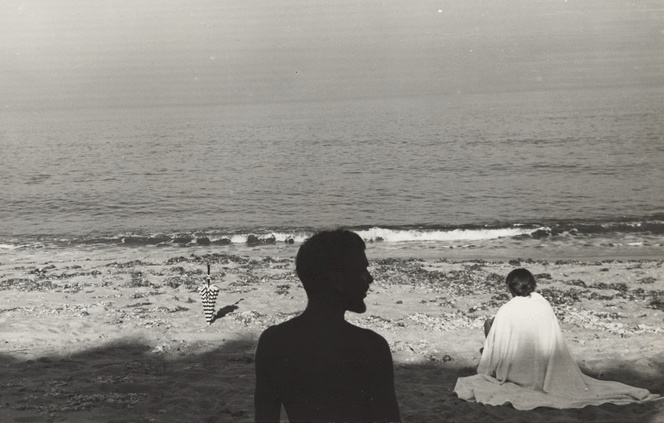
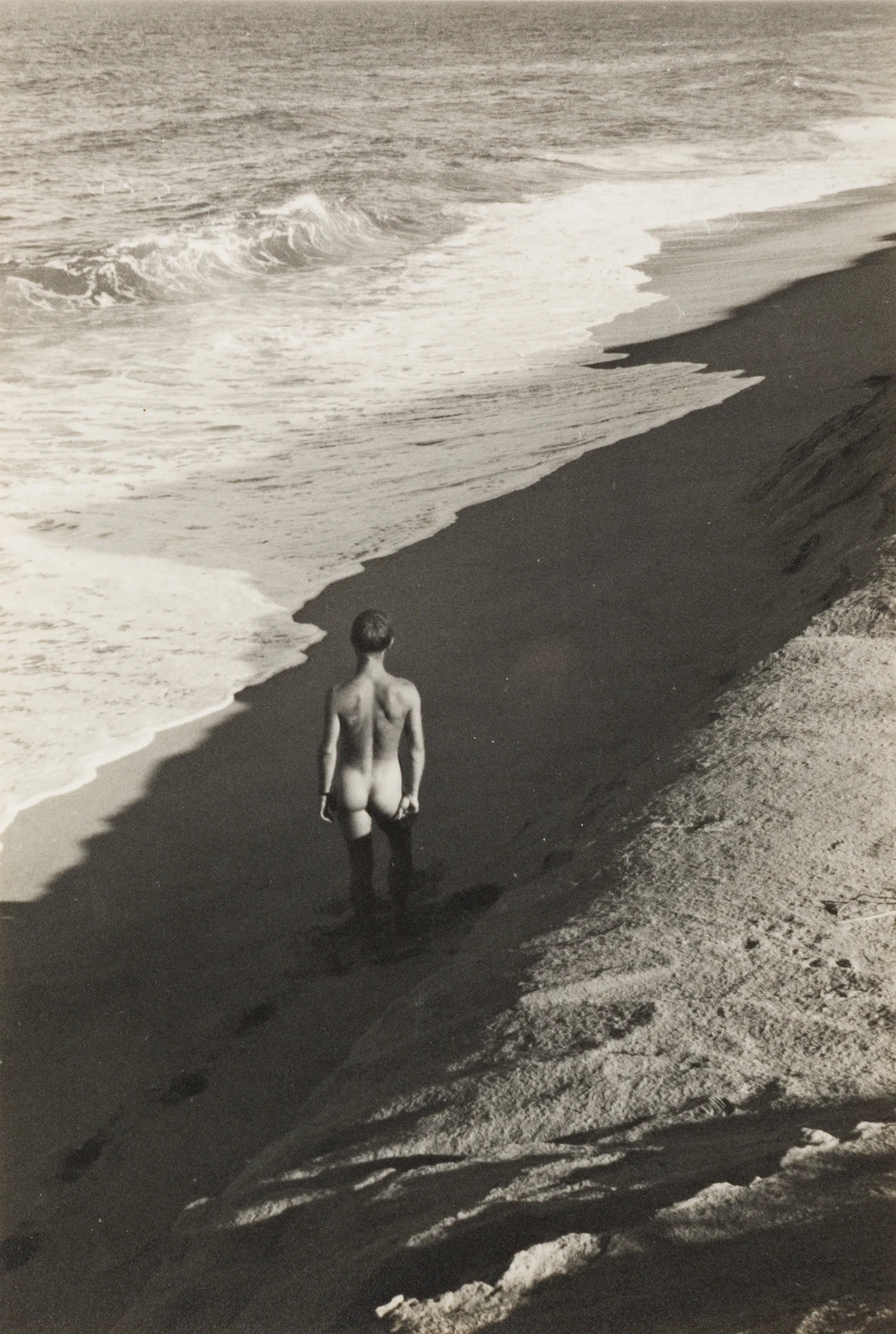
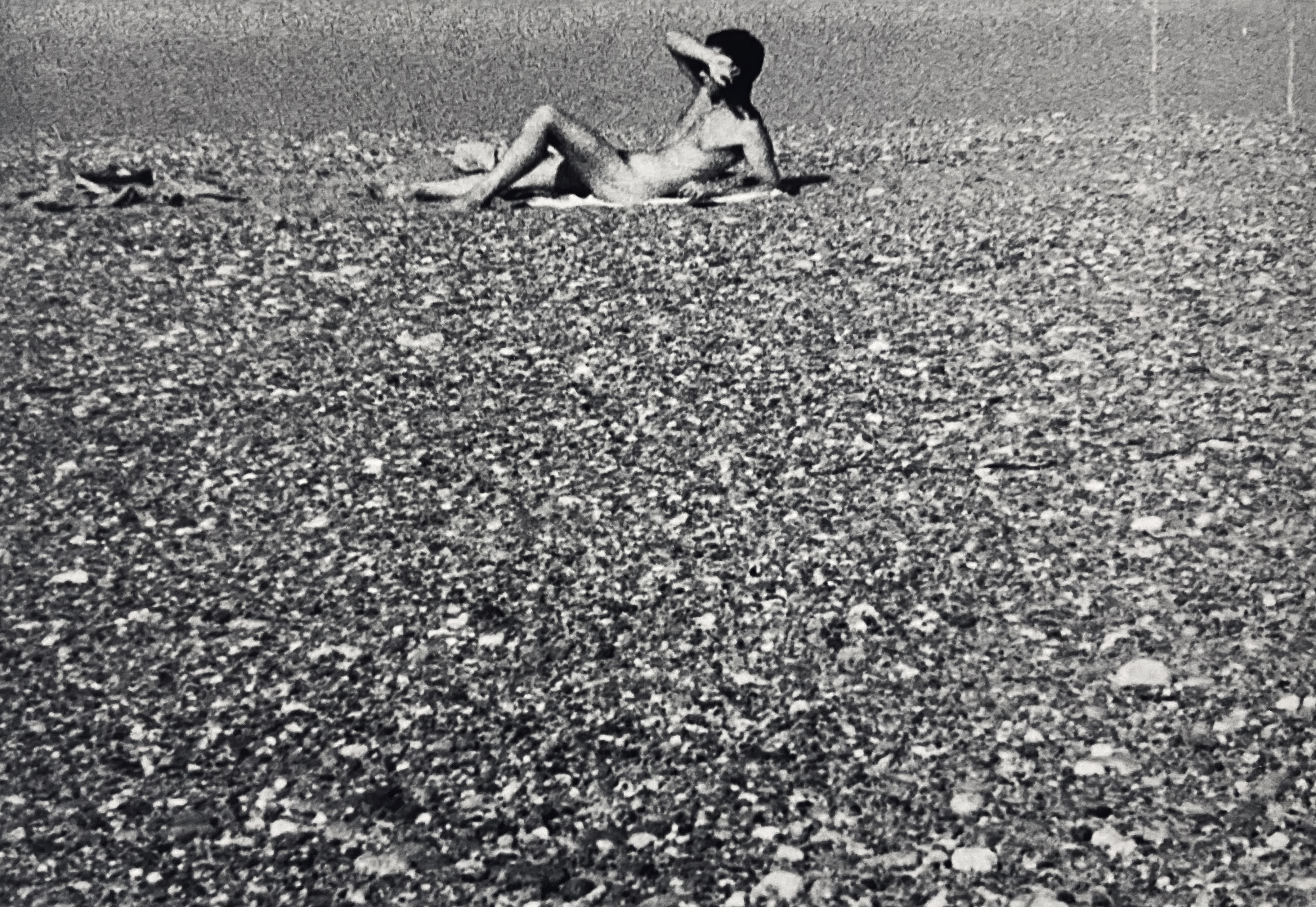
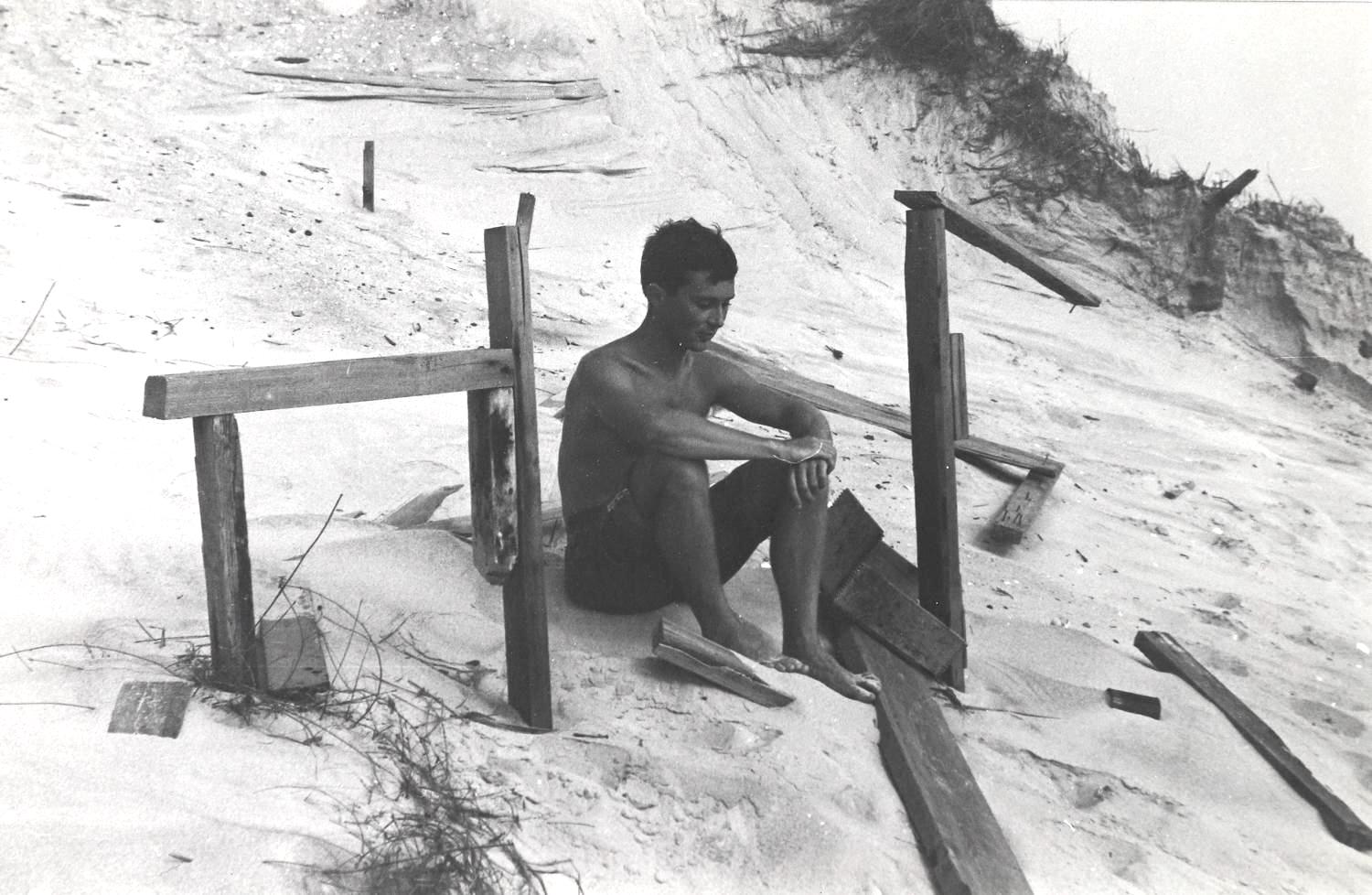
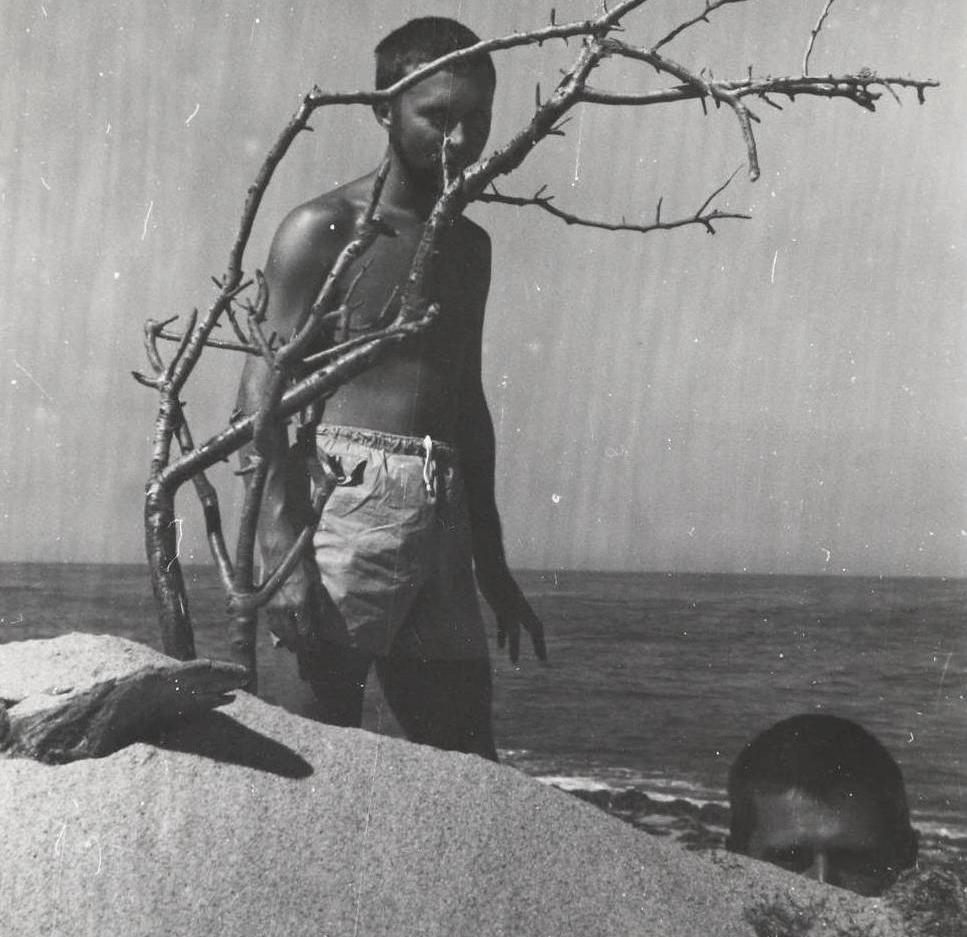
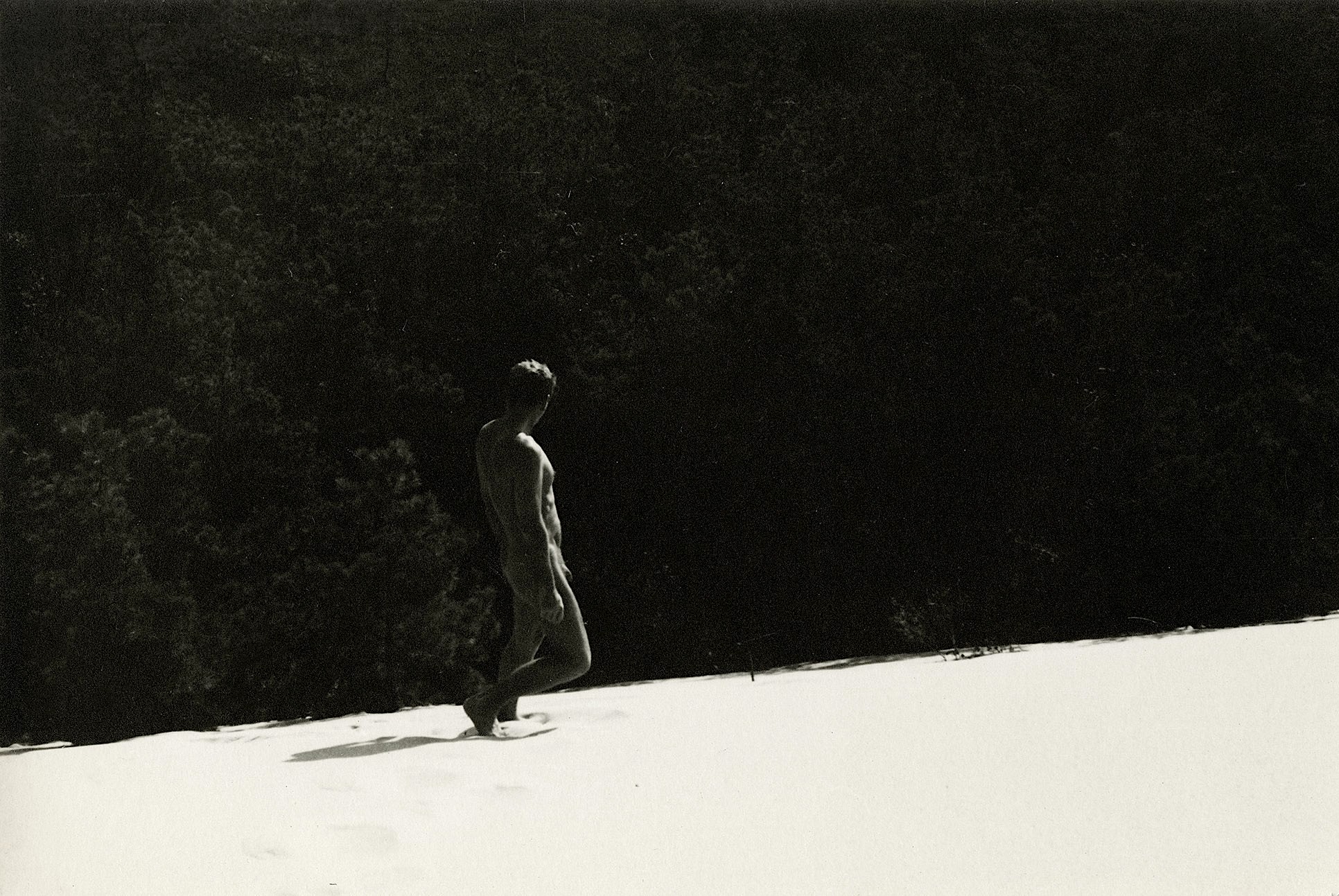
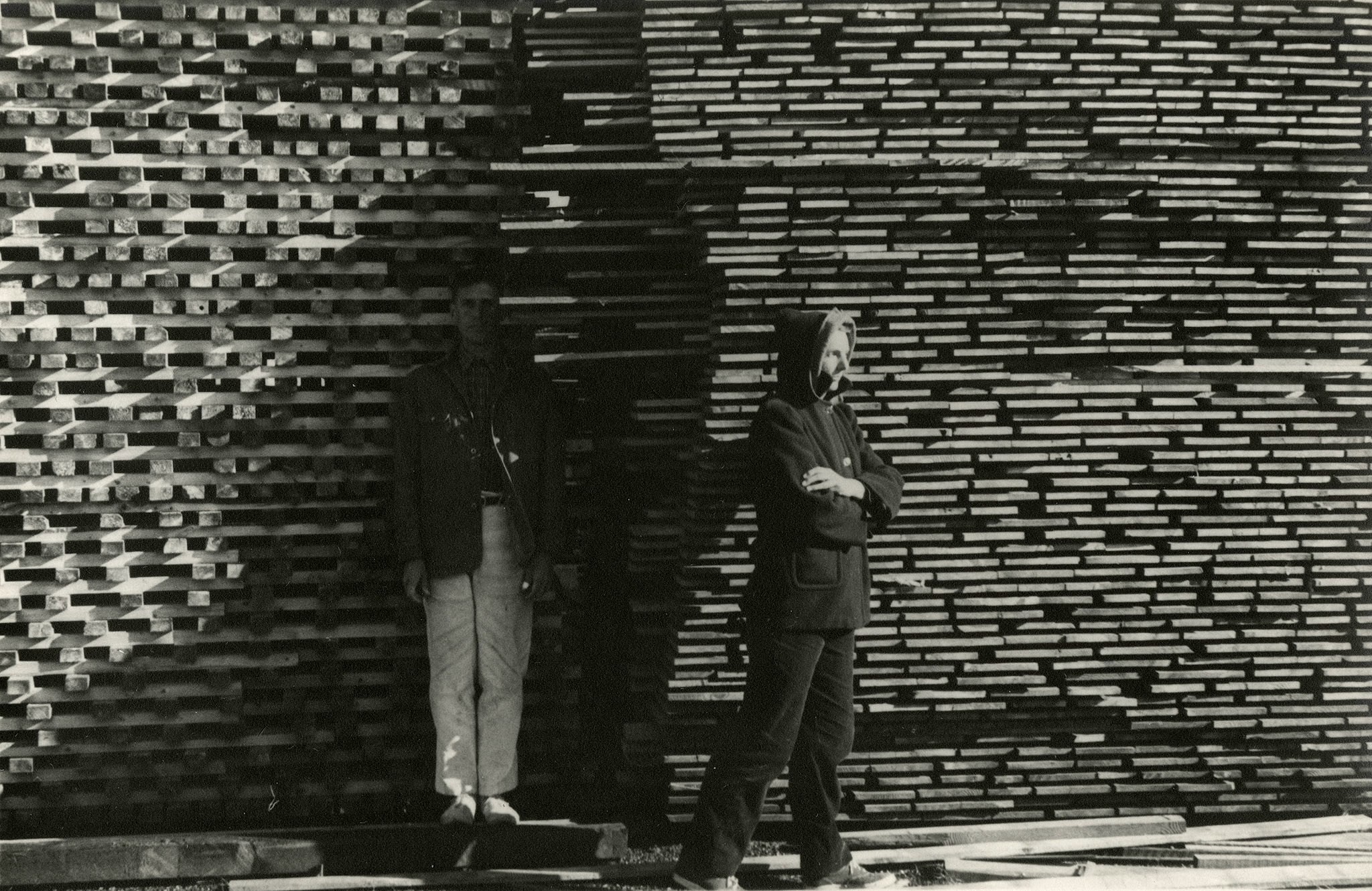
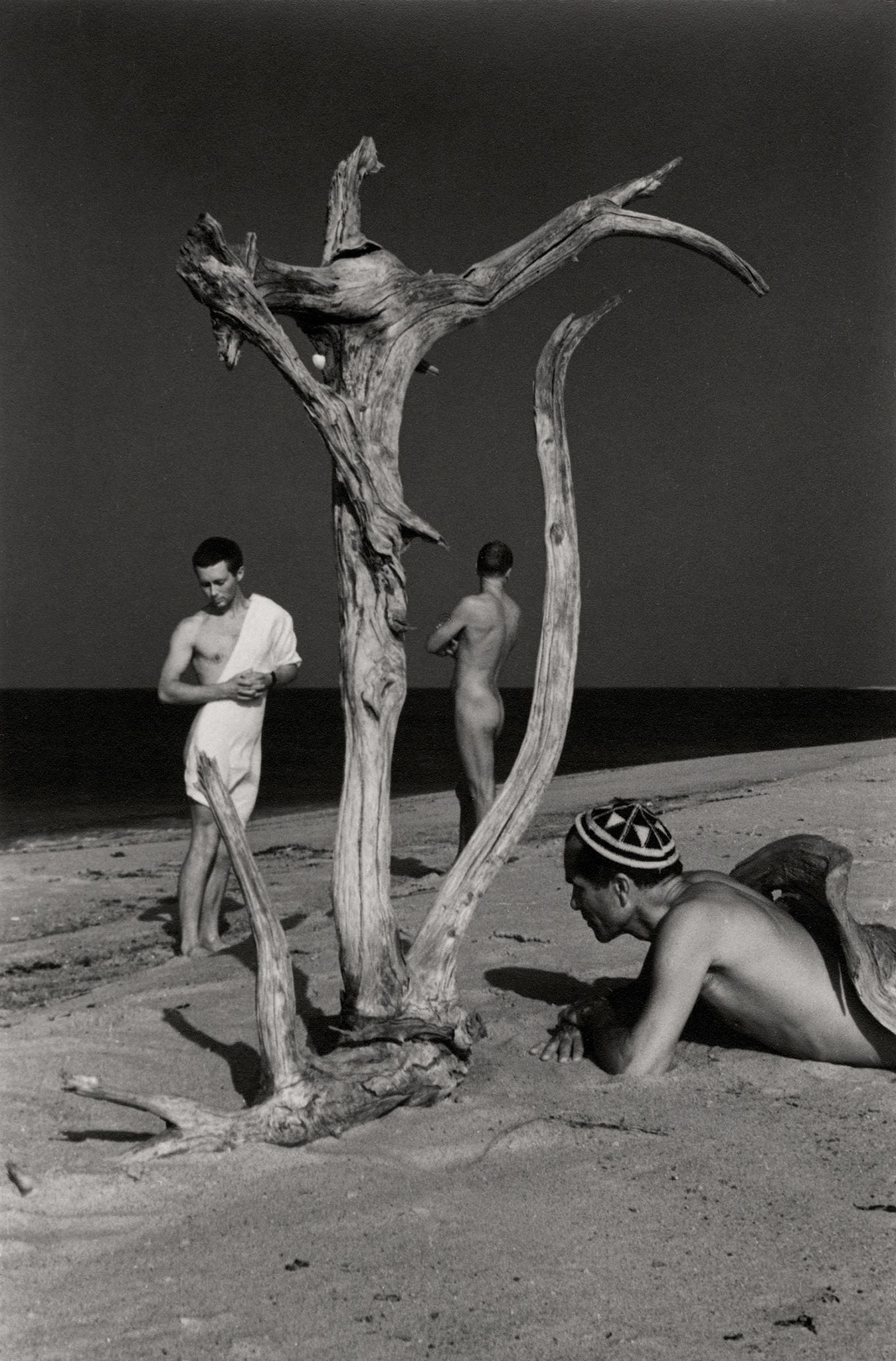
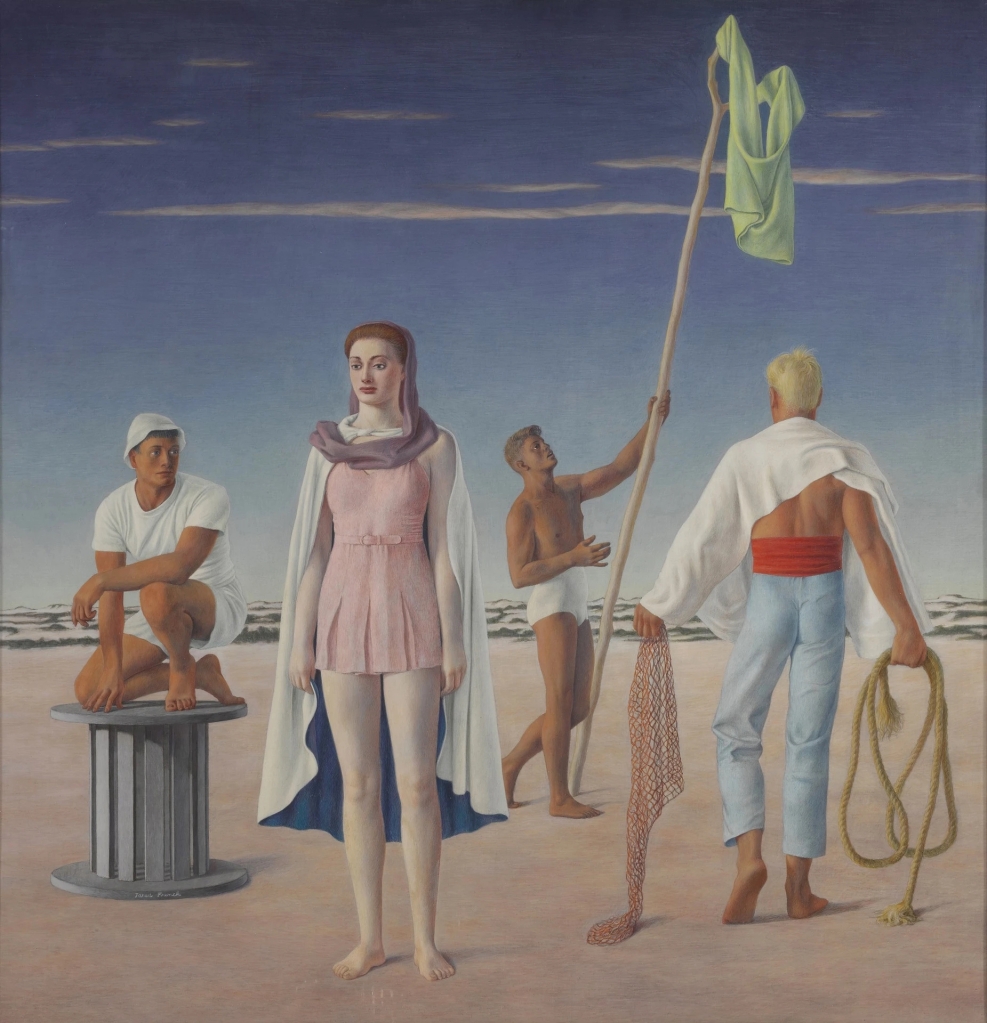
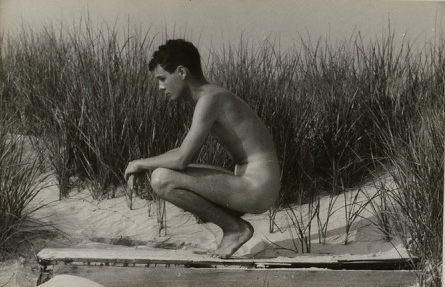
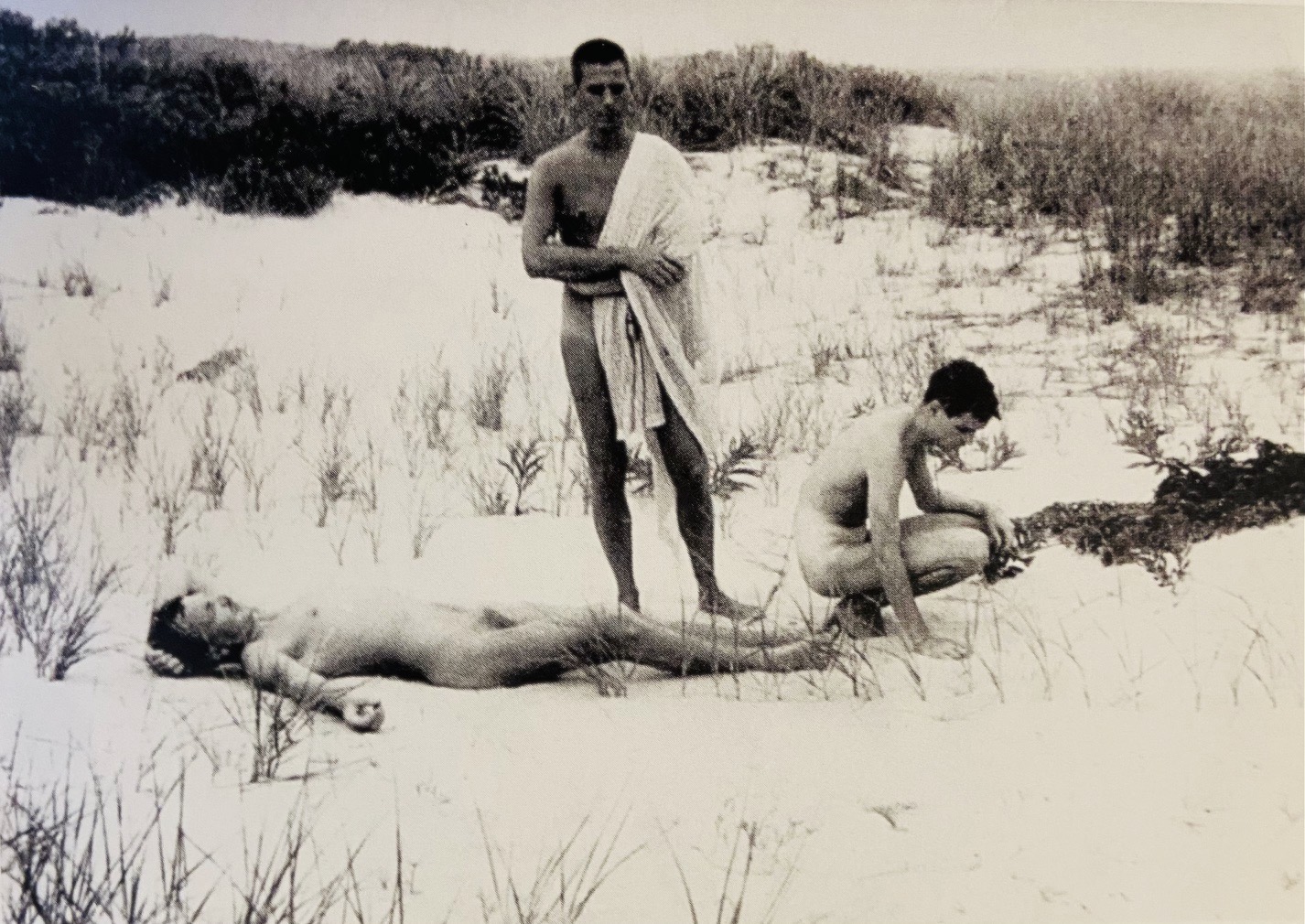
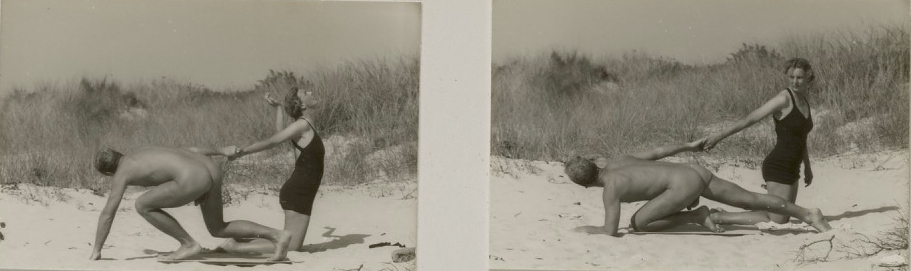
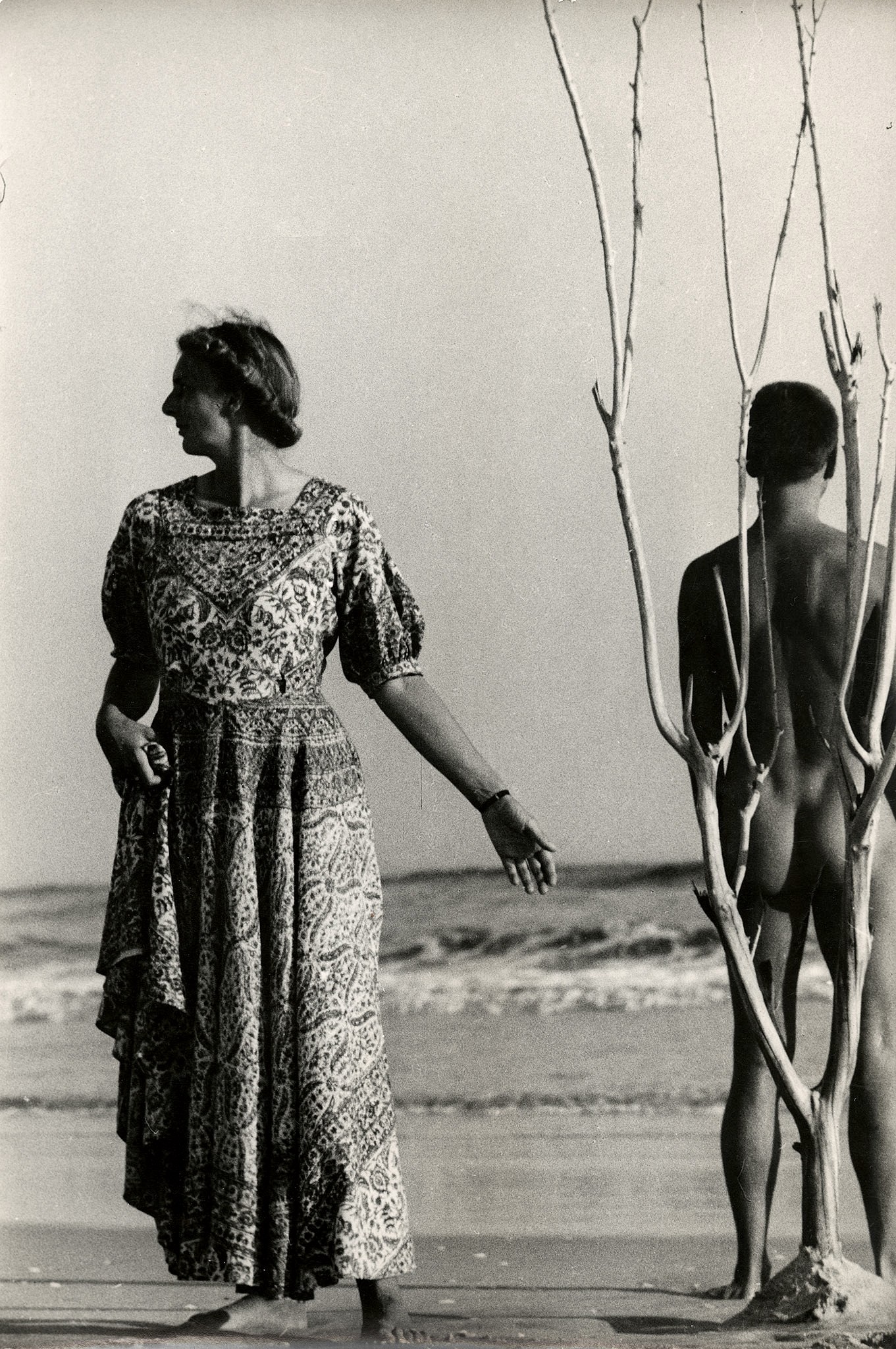
During vacations from the 1930’s through the mid-1950’s, artists Paul Cadmus, Jared French and his wife Margaret Hoening French photographed each other on the beaches of New York’s Fire Island as well as Nantucket and Cape Cod, Massachusettes.
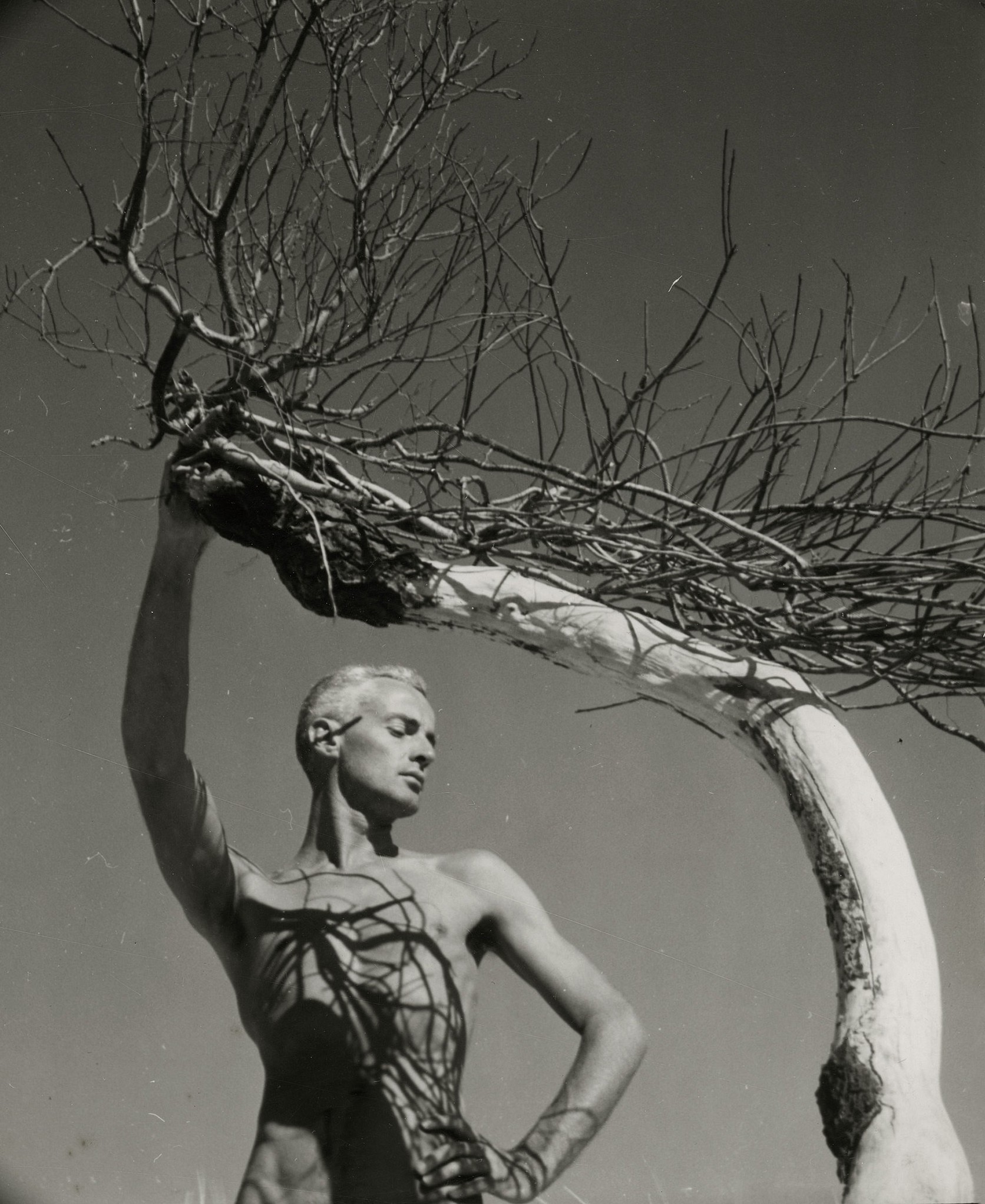
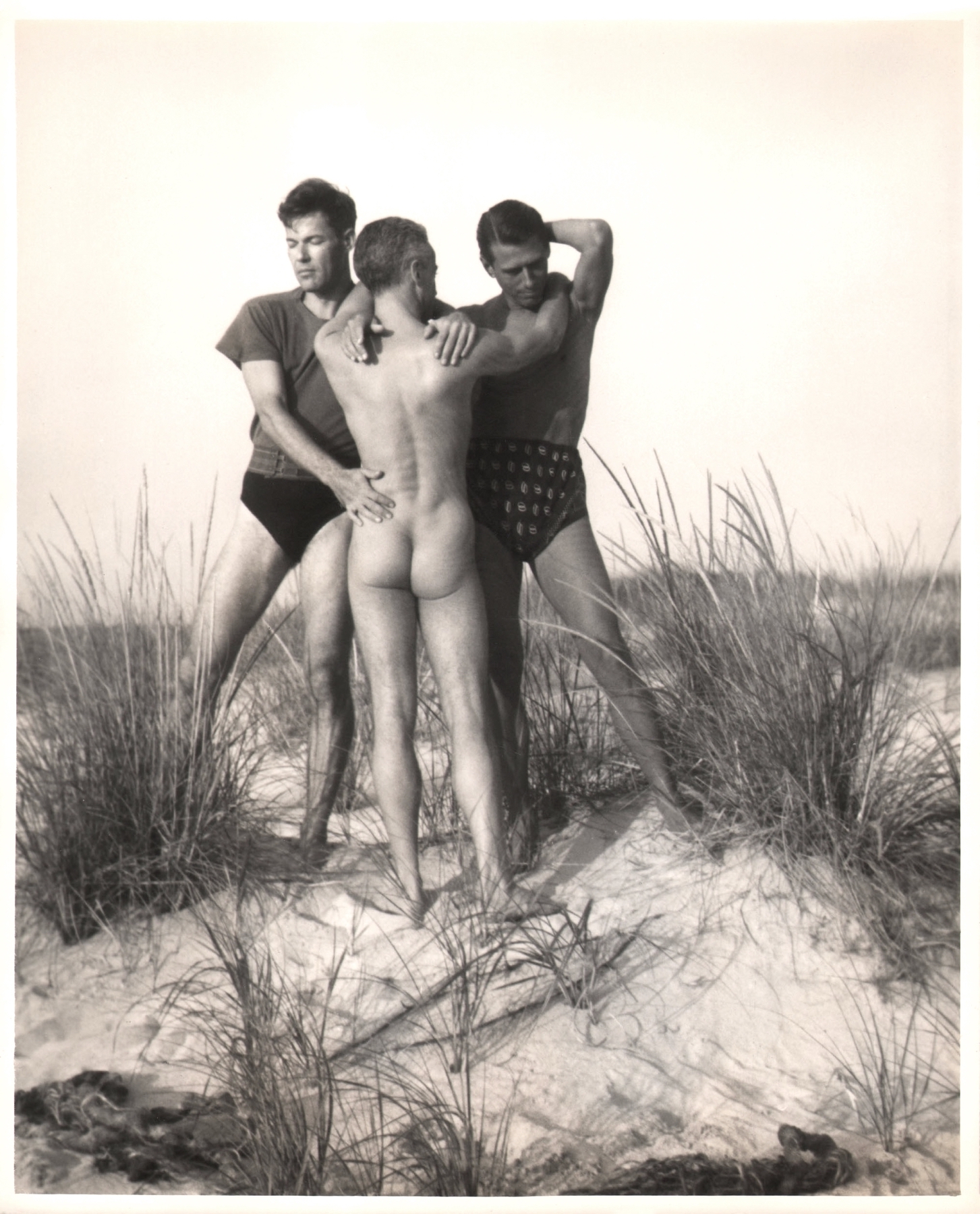
Usually nude or donning simple costumes, the artists also used found objects as props to create stark, surreal and/or erotic images. They passed Margaret’s Leica camera around, taking turns as subject and auteur. This collaborative authorship was reflected in the umbrella name they chose for this work, utilizing the first two letters of their first names: PaJaMa.
Paul Cadmus on Cape Cod (1928)
Years later Cadmus explained, “After we’d been working most of the day, we’d go out late afternoons and take photographs when the light was best. They were just playthings. We would hand out these little photographs when we went to dinner parties, like playing cards.”
The dynamic amongst the trio was complicated: Jared French and Paul Cadmus were lovers – a relationship that continued during his marriage to Margaret. All three lived and worked in a townhouse at 5 St. Lukes Place in Greenwich Village.
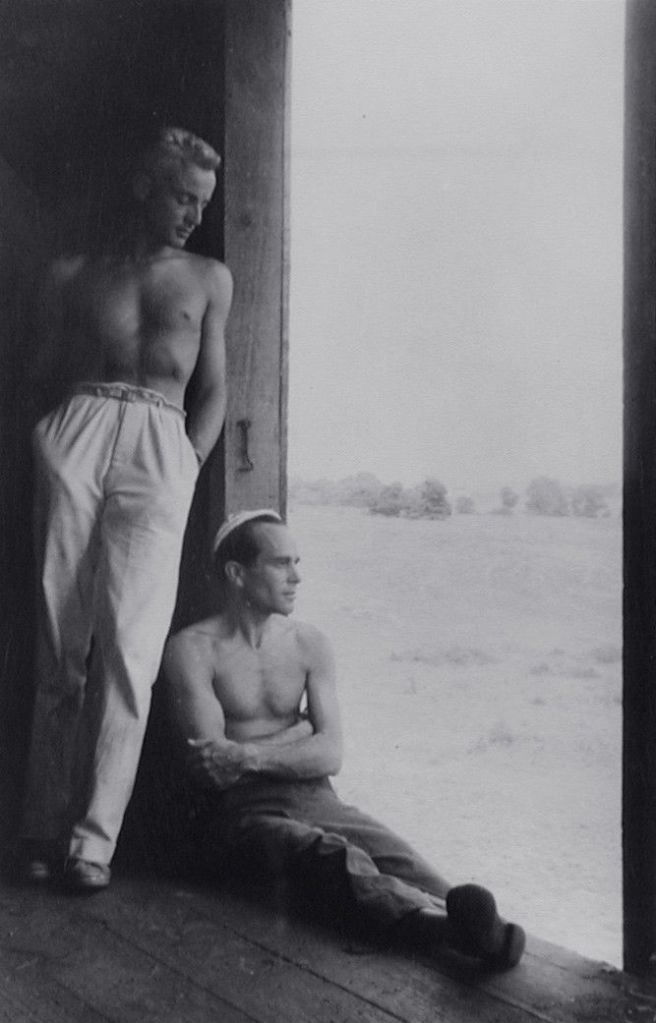
The PaJaMa collective expanded in 1945 with the inclusion of Cadmus’ boyfriend, George Tooker, an artist 16 years his junior. Cadmus would later explain “I had Jerry (Jared) in the daytime and George at night.” Although his name was not added to the PaJaMa moniker, Tooker was an active participant in the collective from 1944-49.
George Tooker with Paul Cadmus in Nantucket and Provincetown PaJaMa photos, (1946-48)
A 2015 New York Times review of a PaJaMa exhibition noted that their photos “breathed eroticism.” While some of the hundreds of photos are masterpieces of magical realism, others appear to be figure studies for their painting.
As when they vacationed on Fire Island, the collective were joined on Cape Cod by various friends and lovers, fellow artists and writers that were part of their New York social circle.
Dancer/choreographer Todd Bolenderwas the subject of a series of PaJaMa photos taken in Provincetown (1947)
Museum curator/publisher Monroe Wheeler is seen in 1947 Provincetown photos with French, Tooker & Cadmus. His lifelong partner Glenway Wescott was more prominent in the Fire Island PaJaMa photos of the early 1940’s.
Writer Christopher Isherwood with his then-boyfriend, photographer Bill Caskey, Provincetown (1947)
Photographer George Platt Lynes (left, wi/ Monroe Wheeler) joined them on Fire Island and later in Provincetown with his own camera.
PaJaMa photos are part of this tribute to playwright Tennessee Williams, displayed at Provincetown’s Atlantic House, one of the oldest gay bars in the U.S.
Provincetown, 1947 (l-r): George Platt Lynes, Monroe Wheeler, Paul Cadmus and George Tooker
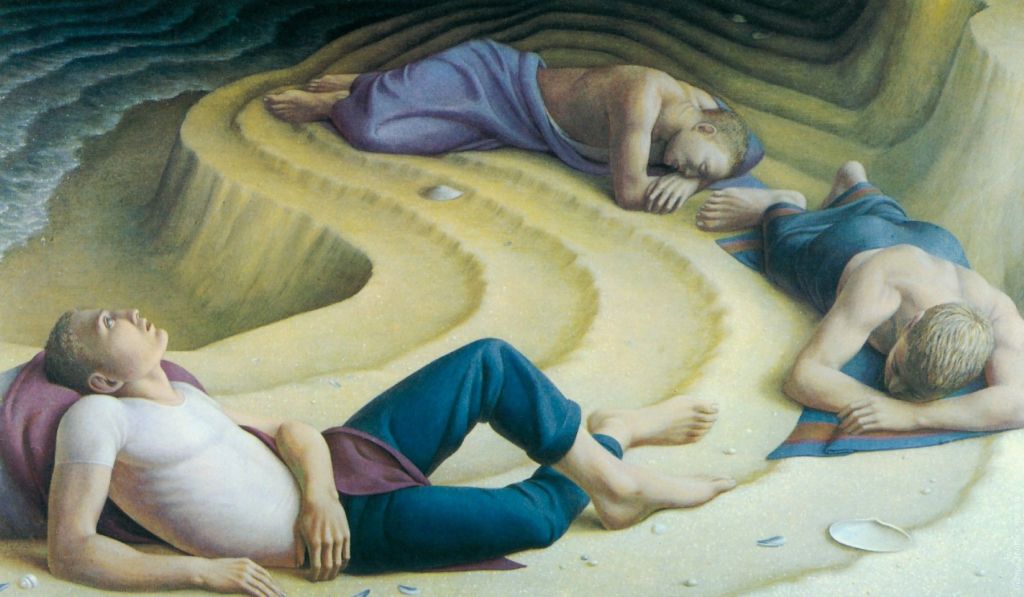
George Tooker, Sleepers I (1951)
On Cape Cod, the collective occasionally experimented with color film, which gave their work a different texture.
The quartet toured Europe in 1949 and by the end of the trip, Tooker had split from Cadmus. He later said “I was looking for a relationship and my relationship with Paul always included Jared and Margaret French.” Tooker would soon find a partner in painter Bill Christopher, with whom he remained until Christopher’s death in 1973.
Back to a trio, the PaJaMa collective would return to Fire Island for their summer getaway in 1950.
PaJaMa, Provincetown (1948)
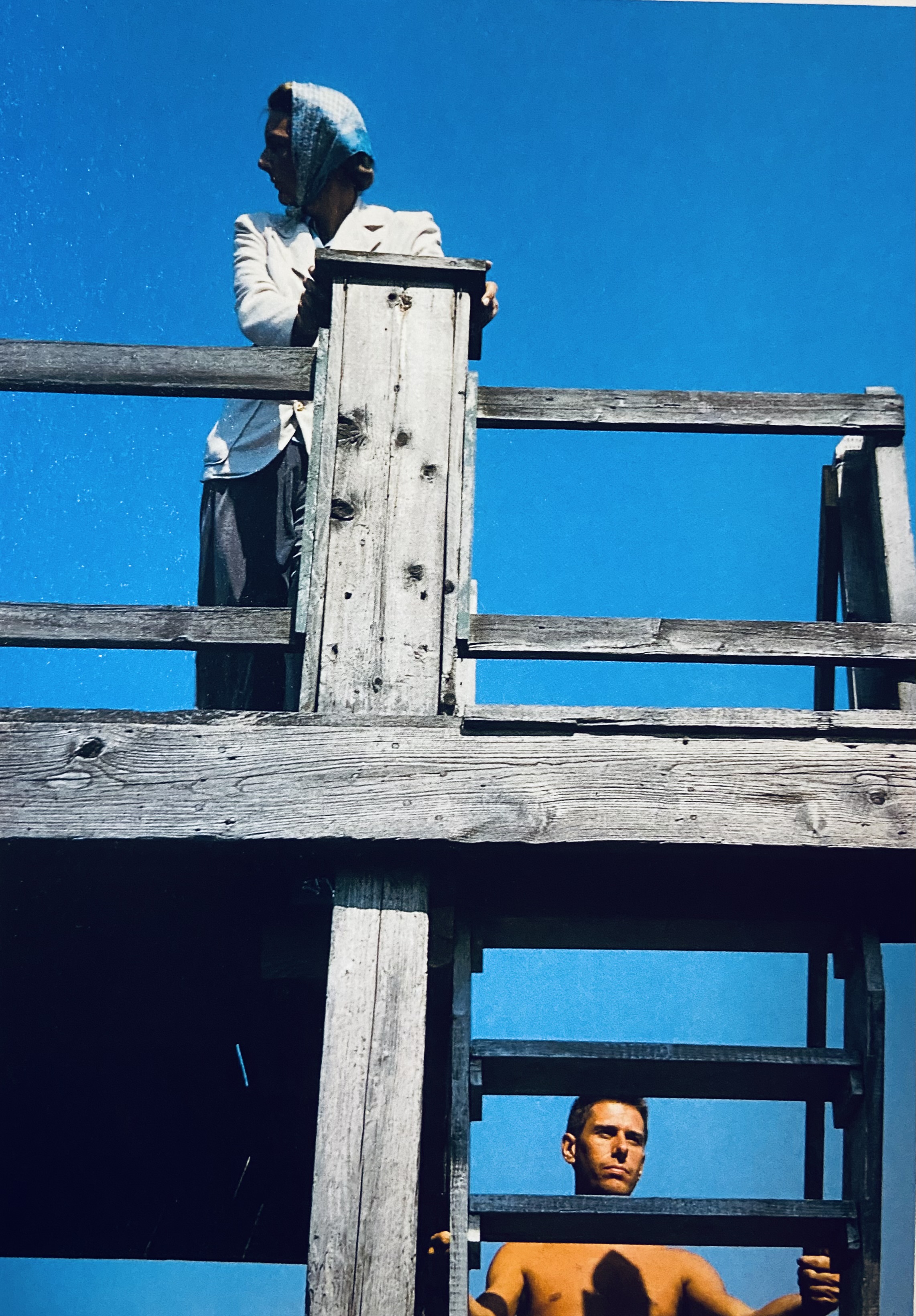
Paul Cadmus & Margaret French, Jenny Lind Tower, North Truro (1947)
PaJaMa, Women & Boys (ca 1940s)
As with George Platt Lynes’ male nude photographs, the PaJaMa photographs did not receive much notice or recognition until the 1990’s. They are now frequently exhibited in galleries and selections are a part of the MOMA collection.
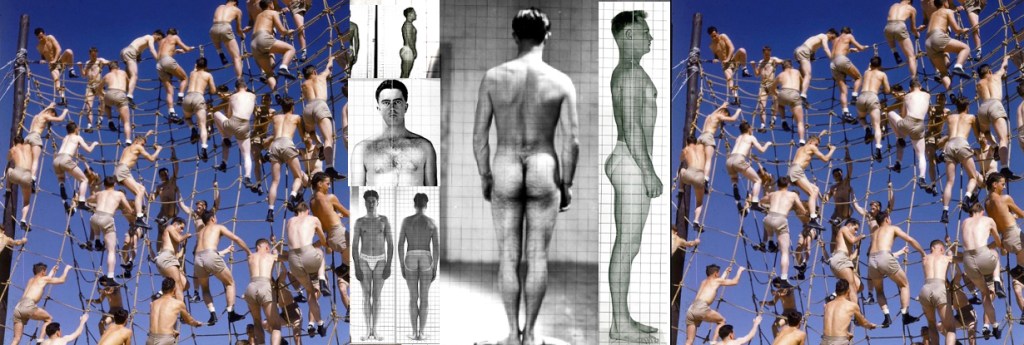
Up until recent years, the fabled Ivy League nude posture photos have been written about but seldom seen. Starting in the mid-1930’s and continuing on until the 1970’s, incoming Ivy League University students were photographed fully nude in order to gauge their posture, detect scoliosis, and address other correctable body issues while simultaneously inflicting emotional scarring on the participants. Talk show host Dick Cavett joked about it in his early stand-up routines:
“Some guys hated it… some seemed to enjoy it. One guy tried to go through twice… one guy fainted… one guy tried to buy his pictures… and one guy tried to get his retouched.”
50 years later, he penned a New York Times Op Ed piece with a much darker view of the experience.
In recent years, the posture photos from Yale have garnered the most press, with tongues wagging at the possibilities of seeing our country’s best and brightest in the buff. The pics were so rare that most articles on the subject did not actually feature any of the images, opting instead to use medical textbook illustrations or military posture photos.
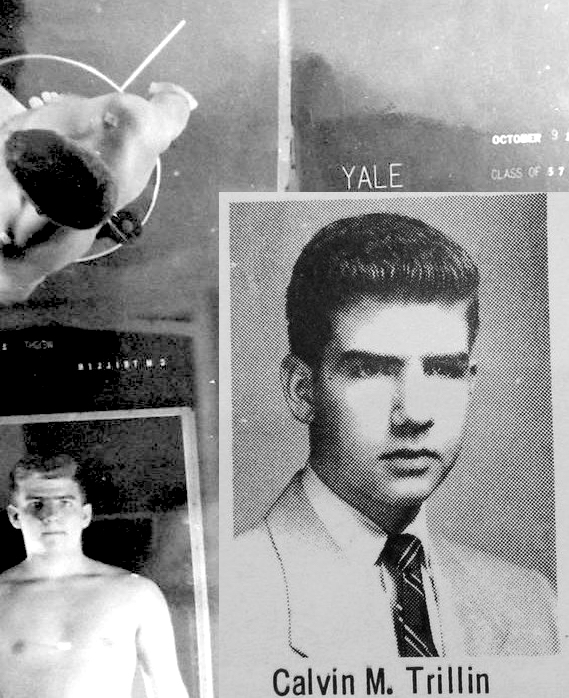
Since 2020, a steady stream of posture photos featuring male freshman Yalies from 1937-1960 have sold on eBay. It was really only a matter of time before some familiar faces began to pop up. I posted about writer Calvin Trillin‘s photo, which went for a little over $100, while the pic of late actor James Franciscus pulled in $1,225.
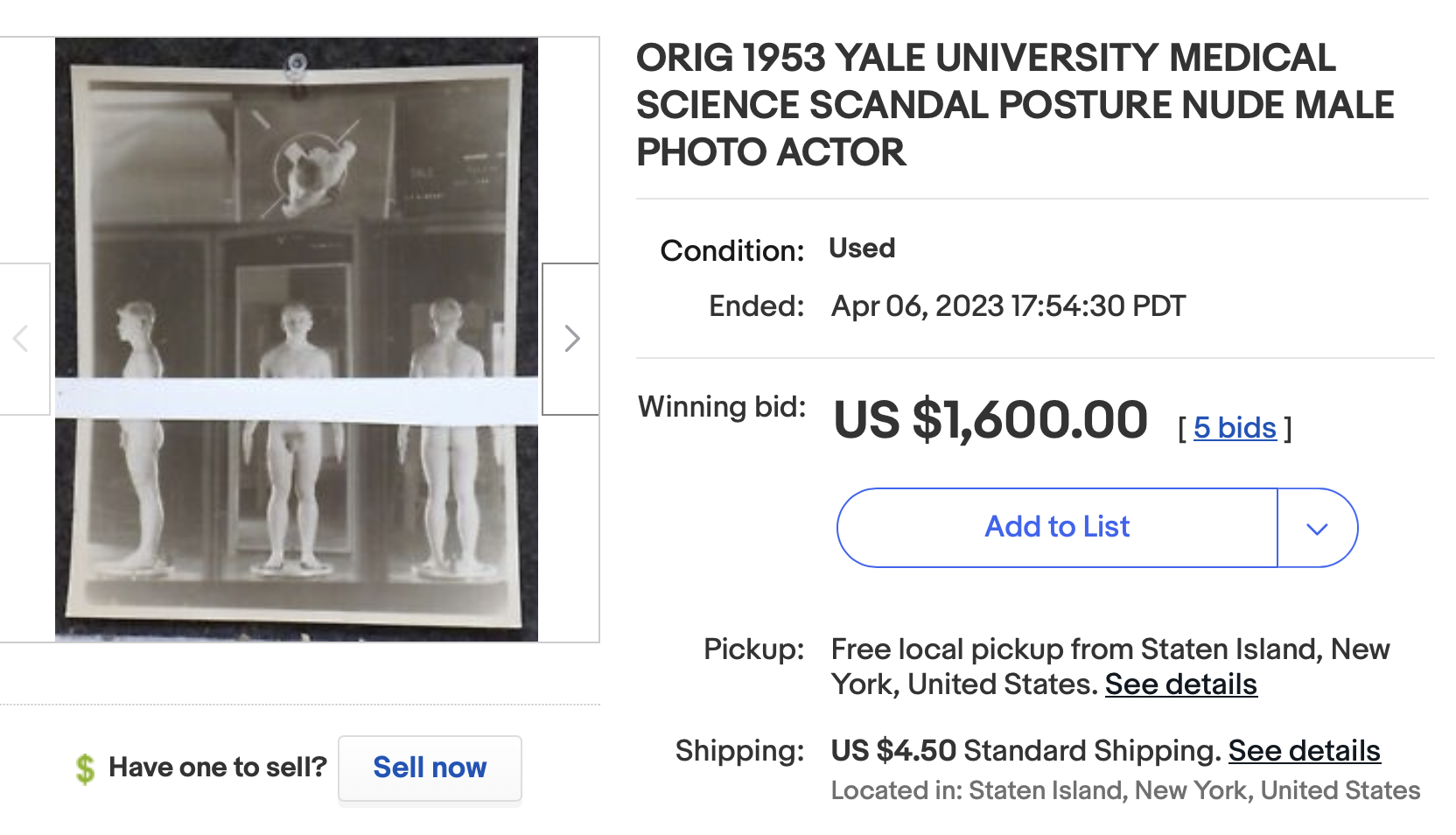
These pics now regularly sell for close to $1,000 each. Earlier this month, actor Bill Hinnant’s photo went for a whopping $1,600.
Chalk one up to eBay for their ever-changing goalposts of propriety. When James Franciscus’ Yale photo went up for auction in 2021, full nudity was prohibited in auction photos. What we were left with was a modesty strip applied by the seller to prevent us from viewing the full Franciscus. Now eBay requires that auctions selling nude photos actually show the goods – to insure that the subject isn’t too…erm… excited to be there. Dean Martin’s dong was covered with a post-it, but now it’s ok to see Bill’s Hinnant:
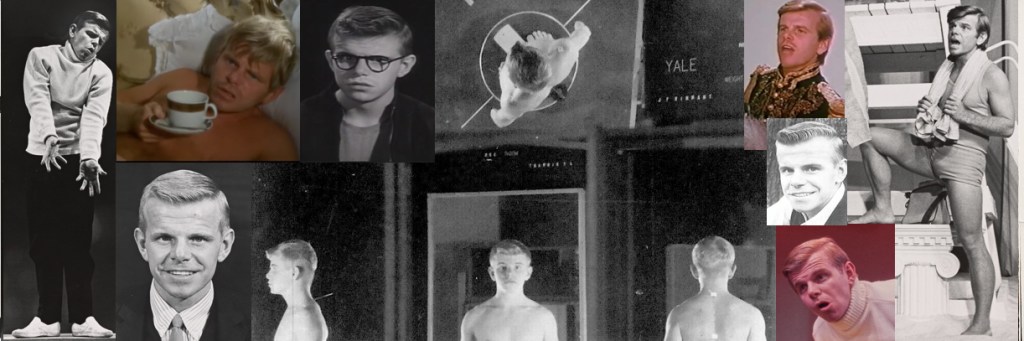
Hinnant was still known by his birth name of John F. Hinnant, Jr. when he arrived at Yale in the Fall of 1953. Originally from Chincoteague Island, Virginia, he had spent two summers as an apprentice at Ogunquit Playhouse in Maine. He made his professional debut there playing Barbara Cook’s son in Carousel. He also appeared in Life With Mother starring the legendary Billie (Glinda the Good Witch) Burke.
Following his sophomore year, Bill departed Yale when he won the role of Lt. Cover in the original cast of the comedy No Time For Sergeants starring Andy Griffith. After a year and a half on Broadway, Hinnant returned to Yale to complete his degree alongside his younger brother, Skip, who was also an actor.
In 1957, Bill Hinnant co-starred with former Yale classmate James Franciscus in the noir film Four Boys And A Gun:
Standing just 5’2″, his stature was usually noted in press articles. “Pintsized blond Hinnant has a full-sized talent!” crowed a 1965 Variety review.
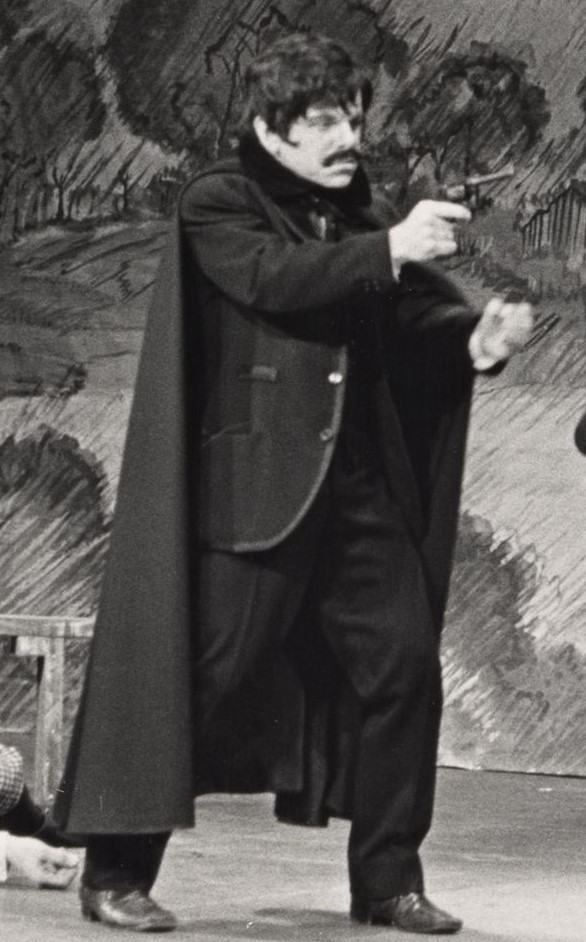
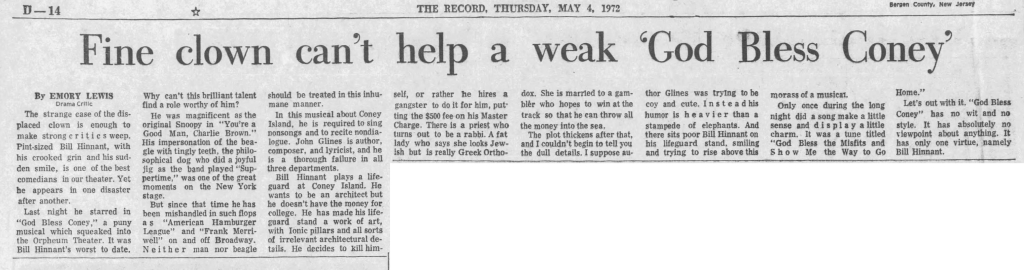
Most of his notices were similar to Variety’s take on the 1963 off-Broadway musical Put It In Writing: “Far from memorable but featuring good work by Bill Hinnant.” This was a theme throughout his career, as he received favorable reviews in forgotten musicals that would close on the road (Maltby & Shire’s Love Match), on opening night (The American Hamburger League, Frank Merriwell), or after a handful of performances (All Kinds Of Giants, God Bless Coney). He guested on television shows ranging from Route 66 and Naked City to sitcoms like Pete & Gladys and Karen Valentine’s self-titled show.
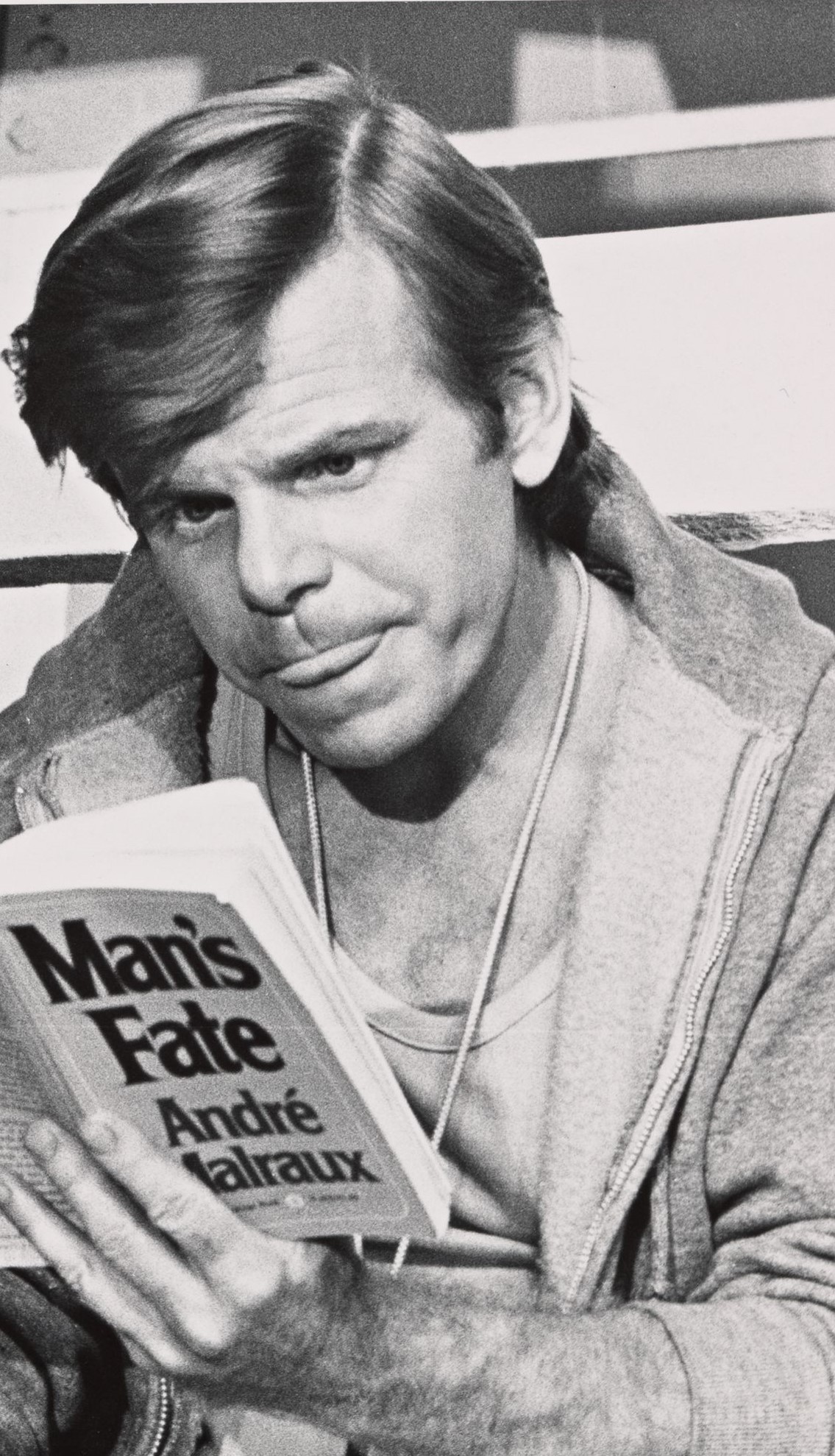
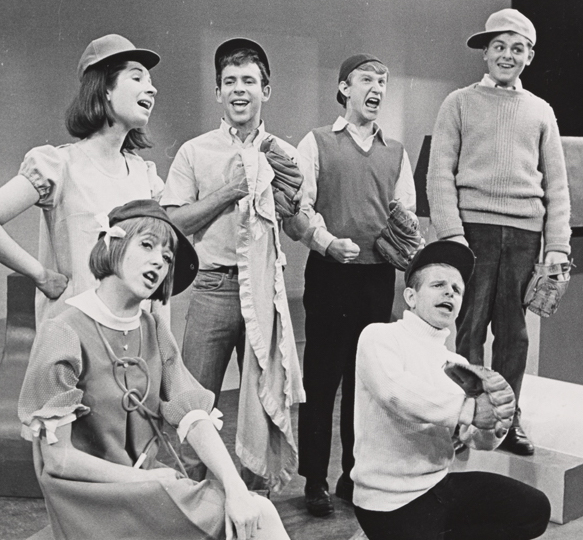
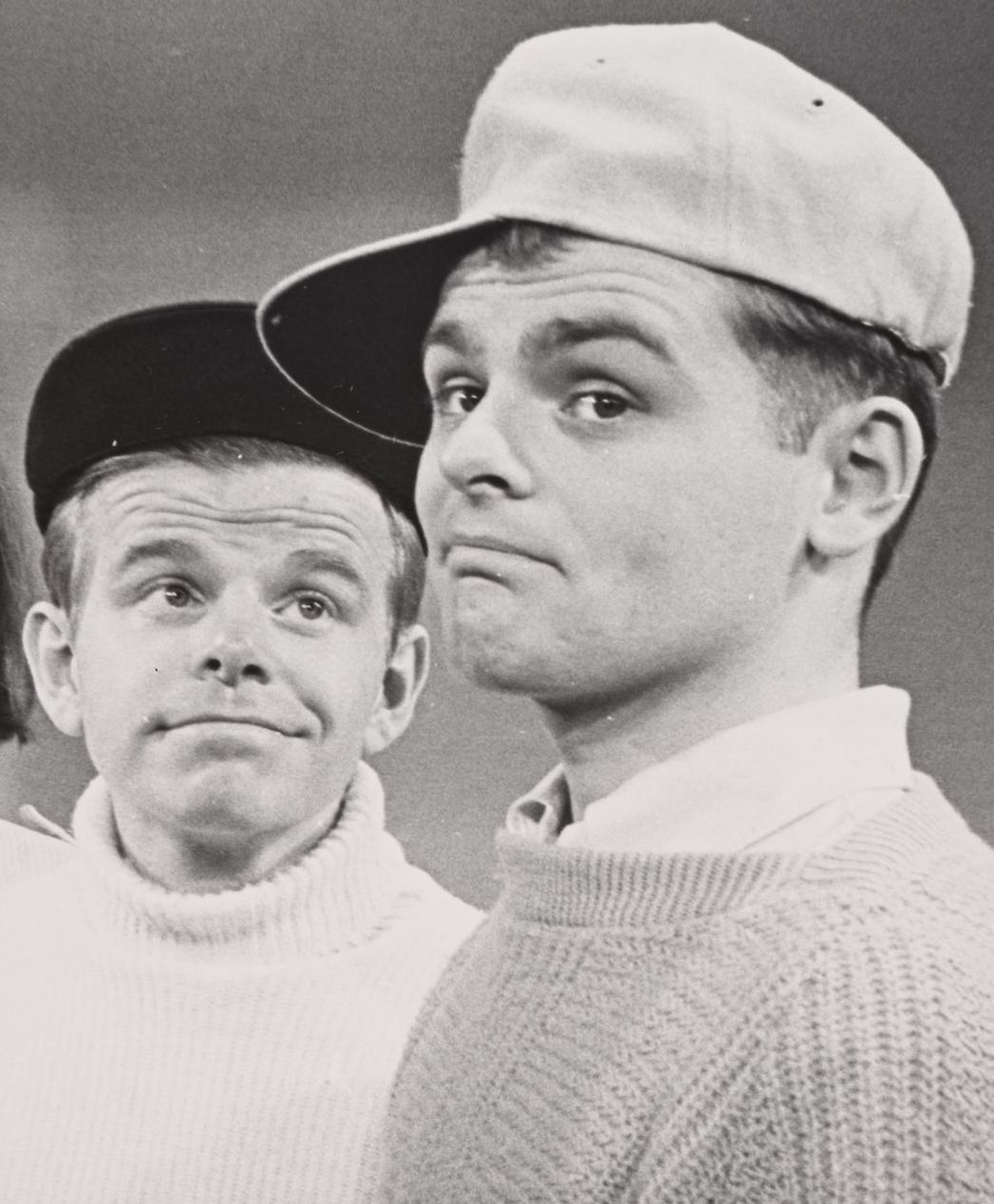
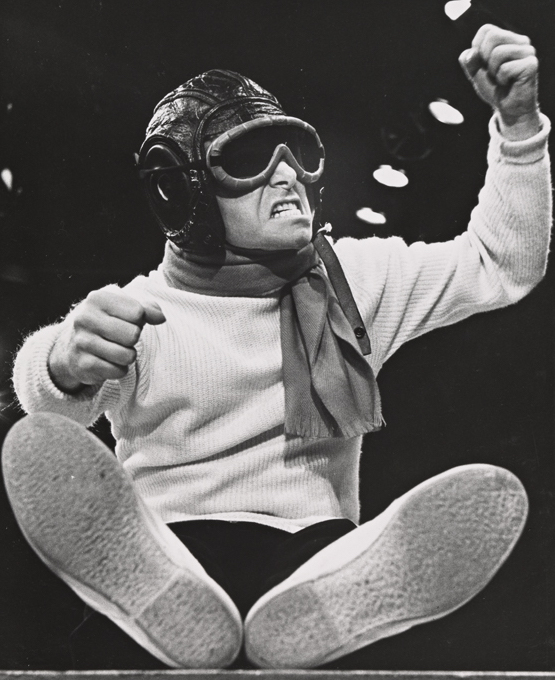
He found his defining role in 1967 when he was cast as Snoopy in the original production of You’re A Good Man, Charlie Brown. The cast included Gary “Radar” Burghoff in the title role, Bob Balaban as Linus and his younger brother Skip Hinnant playing Schroeder. Bill’s scene-stealing Snoopy is still considered to be the definitive interpretation of the role. His performance on the original cast recording is a blueprint for anyone tackling the part. He was awarded a Drama Desk Award for his performance later that year.
In 1969, Hinnant appeared in the film A Nice Girl Like Me with Barbara Ferris:
After a successful run with Charlie Brown, he was still plagued with subpar material- a fact that didn’t go unnoticed by critics:
Even when the material was up to snuff, there were other issues to contend with:
Hinnant reprised his role as Snoopy in a 1973 television adaption of You’re A Good Man, Charlie Brown. This cast featured Wendell Burton as Charlie Brown and My Three Sons actor Barry Livingston as Linus.
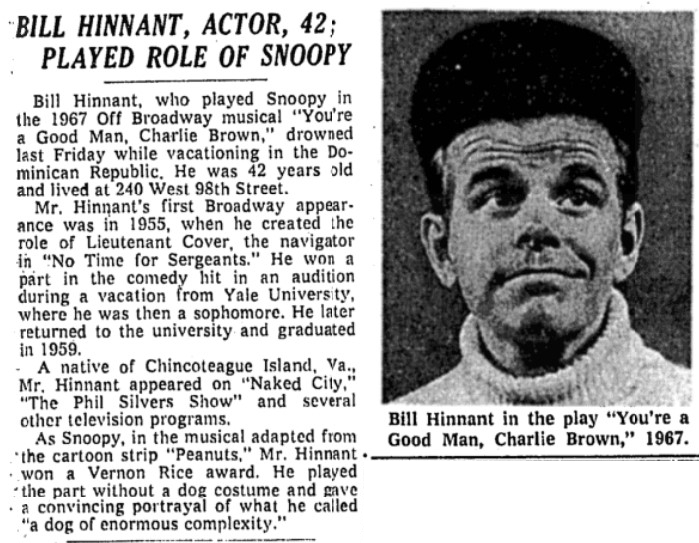
Unfortunately The Bill Hinnant Story does not have a happy ending. On February 17th, 1978, Hinnant drowned while vacationing in the Dominican Republic. He was just 42 years old. The Record noted that “the beige-haired, digest-sized and personable bachelor” was very active in charities for the underprivileged and had adopted several children worldwide through the Foster Parents Plan.
Bill Hinnant is interred (as John F. Bill Hinnant Jr.) at Dulaney Valley Memorial Gardens in Timonium, Maryland.
June, 2022 marked 80 years since the start of the U.S. Navy pre-flight training program that took place at St. Mary’s College. Images of naked or jockstrap-clad cadets were taken during training at the school in Moraga, California when it was requisitioned for the war effort from 1942-1946. You can see more of these photos in our previous posts:
Unfortunately, there is still some confusion when these pictures surface, as they are sometimes miscredited as Ivy League posture photos. For comparison, here are two of the different Yale posture photos:
The single profile pose was used from the late 1930’s until 1952. It was then replaced with a mirror/ triptych setup, which has “Yale” visible in the background.
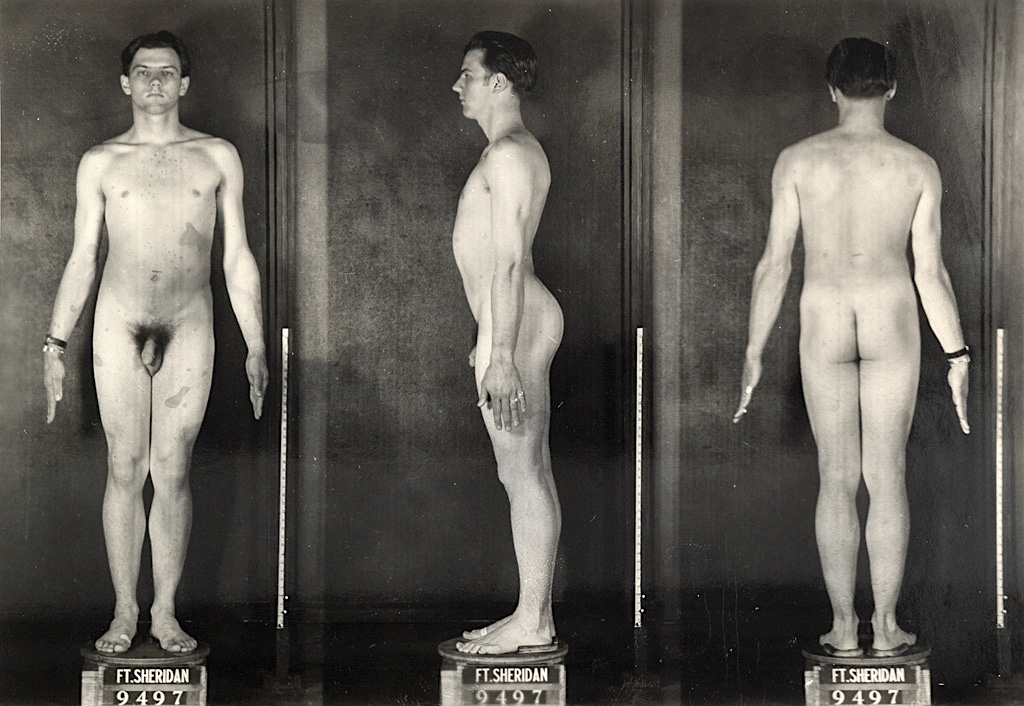
Prior to World War II, there were other physical fitness photos taken at the army base in Ft. Sheridan, Illinois. These fully nude pics do not pop up on the internet as often as those from St. Mary’s Pre-flight school. As shown above, both sets of photos contain the location identified within the photo.
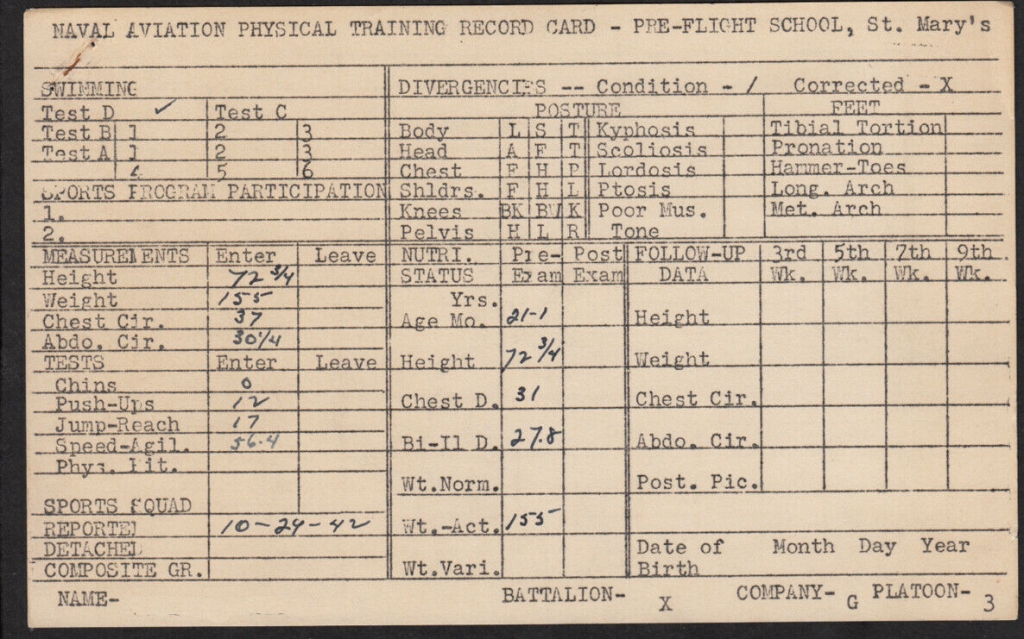
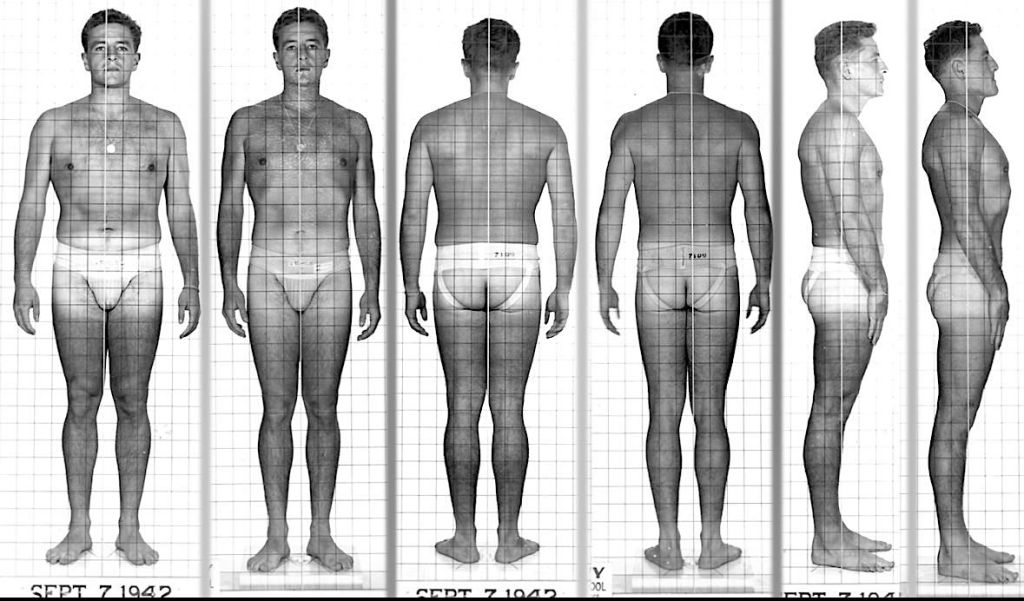
The St. Mary’s photos were taken to measure the fitness progression of each recruit as they underwent extreme physical training. Each picture was accompanied by an index card containing body measurements and physical achievement statistics over the course of several months.
This allows for some contrasting images that would be the envy of many fitness plans.
Comparative photos: March 1 – May 5, 1943
Only the earliest St. Mary’s photos – dated June 13, 1942 – feature the men completely nude. All subsequent photos feature the cadets in jockstraps. In all of the photos, the men stand behind some sort of grid fencing to better illustrate misalignment and spinal curvature.
My collection of photos gathered from around the internet now includes over 750 different cadets. The youngest identified died at age 20 and the oldest lived to 103 years old.
Whether the individual photos of these handsome young men capture them at the beginning of their lives or tragically close to the end, all of the subjects are timelessly captured in prime physical condition as they trained to serve their country. 80 years later, we salute and admire their fine forms and dedication.
Navy Memorial Bench plaque from the St. Mary’s campus.
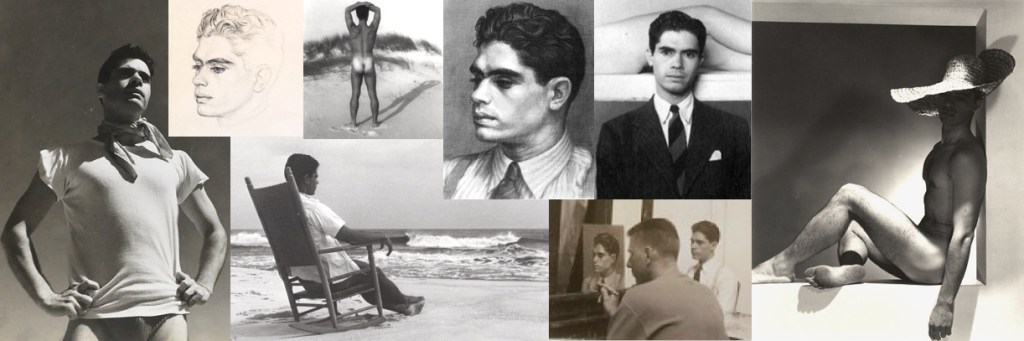
In last summer’s post about the PaJaMa Collective – artists Paul Cadmus, Jared French and his wife Margaret – the focus was on their Fire Island photos of the late 1930’s. One of the friends who cavorted with the trio during that time was José “Pete” Martinez, a dancer from New York City who was involved with their friend, arts patron and ballet impresario Lincoln Kirstein.
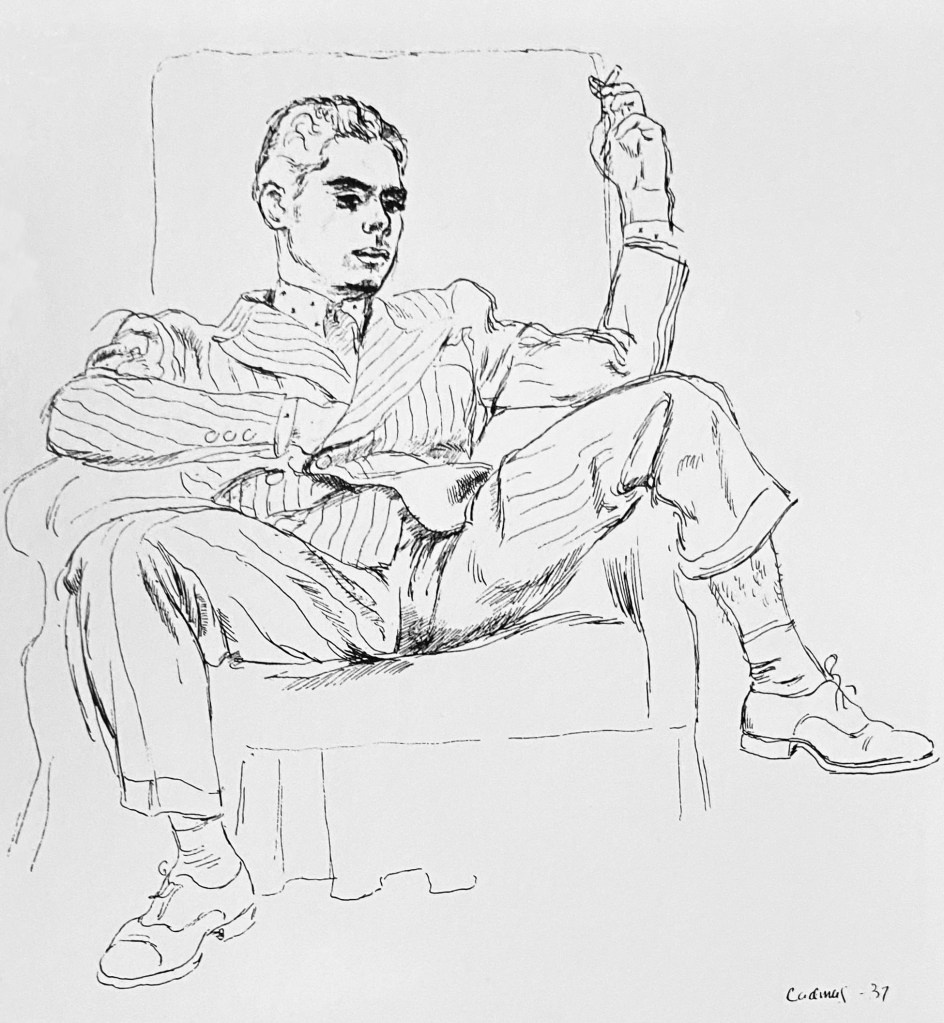
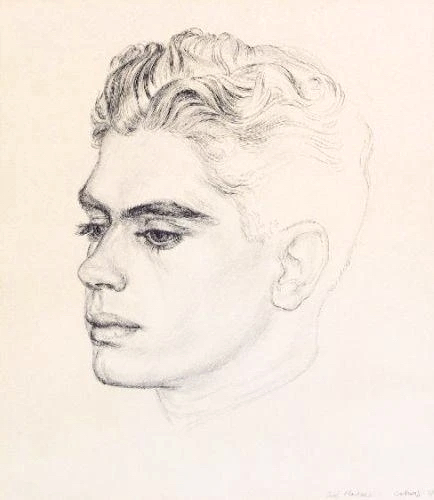
Paul Cadmus’s 1937 sketch of José Martinez appears in Charles Kaiser’s book The Gay Metropolis.
In David Leddick’s book Intimate Companions, Martinez is described as “a droll and witty young man… Those who knew the two men in the 1930’s said he was capable of endlessly amusing his lover, and that of all the men in his life, Martinez was the man that Kirstein most likely loved the most. Kirstein loved gossip and other men’s tales of their sexual exploits, and this love of storytelling drew him to Martinez. In addition, Martinez was handsome, and many artists painted, drew and photographed him. “
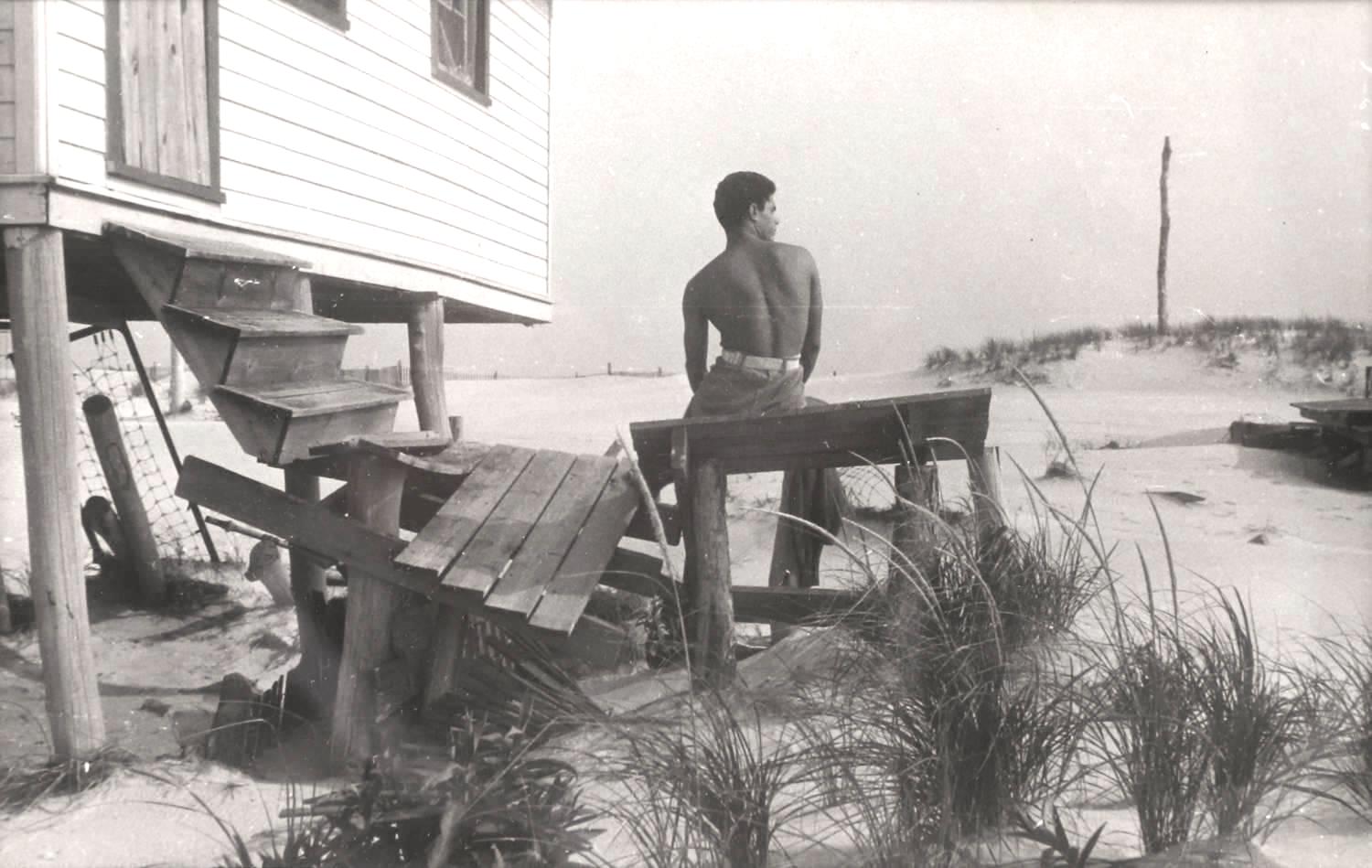
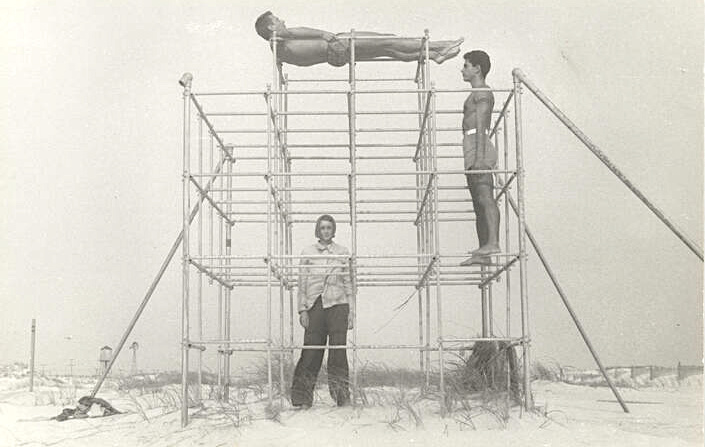
Fire Island PaJaMa photos featuring José Martinez with Paul Cadmus, Jared and Margaret French, ca 1938-39
Besides The PaJaMa Collective, those artists included Paul Cadmus’ sister Fidelma and photographers William Caskey and George Platt Lynes.
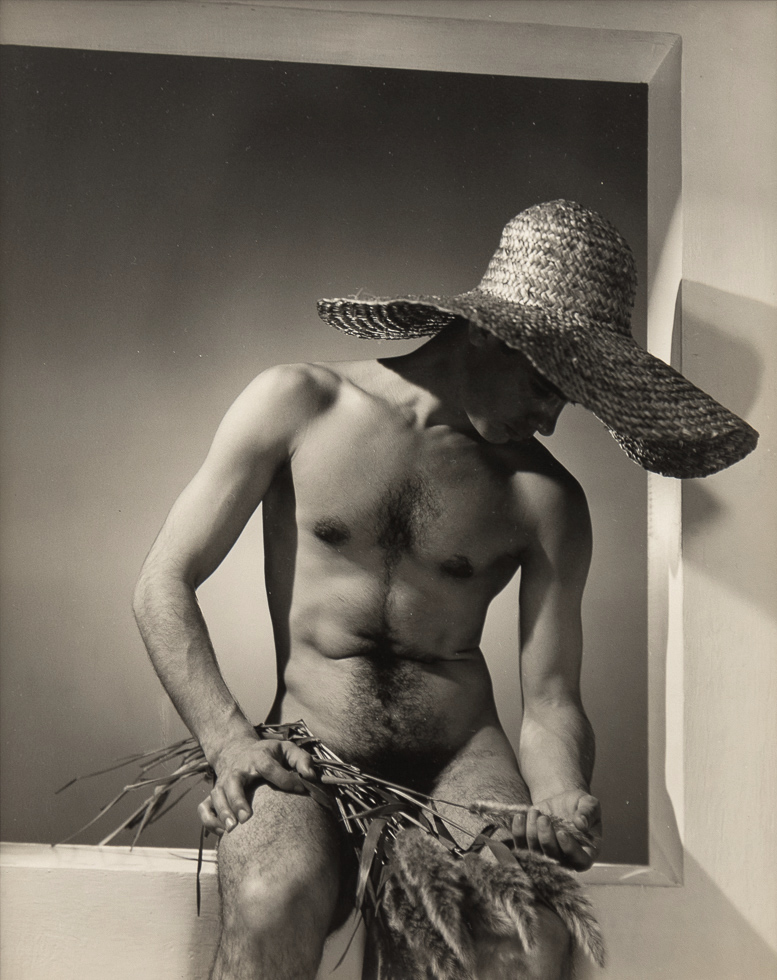
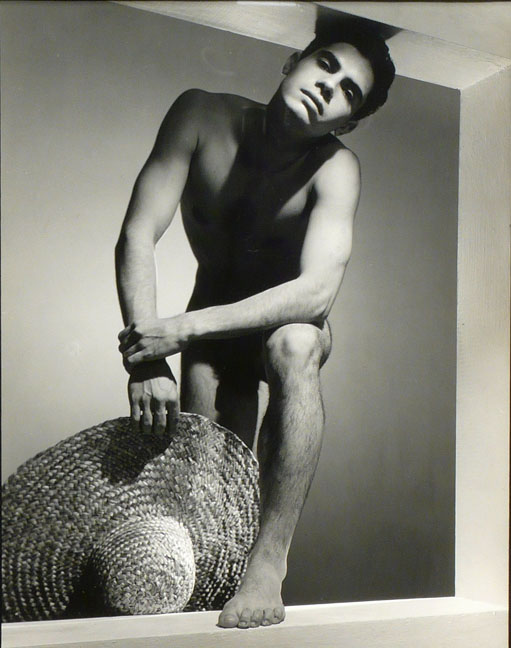
The most memorable Lynes photo of Martinez is a studio shot with the dancer perched in a window frame wearing nothing but a wide brimmed sun hat.
George Platt Lynes photographs of José Martinez.
Pete Martinez (who sometimes used the stage name Pete Stefan) was born José Antonio Martinez-Berlanga in Mexico on March 13, 1913. His family moved to Houston, Texas when he was quite young. Mama Martinez had been a folk dancer back in Mexico and one of Jose’s sisters dreamed of following in her footsteps. Little José was drafted as her dance partner. The scenario is familiar to many boys who begin to study dance as children: the sister loses interest and drops out, but he continues on. It’s a page torn out of A Chorus Line. Later an uncle took him to see Ballet Russe, which further strengthened his resolve to dance. “I was going to set the world on fire,” he would later recount.
After graduating high school, much to the chagrin of his parents, José moved to New York City to study at the School of American Ballet, where he eventually gained a full scholarship. Upon graduation, he was invited to join the company.
José Martinez photographed by Paul Cadmus, ca 1938
Martinez caught the eye of Lincoln Kirstein, and the relationship progressed to the point that they moved in together.
The PaJaMa photo “After The Hurricane” features (l-r) Jared French, Lincoln Kirstein, José Martinez, Forrest Thayer and probably Paul Cadmus. Tragically, costume designer Forrest Thayer was killed in a Southampton single car accident in 1951.
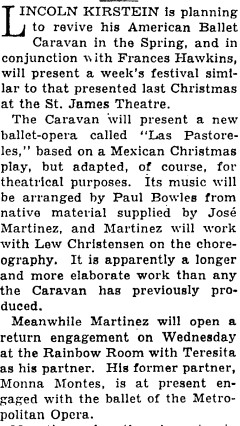
Martinez became a member of The Ballet Caravan, a touring company founded by Kirstein to provide off-season summer employment to American ballet dancers. Here Martinez began to get more involved in the creative process: conceiving the ideas and librettos for ballets, if not choreographing them. He is most associated with the ballet Pastorela, although his exact contribution to its creation varies depending on the source.
As noted in the New York Times article below, Martinez also had several engagements at Rockefeller Center’s Rainbow Room with different dance partners.
New York Times, 12/1/40
Jose Martinez photographed by William Caskey
Lincoln Kirstein & his wife Fidelma Cadmus
Martinez eventually found himself in a triangular romantic situation similar to his friends in The PaJaMa Collective: Paul Cadmus and Jared French had a sexual relationship that continued after French married Margaret Hoening. The three all lived and worked together in a Greenwich Village townhouse at 5 St. Luke’s Place. When Lincoln Kirstein married Paul’s sister Fidelma, she moved into the apartment he shared with Martinez, who continued to live with them for the first year of the marriage.
Martinez was also photographed in the summer of 1938 sunbathing with Jared French and Paul Cadmus on the roof of their home/studios at 5 St. Luke’s Place.
The Ballet Caravan were on a South American tour through 1941 as the U.S. entered World War II. The troupe returned to a very different New York City than the one they had left. When Martinez was denied entry to the Army, he went to work at a hostel for Jewish refugees in Haverford, Pennsylvania where writer Christopher Isherwood was already working. The two were acquaintances through Kirstein but developed a close friendship that would sometimes turn physical, as detailed in Isherwood’s diaries.
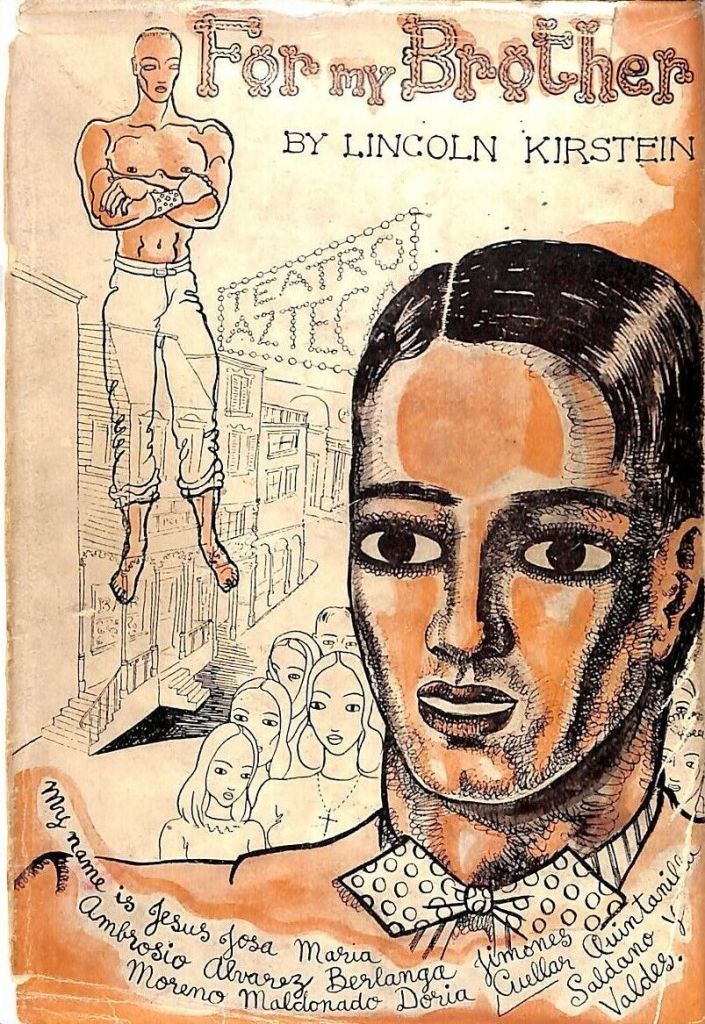
For My Brother: A True Story By José Martinez As Told To Lincoln Kirstein original jacket designed by William Chappell.
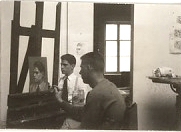
Paul Cadmus photographed sketching José Martinez at 5 St. Luke’s Place.
In 1943, a book was published in the UK with the rather unwieldy title For My Brother: A True Story By José Martinez As Told To Lincoln Kirstein.
From the original dust jacket: “It is the life story of a young American of Mexican origin whose family has settled in a small town in Texas. It is at the same time a study in the contrast between two worlds, two ways of life: industrial, polyglot America, and the more primitive civilization of Mexico just over the border, where many of the hero’s relations still live. The story is told with great poetic feeling and a rare delicacy of perception in human relationships…”
The chronology on Kirstein’s website makes no mention of Martinez and lists For My Brother as fiction “based on a Mexican sojourn.”
The book jacket was designed by fellow dancer-turned-ballet designer William Chappell. For My Brother… is quite rare, as most of the 2,000 printed copies were said to have been destroyed in a warehouse bombed by the Nazis. A Canadian edition was later published by MacMillan.
Martinez was finally able to join the military in 1943 and remained in service until the end of the war.
Back in New York, he resumed his dance career with Ballet Society where he danced in the original 1946 productions of George Balanchine’s Four Temperaments and William Dollar’s Highland Fling.
And then…. to invoke A Chorus Line once again: “What do you do when you can no longer dance?”
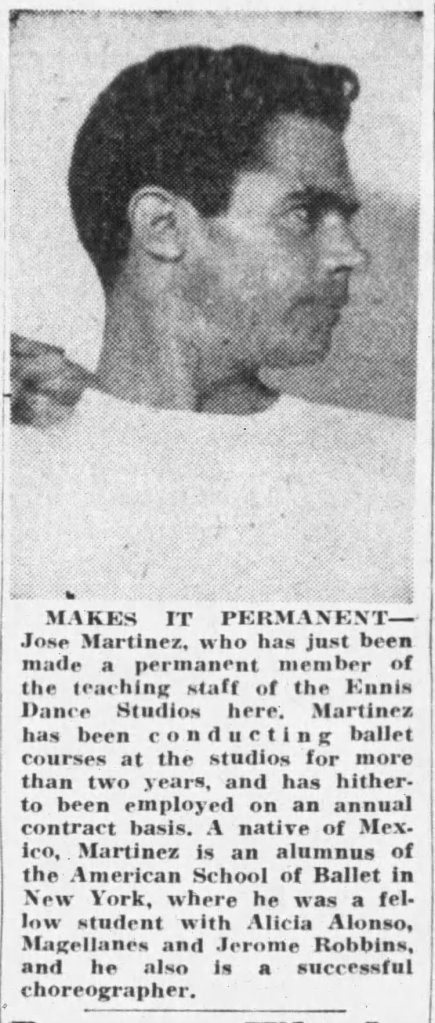
A knee injury hastened the end of his performance career. A June 4, 1950 article in the Norfolk Virginian-Pilot chronicled his coming to terms with the transition. He drifted for a year before settling into the next chapter of his life as a dance teacher in Norfolk, Virginia.
Norfolk Virginian-Pilot, 7/27/47
Norfolk Virginian-Pilot, 6/12/49
After Virginia, Martinez founded other dance studios in Ohio and California, where he retired from teaching in the mid-1960’s.
Lincoln Kirstein died at aged 88 in January, 1996. José Martinez passed away 16 months later in Pasadena, California at age 84.
One of my goals in creating posts about artist’s models like Chuck Howard, Randy Jack, and Ted Starkowski is to clear up misinformation posted online by galleries and auction houses. Whether the inaccuracies are intentionally deceptive or the result of laziness, the errors spread across the internet, with subjects misidentified and photo dates sometimes off by decades.
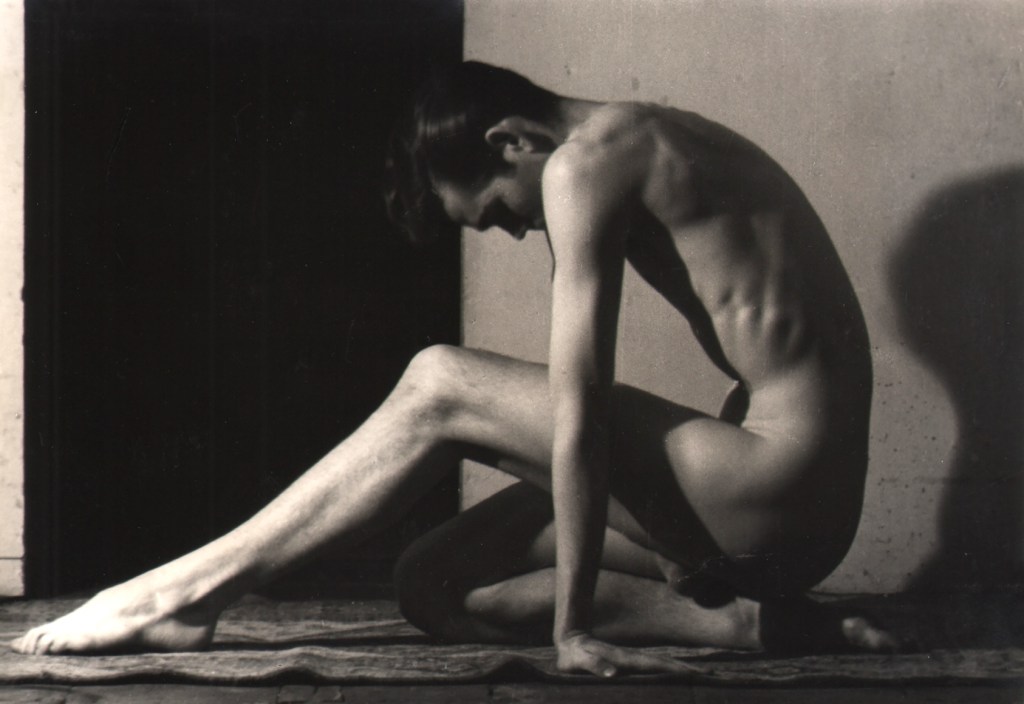
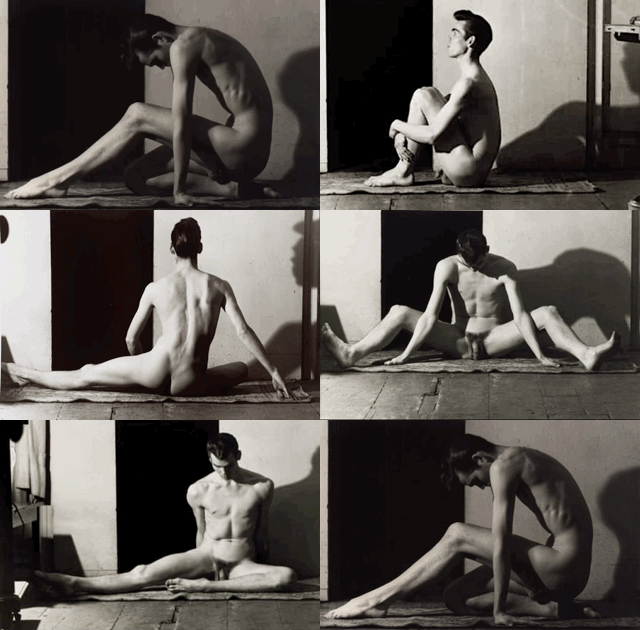
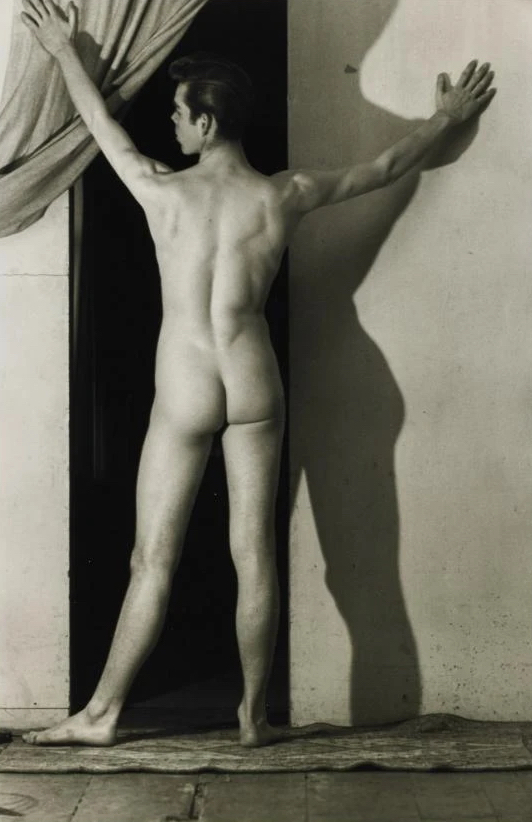
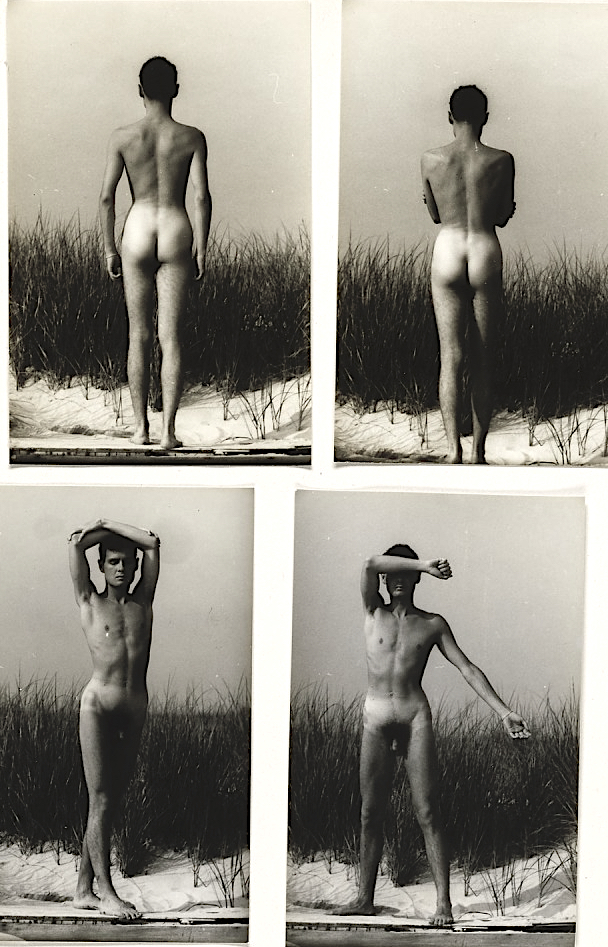
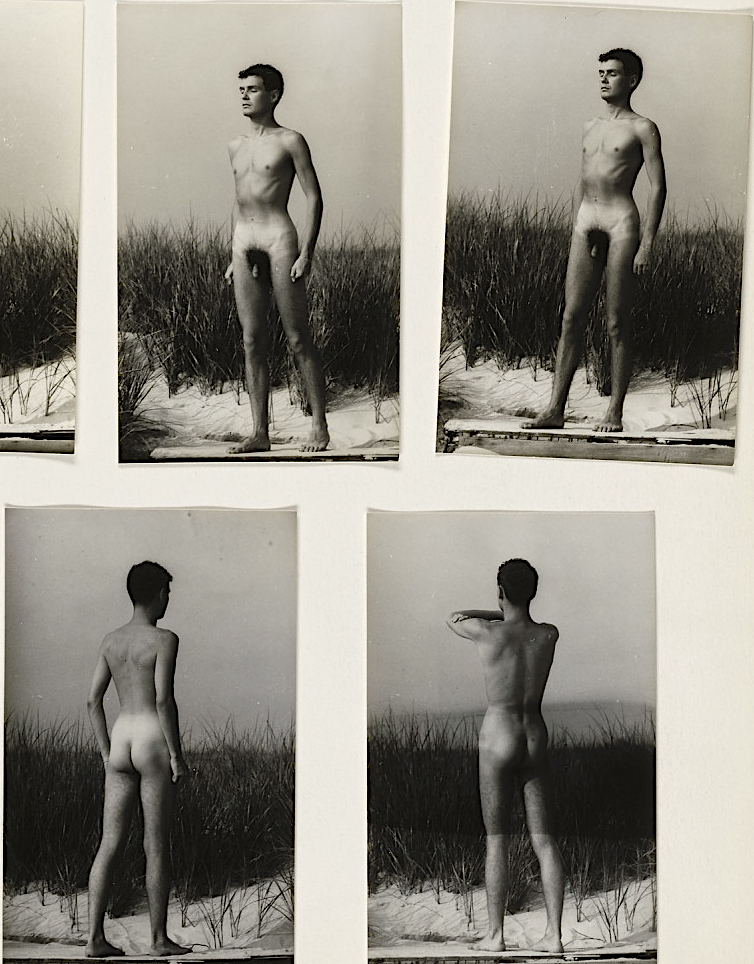
A series of 30+ nude model study photos are have recently been listed for auctions as “Jared French Nude Study of Tennessee Williams” or “Studio di nudo Tennessee Williams.” One set of two 8×10 photos sold for over $650. These should have been credited to the PaJaMa collective, which Jared French was a part of, and unfortunately (or fortunately, depending on how you look at it), the lean muscularly defined model is certainly not writer Tennessee Williams.
Tennessee Williams was the subject of several PaJaMa photos in Provincetown and at Jared French’s New York City studio at 5 St. Luke’s Place. In one of these photos, Williams strikes the same pose in the same place as our mystery model.
Tennessee WilliamsNot Tennessee Williams
So who was the thin young chap with the low-hangers?
Martha Graham levitating John Butler
In another corner of the internet, I found two of these photos in a PaJaMa exhibit, dated 1943 and identifying the subject as dancer/choreographer John Butler (1918-1993). In the early 1940’s, he earned money working as an art model while studying dance with both Martha Graham and George Balanchine.
Besides the PaJaMa photos above, he was also photographed by George Platt Lynes:
John Neilson Butler was born in Charleston, Tennessee and moved to Greenwood, Mississippi with his parents at a very early age. He graduated from Greenwood High School in 1936 and made his way to New York City, where he initially studied dance with Eugene Loring before moving on to Balanchine and Martha Graham.
AP article (1955)
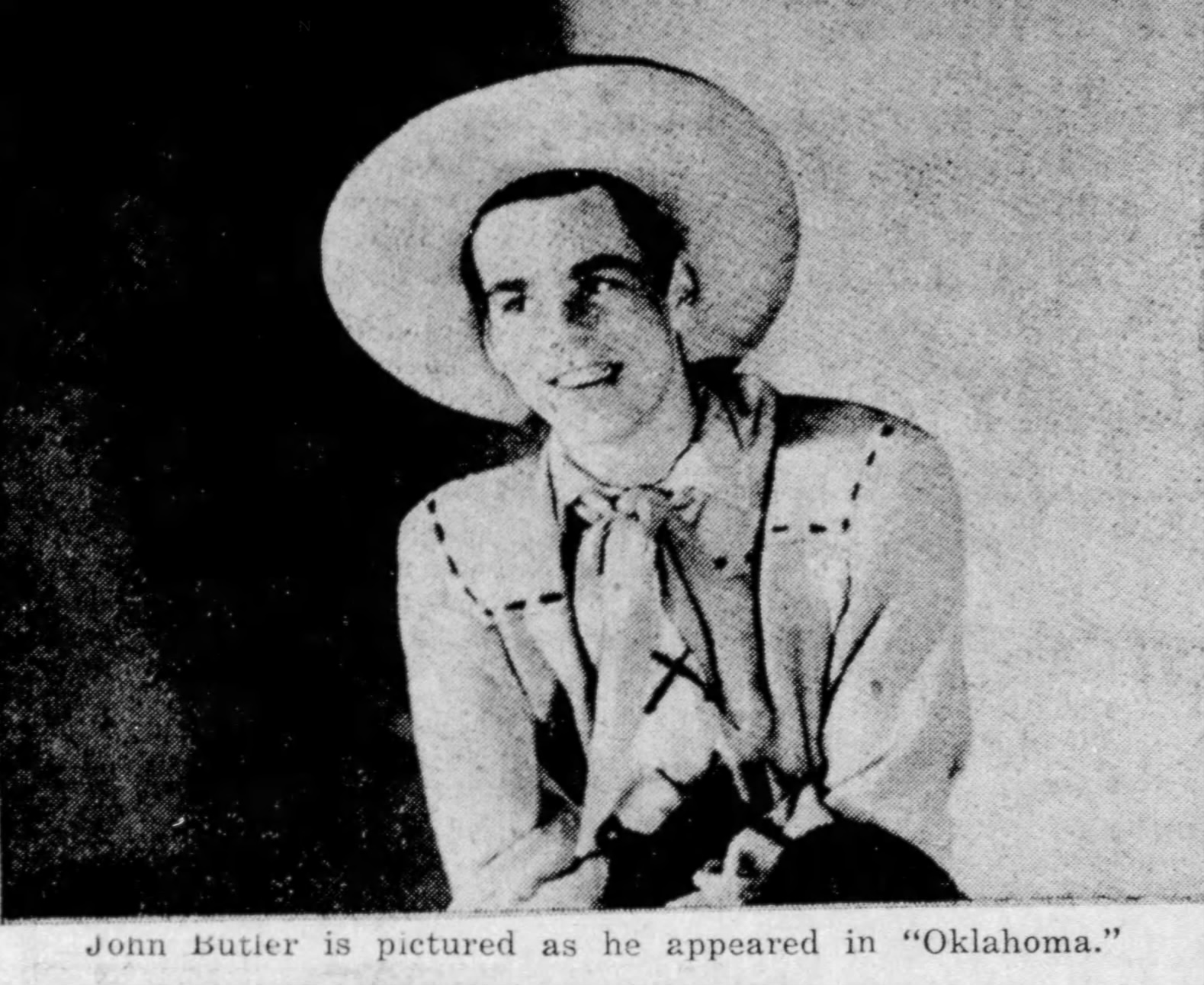
Butler danced on Broadway as Dream Curly in the original production of Oklahoma! He appeared in a string of Broadway musicals throughout the 1940’s including Hollywood Pinafore, Inside U.S.A. and On The Town, where he dated castmate Cris Alexander.
He began to transition into choreography in the late 1940’s. The combined influences of Loring, Balanchine and Graham gave his work unique elements of classical ballet as well as modern dance. He was one of the first to create works specifically for television, which was still considered a new and inferior medium. He choreographed variety show segments (The Ed Sullivan Show, The Kate Smith Show) as well as for Omnibus and full-length ballets and operas. His 1951 staging of Amahl and the Night Visitors was recreated annually for nine NBC holiday specials.
Butler performs as one of the Three Dancers in this 1955 broadcast.
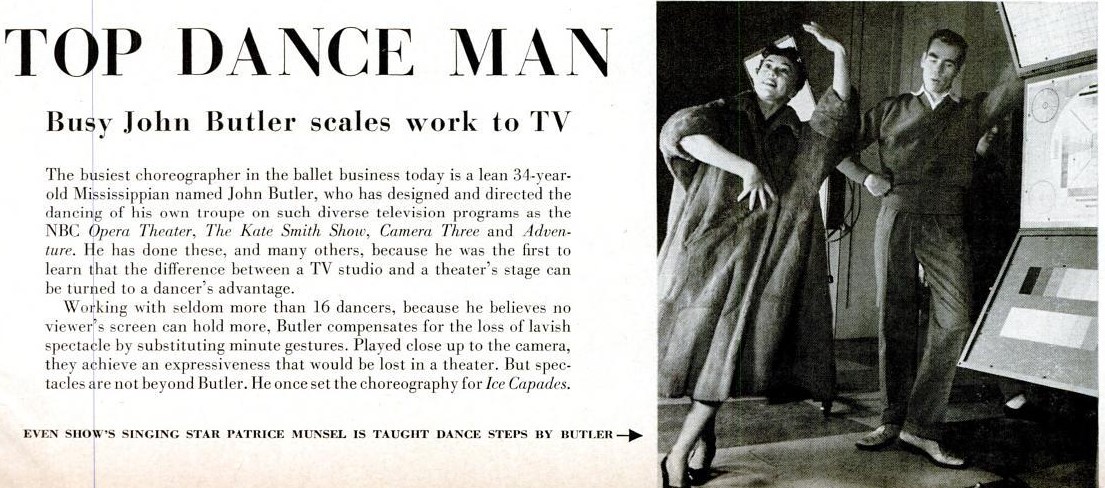
Life Magazine profiled Butler in their April 25, 1955 issue:
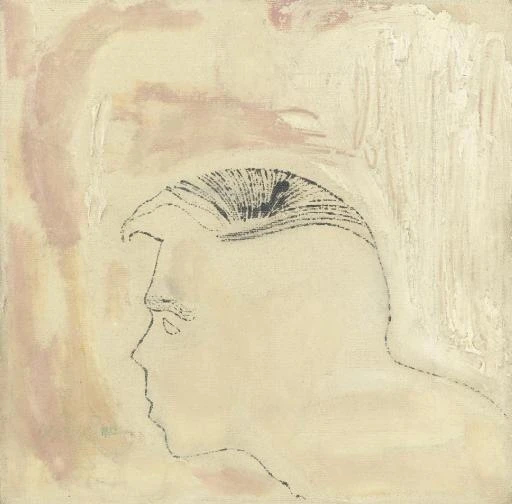
Two sketches of John Butler by Andy Warhol (1952)
Richard Avedon photo of John Butler & Barbara Muller (1954)John Butler photographed by Roloff Beny (1959)
In addition to his work choreographing for Broadway and television, Butler founded The John Butler Dance Company in 1955. It was later renamed American Dance Theater and toured Europe until it disbanded in 1961.
John Butler & Carmen de Lavallade rehearse Portrait of Billie, his dance meditation on Billie Holliday (ca 1960)
John Butler & Melvin Dwork (1963)
His most celebrated work was the New York City Opera staging of Carmina Burana (1959). Through the years, it has been recreated with over 30 companies.
In 1961 he met celebrated interior designer Melvin Dwork, who has called Butler “the love of my life.” They remained companions and friends until Butler’s death in 1993. Dwork was instrumental in preserving Butler’s dance legacy.
The Greenwood Commonwealth, Greenwood Mississippi (3/6/1965)
As he matured, Butler’s voluminous eyebrows became something of a trademark of his appearance. He appears to have embraced this with a level of zeal that surely inspired George Whipple.
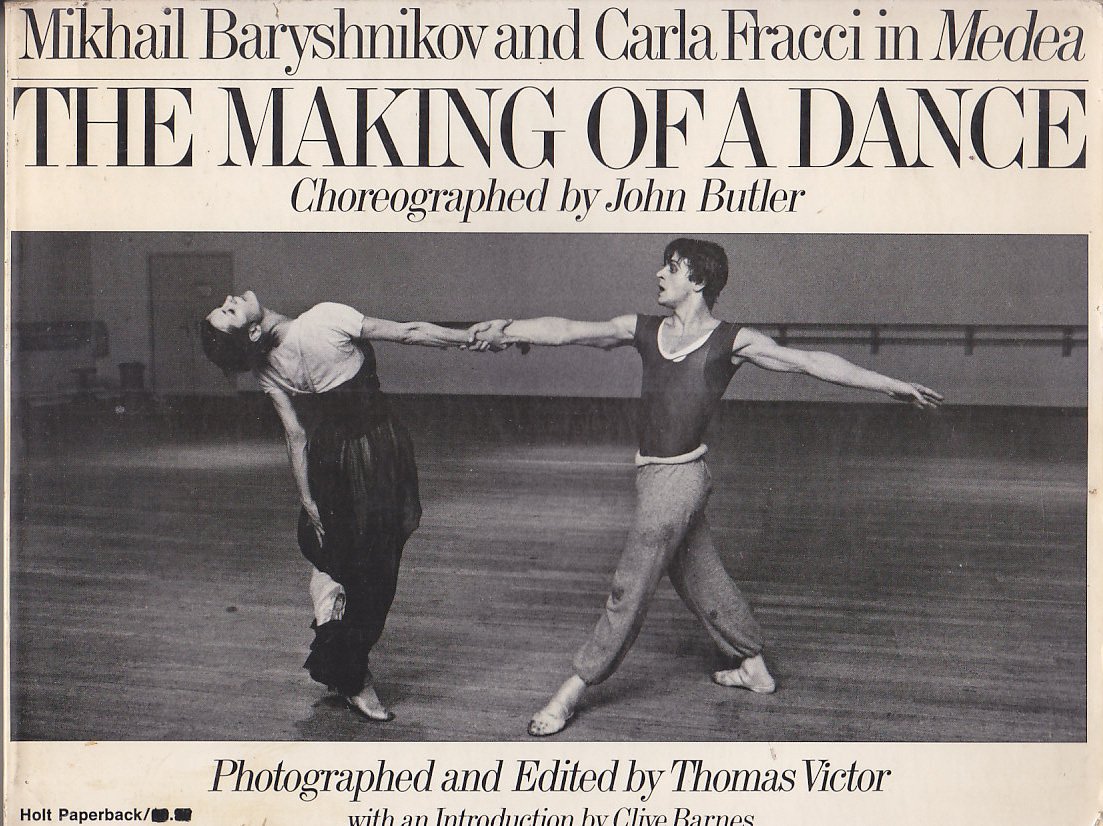
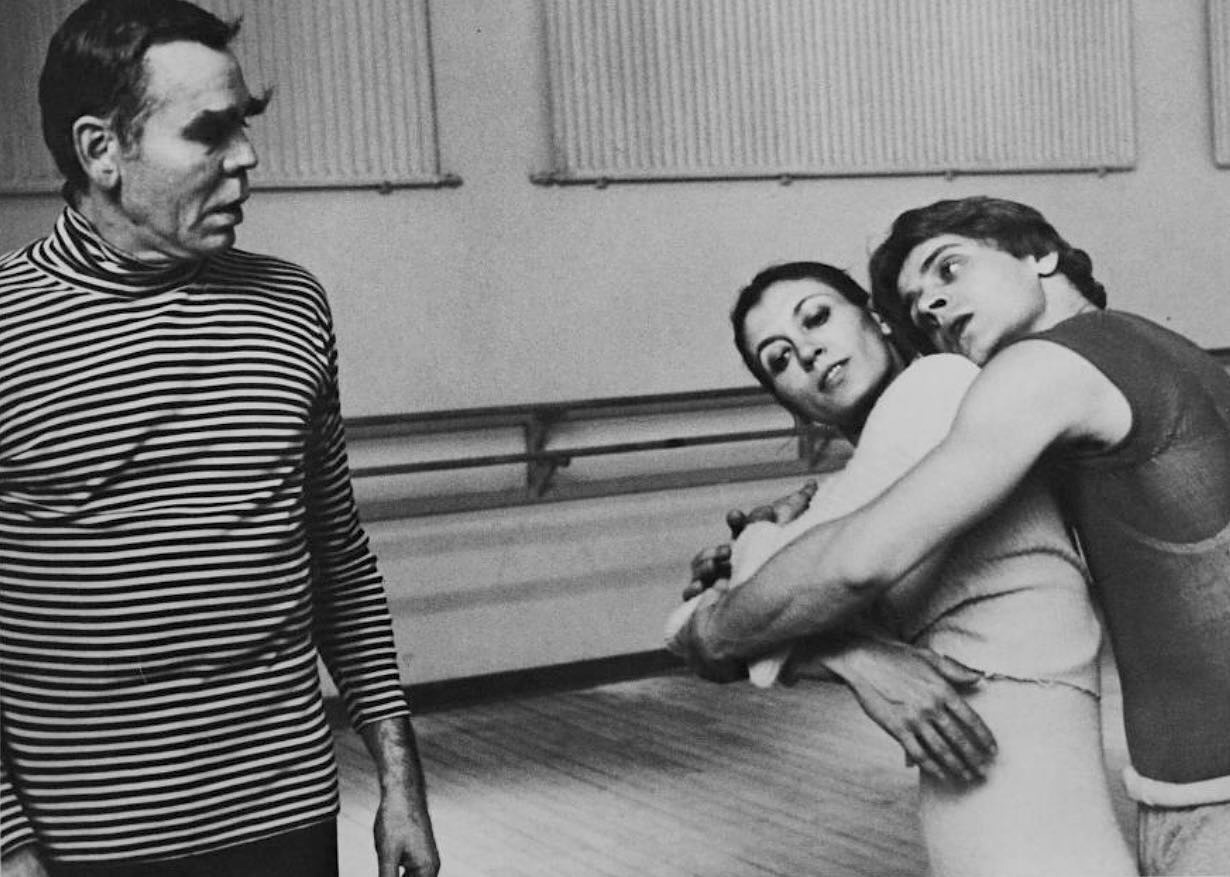
Over the next several decades, Butler continued to choreograph throughout the U.S. and around the world. The Hague, Munich, Sydney, Spoleto, Montreal, and Warsaw were part of his regular rotation with occasional work in Italy and South America. Back in New York City he choreographed Medea, the first dance for Mikhail Baryshnikov after his defection to the West.
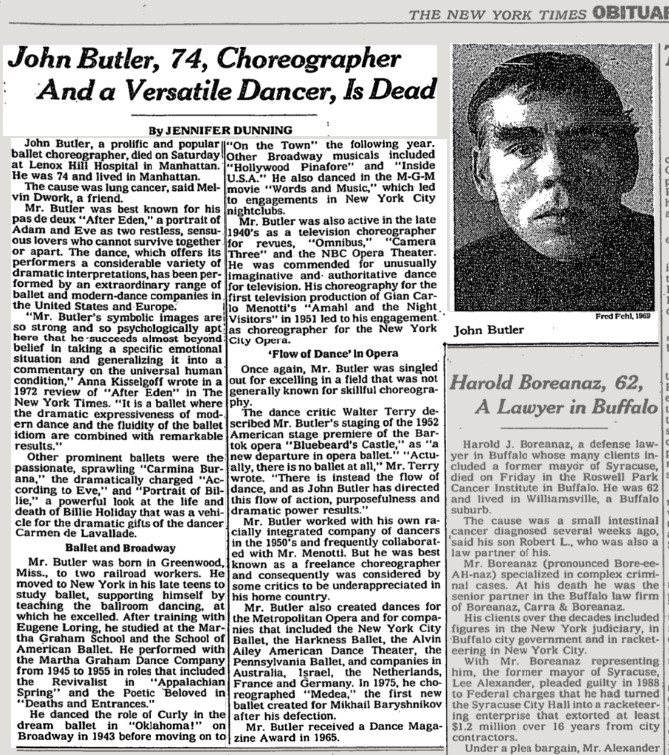
John Butler photographed in April of 1993. He died of lung cancer later that year at the age of 74.
In 1993, author Camille Hardy interviewed John Butler for Dance Magazine shortly before his death. As they sat in his Upper East Side apartment, surrounded by his artwork collection and the walls lined with the works of Warhol, Avedon and Lynes, he said “I’ve done everything in my life I ever wanted to do.”
In the profile Artist’s Muse: Randy Jack, I wrote about his relationship with photographer George Platt Lynes, which came to an end in the Fall of 1948. Just 10 days after Jack moved out of the apartment, another former military man named Chuck Howard moved in as Lynes’ next boyfriend.
Charles “Chuck” Howard was born in Cochran, Georgia on March 4, 1927. After graduating from high school during World War II, he joined the Naval Air Force and became a tail gunner. While stationed in Miami Beach, he met New York artist Bernard Perlin and the two would “reconnect” whenever Chuck was in New York City. After the war, Howard studied fashion in France on the G.I. Bill before moving back to NYC to live with the artist. When Perlin was offered a residency in Rome, he threw himself a farewell party, and Chuck was introduced to Lynes.
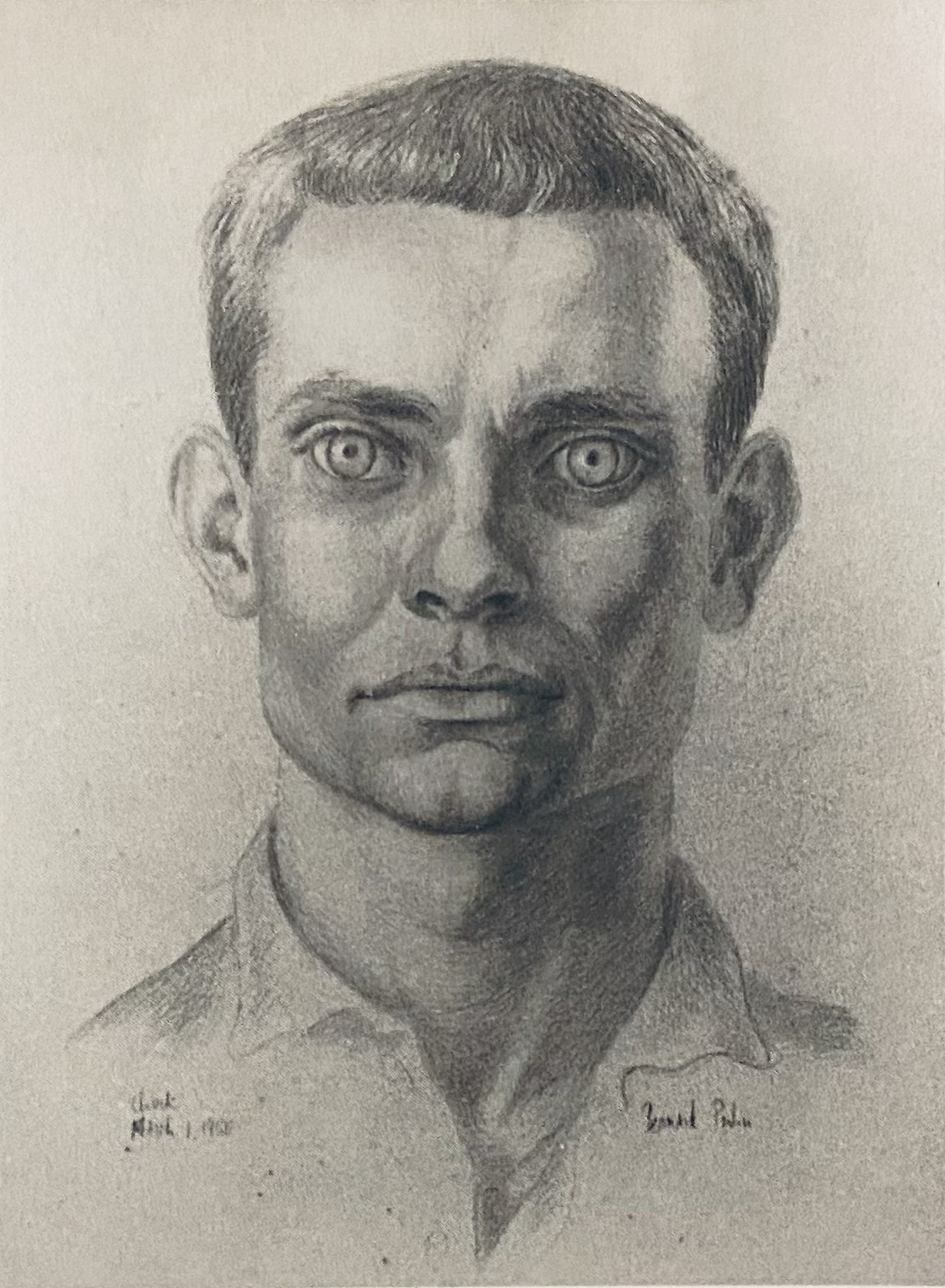
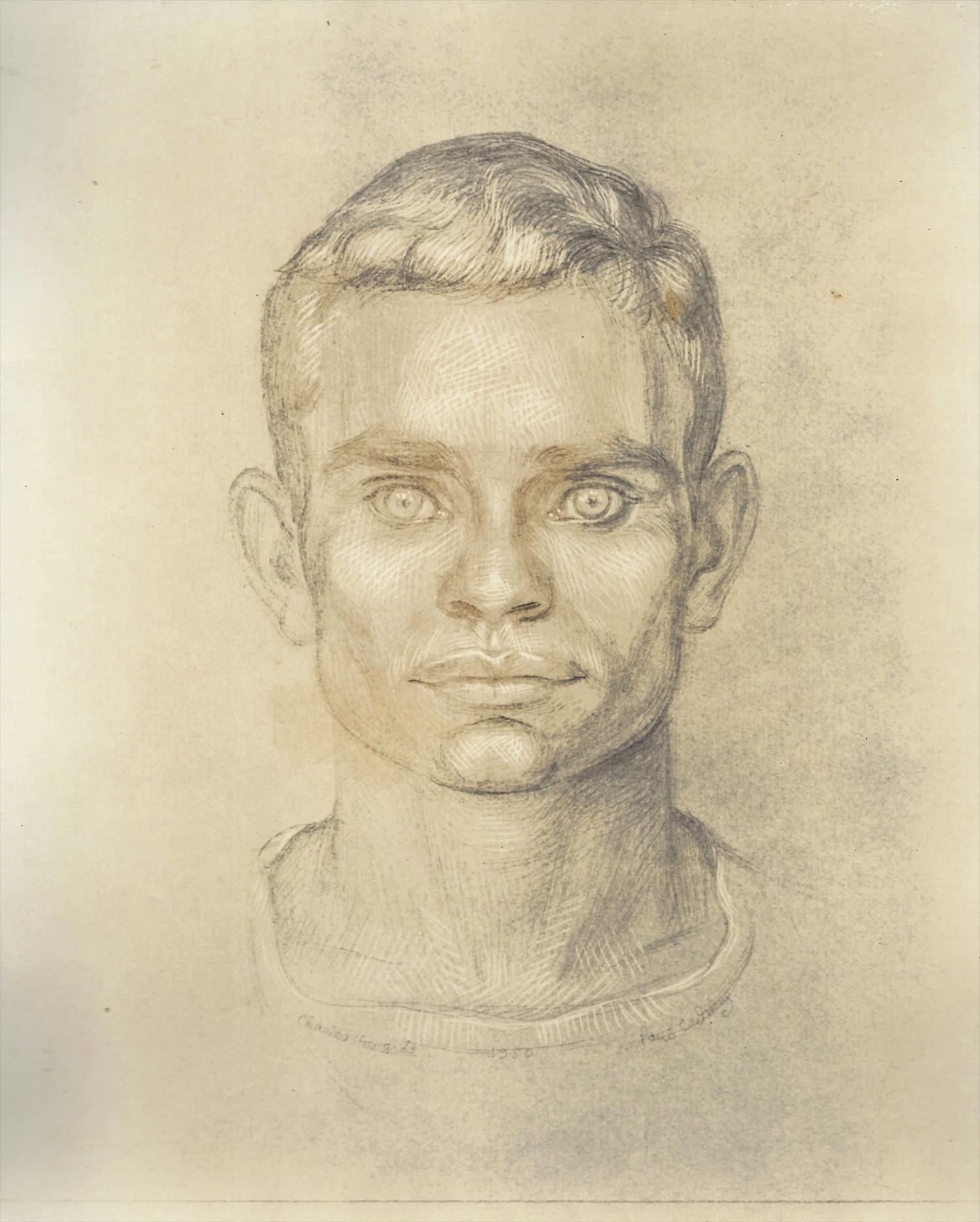
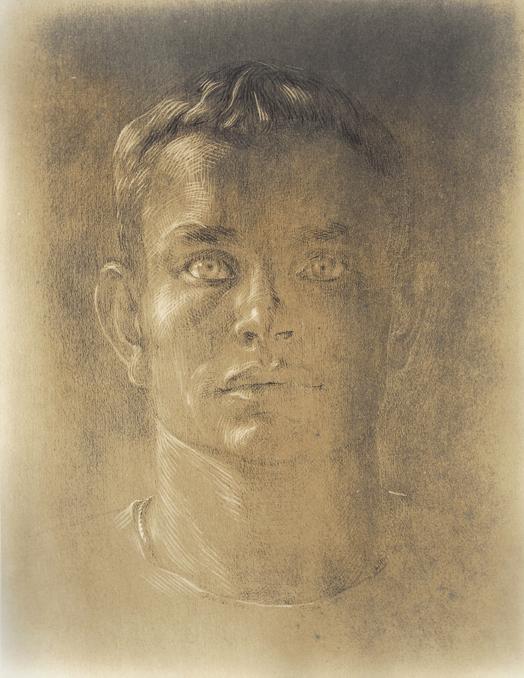
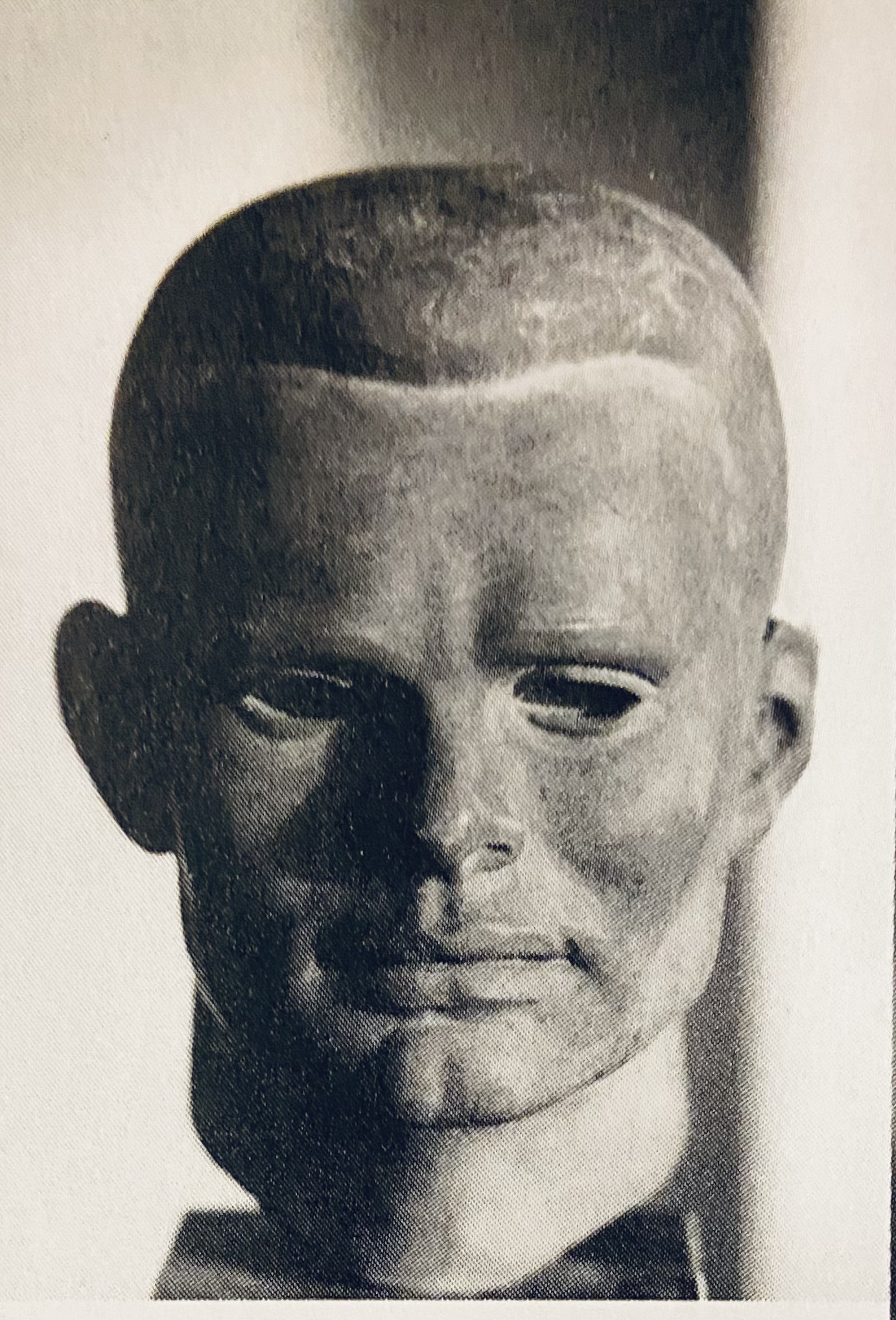
Four sketches of Chuck Howard by Bernard Perlin
George Platt Lynes self portrait with Chuck Howard, ca 1948
Chuck Howard and George Platt Lynes, ca 1950
“Another twenty-one-year-old has moved in on me bag and baggage, almost without being invited..” Lynes wrote in a letter to his friend, author Katherine Anne Porter.
Howard was viewed favorably by Lynes’ friends and was said to have a grounding effect on the photographer. The relationship lasted for just over two years.
George Platt Lynes & Chuck Howard, ca. 1950
Although Howard had previously posed for Bernard Perlin, it was after his introduction to Lynes and his circle of friends that he became a favorite model for the artists. He posed for George Tooker, sculptor John LaFarge, and Jared French, with whom he also had a physical relationship.
Paul Cadmus also sketched him several times and used him as the model for the central figure in his painting Architect (1950).
Architect by Paul Cadmus (1950) Chuck Howard was the model for the central figure with George Tooker reflected behind him.
When Lynes’ nude photography became more widely exhibited decades after his death, photos of Chuck Howard were among the most celebrated. Howard downplayed the photos, describing his work modeling for Lynes as “primarily lighting tests.” Collectors disagree.
Chuck Howard also had a film career of sorts when he participated in Dr. Alfred Kinsey’s famous studies, performing sexual acts with poet Glenway Wescott in front of the researchers’ movie camera. Howard later remarked; “It wasn’t Hollywood.”
Lynes and Howard parted ways in January, 1951. “Chuck has decided to go off and live by himself;” Lynes wrote to his mother. “I shall miss him but I don’t disapprove… I’m afraid that my influence is too often all-pervading, all-inclusive.”
In an earlier blog post on Ted Starkowski, I mentioned that he and Chuck then embarked on what author David Leddick described as “a tempestuous affair.” The couple were photographed together on Fire Island while vacationing with Paul Cadmus, Jared and Margaret French: aka The PaJaMa Collective.
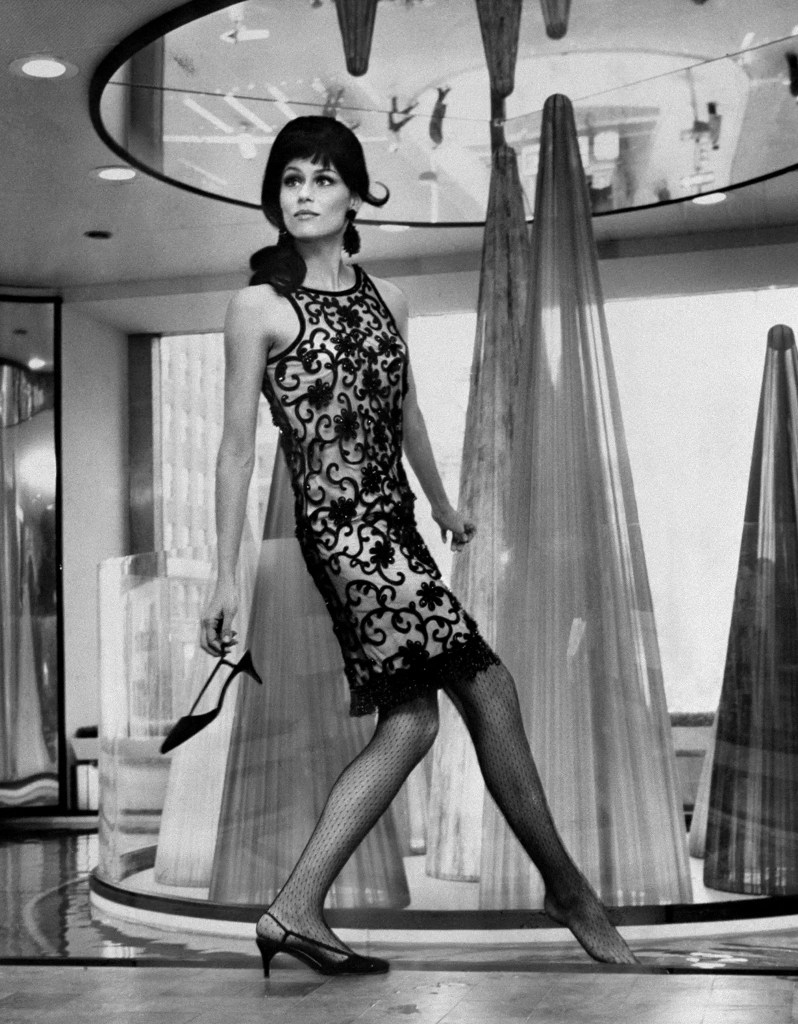
Lauren Hutton modeling a dress by Chuck Howard. (1965)
Act II: Chuck Howard’s career in the fashion industry began to flourish in the late 1950’s when he sketched for several designers, including Bill Blass. He worked for David Crystal before moving on to Anne Klein’s Junior Sophisticates. In 1965, he joined Townley, working his way up to become chief designer and head of business operations. The company was then renamed Chuck Howard, Inc. His design style was noted for its sense of humor with sporty, colorful coats, tunics, pants and jersey shirts.
Around this time, a Parsons student named Donna Karan began working for Howard and he eventually introduced her to Anne Klein.
After Klein’s death in 1974, Donna Karan succeeded her as designer for the Anne Klein studio. Chuck Howard then closed his company and became a designer and creative coordinator there, where he was responsible for several of its collections. He departed with fellow designer Peter Wrigley in 1976 to form their own company.
Chuck Howard (r) with his partner Ed Vaughan in their restaurant (1981)
Act III: In 1980, after his departure from the fashion industry, Chuck Howard opened his self-named restaurant on Restaurant Row. Assisting him in this next chapter was his partner Edward Vaughan. The couple rented a three story townhouse at 355 W 46th St and lived on the third floor above the restaurant.
Soon after opening, twenty-two-year-old Anthony Bourdain took over running the back of the house. He later recounted his time at the restaurant in the “Chef of The Future!” chapter of Kitchen Confidential, with Chuck and Edward referred to as “Tom and Fred.” He writes, “They were genuinely lovely, intelligent, warm-hearted and funny older guys who cooked well, had impeccable taste and were considered (rightly) to be wonderful, charming and entertaining hosts – naturals, it had been said, for the restaurant business, especially a restaurant in the heart of the theater district where they knew and were liked by so many.”
New York Daily News, (1/15/81)
The restaurant was initially successful, although the Daily News review suggested that it wasn’t destined to last. Bourdain further describes the restaurant’s decline, with mounting costs and dwindling guests. “What I learned… was a sad lesson that has served me well in decades since: I learned to recognize failure. I saw, for the first time, how two beloved, funny and popular guys can end up less beloved, not so funny and much less popular after trying to do nothing more than what their friends told them they were good at.” Bourdain moved on to another restaurant, and by the end of 1982, Chuck Howard’s had closed.
The couple retired to the island of Saba in the Netherlands Antilles where they lived for several years before settling in Santa Fe, New Mexico.
On October 5, 2002, Chuck Howard died of pancreatic cancer at the age of 75 in Albuquerque, New Mexico. He was survived by his long time partner Edward Vaughan.
Chuck Howard, ca 1950 / 1997
Chuck Howard’s life had a similar trajectory as fellow Lynes paramour Randy Jack: A WWII military man who became an artists’ muse before moving on to the world of fashion and finally ending up as a restaurateur. In their twilight years, both also enjoyed a bit of recognition for the work they inspired in some of the great American artists of the 20th century.
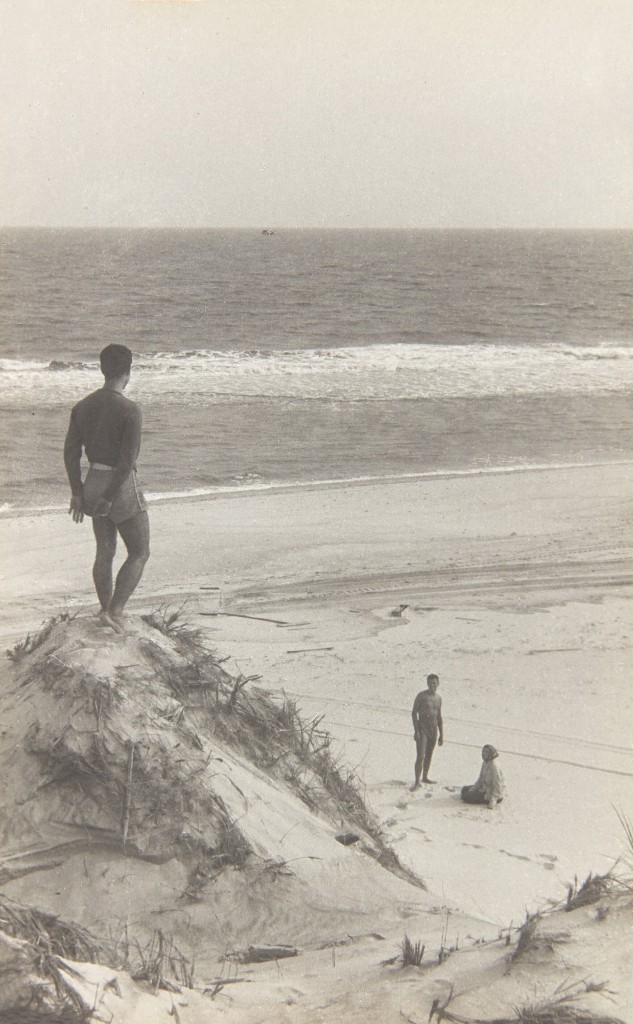
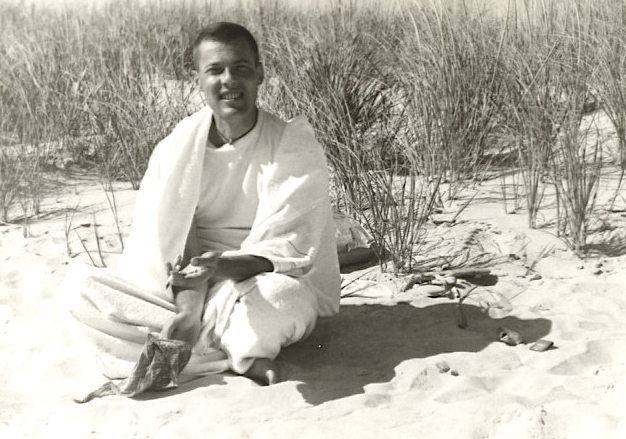
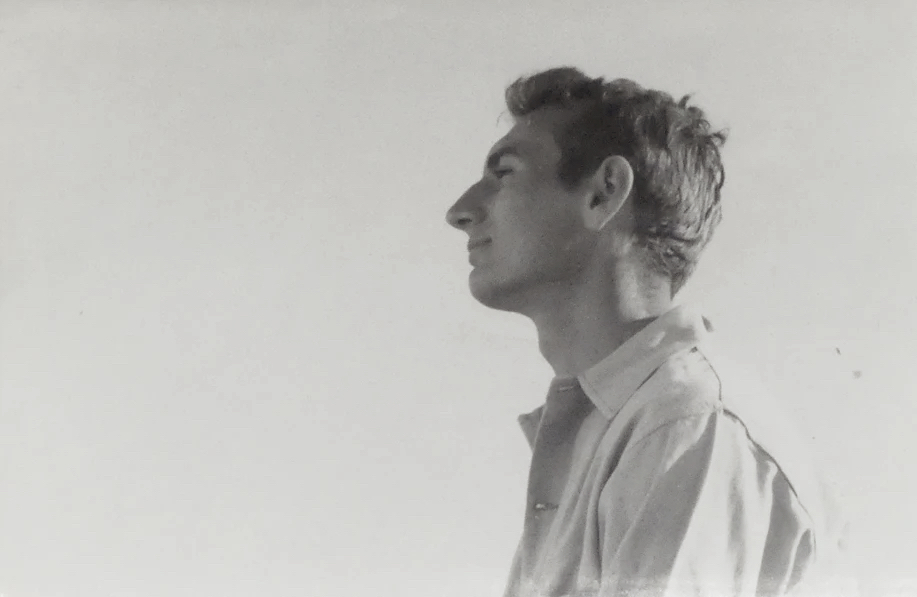
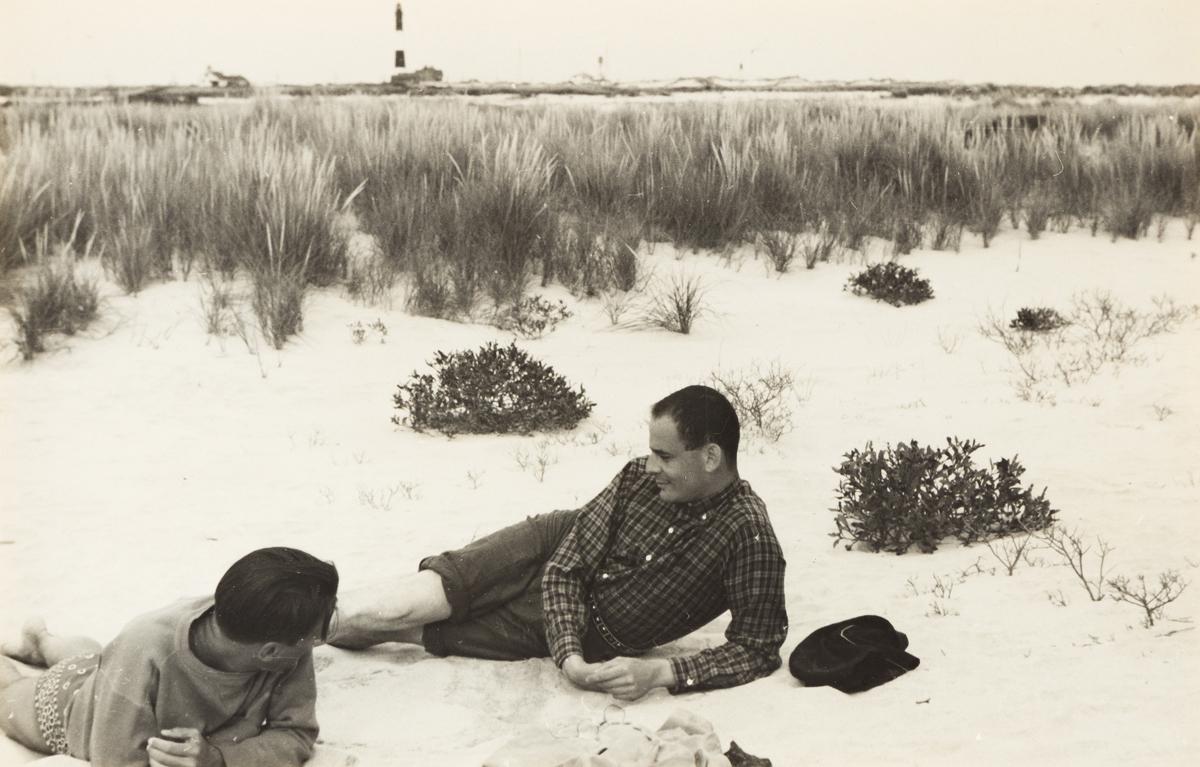
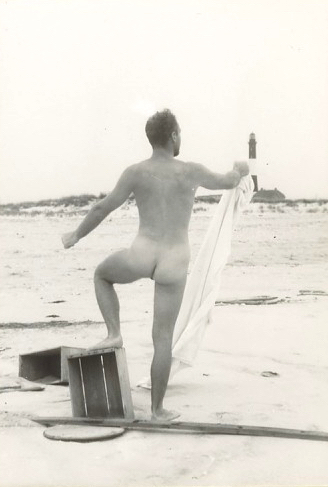
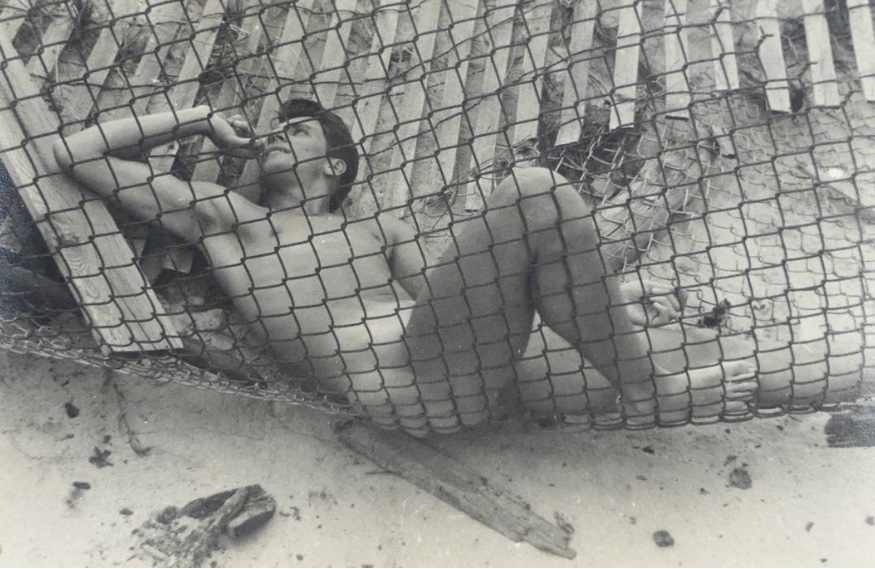
During vacations from the 1930’s through the mid-1950’s, artists Paul Cadmus, Jared French, and his wife Margaret Hoening French photographed each other on the beaches of Fire Island and later Cape Cod. Usually nude or donning simple costumes, they would also use found objects as props to create stark, surreal and/or erotic images. They passed Margaret’s Leica camera around, taking turns as subject and auteur. This collaborative authorship was reflected in the umbrella name Paul Cadmus later chose for this work, utilizing the first two letters of their first names: PaJaMa.
Cadmus explained, “After we’d been working most of the day, we’d go out late afternoons and take photographs when the light was best. They were just playthings. We would hand out these little photographs when we went to dinner parties, like playing cards.”
The dynamic was complicated: Paul and Jared were lovers – a relationship that continued during Jared and Margaret’s marriage. All three lived and worked in a townhouse at 5 St. Lukes Place in Greenwich Village.
Paul Cadmus & Jared French, Fire Island, PaJaMa (1941)
A 2015 New York Times review of a PaJaMa exhibition noted that their photos “breathed eroticism.” While some of the hundreds of photos are masterpieces of magical realism, others appear to be figure studies for their painting. And then there are simple snapshots of nude men frolicking on the beach, enjoying the sun and surf.
Right: Jared French on Fire Island (1940) Left: Paul Cadmus’ etching “Youth With Kite”, 1941
Jared French and his considerable wares are the most frequent subject of the photographs, with entire rolls of film devoted to his nude poses and posturing. Cadmus and Margaret are slightly more demure although we do not know who was giving direction from behind the camera at any given time.
These three artists were joined by various friends and lovers through the years, fellow artists and writers that were part of their New York social circle.
Dancer/Model José “Pete” Martinez appears in PaJaMa photos of the late 1930’s with Paul Cadmus
1938 PaJaMa photos of writer Glenway Wescott sometimes appear online mislabled as Paul Cadmus or Ted Starkowski.
Photographer George Platt Lynes was a frequent guest with his own camera.
Artist Bernard Perlin captured by the PaJaMa lens on Fire Island (1939)
Jared French in Saltaire after the devastating hurricane of 1938.
West of Saltaire, the Fire Island Lighthouse served as a frequent backdrop.
Jensen Yow, Bill Harris & Jack Fontan, ca. 1950
Alexander Jensen Yow recently recalled the circle of artists, as well as his participation in PaJaMa photos of the early 1950’s. “Paul posed us and took the pictures. I was never out there with Jerry (Jared). There were plenty of personality conflicts all scattered around with these people, but I never knew what they were or anything… Jerry was always nice to me though. But his and Margaret’s was a strange relationship… She was crazy about Jerry but she was always in the background, you know. Always there. Jerry did what he wanted to do, and she tagged after him. I was so green when I met these people that I didn’t know how to act…. I tried to be discreet but it wasn’t easy.” (NOTE: Jensen Yow died at age 95 in September of 2022)
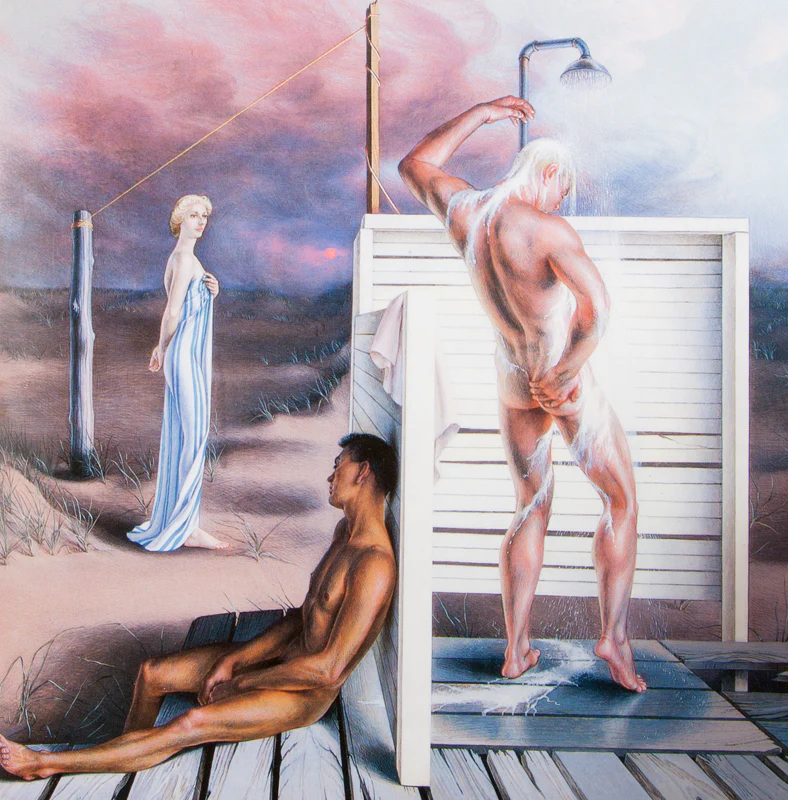
Paul Cadmus, “The Shower”, 1943
Margaret French, “The Moon by Day”, 1939
As with George Platt Lynes’ male nude photographs, the PaJaMa collection did not receive much notice or recognition until the 1990’s. They are now frequently exhibited in galleries and selections are a part of the MOMA collection.
Donald Windham, Saltaire, FI (1942)
In George Parlett’s 2022 book Fire Island, he writes of a PaJaMa photo of Donald Windham:
It’s composition seems to show us how remembering is an act, not a given. There Windham is, dragging the large net, collecting and carrying with him the various and unknown sediments of the shore while offering his gaze wholly to his beholder. There is a levity there, in the resemblance of the net to a gown or a veil, its slightly campy or drag quality, but also a quiet note of death, in how this black material evokes a shroud, or mourning garb. Fire Island has long been a place where such contradictions are brought together; youth and death, glamour and grit. This interplay can be felt, the image tells us, in the landscape of the place.































































































































































 Brian Ferrari's Blog