Armistead Maupin’s Mandate & Torso (1983)

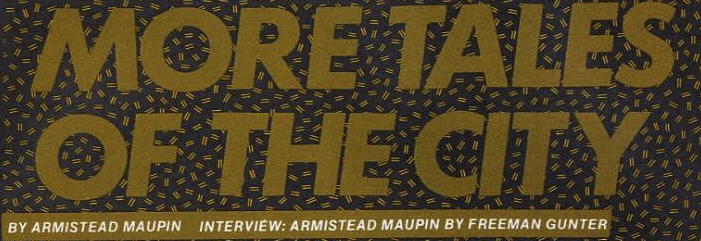
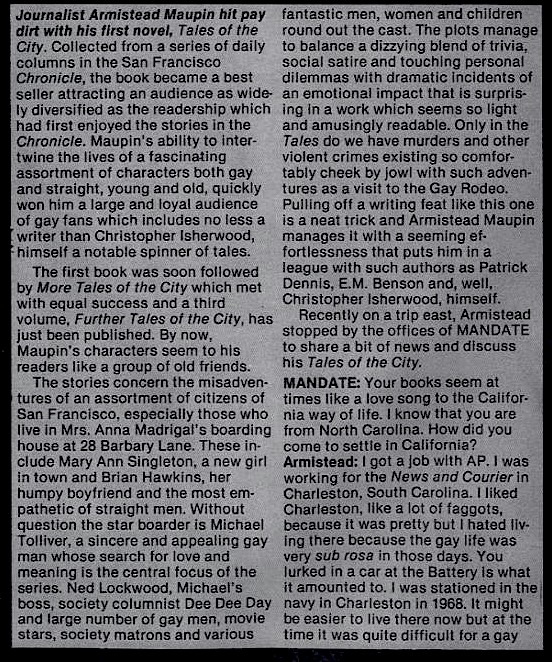
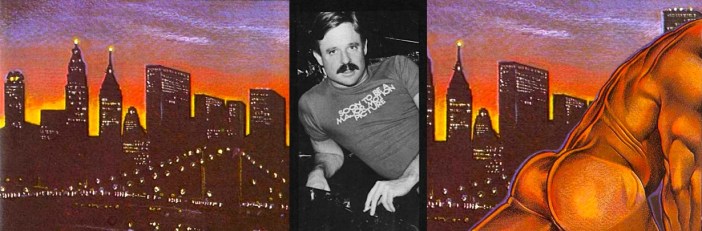
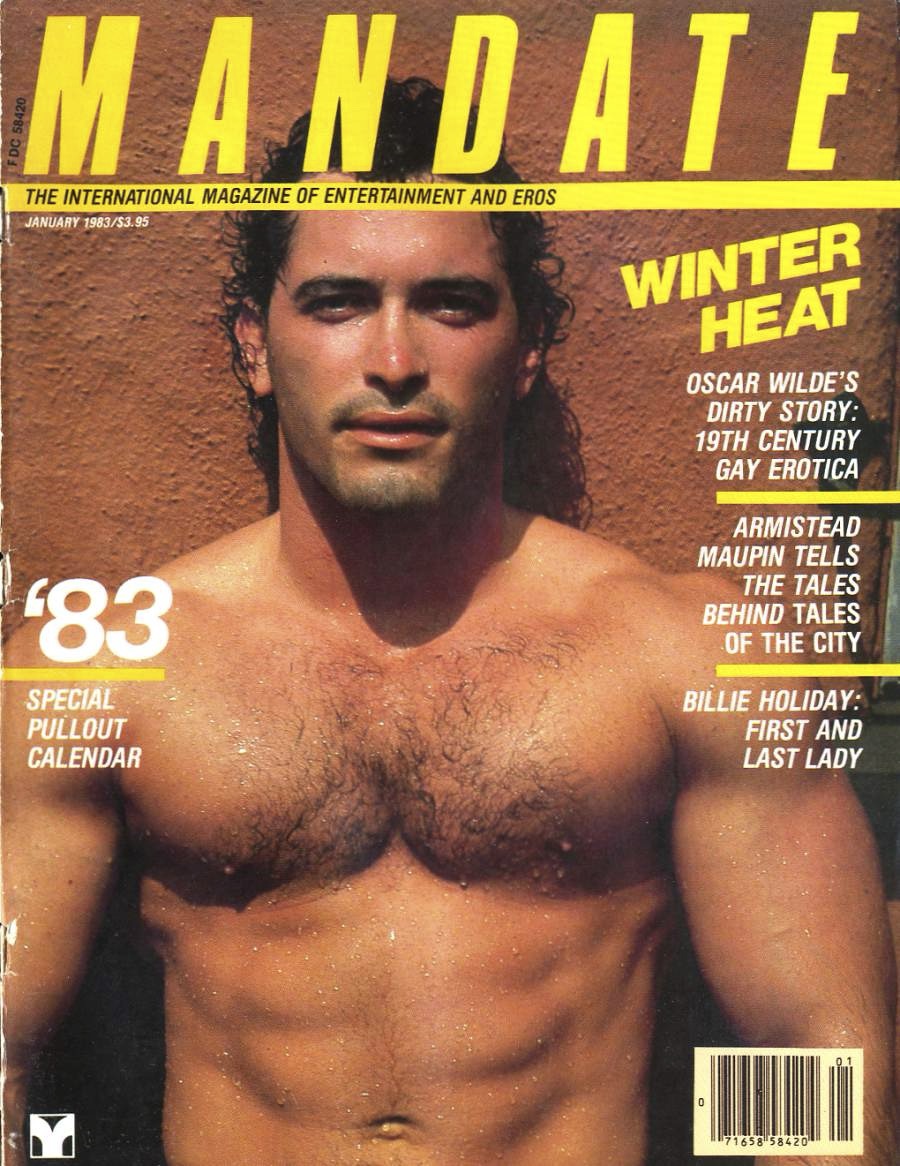
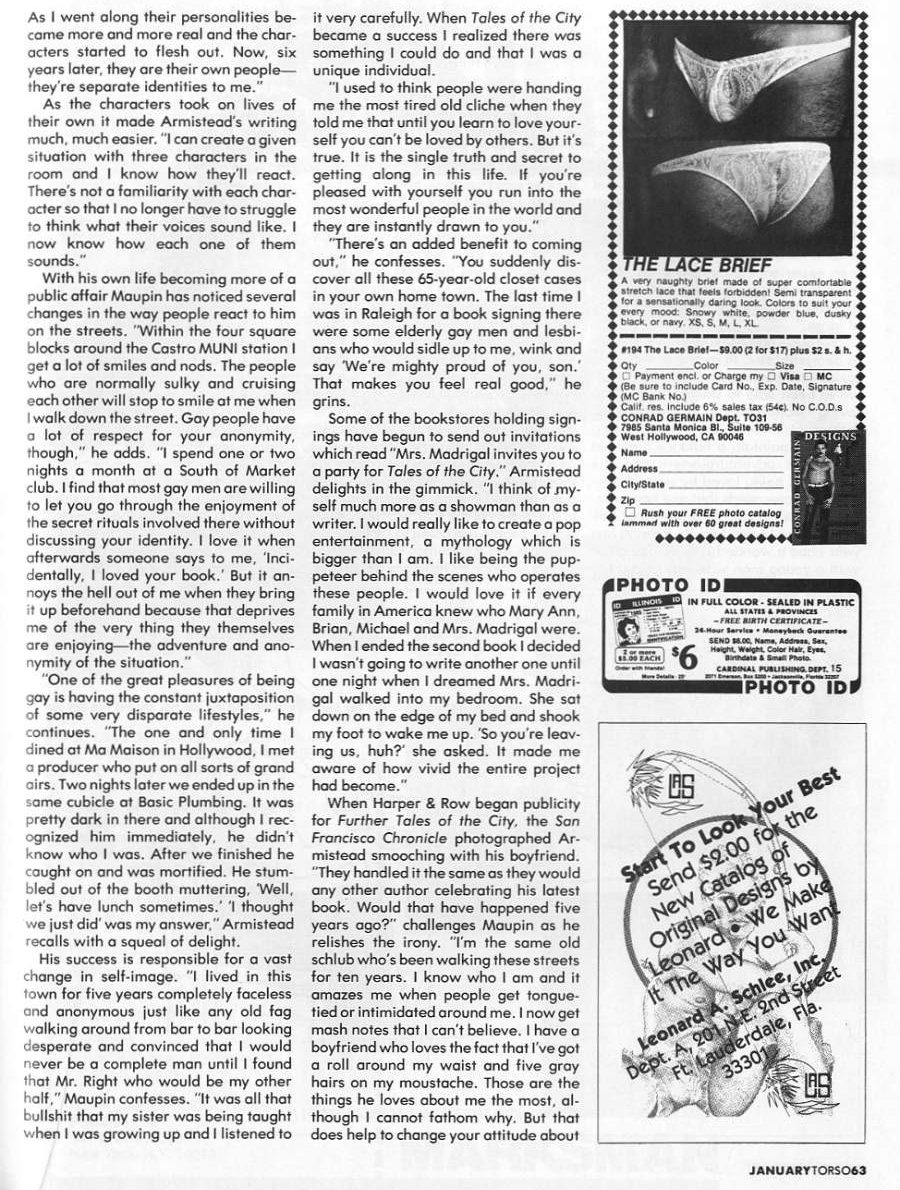
In January 1983, Armistead Maupin made the rounds of gay publications with interviews in both Mandate and Torso magazines. He was at a unique point in his life and career: Further Tales of the City, the third book in the series had just been released. Maupin mentions that he had been named as “executive story editor” for an HBO series adapting the first two Tales… books. Unfortunately, this did not come to fruition, and it would be another 10 years before the first book was filmed as a 6-part miniseries for Channel 4 (UK) & PBS (US)

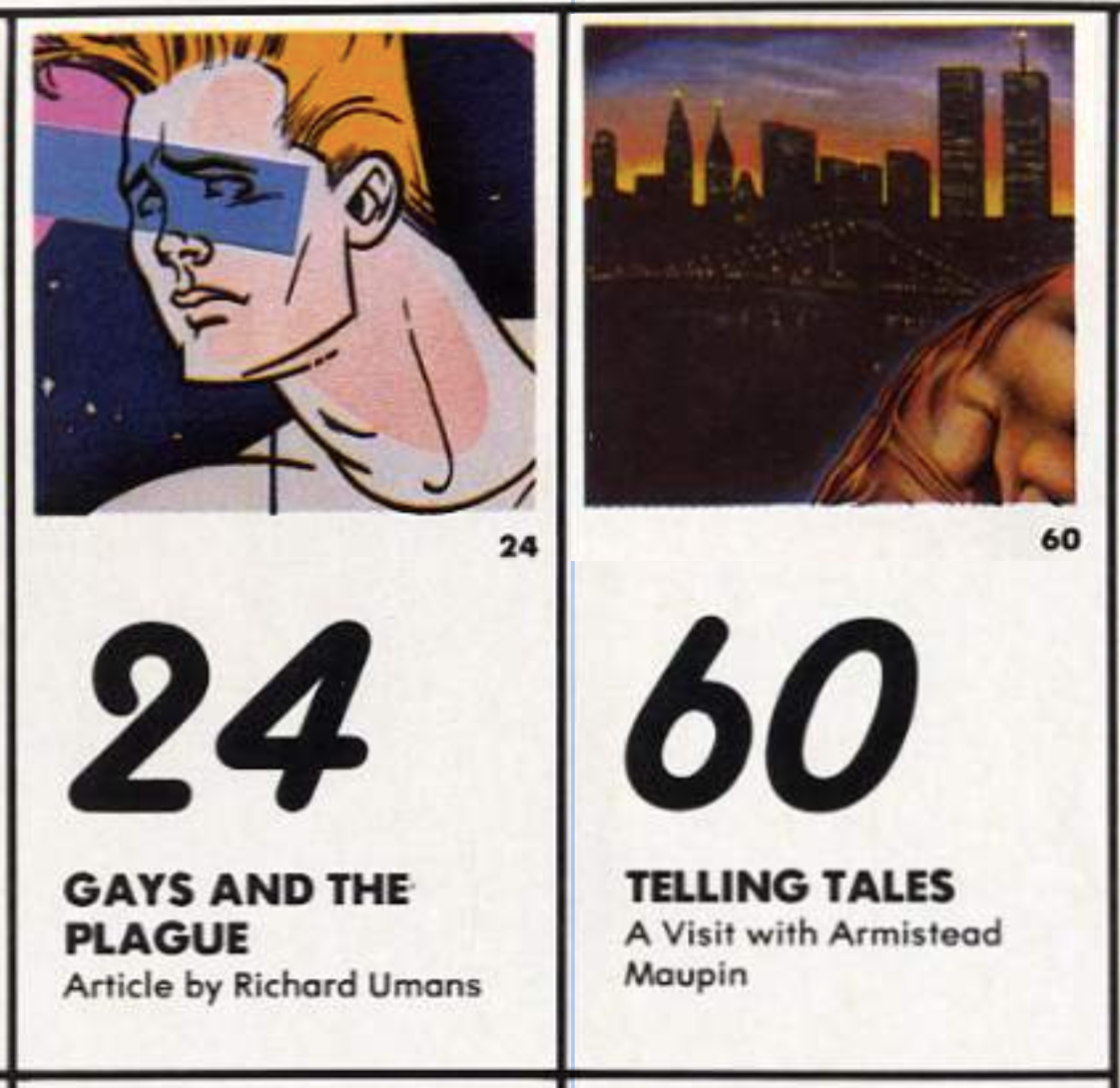
Just a few pages before the Torso feature is an article titled “Gays And The Plague.” The name “AIDS” had not yet been coined and the cause of the “gay cancer” was still unknown. The epidemic would have a devastating effect on Maupin, the gay community, and the fictional characters of Barbary Lane.
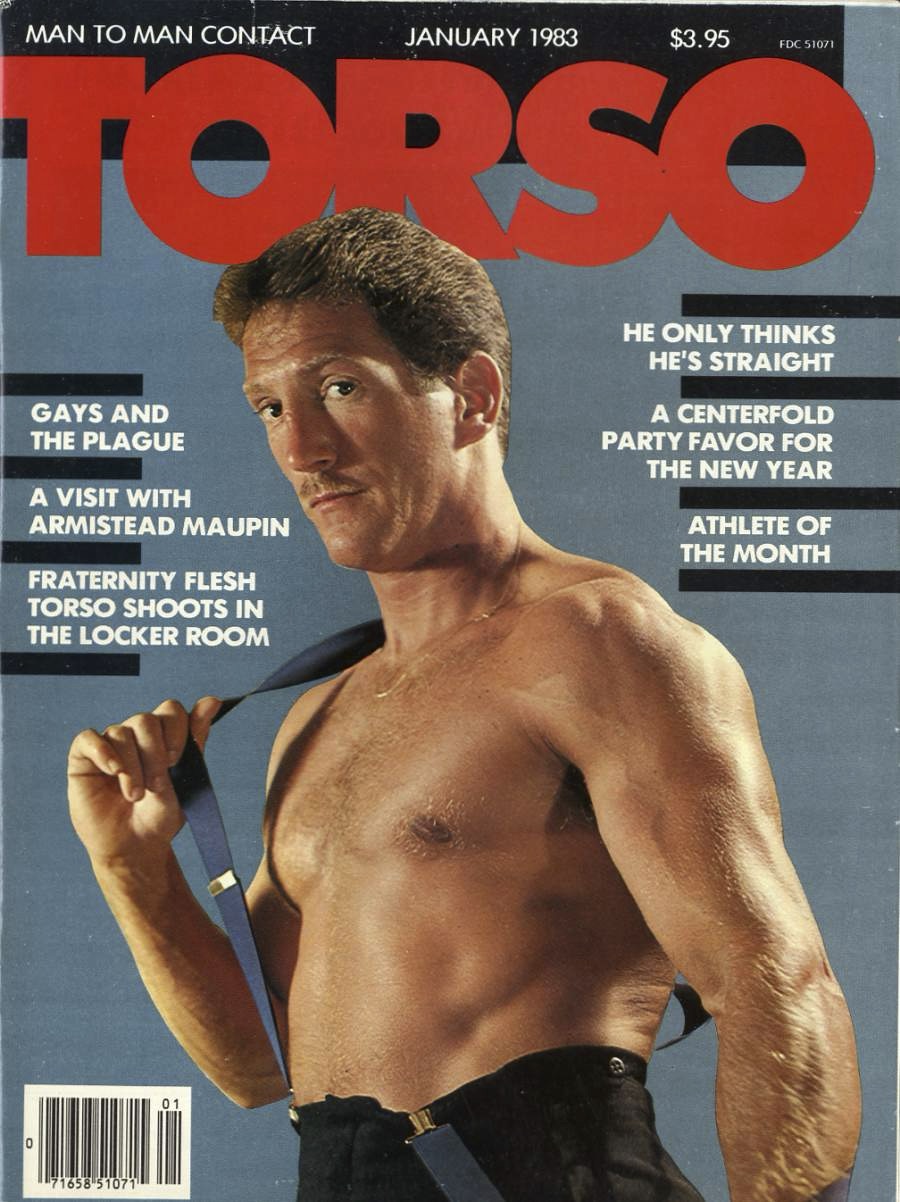
“We come back to California from New York and reassure ourselves that it’s too noisy and too hot and too cold and too crowded and too dangerous but, in the long run, we sort of think… well, it could really be exciting.”
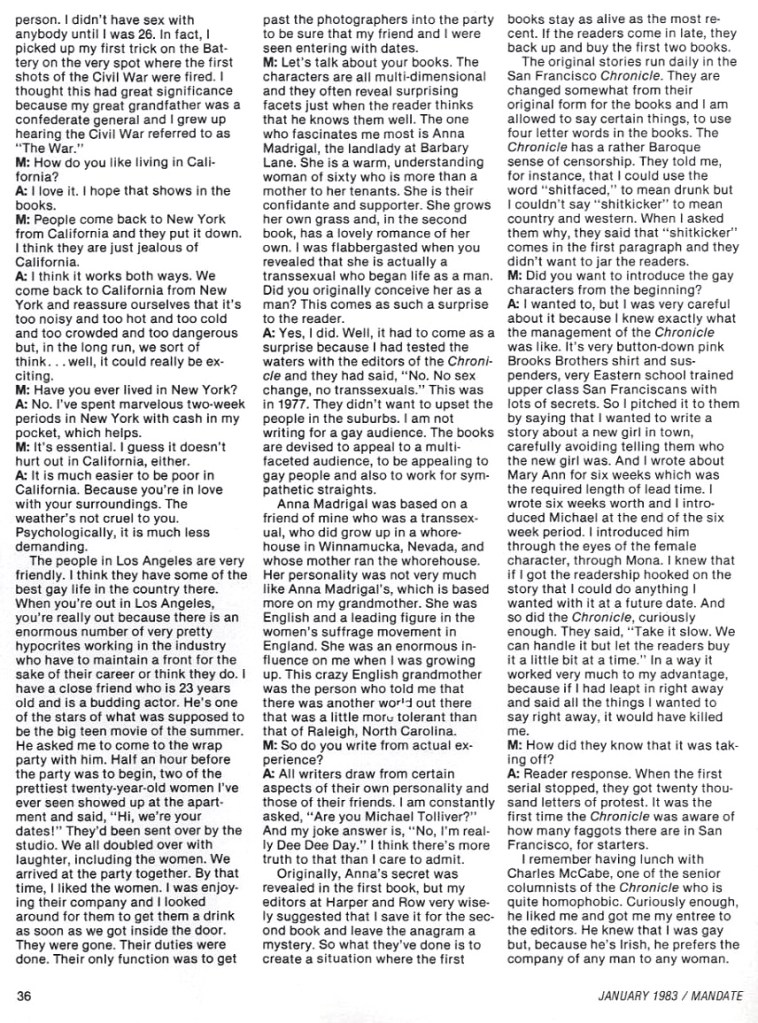

“I came out to my family during the course of the book. Michael’s letter to his parents was my letter to my parents.”
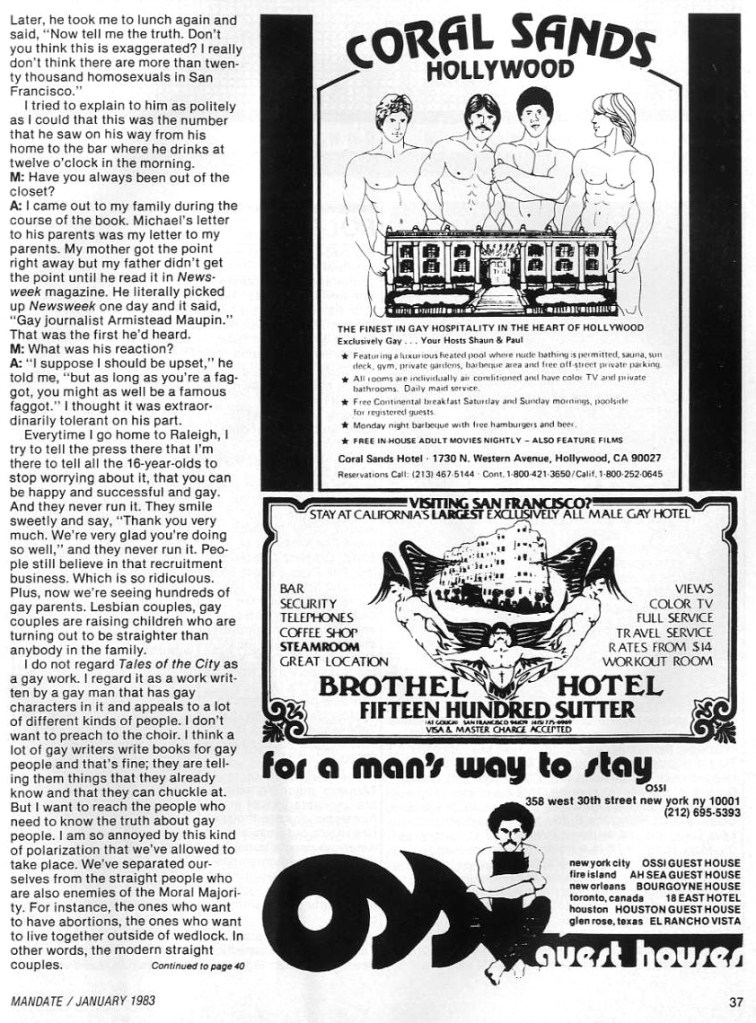


“I do not regard Tales of the City as a gay work. I regard it as a work written by a gay man that has gay characters in it and appeals to a lot of different kinds of people. I don’t want to preach to the choir.”
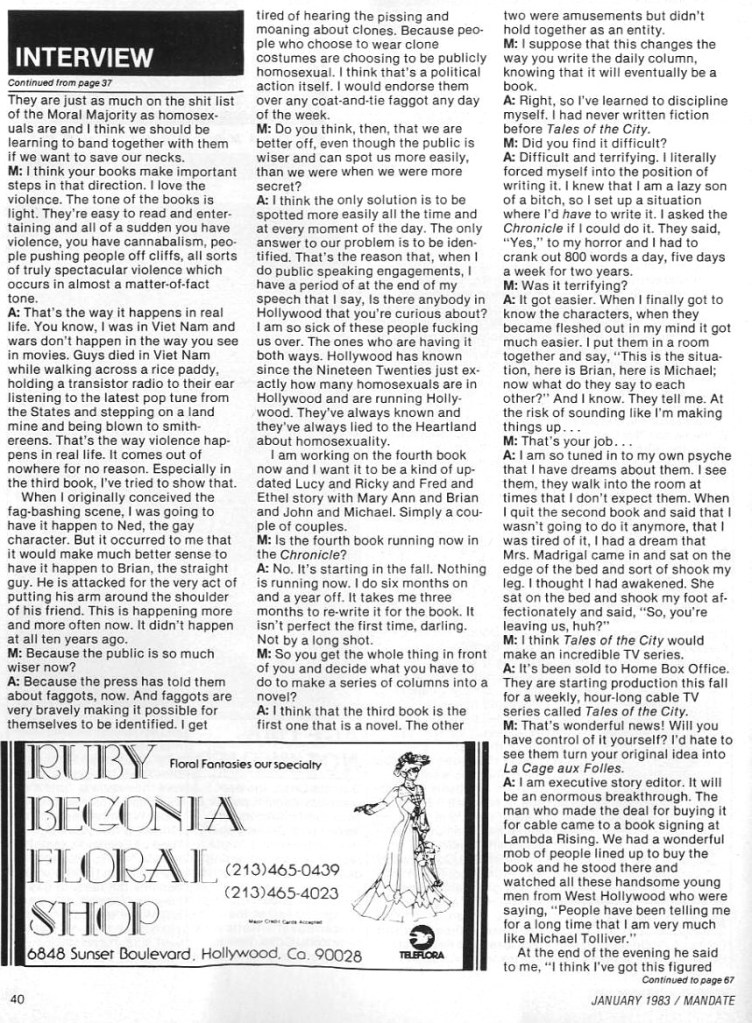


“When I quit the second book and said that I wasn’t going to do it anymore, that I was tired of it, I had a dream that Mrs. Madrigal came in and sat on the edge of the bed and sort of… shook my foot affectionately and said, ‘So, you’re leaving us, huh?'”
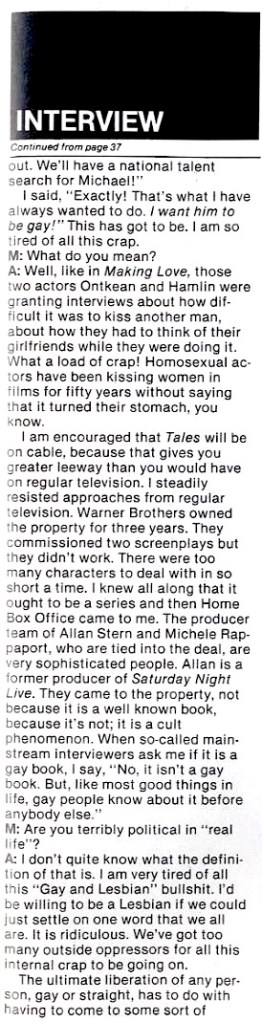
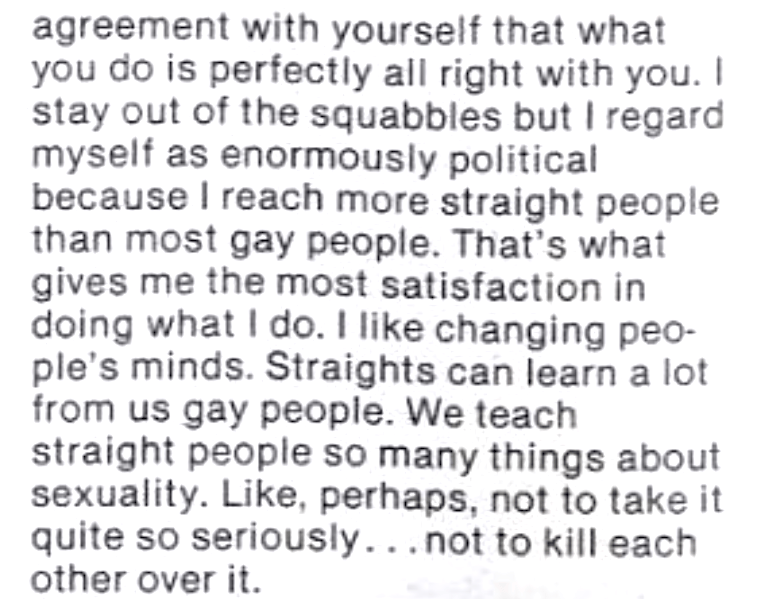

“I regard myself as enormously political because I reach more straight people than most gay people. That’s what gives me the most satisfaction in doing what I do. I like changing people’s minds.”

The Torso article below refers to another Maupin serial that is often overlooked: Jackie Old – a fictional piece about Jacqueline Kennedy Onassis at age 70. Unfortunately, she did not live to see 70 and this series – 5-parts initially published in New West magazine –  would not get an official release until 2014 as a Kindle novella. Even so, it is not included in his bibliographies.
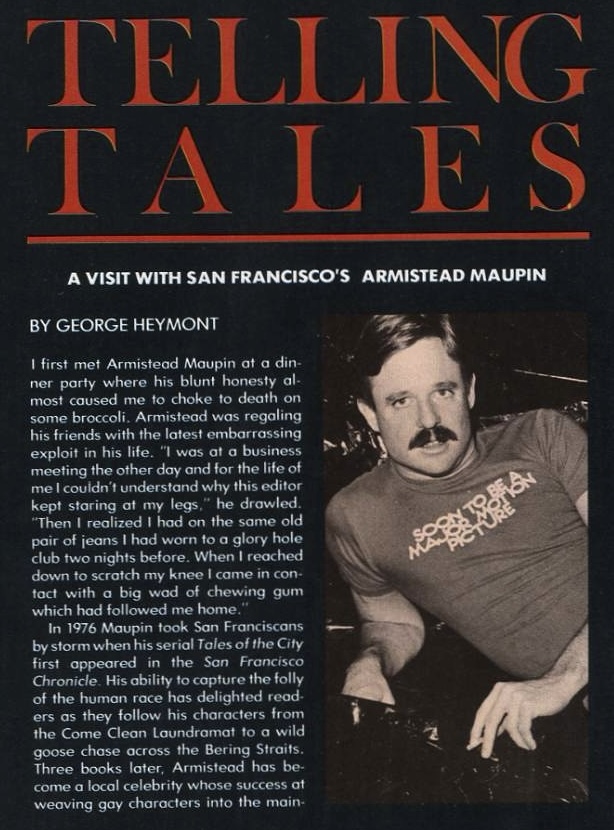
“First of all, we do not all have good taste,” he smirks.
“All of us think we have good taste – which is where it gets dangerous.”
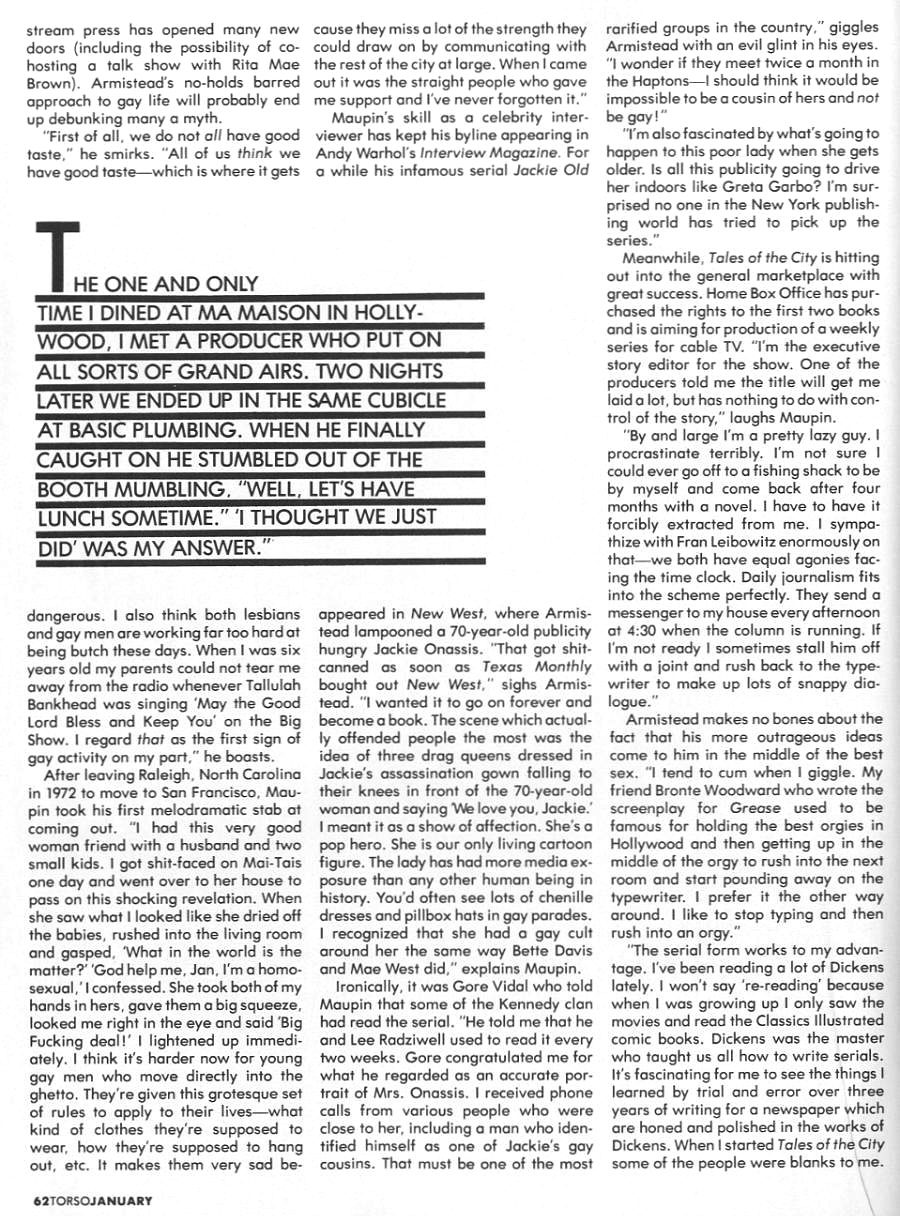
“By and large I’m a pretty lazy guy. I procrastinate terribly… I sympathize with Fran Liebowitz enormously on that – we both have equal agonies facing the time clock.”
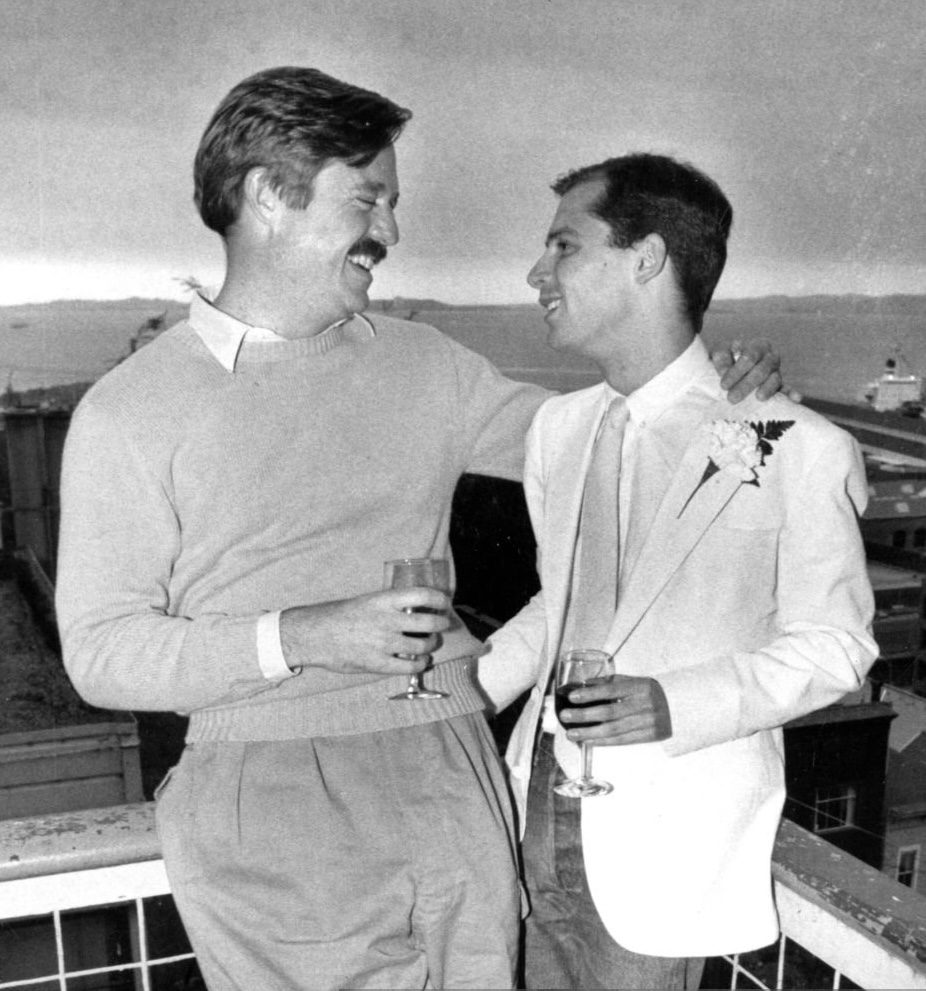
Armistead Maupin at home with Gregory Skraznas, 07/1982 (Photo by Steve Ringman/San Francisco Chronicle via Getty Images)

When Harper & Row began publicity for Further Tales of the City, the San Francisco Chronicle photographed Armistead smooching with his boyfriend. “They handled it the same as they would any other author celebrating his latest book. Would that have happened five years ago?”
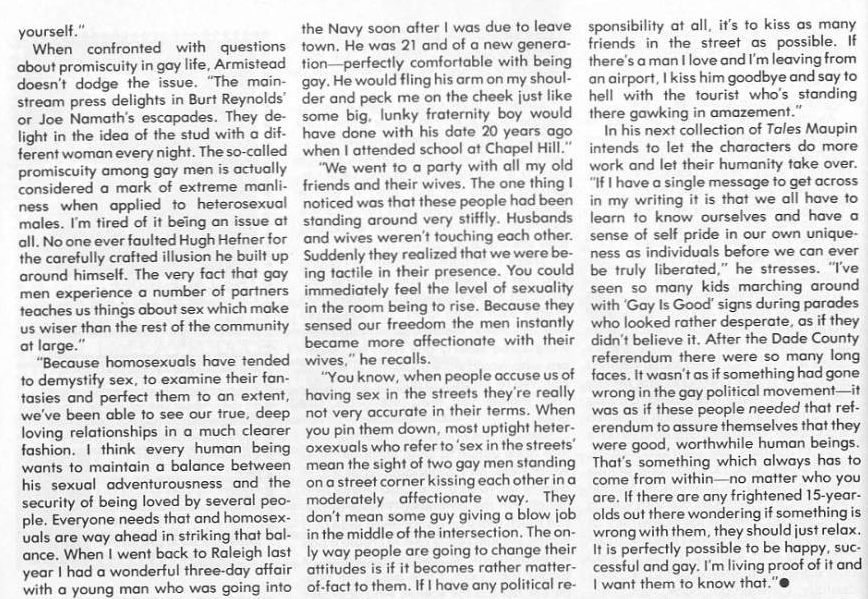
“If I have a single message to get across in my writing it is that we all have to learn to know ourselves and have a sense of self pride in our own uniqueness as individuals…
that’s something which always has to come from within – no matter who you are.”

See Also:
Armistead Maupin in Blueboy Magazine (1980)
San Francisco: In Touch For Men (1979)
New York City: In Touch For Men (1979)
Gay Times #69 (1978)
Blueboy 1980: Gays of NYC
John Waters in Blueboy Magazine (1977)
Al Parker: In His Own Words
Revisiting Bette Midler’s Thighs & Whispers (1979)
Costello Presley & 80’s Gay Porn Guilty Pleasures
George Platt Lynes: In Touch Magazine (1982)
Maybe.

Part I – The Early 1970’s

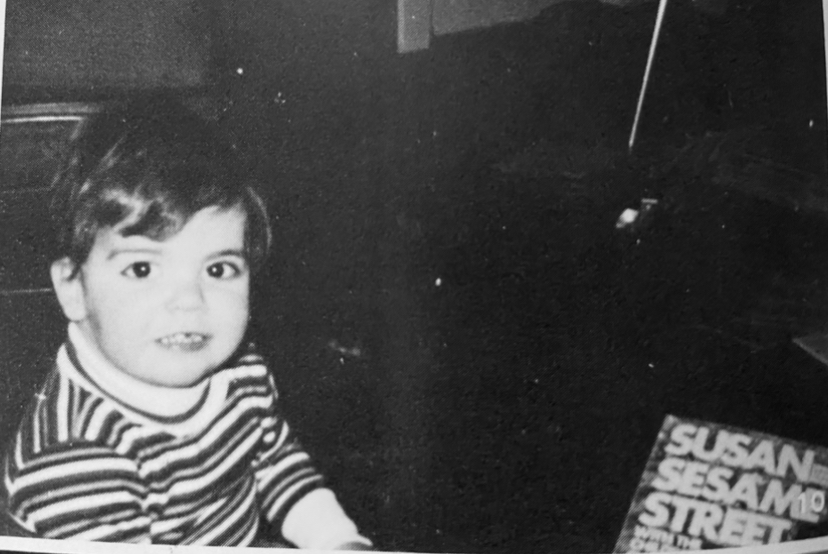
With my Susan Sings Sesame Street LP (1971)

When I was two years old, my mother wrote in my baby book that I liked to listen to records. That’s how far back that goes. Among my Disneyland and Sesame Street records were all of my parents’ discarded 45s from their formative years. This was now the 1970’s and albums were what they were purchasing. 

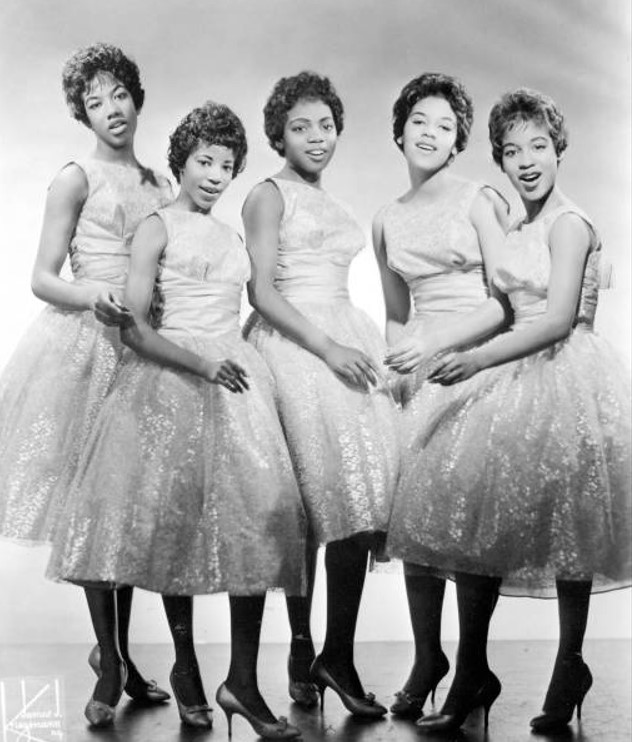
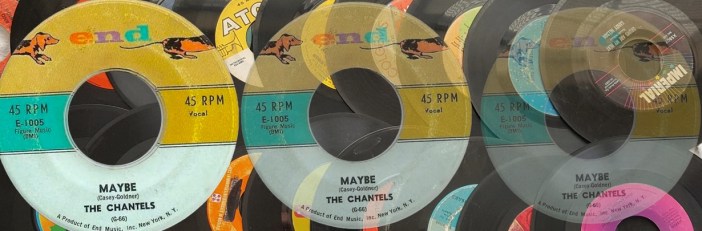
Even before I could read, I could tell by looking at the record label which songs I liked. The blue ones with the map on them were good (it was Motown). The ones with the orange and yellow swirl were The Beatles and The Beach Boys. (Capitol records – fun to watch spin on the turntable). My favorite record, though, was the only one with little doggies on the label: “Maybe” by the Chantels, on End records.

“Candy” – my mother’s name – was written on the label in neat pre-teen cursive. She told me many times that she used to listen to this record every day when she came home from school.

By this time, she was no longer quite so fond if it. She didn’t care for any of the old records, really. Not anymore. There wasn’t a lot of nostalgia in our house. The old-fashioned “ba-da-dum-dum dum” piano intro of “Maybe” would start and she’d roll her eyes, asking why I insisted on playing those old songs. But sometimes while doing housework, she would loudly sing along, complete with dramatic gestures that made me laugh. 

Part II: 1979

My mom, her boyfriend, and I are sitting around listening to music. They met working at the Pizza Hut. He’s 20 years old and listens to Kiss and Foghat. She’s 33, divorced with three kids and likes Billy Joel and the Saturday Night Fever soundtrack.

I don’t recall how “Maybe” came up, but I went and fished it out of my pile of 45s. Like me, he wasn’t born yet when this record came out. The song intro starts, and he jumps on it. “What the hell is that?” It is decades away from current popular music, and he’s making fun of it. Poking fun at her, really. Not in a mean way. Everyone is laughing.

He keeps starting the record over – playing that creaky piano intro over and over again until she’s laughing so hard, she has tears in her eyes.

Part III: July, 2011

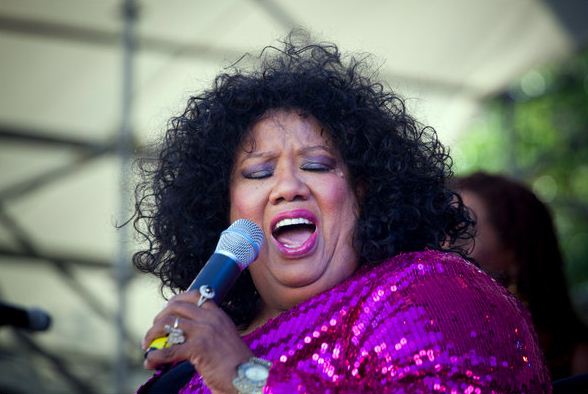
July 30, 2011, I’m at Lincoln Center’s Damrosch Park for She’s Got The Power! A Girl Group Extravaganza. This is an all-day concert celebrating the girl groups of the 1950’s and 60’s. Former Chantels lead singer Arlene Smith is one of the performers.

By this point, “Maybe” is considered to be one of the greatest records of the 1950’s, paving the way for the girl group era and making a place at the table for female R&B vocal groups. Singers like Darlene Love and The Supremes cite the recording as an early influence.

Arlene Smith takes to the stage draped in glittery fabric, seated in an electric wheelchair that she expertly maneuvers around the stage as she sings the song. 54 years have passed since she recorded this, but her voice is still strong. I decide to call my mother, tell her where I am and hold up the phone for her to hear. 

“Oh my god. I haven’t heard that song in years!” she says. She gets a little choked up, and I tell her I’ll call her later when I get home.

In the documentary Girl Groups – Story Of A Sound, Arlene Smith recalled that she had just turned 16 years old when the Chantels recorded “Maybe.” “I was singing about the kind of love that I didn’t know… I loved my parents.”

Part IV: July, 2026

We are enjoying a summer evening in my sister’s back yard, as best we can. A year and a half of cancer treatments has reduced my mother to 90 lbs, but it’s the Alzheimer’s that has now taken the lead in this battle. Earlier in the afternoon, we had her try to draw a clock – a cognitive test used to detect the disease. She couldn’t do it, although she can still tell the time on her watch. It’s a tricky thing to navigate.

I suddenly have an idea. I pick up my sister’s phone and hijack her Summer BBQ Spotify playlist. I tell my mother I want her to listen to something and see if she remembers it. 

The piano begins “ba-da-dum-dum dum” …” Her brow is slightly furrowed. When the vocals start, she mouths the words, but she doesn’t sing. I don’t remember the last time I heard her sing.

My stepfather is dozing next to her. Without opening his eyes, he says “What year was that?”

“1958. Do you remember this song?,” I ask.

“Sounds familiar,” he says.

I tell my mother; “This was your favorite record when you were a kid. You said you used to listen to it every day when you came home from school.”

She nods and softly says, “I was heartbroken.”  

“Over who?”

“I don’t remember.”

She may not have remembered, but later that night, I did. His name was Jackie. I grew up in the same house that my mother did and sometimes I would find little hearts drawn in hidden places: on the wall inside the linen closet, on the underside of the coffee table. In these hearts she had written “Candy loves Jackie.” I remember asking her about him back then. She told me about the first boy she was in love with, and how crushed she was when it didn’t work out.

Would I have mentioned his name if I had thought of it in the back yard? Are painful memories better left forgotten? Or is it important to keep trying to remember simply as a brain exercise?

Maybe if I play this record for her next weekend, it will trigger a different memory. Maybe she will remember singing around the house, or the Pizza Hut guy. Maybe the memory of my phone call from Lincoln Center will come back to her. Or maybe next time, the song won’t sound familiar to her at all.

The record fades out as Arlene repeatedly pleads “Maybe…” Her fellow teenage Chantels, forever frozen in time, sing back to her; “Maybe maybe maybe…”

See also:
My Mother, The Superhero
The Playground Swing
The Tin Man & The Lion: Unanswered Prayers
The Lion In The Emerald City: Promise Of A New Day
1991: Homo Alone
We Got Hitched
60’s Girl Group Survivors
She Knew Something About Love: Brenda Reid (1945-2026)
Girl Group Heaven: Ronnie, Rosa & Wanda
Back To The Girl Zone: 60 Degrees Returns

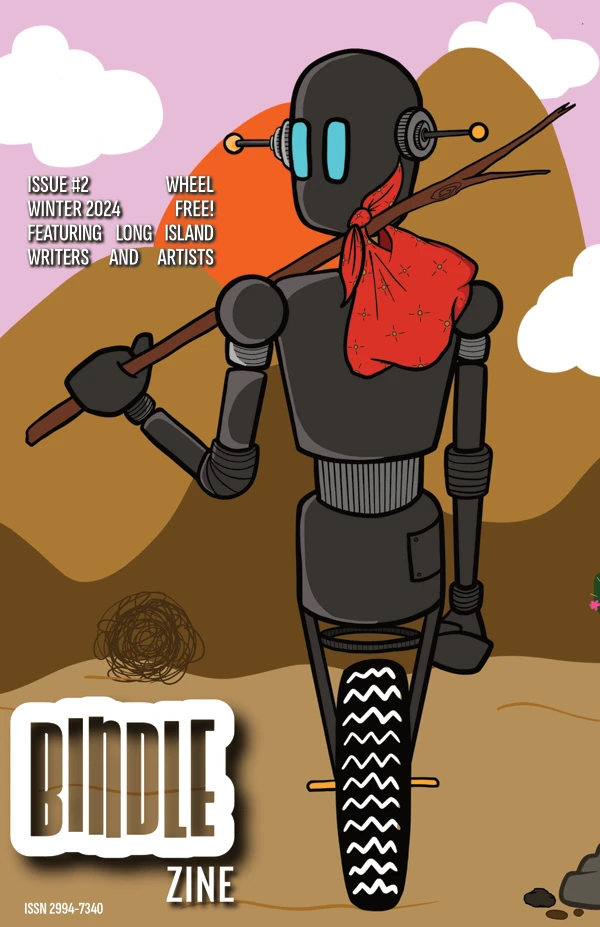
Bindle Zine #2 Is Here! Winter 2024

The Winter, 2024 issue of Bindle Zine is out and once again my husband Tobias and I are delighted to be included in the collection of writers and artists, which you can find here. Toby’s artwork, “The Second Time You Die” is inside the front cover and he also contributed an illustration to accompany my essay, “General Slocum.”

The Second Time You Die by Toby Fox Ferrari

General Slocum

I was sitting at a table outside the Life Café when the self-appointed mayor of Avenue B waved his change cup towards Tompkins Square Park and said “It’s just beyond those trees – a pink marble monument, engraved on one side: In Memory Of Those Who Lost Their Lives In The Disaster To The Steamer General Slocum, June 15th, 1904– 1,100 or so lost – they never did get a total- burned on board or drowned in the East River. Women and children, mostly. The heart of this neighborhood, they said.

“You go ’round to the front of the monument where a boy and a girl look away from you – gazing back towards the river with faces obscured by design and a century of wear. Can’t hardly read it anymore but it says: They were Earth’s purest children, young and fair.

“Below that, a lion head spits water into the fountain with a stream that arcs over 100 years, as if to say ‘Here I bring you water to douse the fires in which your loved ones perished…this water, tamed of its currents that swept away your young. Here it flows in its simplest form as you reflect upon what has been lost.’

“But nobody reflects. ‘Cuz nobody remembers. That monument – erected so they would not be forgotten – has been forgotten.”

bin•dle (noun): a bundle of clothes or bedding, stereotypically carried on a stick by runaway children and transients

“We all wander through our lives, and we collect memories, possessions, and relationships. Bundle them all together, and you have yourself a bindle. Our zine represents a collection of writing and art and photography – a bindle of creativity that we send across America, a tramp in search of a mailbox.”

See Also:
Bindle Zine #1 – Summer 2023
Zombie Divas
Circle In Monkeyshines: Winter 2022
The Tin Man & The Lion: Unanswered Prayers
The Lion In The Emerald City: Promise Of A New Day
1991: Homo Alone
Debbie At The World (1989)
We Got Hitched
Pride Parade (2011)
Sunshine & Tinsel: A Canine Christmas Tail
Maybe.