As some of you may know, I have ramped up the blog posts in the last few months. Here’s a little backstory on why:
I was abruptly let go from a humanitarian organization back on October 1st as my position was relocated to the London office. I spent the next 5 months at home, searching for a new job… and also devoting more time to this blog and other creative endeavors. I am lucky to have a partner and his nephew at home with full time jobs to help get through that period.
I was recently hired into the president’s office of a university downtown – my first day was March 9th. The following day, all classes were switched to online… and you can imagine how it has progressed from there. By the end of the week, my partner and his nephew – a chef and a theatre manager – were laid off from their jobs.
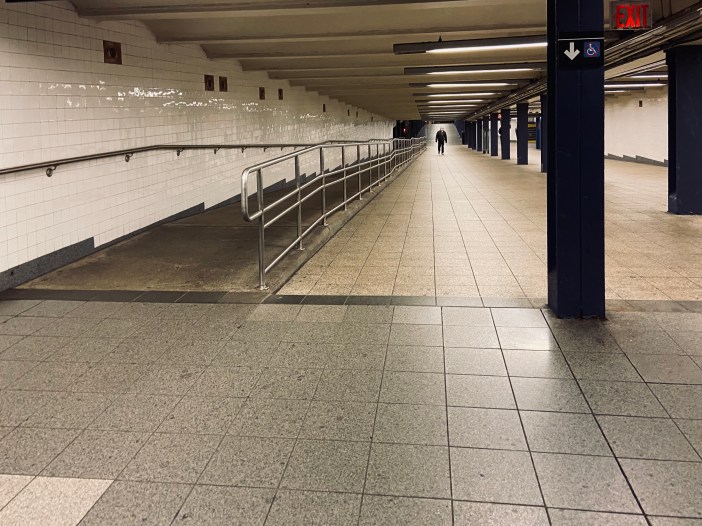
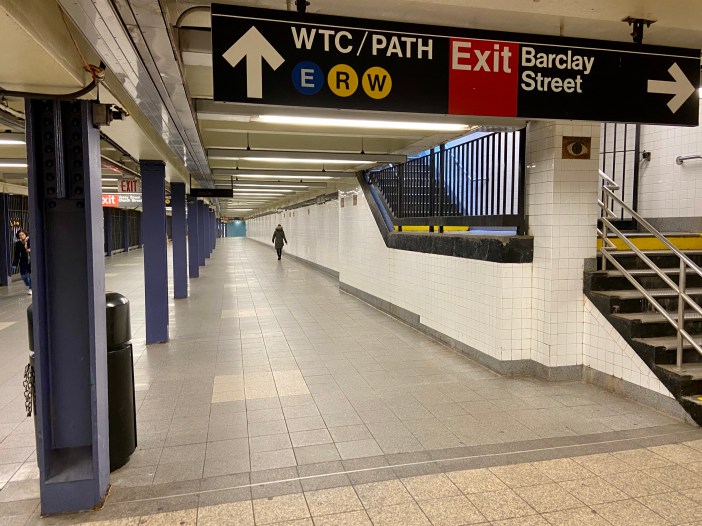
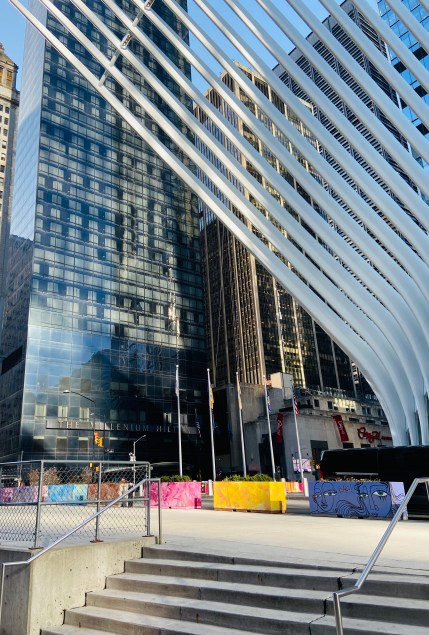
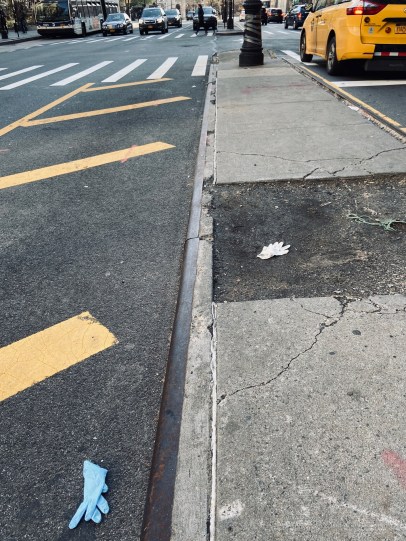
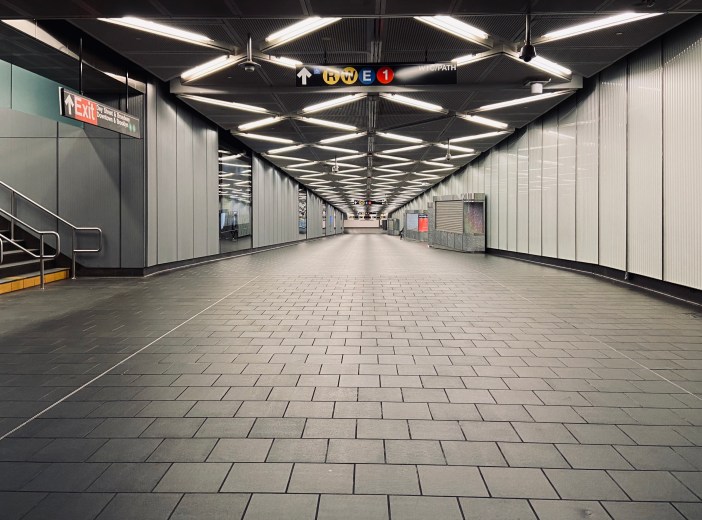
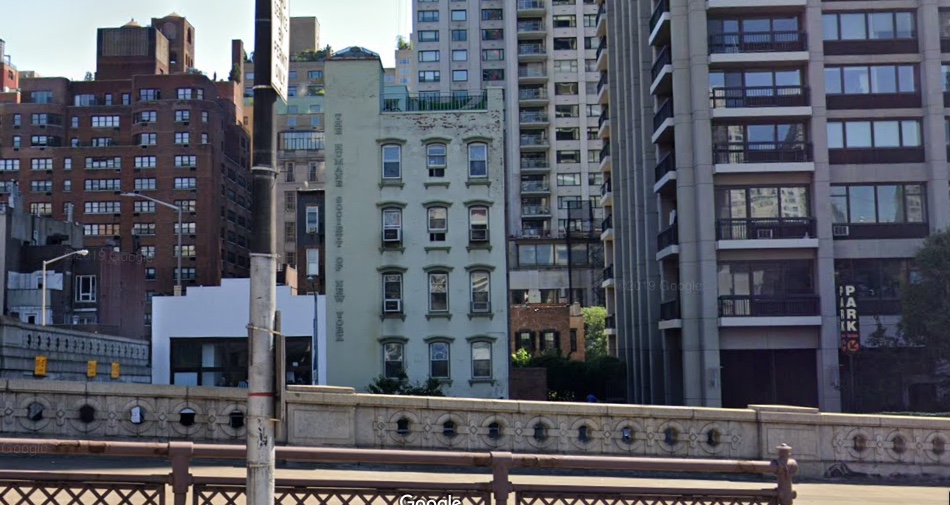
At work, the number of people on campus dwindled, but we kept working in the president’s offices. I started taking pictures as the normally packed downtown/WTC/Brooklyn Bridge area started to empty out.
The first picture above was included in an NBC news story about empty New York City.
The above photos were taken at 1pm on Friday 3/13 – I wish I had retaken these angles today because it would have been much more stark, as you can see from the other photos I have taken since then.
When I got the office today, I was told that we could now work from home, so I won’t be going back for a while. I’m grateful that I still have a job.
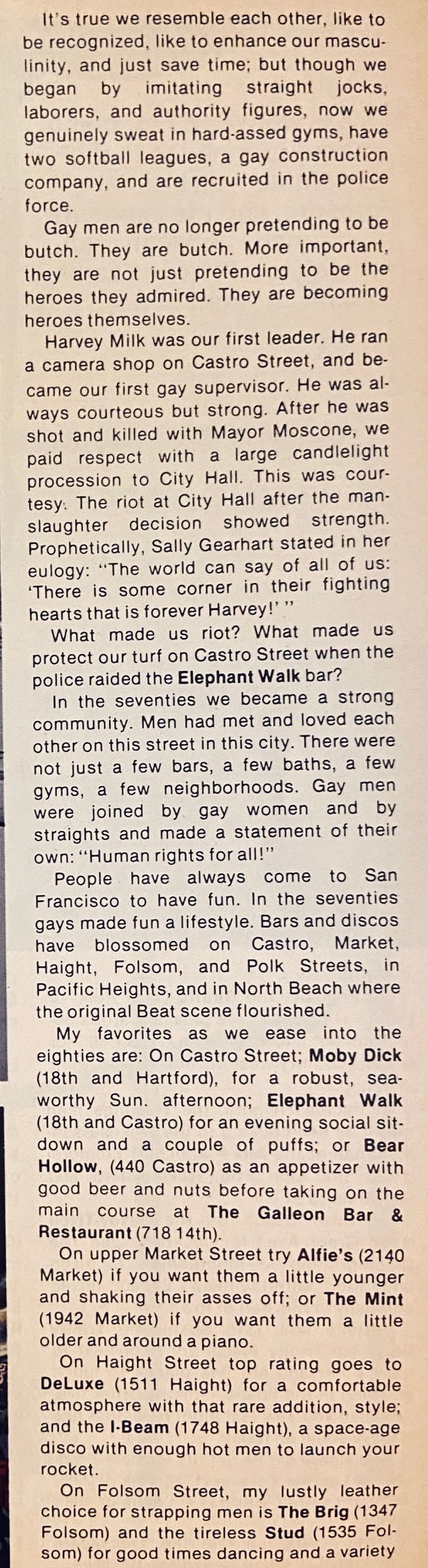
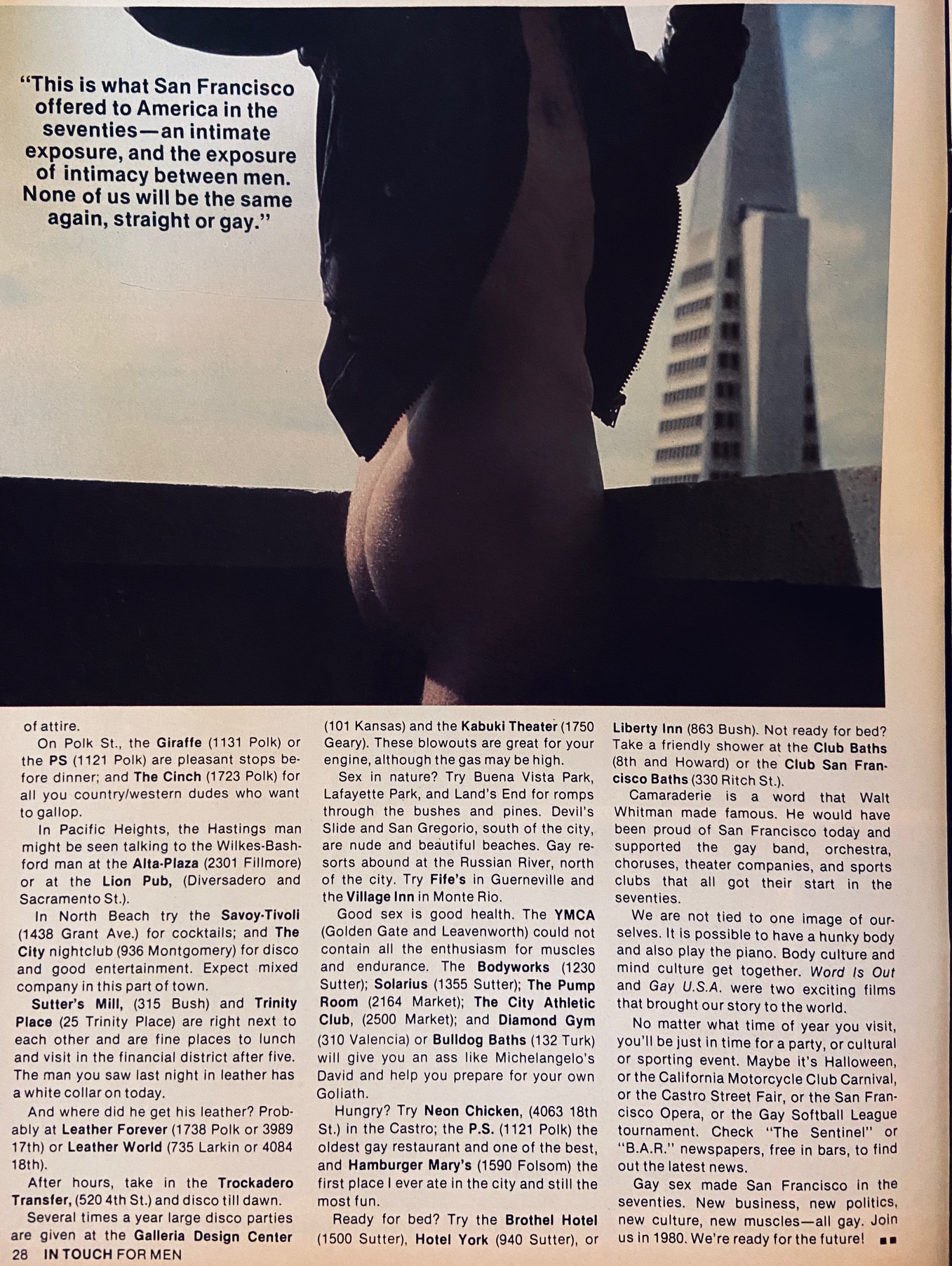
A few weeks ago, I posted an article from the Nov/Dec 1979 issue of In Touch Magazine. This was part of trio of San Francisco articles from gay publications (the other two from the September, 1980 issue of Blueboy featured essays by Armistead Maupin and Randy Shilts).
Shifting focus back to the East Coast, there were some New York-centric ads and pop culture info that I wanted to post, since that’s my home turf.
So here we are again, back in 1979 with Issue #44.
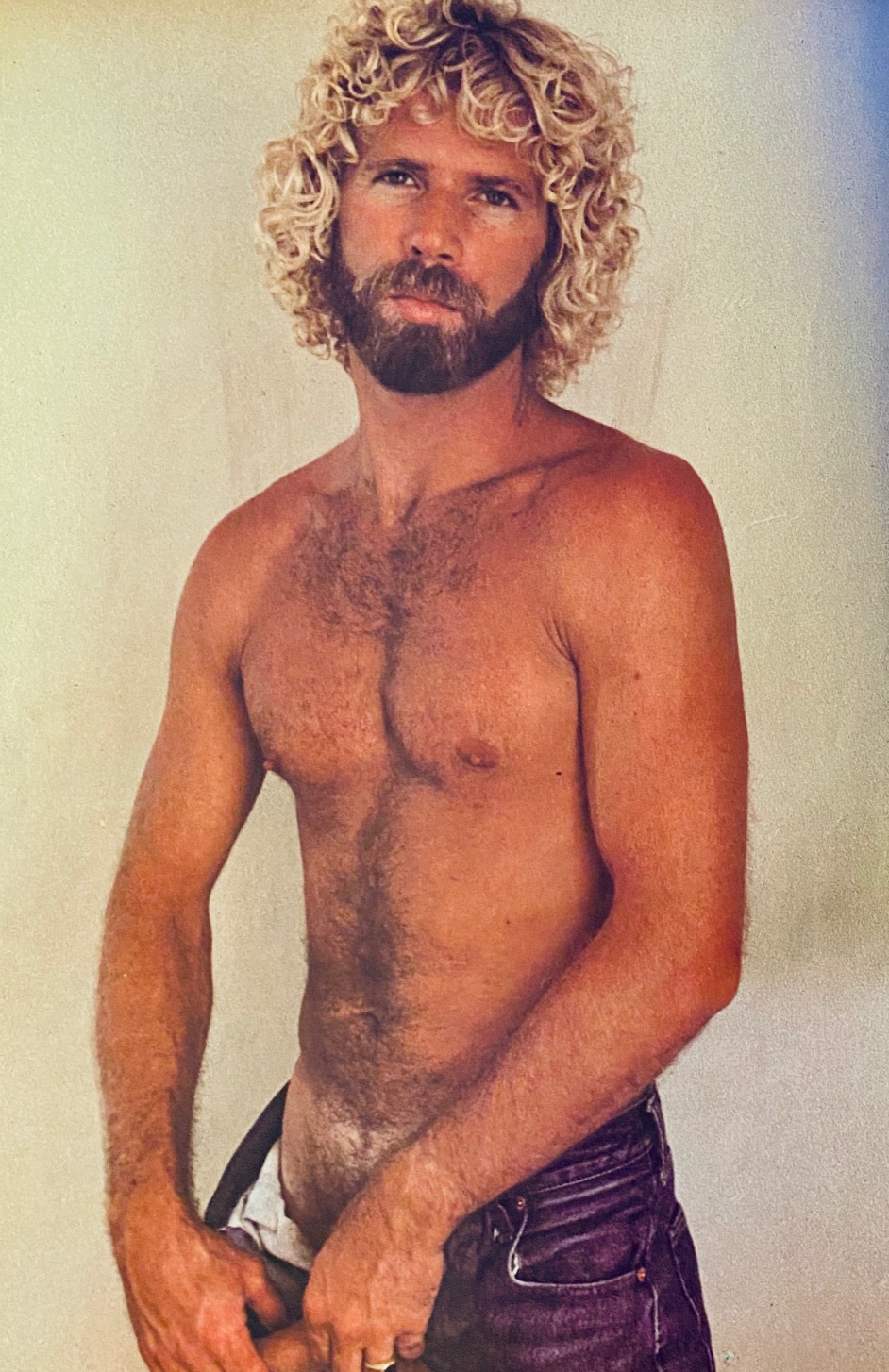
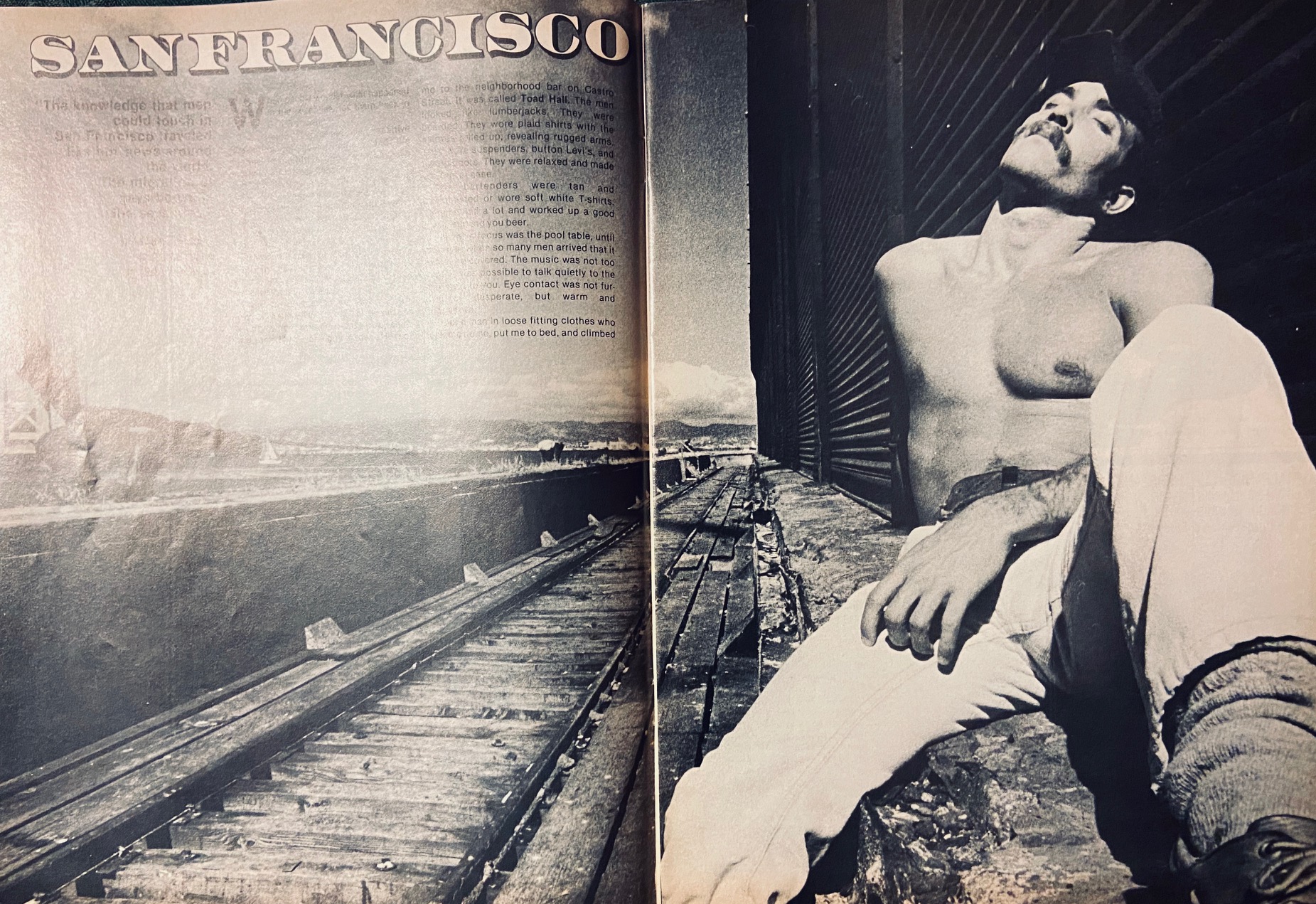
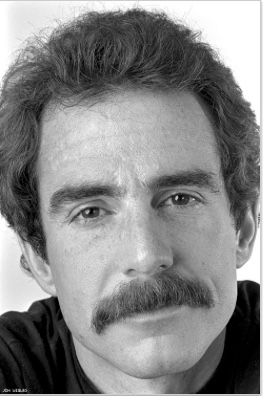
Lets get a different perspective of cover model / centerfold Todd Denson:
There are several ads throughout the magazine for CBC Clubs – a gay-owned chain of bathouses that dotted North America. CBC Club New York was located at 24 First Avenue in the East Village. This branch closed in the mid-80’s and the space was purchased by the Suthon family, which turned it into the restaurant Cave Canem and later Lucky Cheng’s. It was during the twilight days of Cave Canem that I moved to the neighborhood.
I had been living there for about a year when my boyfriend and I saw a listing in HX magazine for a gay bar/restaurant inhabiting an old bathhouse located at 24 First Avenue. This seemed strange – it was only 4 blocks from our East 6th Street apartment, yet we had never heard anything about it.
One night we ventured over – only to be turned away by a surly doorman who claimed there was a private party inside. We didn’t believe him – how did he know we weren’t invited guests? Our imaginations went wild with speculation of what gay/leather/sex dungeon lurked behind those doors. After reading this interesting piece on the history of the space in Jeremiah’s Vanishing New York, I gather that it probably WAS a private party that we tried to crash… and possibly a lesbian orgy.
The following year Lucky Cheng’s Chinese Restaurant opened with its now famous drag and gender-fluid waitstaff, thriving at this location for 19 years. By the time I finally ventured in – just once – it was to buy a gift certificate for my parents, at their request. The once bohemian restaurant had become an edgy staple for straight out-of-towners. Lucky Cheng’s eventually followed the tourist trade up to the theatre district. The building was sold and is slated to be torn down and replaced by… you guessed it: Luxury Apartments!
One other note to add a little context: right across the street at 19 First Avenue is Lil’ Frankie’s Restaurant and the home of East Village Radio’s storefront broadcast booth. This is where my 60’s girl group show 60 Degrees with Brian Ferrari aired from 2008-2013… and resumed broadcast in 2024. (see & hear here & here)
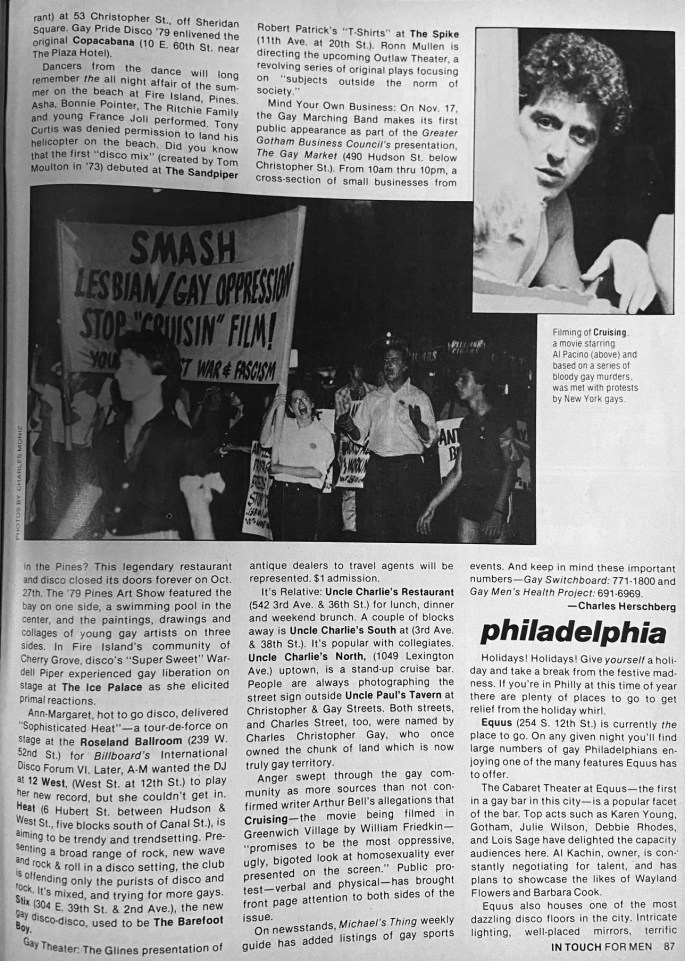
1979 marked the 10th anniversary of the Stonewall Riots. Here’s an account of how the occasion was celebrated in NYC and Fire Island, as well as the protests surrounding the filming of Al Pacino’s laughable misfire Cruising.
Some background on the musical references above:
16 year old France Joli’s July 1979 Pines performance is the stuff of legend. She made a return to the annual Beach Party in 2018.
Wardell Piper is mentioned performing “Super Sweet” at the Ice Palace in Cherry Grove. She had been a member of soul group The First Choice, but this was her biggest solo hit:
I love the passing reference that Ann-Margret – “hot to go disco” – couldn’t get into a West Village club to have them play her record. Sounds like the gays weren’t having it. “Love Rush” was a track from this brief chapter of her career. Any allusion to poppers is purely intentional.
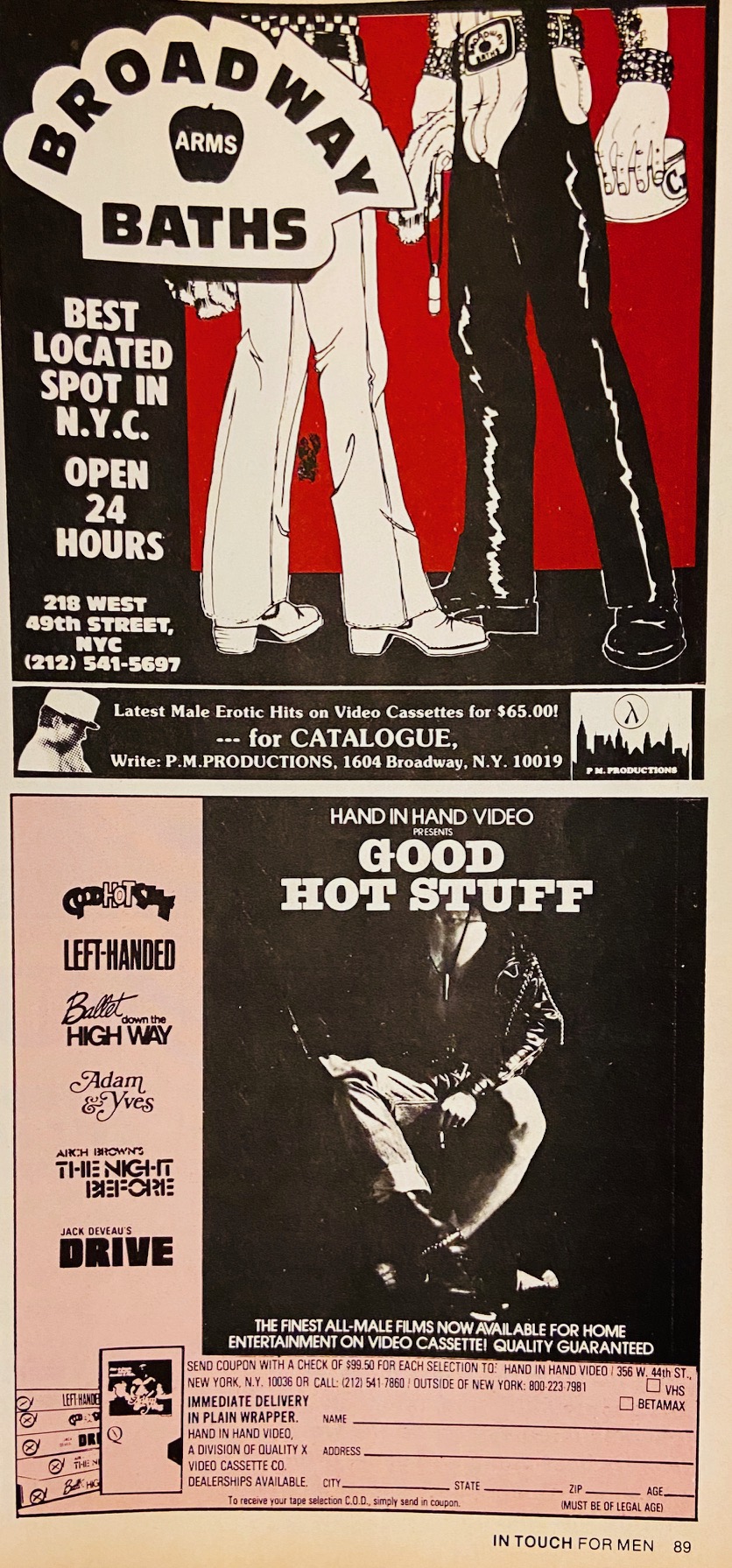
Here’s some other ads – one for Broadway Arms Baths, which was located across the street from the Ambassador Theatre on West 49th Street, and two NYC-based gay porn video companies featuring VHS tapes for the low low price range of $65-$99.50! Just imagine what the VCR cost.
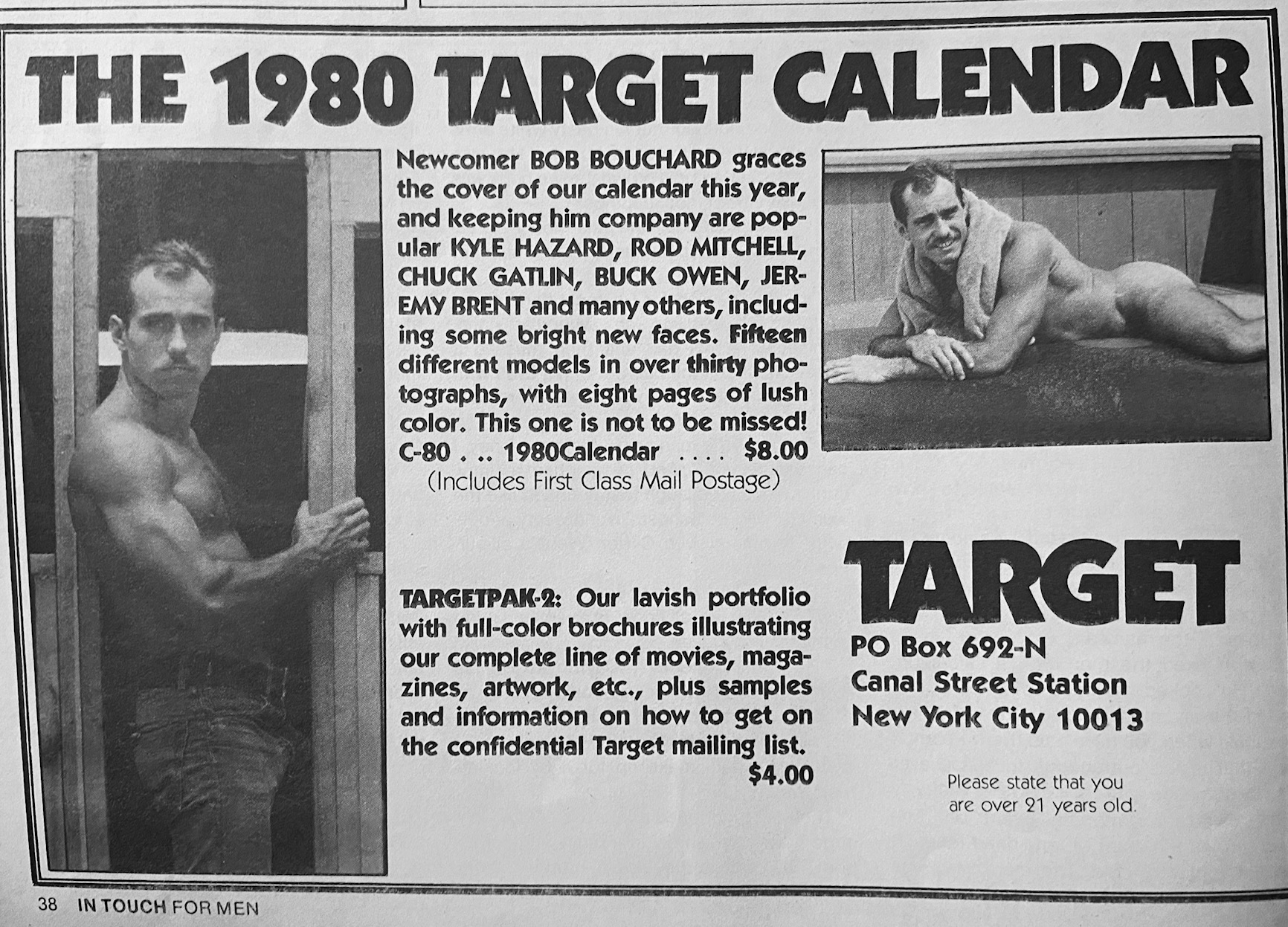
I had to post pics of this guy, who is SO 1979 that it hurts. Michael Mouse Hank Owens is a landscaper, a Sagittarius and only indoors when he’s at the disco!
That’s all for now! I leave you with an ad for lube. Natural lube. With a horse.
Here’s a little something I thought I would share…
I recently stumbled across a TruTV show called Rachel Dratch’s Late Night Snack. This ran from 2016-2018 – somehow I had never seen or heard of it. One segment in the “Ghost Story Club” episode had a character who was a roadie for a band playing at Fauxchella – a fictional Coachella-like music festival of cover bands. A list of the lineup flashed on the screen in one of those freeze-frame-or-you’ll-miss-it moments.
For your enjoyment, here is the Fauxchella lineup:
Fish With An “F”
The String Cheese Accident
Hall and Wheats
Mow
Dave Matthews Hand
The Whom
The Bortles
Piss Sextols
Puhink Fuhloyd
311 Was An Inside Job
Ungrateful Undead
Booty and the Hofish
Creamy
Steve Miller’s Dad’s Band
Lady Naked Bears
Faux Fighters
Minivan Halen
BOSTON… Massachusetts
What About Bob? Dylan!
Mother Of Pearl Jam
Nirvaner
Puns N’ Roses
Third Eye Legally Blind
Won’tco
Very Dizzy Gillespie
Three Cat Day
YY Bottom
Sneaky and the Family Rock
Kilometers Davis
Expensive Trick
The Lovin’ Sporkful
The Laming Flips
Will, Jada, and Aero Smith
Stevie 1der
Farther
Gerry Jarcia
Sham! (Like Wham!)
Barry Off-White
Fleetwood Mock
Disco English Muffins
Bela Fake and the Faketones
Shallow Purple
The Black Keyholes
Tim Peppy and the Heartdestroyers
Brunette
The Further Backstreet Boys
The Doors(tops)
Simon & Garfinkle
The Faux-lice
The Velour Underground
Billie Jewish Holiday
Rochester Springfield
I have visions of the writer’s room with a board full of post-its.
Got any to add?
UPDATE: KennethInThe212 blog did cover a couple of clips from the show, including this one:
“She was once like Whistler’s Mother – now they whistle when she passes.”
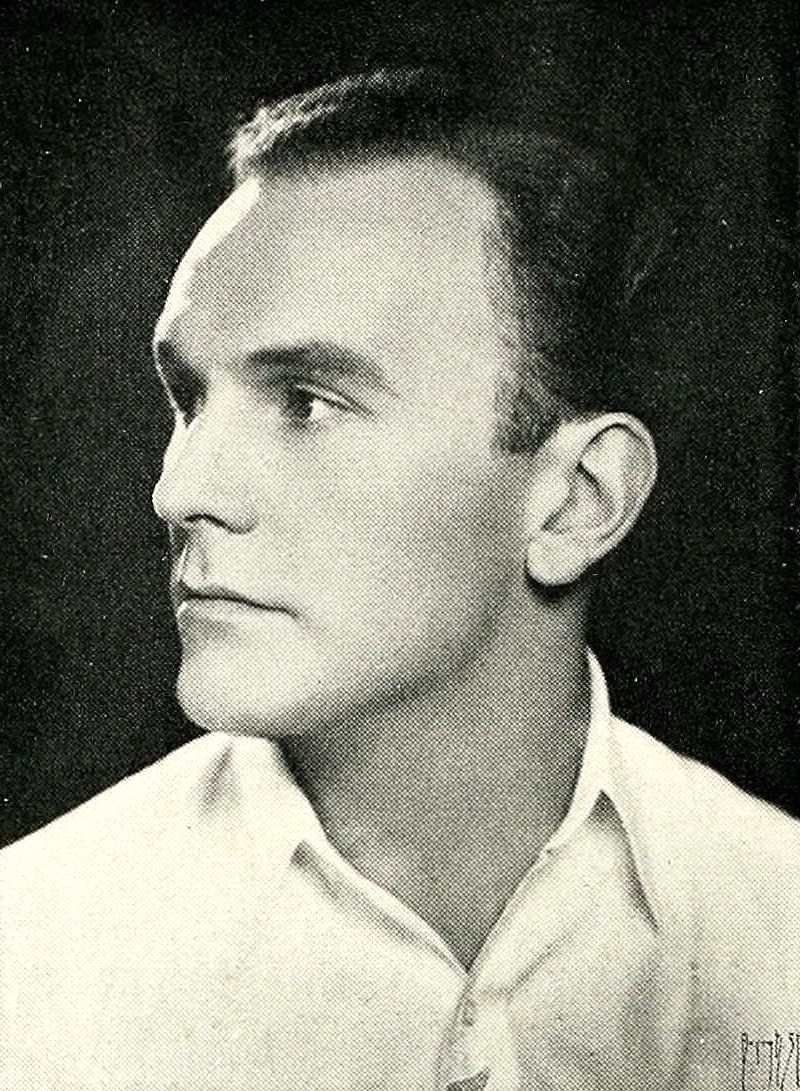
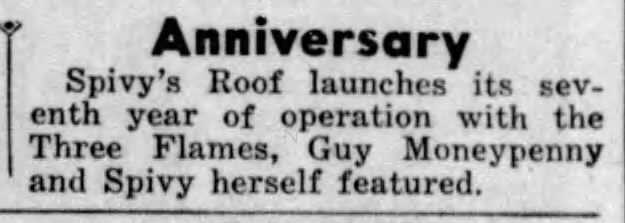
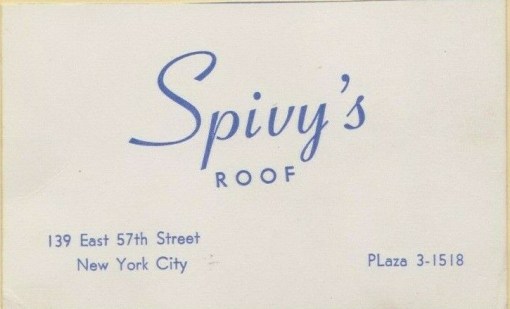
Ladies and Gentleman, it is time once again to revisit that late great dynamic lady of song, Madame Spivy LeVoe (1906-1971), also known simply as Spivy. A lesbian entertainer, nightclub owner and character actress, Spivy has been described as “The Female Noel Coward” – to which I add “…. if he was born Bertha Levine in Brooklyn.” You can see earlier posts about her here and here.
Since my last Spivy post, I was thrilled to see that she had been profiled on Dennis Dermody’s Cinemaniac website, and even happier to see that, after a little nudge, I was given some credit for all the “borrowed” photos, video and large portions of my previous posts. Bless his heart, I’m sure it was just an oversight.
Moving on… today we will be listening to “Auntie’s Face”, a song written by Broadway actor and fellow nightclub performer Guy Moneypenny (1906-1983).
Spivy’s recording was featured on her 1949 album An Evening With Spivy.
Spivy had something of a catchphrase that she would use to introduce a song: A solemn pronouncement that “This is VERY sad and we must be VERY quiet, please.” She would then launch into a number that was anything but either of those things. At least four of her recordings contain this introduction – one can imagine that it was a playful way to get the attention of a noisy nightclub audience.
Auntie’s Face
We all have strange relatives… but let me tell you about my Aunt Grace.
She’s a MAD thing. This is very sad and we must be very quiet, please.
This is the tragedy of poor Aunt Grace – how she became a complete disgrace
It all began when she lifted her face and decided to be young and gay.
Since she’s become a rejuvenated case, the whole house suffers from her madcap pace
There’s no longer any quiet in the whole damn place
So we lift our eyes to heaven and pray.
Please God make Auntie’s face fall. For we’ve all got our backs to the wall
Her reputation’s battered. Our principals are shattered. She hasn’t any moral code at all.
Her breath now reeks of bathtub gin. Goes out nights in search of sin.
We wake up in the morning to find her coming in… from an all night brawl.
We’re all in such a dither, for heaven knows she’s coarse.
When she brings the milkman with her – wait ‘til you hear this one – why must she bring his horse?
Please God make Auntie’s face fall. For nothing is sacred at all.
We caught her teaching Granny to manipulate her fanny in a rhumba with a cashmere shawl.
And just last night they phoned from the jail – it seems they’re holding Auntie ‘til we fork up the bail
They found her on Broadway singing “Love For Sale”. Yes they did! And the price was small.
She steals cigars from brother. She’s thrown away her glasses. She was once like Whistler’s Mother – now they whistle when she passes. She thinks she’s the belle of the ball. We’re afraid that she’s going on call
Dear God we beg your pardon but to hell with Lizzie Arden
If you’ve any mercy left at all… please God make Auntie’s face fall!
Some of Spivy’s other recordings contain obscure references that require a little research and explanation. Not so with “Auntie’s Face”: Cole Porter’s standard “Love For Sale” is still well-known. The line “To Hell with Lizzie Arden” is a reference to cosmetics queen Elizabeth Arden, whose beauty product empire still stands. And who isn’t familiar with Whistler’s Mother?
Furthermore… a song about plastic surgery certainly rings truer today than it did 70 years ago. It may come as a shock to fans of the Real Housewives that the first facelift procedures took place in the early 1900’s.
For 10 years (1997-2007) I produced and hosted a late night public access program on the air here in New York City called Bri-Guy’s Media Surf.
This 1998 flyer features the stop-action roiling sea of celebrities used in the opening credits to the show. Amongst the beefcake models and my first grade class photo, we also have: Bette Midler (3x), Goldie Hawn (2x), Diane Keaton (First Wives Club), Erasure (2x), Dusty Springfield, James Dean, Madonna, Lisa Loeb, Mark Wahlberg, Rupaul, Paula Cole, Keith Haring, Greg Louganis, Michael Stipe, kd lang, Julia Fordham and James Dean.
The quote at the bottom is a nod to legendary NYC late night hostess Robin Byrd.
One of my faithful viewers (Tammy) Remington Write recently reached out about doing an interview and has written a wonderful piece for Medium. Thank you so much for remembering, Tammy!
In the article she recounts when we first met on the street back in 2005. Viewers did not approach me often enough that I ever got used to it. I was always thrilled to be reminded that this thing I was creating alone in my apartment was being broadcast and people were watching.
I was going to just post the link to the Medium article here and leave it at that, but while looking for something unrelated on a backup computer disc, I came across this piece I wrote in 2006 for a MySpace blog that I had completely forgotten about:
Every once in a while I’ll hear from a viewer of my NYC public access program, Bri-Guy’s Media Surf. It’s still running, mostly in repeats, on MNN in Manhattan.
Media Surf promo shot (1997)
I got an IM yesterday from a viewer that I have conversed with from time to time over the years. He’s a nice guy – perhaps a little off, but aren’t we all in one way or another? He still hasn’t gotten over the fact that sapphic little Dana Owens who worked in his record store in the late 80’s morphed into Queen Latifah. He brings it up in every conversation. That, and his obsession with Sylvia Miles. I’m not kidding. He scared her and now she won’t talk to him.
He lives in New Jersey but a friend would tape my show and pass him VHS copies. That ended at some point a few years ago and I wasn’t sure if he was still watching it. I don’t hear from him for long stretches of time and then he will suddenly IM me out of the blue.
This was today’s exchange in its entirety:
(curtain up)
Him: I used to trick with a fuckbuddy in Harlem so I could see your show
Me: You what?
Him: I would time it just right
Me: How funny.
Him: Sex after your show – I am not kidding
Me: That’s so sweet!
(curtain down)
Now… who could ask for a better compliment than that?
Media Surf promo shot (2003)
This is actually the second person to extol this type of adulation. Last summer a guy came running up to me on the street to let me know how much he loved Media Surf, and that he had a regular Friday night tryst with his “one night a week boyfriend.” This had gone on for years: they would get together to watch the show and then have sex. Or vice versa. In their case, I’m not sure if the show was an appetizer or dessert. The point is, it was on the menu.
This is my fan base, if you will. For a while, it seemed like viewers who recognized me would only come up and talk to me when I was trying to pee in public. Apparently I am most approachable in public bathrooms. Not that I make a habit of hanging out there. Shut up.
Once after I disembarked from a flight at La Guardia Airport, I entered the restroom with some urgency and a member of the janitorial staff greeted me with a hearty “Hey Bri-Guy!”
On the set: Media Surf(2005)
It wasn’t a terrible welcome back to New York City – the one place where I have just a smidge of recognition.
A guy reached over the toilet stall to shake my hand as I stood at the urinal one drunken evening in Dick’s Bar. I guess I’m less intimidating with my fly open. Or more vulnerable, at the very least.
In the realm of things, hearing that someone would choose their rendezvous to accommodate Media Surf’s broadcast schedule is high praise, considering that after 9 years on the air, I rarely bother to stay up late enough to watch it myself.
It means enough to these people to approach me and let me know that they like the show that I put together. To be a part of their philanderings – in some tangential way, without ever taking my clothes off or having to shower afterwards – is kinda cool.
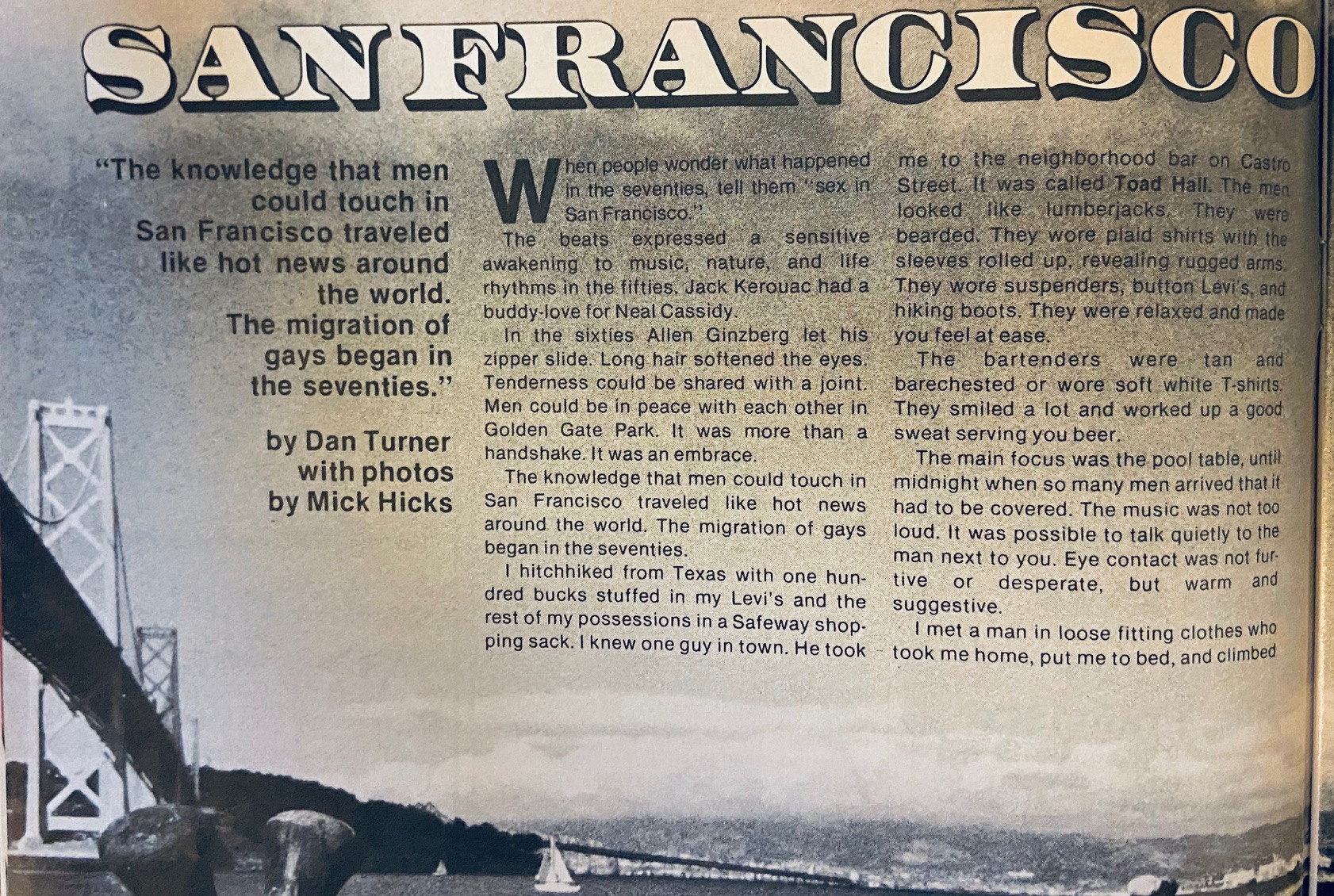
I recently posted two San Francisco-based articles from the September 1980 issue of Blueboy magazine – one by Armistead Maupin and another by Randy Shilts. I was ready to move back to the east coast when I came across a third article – written by Dan Turner for the Nov/Dec 1979 issue of In Touch Magazine. It seemed to work as a literary triptych with the other two articles. Also… it looked somewhat familiar….
The flipped version of the shot below accompanied the Armistead Maupin piece in Blueboy. And no, those are not nude sunbathers on the roof – it’s an overlapping photo.
The shot below was from the Nov/Dec In Touch Magazine article. Same guys, same clothes or lack thereof. Some people have shifted around a bit, so it was taken at a different time on the same day.
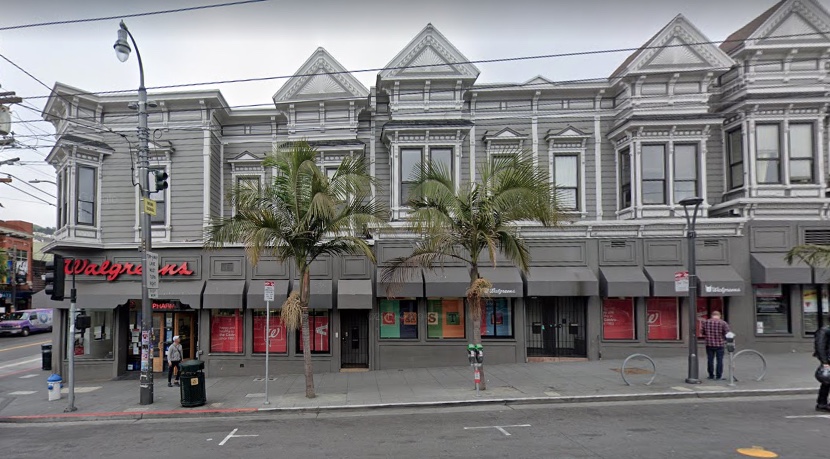
Through internet magic, I did a little “Google map virtual walk” down Castro Street, which led me to the corner of 18th st. And there it is: the boys’ perch, 40 years later. The pharmacy is now a Walgreens:
I felt like I was slipping down the rabbit hole. Next stop: YouTube with a search of 1979 Castro Street Fair videos! Sure enough, there they were – captured in grainy home movie footage.
Theses guys were photographed more than the soldiers at Iwo Jima. Call it Gay-wo Jima.
Before I started to save videos and crop and edit and convert to gifs and blah blah blah, I took a step back from the edge. I felt that I had lost the plot at this point. Where were we? Oh yes.
That last paragraph just hurts. How could anyone have known what the future held? In 1981, the author of this piece, Dan Turner was one of the first people diagnosed with AIDS. This was before it even had a name. He helped found the AIDS Foundation, People with AIDS and the AIDS Switchboard. He was the longest surviving person with AIDS when he passed in 1990 at age 42.
“…they are not just pretending to be the heroes they admired. They are becoming the heroes themselves.”
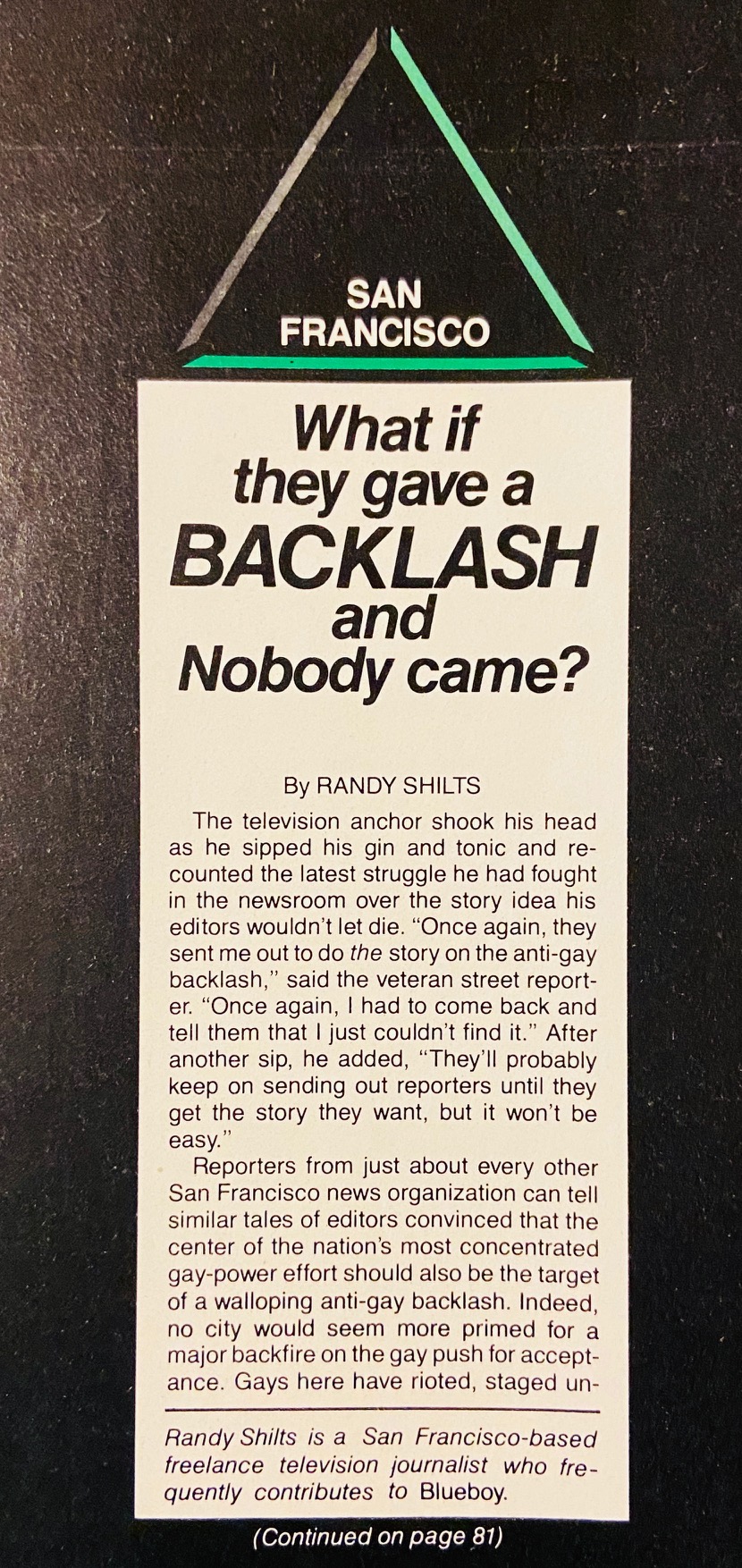
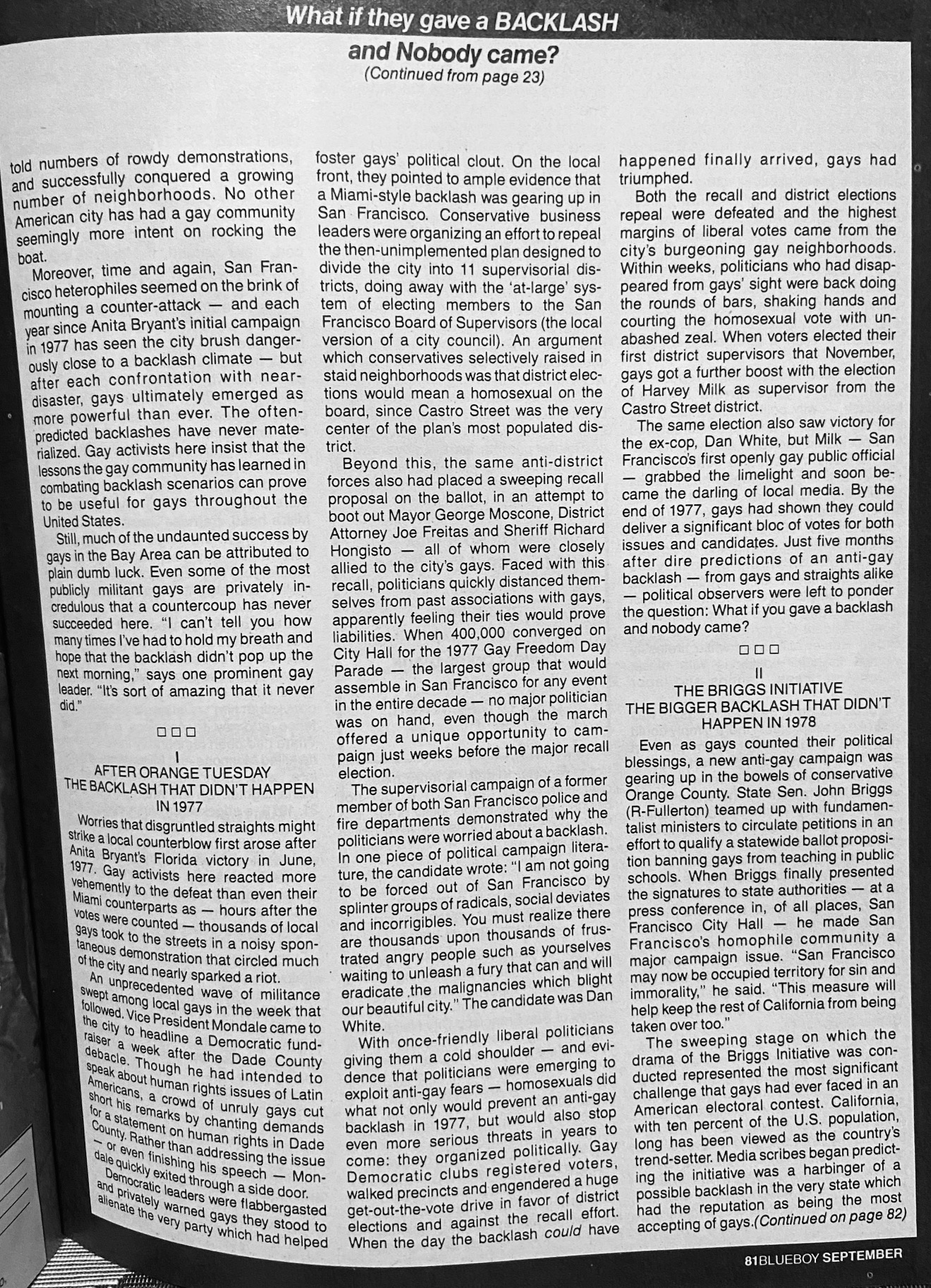
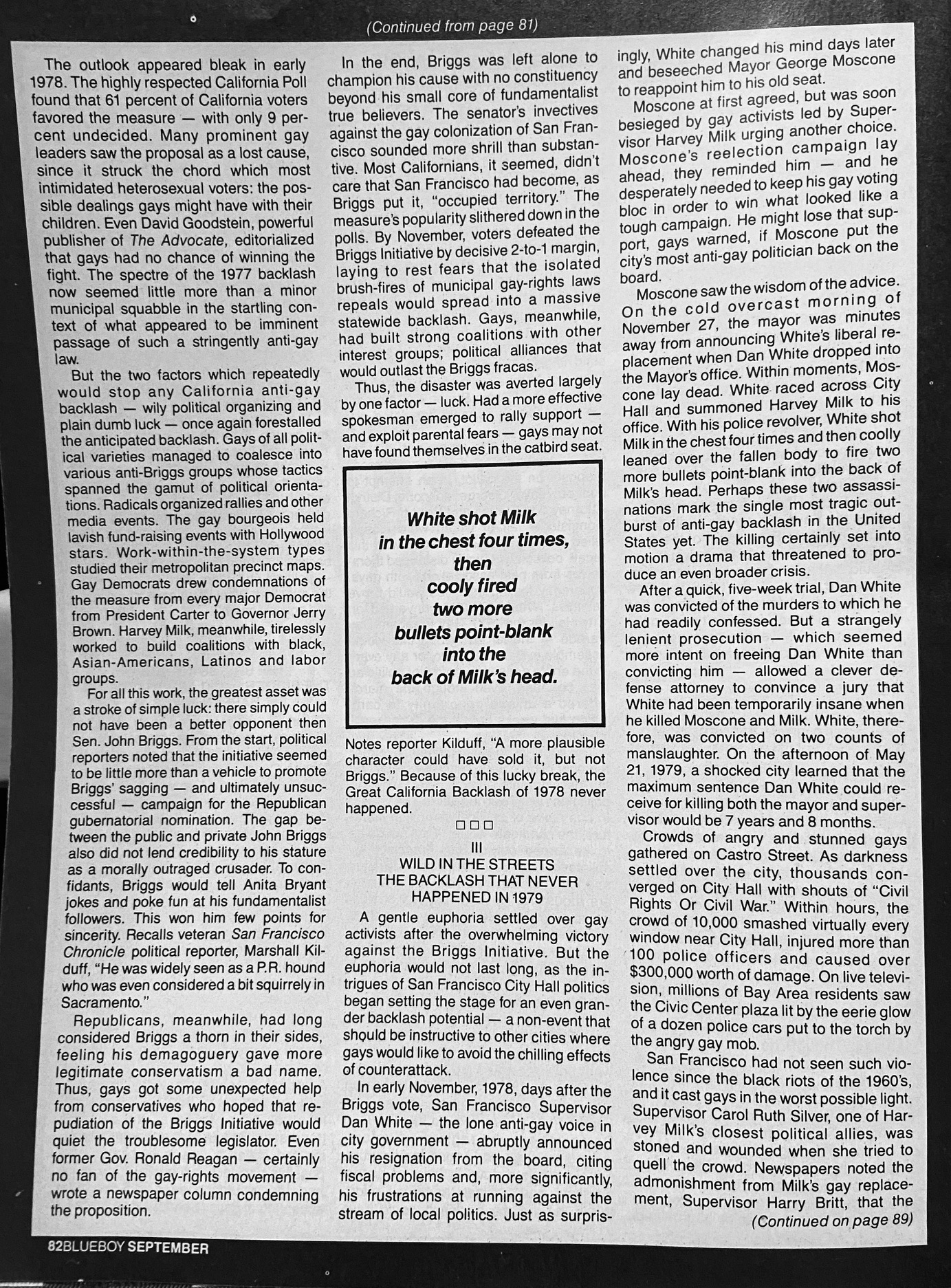
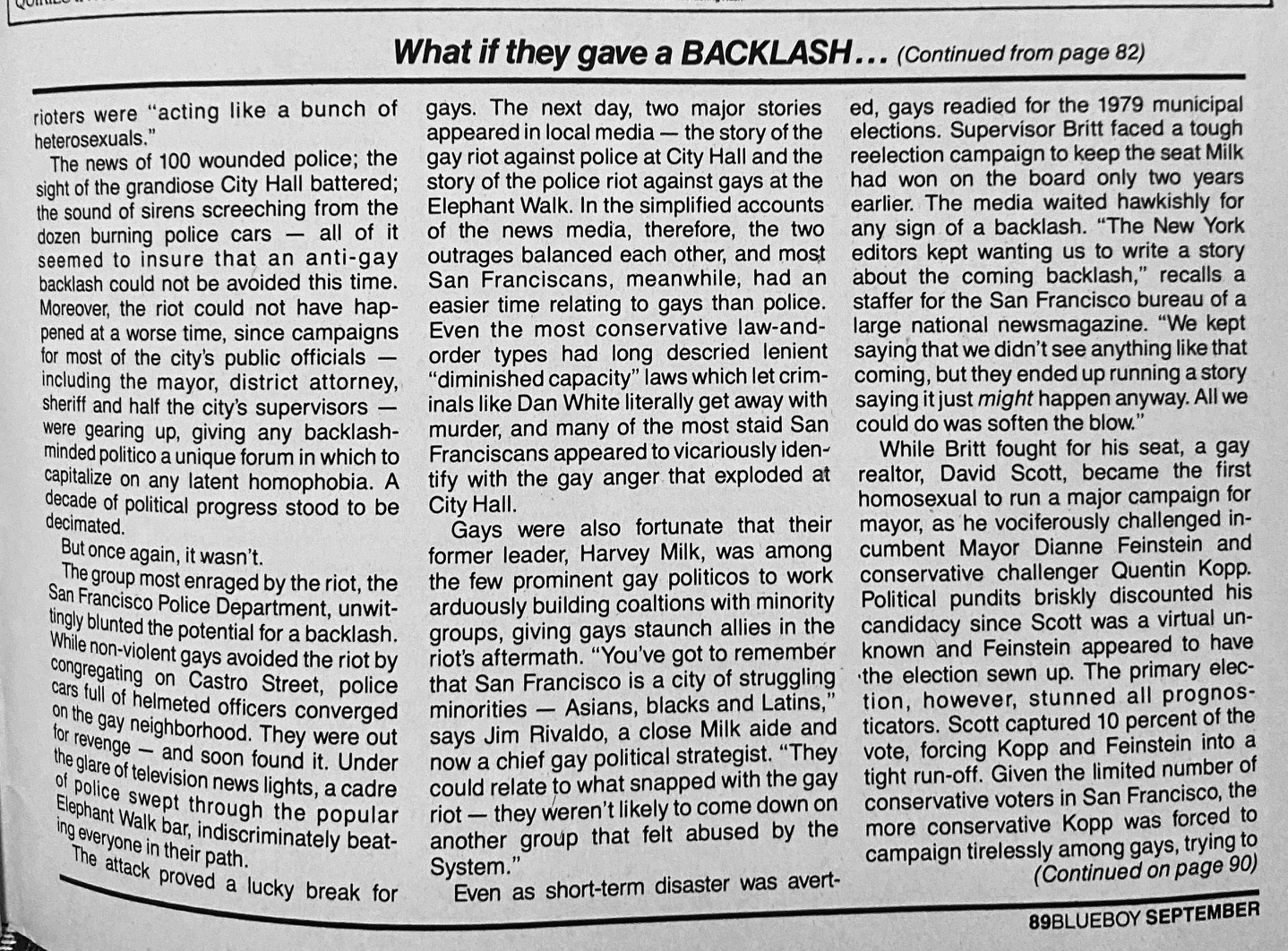
A recent post – the one featuring an essay written by Armistead Maupin for the September 1980 issue of Blueboy Magazine – was my most-viewed ever. This was thanks in part to links from Queerclick and KennethInThe212. I threatened to upload another article from the San Francisco-themed issue written by Randy Shilts: “What If They Gave A Backlash And Nobody Came?” Several people requested it, so here it is.
But first… a couple of other items of interest from this same issue:
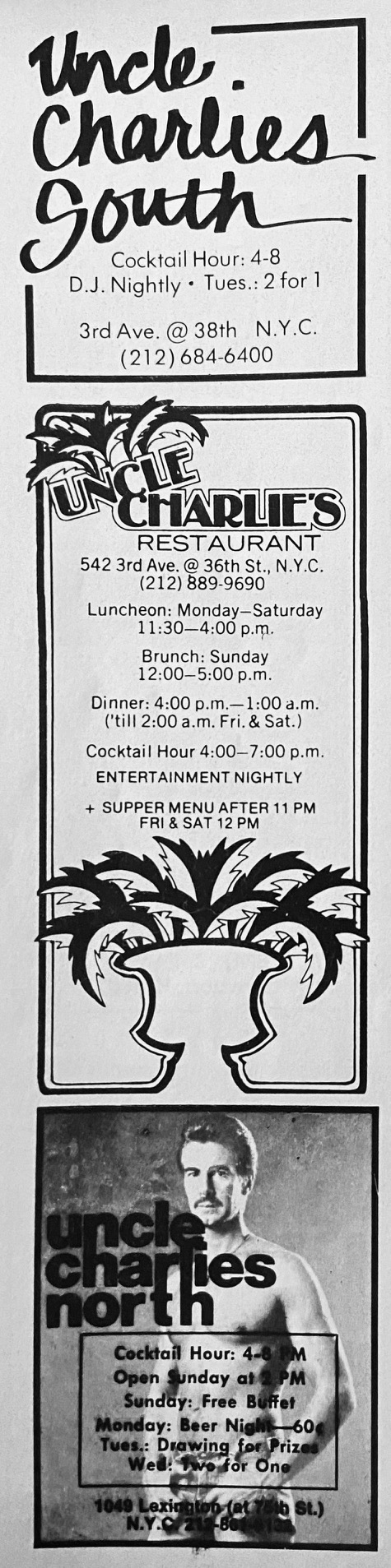
There used to be a whole lot of Uncle Charlies in New York City! None of those advertised above is the one that lasted longest: The Uncle Charlies bar on Greenwich Ave. in the West Village, which closed in 1997. And then there’s the one that has been on E. 45th st for 10 years now.
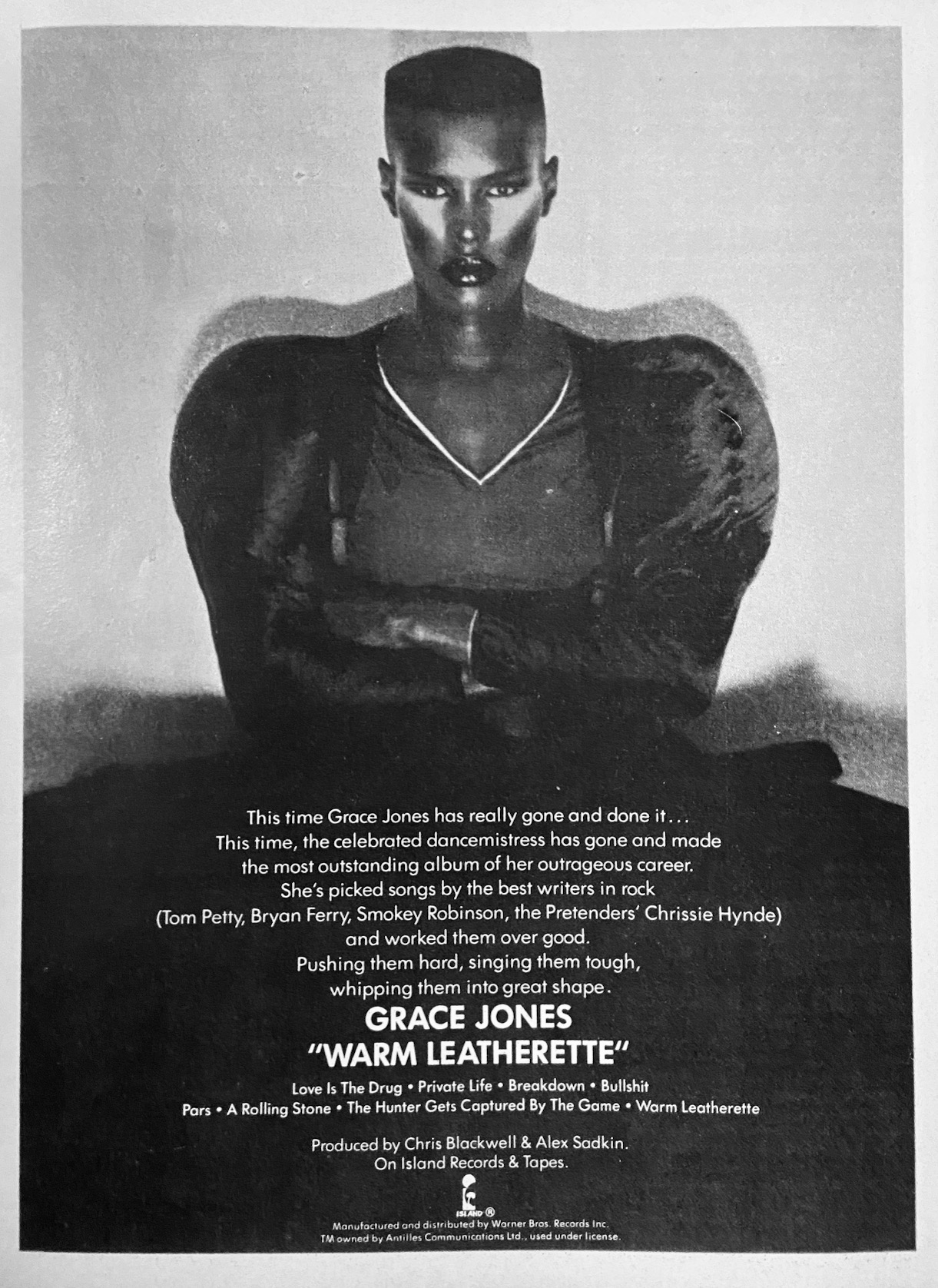
And Look! It’s an advertisement for Grace Jones’ fourth LP… her first good album!
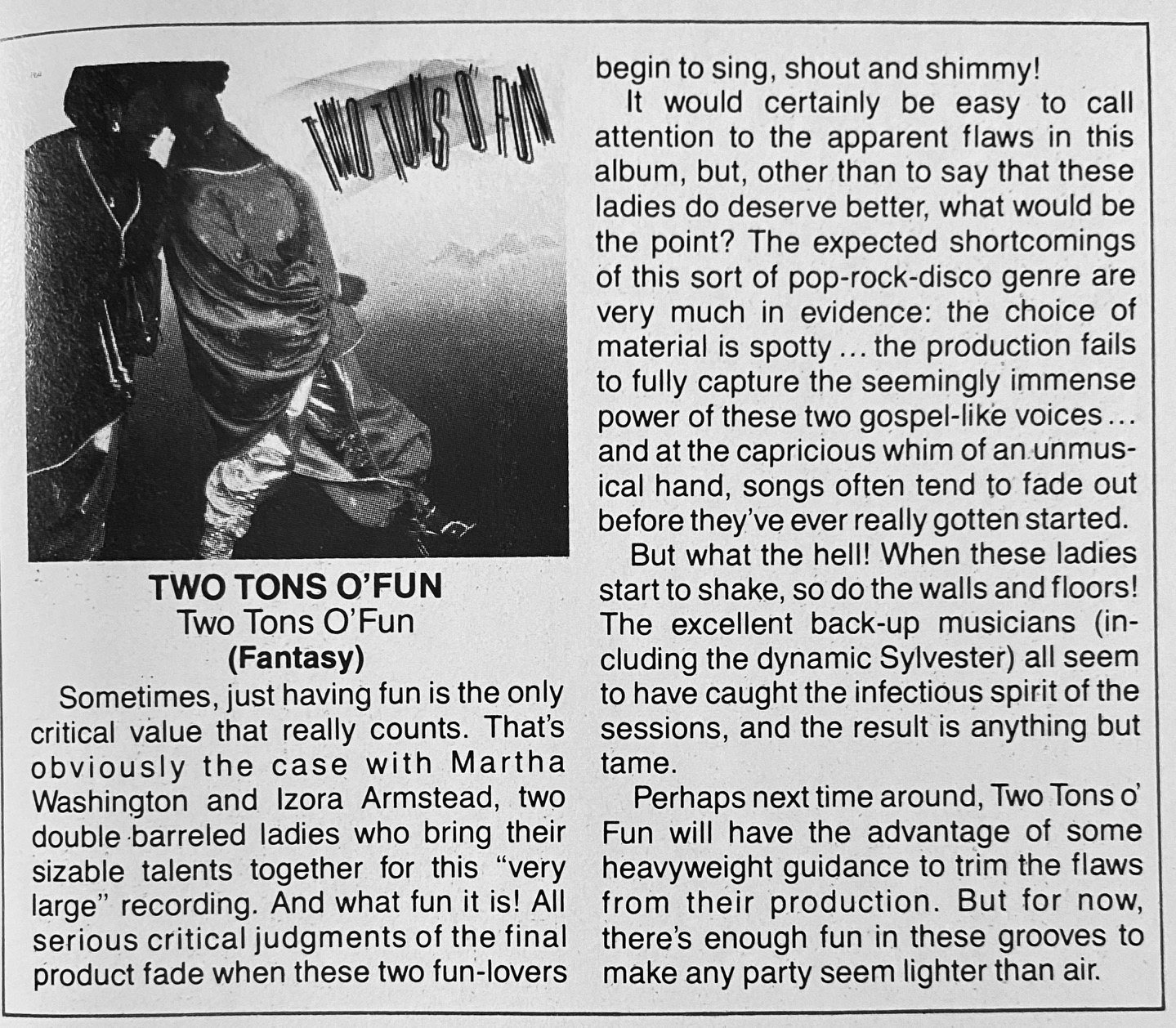
Record review: San Francisco’s very own Two Tons O’Fun. Izora Armstead and Martha Wash had been Sylvester’s backup singers. They soon changed their name to The Weather Girls when it started raining men… and the rest is history. Hallelujah!
10 time capsules from PM Productions. Check ’em out! They’re a hoot. And Christopher Street Blues has a zippy little theme song.
And now for our feature presentation. This article recounts several significant incidents where backlash against the San Francisco gay community was anticipated, but did not happen. It’s interesting to read Shilts’ account of what had been accomplished up to this point in time – with no idea that they were standing on the precipice of a health crisis that would decimate the community and undo so much of the work towards assimilation that he was highlighting.
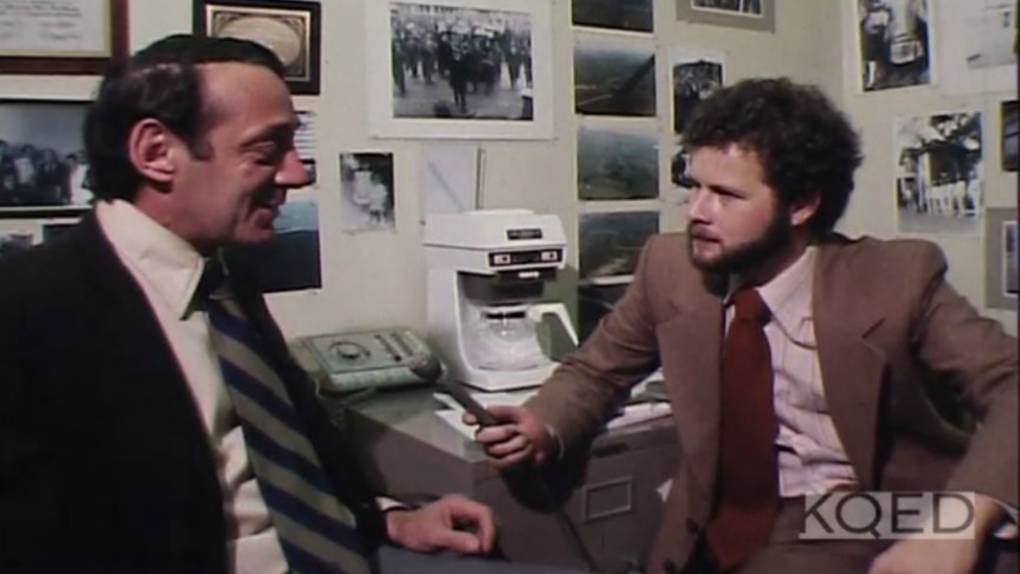
Randy Shilts Interviews Harvey Milk (1977/78)
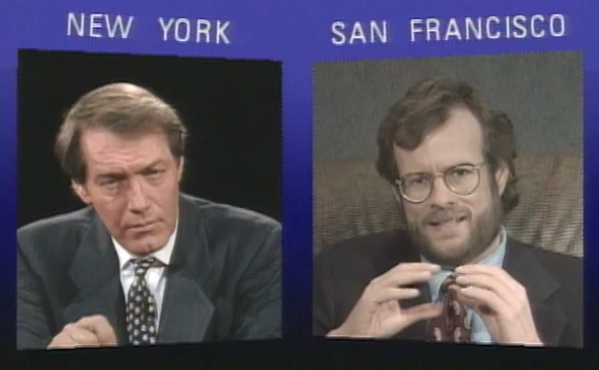
Randy Shilts on The Charlie Rose Show (1993)
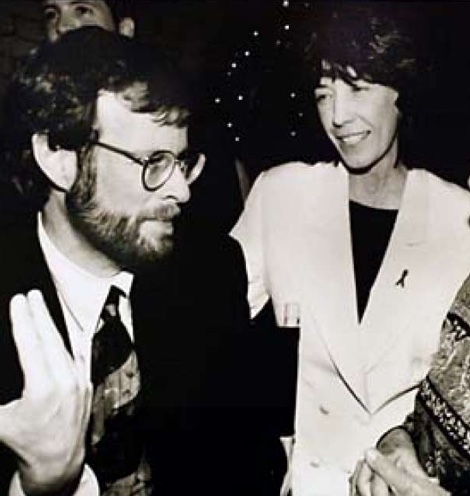
Randy Shilts with Lily Tomlin (1993)
Shilts would go on to write three books, all important documents of gay history: The Mayor of Castro Street – a Harvey Milk bio, And The Band Played On, which chronicled the early days of the AIDS epidemic and Conduct Unbecoming: Gays and Lesbians In The Military. He died of AIDS complications in 1994.
Just imagine what he would have to say about the current administration. Or Mayor Pete. Picture him as a frequent guest on Rachel Maddow. His voice is sorely missed.
Terry DeCarlo was only 57 years old when he passed away earlier this week, yet he seemed to have lived multiple lives. His partner of 23 years, Bill Huelsman announced on Facebook that Terry had lost his battle with cancer on January 27th.
Terry DeCarlo with Pete Buttigieg in June, 2019
DeCarlo held many jobs over the years – his Instagram account lists Communications Manager of Broward County, Co-Hosting Out & About America and USAF Intelligence Officer in addition to his most prominent position as Executive Director of The LGBT+ Center in Orlando. DeCarlo became a national figure when the Pulse massacre occurred and led a grieving community through a tumultuous time.
He is seen here in an appearance on Rachel Maddow’s show:
All of his obits and online tributes – including this New York Times piece – have rightfully focused on his 20+ years of activist work in Florida, so it’s easy to forget that he first came to prominence as a porn star.
In the early 90’s DeCarlo was a fixture on the New York City gay nightlife scene, appearing regularly on The Robin Byrd Show to promote his adult films and ongoing residency at Show World strip club. One particularly memorable performance featured a giant live snake. (Insert python joke here)
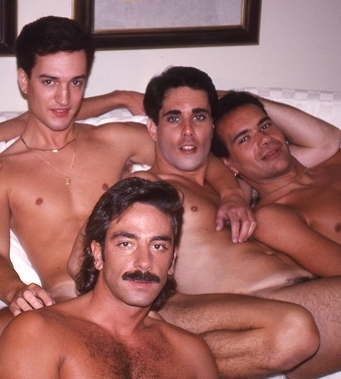
Terry DeCarlo (center) with Dave Logan and Mark West on the box cover for Lunch Hour 2 (1992)
Lunch Hour 2 (1992)
He appeared in films alongside (although not necessarily in scenes with) porn legends Jon King, Joey Stefano, Karl Thomas and Mark West.
DeCarlo in Solid Intake (1993)
19 Good Men (1993)
DeCarlo (right) with Storm, Giovanni and Jason Lamont in 19 Good Men (1993)
DeCarlo on the old Christopher Street Pier in Put It Where It Counts (1993)
A partial filmography: Lunch Hour 2 (Catalina video 1992) 19 Good Men (Robert Prion, Bijou 1993) Put It Where It Counts (Robert Prion, Bijou 1993) What Men Do (Tenderloin, 1993) Solid Intake (Robert Prion, Bijou 1993) Leather 2 (Catalina video, 1994) Forever Hold Your Piece (Catalina video, 1994)
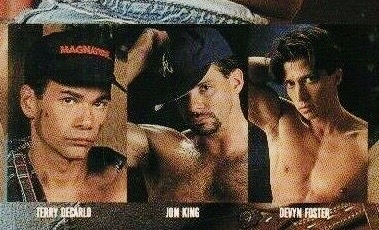
Forever Hold Your Piece (1994) Box cover with Jon King and Devyn Foster
After he retired from performing, DeCarlo moved to Florida and focused on his activist work. Besides those previously mentioned, he also worked at other organizations such are Care Resource and the Broward House, helping to ensure that health care, medication, shelter and basic needs were available for all. He was an integral part of the White Party, AIDS Walk Miami, Dining Out for Life, the Smart Ride and countless other fundraising events.
He dedicated his life to helping others and will not be forgotten. My heart goes out to his partner Bill and their Wilton Manors community.
Back in the early aughts, an older friend of mine was preparing to move out of his NYC apartment and gifted me with a gay time capsule: a closet full of porn magazines dating back to the mid-1970’s. He had moved into this rent stabilized 5th floor walk-up in college and stayed there for 30 years. Roommates and boyfriends came and went – leaving a trail of old magazines in their wake. But my friend stayed in this spacious top floor railroad apartment in the last remaining tenement building on a stretch of East 59th street, with a living room facing the Queensboro Bridge. Why move? The landlord finally offered him a sizable cash settlement to leave, unaware that he was ready to depart NYC anyway. But it was a nice parting gift.
I, in turn was given a King’s Chamber of gay erotica: 7 file boxes full of near-pristine old smut.
Shocker: porn is lucrative. For a few years I supplemented my income by selling them singly on eBay. The shrinking collection has now moved through 4 different apartments in the last dozen years. Unfortunately I did not have my friend’s tenacity (or luck) when it came to NYC real estate.
Recently I cracked the boxes open again and came across an article I thought was worth sharing. Yes, an article. As the old joke goes – I like these old porn mags for the articles. Well… the photo layouts are nice too, but… the articles do give a window into what gay life was like before the plague.
The September, 1980 issue of Blueboy Magazine was dedicated to the city of San Francisco – The Promised Land for gays. Presented below is an article titled “The City That Dare Not Speak Its Name” penned by Tales of the City author Armistead Maupin.
Author Armistead Maupin at the San Francisco Chronicle.
Although this was written just before the AIDS epidemic blew the gay community sky high, San Francisco had already been through some shit, as Maupin mentions in his opening paragraph. The Zodiac Killer, Jonestown Massacre, Patty Hearst kidnapping, the murders of Harvey Milk and Mayor Moscone… followed by Dan White’s acquittal…. I am unclear what “Decadence” he is referring to, but surely it was a bloodbath.
Maupin sensed that the press was sharpening its knives to criticize his beloved city. And he wasn’t wrong in his assessment. Like his Tales of the City series, the article is a love letter to San Francisco, capturing the time and place as nobody else could. It was the best of times… it was the worst of times….
A couple of notes: The mayor mentioned in the article is Dianne Feinstein, now the senior California senator. And the 30-inch girlfriend he refers to was Tamara De Treaux, basis for the main character in his novel Maybe The Moon.
Armistead Maupin photographed in 1978 as part of Don Herron’s Tub Shots photo series.
In the spirit of “everything old is new again,” Maupin observes “…. some local lavender ward healers (that) propagate the Cult of the Politically Correct can grow tedious beyond belief, and I wonder, in my heart of hearts, whether the immeasurable joys of cocksucking are worth the price of being either political or correct.” Yes, he ultimately concludes that nobody embraces eccentricity as unconditionally and as joyously as do San Franciscans.
40 years later, I think those who love the city would agree… even if they do complain about all the human feces in the streets.
The article concludes with a reference to a novel Maupin was working on: Jackie Old – a fictional piece about Jacqueline Onassis at age 70. Unfortunately she did not live to see 70 and this novella – initially published as a 5 part series in New West magazine – would not get an official release until a 2014 Kindle edition. Even so, it is not included in his bibliographies.
Also featured in this mag is an extensive piece by another prominent gay San Franciscan: the late great Randy Shilts, author of And The Band Played On. I will post this piece – “What If They Gave A Backlash And Nobody Came?” -if there is interest. Lemme know if you want it. (UPDATE: I posted it HERE)
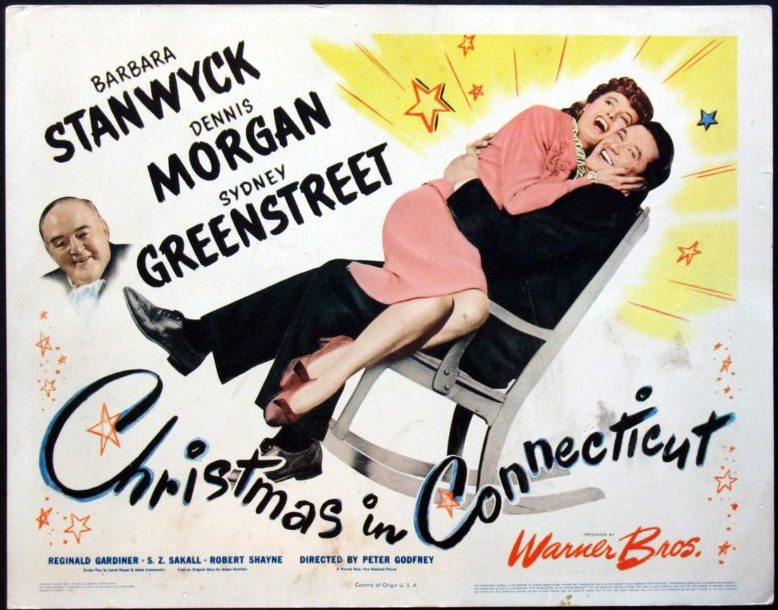
The question, which I have been asked many times over the years, always comes from a fellow gay person who then proceeds to explain why this 1945 film is a Christmas classic. Inevitably the conversation includes a mention of The Delivery Woman. “Just wait for her;” they would say.
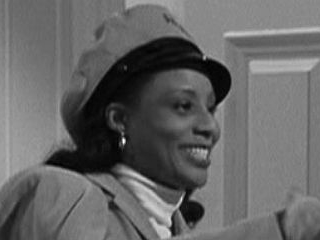
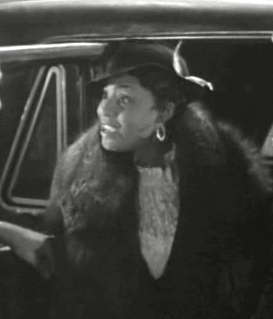
The Delivery Woman appears 11 minutes into the film – just after we meet leading lady Barbara Stanwyck. She enters carrying a large box tied with a bow – it’s a mink coat. She has two lines – six words: “Miss Lane?” and “Same to you, Miss.” She smiles throughout her performance – she is beautiful. Stylish. She wears a hat, cape and gloves. Tasteful earrings. And she has a musical cue – a slinky clarinet riff. She seems to know things.
One friend described her as “sassy” although I think that assessment is a modern projection. She is on screen for just over 10 seconds. And then she is gone. She has other places to go. Other minks to deliver.
“Wouldn’t it be great if postal workers dressed like that?” is another comment I have heard more than once. I think she is actually a department store delivery person and not a postal worker. In any case, yes, I agree – capes and hats and leather gloves would be a welcome addition to any FedEx, UPS or Amazon Prime uniform.
We do not know the actresses name the IMDB does not list her. One day I expect to receive a blog comment that says “You uneducated fool! Everybody KNOWS it’s a young Rudy Dee / Hazel Scott / Dorothy Dandridge.” Until that time… the mystery remains. At least in my house. (Scroll down for an update!)
In The Celluloid Closet, a 1995 documentary about the history of homosexuality in Hollywood, writer Susie Bright says something along the lines of “A gay audience is so accustomed to crumbs that you will watch a whole film just to see a hint of a gay subtext.”
In Christmas In Connecticut, it’s pretty clear that Barbara Stanwyck’s sham fiancee – a disinterested interior designer – would be a gay character if 1940’s society and the movie code allowed for it. But that’s beside the point. The “accustomed to crumbs” statement can be applied to any minority in a classic Hollywood studio film : you wait for someone to show up, cross your fingers for a positive depiction, and then hold onto it when you find it.
The Smart Bitches, Trashy Books website mentions The Delivery Woman in a 2016 post dissecting the film. “PERSON OF COLOR. PERSON OF COLOR;” they scream upon her entrance. “This movie is already more inclusive than several films released this year.”
And this is why, 75 years after it’s release, I am writing about 10 seconds of this film.
I tip my stylish cap to that nameless actress. We salute you!
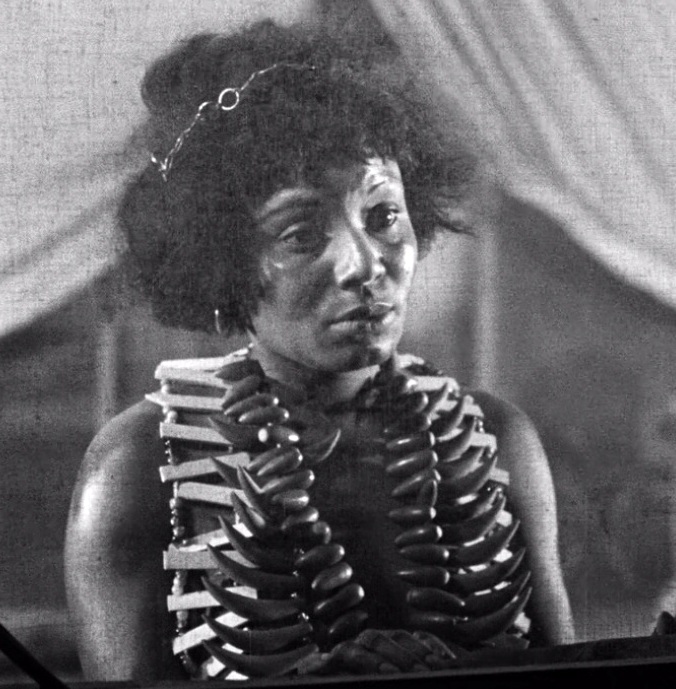
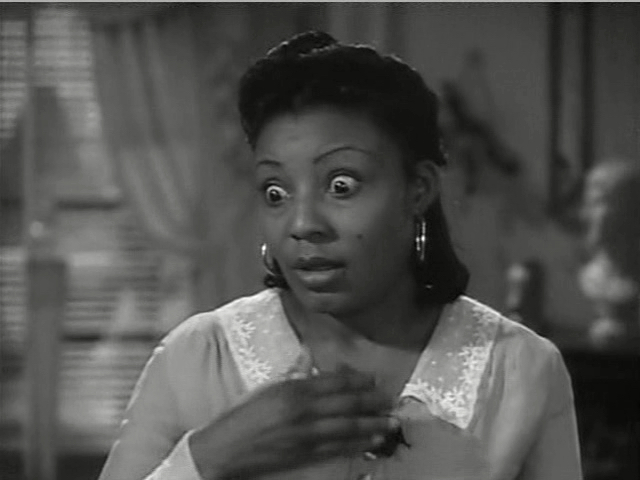
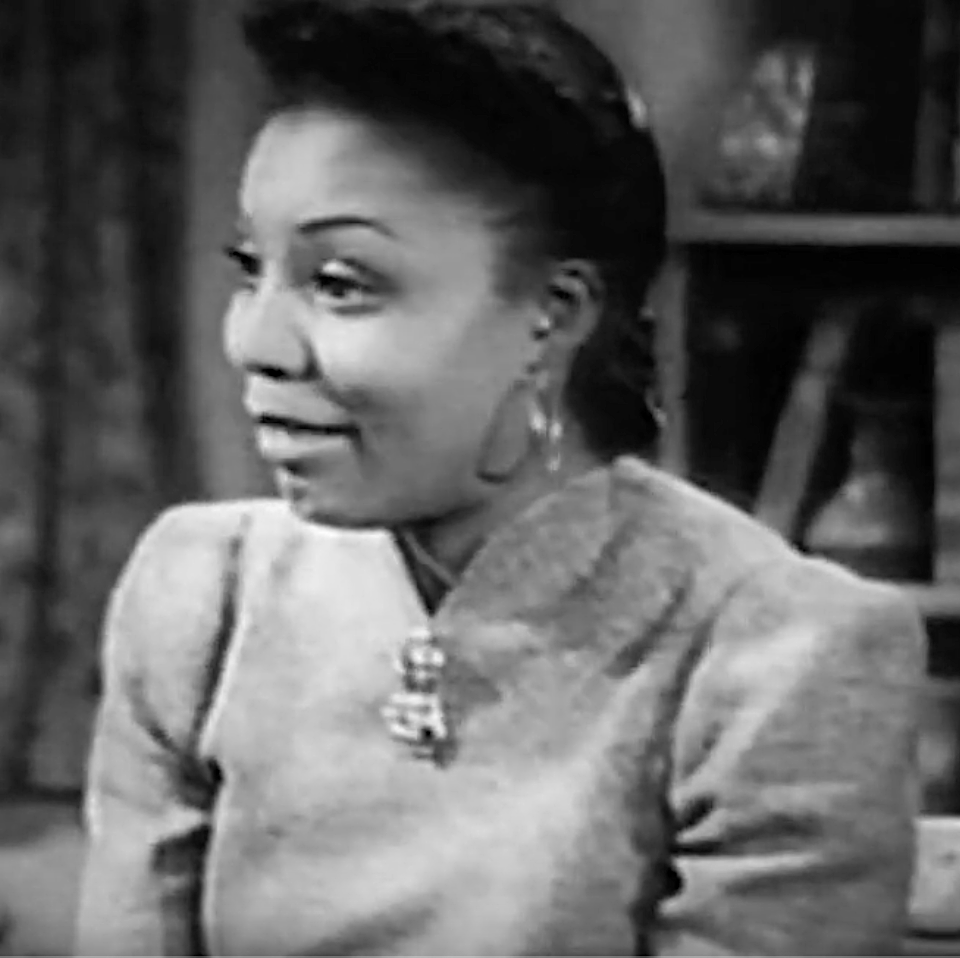
UPDATE: Since this was first posted in 2019, there have been several suggestions in the comments section. I am inclined to agree that it is Daisy Bufford (1913-1987), an actress with over 30 movie credits, including Cabin In The Sky and Gone With The Wind. What do you think?
She can be seen here in Son Of Ingagi (1940), which has been called the first black Sci Fi/Horror movie:











 The following year Lucky Cheng’s Chinese Restaurant opened with its now famous drag and gender-fluid waitstaff, thriving at this location for 19 years. By the time I finally ventured in – just once – it was to buy a gift certificate for my parents, at their request. The once bohemian restaurant had become an edgy staple for straight out-of-towners. Lucky Cheng’s eventually followed the tourist trade up to the theatre district. The building was sold and is slated to be torn down and replaced by… you guessed it: Luxury Apartments!






 In the article she recounts when we first met on the street back in 2005. Viewers did not approach me often enough that I ever got used to it. I was always thrilled to be reminded that this thing I was creating alone in my apartment was being broadcast and people were watching.



















 Brian Ferrari's Blog