
Since 2020, a few gay holiday films have dribbled out each December – not just on The Hallmark Channel but also on Lifetime, Netflix and elsewhere. I’m not here to crap on the genre, but there is a conveyor belt feel to these films. With the similar actors, sets, and plots, it can be difficult to remember which one had which fading star of yesteryear playing the mom. Obviously, if I didn’t get some enjoyment out of watching them, I wouldn’t tune in. But I don’t go all in for them, either. Please give me a combination of humor, wit, romantic chemistry, decent acting and/or a plot twist and I’ll stick with it. Check off more than a couple of those boxes and I might watch it again next year… if I can remember the title and what channel it was on.
In 2022, I put together a list of these movies to try and keep them straight, so to speak. What I didn’t realize at the time was that the following years would bring less, not more entries in the genre.

In December 2023, Queerty posted an article proclaiming, “The Hallmark Channel is gayer than ever this year!” As evidence, they had a massive list of exactly THREE movies that they considered gay. The first one, Catch Me If You Claus starred Luke Macfarlane in his 16th movie for the network. Yes, the Bros co-star is gay in real life, but the character in the film is not. Kudos to him for continuing to be cast in straight roles, but… do we then count this as a gay film?
As a reminder: The Hallmark Channel premiered 42 – FORTY-TWO – new Hallmark Christmas movies that season. And we’re supposed to kvell because TWO of them are gay-ish? Honey, please.
The 2024 holiday season garnered even less results: A sequel to an ensemble film from 2023 with Hallmark’s resident gay Jonathan Bennett in the cast. He must have an ironclad contract.
In retrospect, 2020-2022 is beginning to look like the lavender age of inane gay holiday movies. Let the nostalgia begin!
Fortunately, with so many different streaming services, you can now find some of these movies on multiple outlets, giving evidence that maybe they weren’t quite so disposable after all.

1) The Christmas Setup (2020) – Lifetime, Hulu, Sling TV
Older star playing a parent: Fran Drescher
Romantic chemistry? Yes – this real-life couple generate a believable amount of TV movie warmth.
The Christmas Setup follows the story of New York lawyer Hugo (Ben Lewis) who heads to Milwaukee with his best friend Madelyn (Ellen Wong) to spend the holidays with his mom Kate (Fran Drescher). Kate arranges for Hugo to run into Patrick (Blake Lee), his high school friend and secret crush, who has recently returned after a successful stint in Silicon Valley. Hijinks begin.
2) Dashing In December (2020) – Amazon Prime

Older star playing a parent: Andie McDowell
Romantic chemistry? Some. I guess. It’s an enjoyable movie but I don’t see these boys staying together.
After Wyatt (Peter Porte) comes home for the holidays to try to convince his mother (Andie MacDowell) to sell the family’s Colorado ranch, he finds romance with the dashing new ranch hand (Juan Pablo Di Pace) who dreams of saving the property and its magical Winter Wonderland attraction.
It’s a nice surprise to see Andie McDowell here, but I am reminded of when comedienne Paula Poundstone described her face as “an egg with a smile drawn on it.”

3) Happiest Season (2020) – Hulu
Older stars playing the parents: Mary Steenburgen & Victor Garber
Sapphic chemistry? Yes, but not between the two that we’re supposed to root for.
This is the one with Kristen Stewart, Aubrey Plaza & Dan Levy. Stewart’s girlfriend invites her home for Christmas but fails to mention that she’s not out to her family and they must pretend to be friends. Hilarity ensues. A cut above Lifetime/Hallmark movies but I’m including it because it satisfies the same itch. Same genre, but overall higher quality thanks to the cast and Clea Duvall’s writing & direction. One caveat: I wanted Kristen Stewart’s character to end up with Aubrey Plaza. But that doesn’t fit the formula, does it?
Bonus points: Jinkx Monsoon & BenDeLaCreme are on hand for a couple of holiday songs.

4) The Christmas House (2020) – Hallmark+, Amazon Prime & Others
Older stars playing the parents: Treat Williams & Sharon Lawrence
Romantic chemistry? The gay married couple is peripheral here, so it’s not required. They’re fine.
This was the first Hallmark movie to feature a gay couple, even if they are supporting players. Jonathan Bennett is the gay son with Brad Harder as the devoted husband. They want to adopt kids – that’s their side plot. The straight brother has the romantic interest storyline, while the parents have decided to give up their traditional grand ole “Christmas House” which, like all the other houses in these movies, looks like a realtor’s model home with decorations recently purchased at Kohl’s.

5) The Christmas House 2: Deck Those Halls (2021) – Hallmark+, Amazon Prime & others
Older stars playing the parents: Same as above. R.I.P. Treat Williams. ☹
Romantic chemistry? Maybe I’m being a sap, but this couple grew on me.
The sequel to the above film. This time the brothers are competing on a reality show to create the best Christmas House. It’s harmless fun.

6) Clusterfünke Christmas (2021) – Paramount+, Roku, Amazon Prime
“A no-nonsense hotel exec buys a family inn in northern Maine, but the town’s Christmas spirit clashes with her cosmopolitan values.” This one’s actually a spoof of the genre written by and co-starring Rachel Dratch & Ana Gasteyer as the innkeepers. Out actor Cheyenne Jackson plays the straight romantic lead. If Queerty can claim the Luke Macfarlane movie as gay, then we get this one, if not for Jackson, then just for pure camp value.

7) Under The Christmas Tree (2021) – Lifetime Movie Club, Amazon Prime, Roku
Older stars playing the parents: Wendy Crewson & Enrico Colantoni. Ricki Lake is also on hand.
Sapphic Chemistry? Yes
As described in Vulture: Lifetime’s new and first-ever lesbian Christmas movie is a legitimately good queer film in which the main character, Alma (Elise Bauman), is not only accepted by her Maine-based, small-Christmas-business-owner parents for being a lesbian but encouraged to fall in love with out-of-town stranger Charlie (Tattiawna Jones). Cheesy as it is, the premise is as sweet as it is predictable with plenty of fun, memorable scenes and unexpected moments thrown in.”

8) Single All The Way (2021) – Netflix
Older stars playing the parents: Kathy Najimy & Barry Bostwick with Jennifer Coolidge as the diva aunt.
Romantic chemistry? Yes
Peter (Michael Urie) finds out his boyfriend is married. They break up and he invites his best friend home with him for Christmas to pretend they’re a couple. His mom tries to set him up with Luke Macfarlane anyway. You’ll never guess who he ends up with. This one beat out Under The Christmas Tree to win the GLAAD Media Award for Outstanding TV Movie. Probably the best of the bunch, and not just for this monologue:

9) The Holiday Sitter (2022) – Hallmark+, Roku, Amazon Prime & others
Older stars playing the parents: NONE
Romantic chemistry? Not that I recall.
Another Hallmark movie with resident gay Jonathan Bennett. Now he’s a workaholic from the big city who gets stuck watching his sister’s kids because of a snowstorm and she’s pregnant and going into labor or something. He recruits hunky neighbor Jason (George Krissa) to shepherd the precocious children through an endless list of absolutely necessary holiday activities. Bennett’s first major role years ago was in the movie Mean Girls. He also co-wrote this script, in which he actually tells the family dog “Stop trying to make ‘fetch’ happen.” I have nothing more to say.
10) A Christmas To Treasure (2022) – Lifetime, Hulu

Older stars playing the parents: Nobody I recognize. Maybe they’re big in Canada?
Romantic chemistry? NONE.
A real-life gay couple with no chemistry try to find a hidden treasure… before it’s too late! 33-year-old Tyler Frey and 41-year-old Kyle Dean Massey are supposed to be high school sweethearts reunited with each other and their friends: two racially diverse straight couples. Everyone’s on an elaborate treasure hunt somehow engineered by a beloved frail old neighbor just before she croaked. However, nobody really needs the money except Frey, who wants to save the grand ole Marley house (again, a model home decorated at Kohl’s.) Someone actually says “I don’t need the money. I’m here for the cocoa.”
This one broke me. Who are these people? This movie is a painful reminder that a film can be racially diverse, but it certainly isn’t class-wise. If everyone’s so damn rich, why don’t they just give Frey the money to save the house? This one caused me to take a long break from viewing these movies. But now it’s a new season, and here we are.
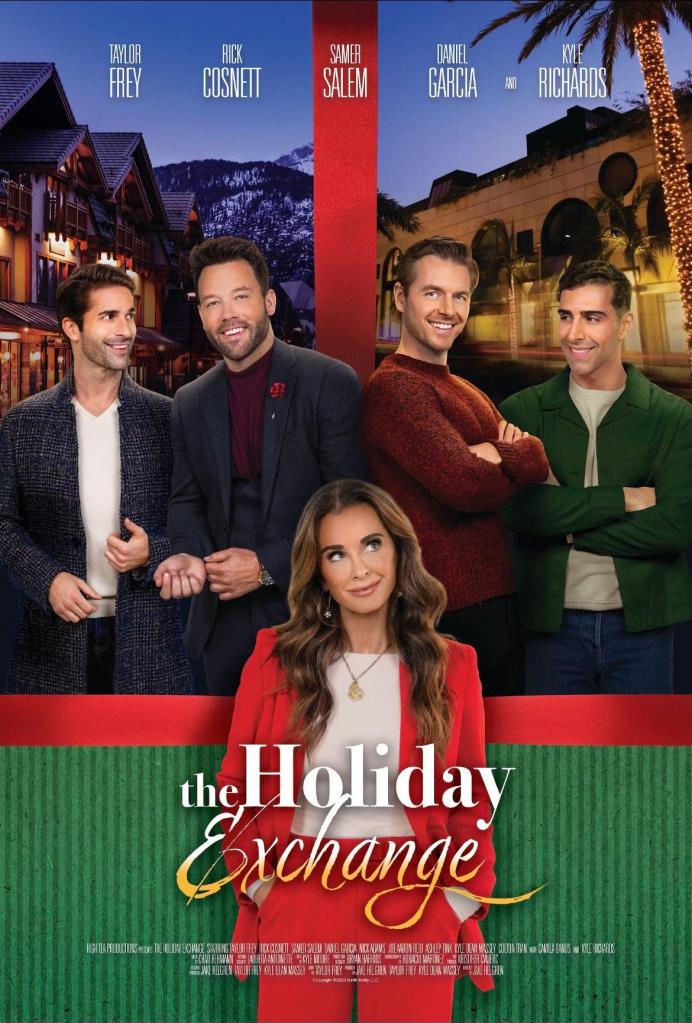
11) Holiday Exchange (2024) – Tubi, Roku, Amazon Prime
Older stars playing the parents: Real Housewife Kyle Richards plays Mom.
Romantic chemistry? Varying between the two couples.
The aforementioned Tyler Frey wrote the screenplay and stars in this gay version of the Kate Winslet/Cameron Diaz rom-com The Holiday. There are two budding romances, with Frey’s real-life husband Kyle Dean Massey left to play his ex-boyfriend. Rick Cosnett plays the Winslet role – a Brit transplanted in L.A. Maybe it’s the wine, but I found this one rather enjoyable.

12 & 13) Christmas on Cherry Lane / Season’s Greetings From Cherry Lane (2023/2024) – Hallmark +
There are actually four of these Cherry Lane Christmas movies – all are centered on the same house is different eras. Omnipresent Jonathan Bennett plays opposite Vincent Rodriguez III in two of them.

14) Friends and Family Christmas (2023) – Hallmark+ and others.
This one centers on lesbian friends (Humberly Gonzalez & Ali Liebert) who must pose as a couple for the holidays… and you’ll never guess what happens!

15) A Keller Christmas Vacation (2025) – Hallmark+
This ensemble piece stars (surprise!) Jonathan Bennett as one of three adult siblings who reluctantly join their parents on a Danube river cruise for Christmas, leading to family bonding, unexpected romance, and resolving old issues amidst European Christmas backdrops. The movie focuses more on family dynamics than typical Hallmark romance.

16) The Christmas Baby (2025) – Hallmark+
Hallmark’s singular gay-centric movie of 2025 is set to premiere on December 21st. Ali Liebert and Katherine Barrell play a lesbian couple who find a baby left on their doorstep. This leads them to explore fostering and adoption during the holidays.
Happy Holigays!

See also:
Truman Capote’s Christmas Memory
Dusting Off The Holiday Favorites (2025)
The 60 Degrees Girl Group Christmas Show
The Christmas In Connecticut Delivery Woman
March Of The Wooden Soldiers: 10 Things You May Not Know About This Holiday Classic
Sunshine & Tinsel: A Canine Christmas Tail
Len & Cub: A Relationship In Photos
We Got Hitched
Yes Virginia, There Is A Spotify Playlist
A Christmas Without Miracles: The 1987 Motown Xmas Special



























































 Brian Ferrari's Blog